
Repair welding
EN 15085
Freight wagon underframes
EN 15085 Repair Welding in Turkey: How Welding Coordinators Manage Freight Wagon Underframe Repairs
By First Welding Certification Technical Editorial Team
6 Mins Read Time
01 Nov 2026
Table of Contents
- Introduction
- Understanding repair welding on freight wagon underframes
- Why EN 15085 is important to railway repair
- Reasons for repair welding on underframes
- Welding coordinator
- Step by step process
- Control of WPS and WPQR
- Control of welders
- Inspection
- Documentation
- Common errors made
- Example underframe repair in a Turkish railway workshop
- Frequently Asked Questions
- Related searches
- Conclusion
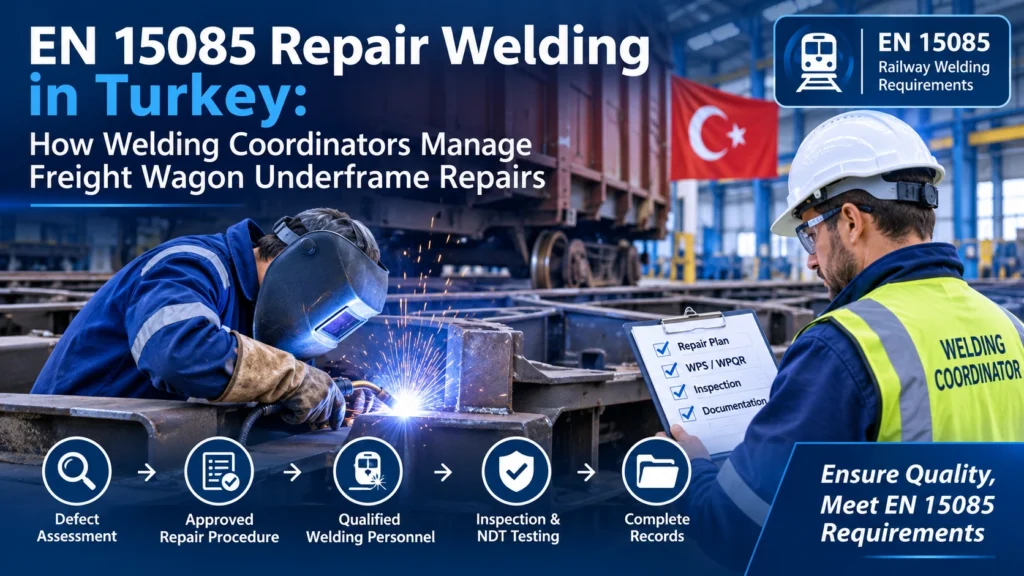
Freight wagons are an essential part of the railway industry. They transport a variety of industrial items including: minerals, agricultural products, containers etc. The structural elements of the freight wagon need to be durable and withstand constant loading, vibration and stresses. One of the main structural elements of a freight wagon is the underframe. This structure supports the wagon body and transfer loads to the relevant areas. Ensuring high quality welding is important during manufacturing and repair.
Manufacturers and repair organisations within Turkey will want to ensure they have good controls for the quality of welding. If there are problems found with cracking, weld discontinuity, corrosion damage etc. then controls must be put in place to ensure repair welding is planned and executed. EN 15085 is an important standard to follow when undertaking repair welding on a railway vehicle/component. The welding coordinator should be involved in the planning of the repairs, organising qualified welders, controlling welding and ensuring records are in place.
Understanding repair welding on freight wagon underframes
The underframe of a freight wagon may contain a variety of components including: longitudinal, cross members, plates, brackets and welds. During manufacturing, inspection or in service, welding problems may be found. This may involve removing the faulty weld, preparing the area and adding new weld metal. The welding may also require inspection.
However, not all defects can be repaired. Several factors must be considered including:
- What type of defect has been found.
- What grade and thickness of material.
- What joint design was originally used and any welding.
- What design and repair requirements are.
- How the component is being used and how important is it structurally.
- What repair instructions are approved.
Not all defects can be repaired. The organisation must ensure the defect can be repaired in a technically acceptable way.
Why EN 15085 is important to railway repair
EN 15085 covers the requirements for welding on railway vehicles/components. This helps organisations manage their welding and ensure:
- Welding is managed by people with the right responsibilities and competency.
- Appropriate WPS are available.
- Welders have appropriate qualifications.
- Inspection is carried out.
- Information is recorded.
It is important to understand that just because a component is certified to EN 15085 does not mean all repair welding can be done. The repair must be authorised and technically acceptable.
Reasons for repair welding on underframes
The underframe of a freight wagon may need to be repaired during manufacture, maintenance or refurbishment. This could be due to:
- Cracking – Cracks may be found during visual inspection or NDT. This needs to be assessed.
- Lack of fusion/penetration – Discontinuities may be found during inspection or manufacture. The repair should match the actual defect and meet acceptance requirements.
- Porosity – Porosity and other surface defects may need to be assessed. Not all may need to be repaired.
- Damage to weld joints – Brackets, support plates and other welds may get damaged during handling, use or maintenance. The original design and load must be considered when repairing.
- Non-conformities – Issues with dimension, weld size or other issues during manufacture may occur. The relevant technical person should be consulted to ensure the defect can be repaired.
Welding coordinator
The welding coordinator will have responsibility for controlling repair welding. This may include:
| Responsibility | Main activity |
|---|---|
| Repair assessment | Review the defect and proposed repair requirements |
| Technical coordination | Coordinate with design, production, maintenance and quality personnel |
| WPS control | Confirm that the applicable welding procedure is suitable |
| Personnel control | Verify the qualifications and assigned scope of welders |
| Material control | Check material identification and relevant consumable requirements |
| Production monitoring | Monitor preparation, welding conditions and process compliance |
| Inspection coordination | Arrange required visual and non-destructive testing |
| Record management | Ensure repair and inspection records are maintained |
Responsibilities for repair welding should be well defined. If design approval, engineering assessment or customer authorisation is required then this should be done by the correct authority.
Step by step repair welding
Having a step by step process will help manufacturers and repair organisations manage quality.
Step 1: Identify defect
When undertaking repair welding the first step will be to identify the defect. This should be marked with the correct identification. This could be done using photos, inspection reports or drawings.
Record the type of defect, location and inspection.
Step 2: Can it be repaired?
Before starting welding the defect should be assessed by the relevant technical person.
Consider:
- How important the area is structurally.
- Material type and joint design.
- Size of defect/damage.
- Original design and technical requirements.
- Any limitations to repair.
If the defect cannot be repaired technically then replacement may be required.
Step 3: Prepare repair instruction
An approved repair instruction should be produced. This should show what is required to repair the defect and what controls need to be applied. This may include:
- Defect removal.
- Joint preparation and size.
- Welding process.
- Welding position and parameters.
- Preheating/interpass temp if required.
- Inspection and acceptance.
The repair instruction should match the design requirements and approved welding processes.
Step 4: Defect removal
If the defect needs to be removed then it should be done using an appropriate controlled method. This area should be inspected to ensure the defect has been removed to the required extent.
Further inspection may also be required.
Step 5: Repair welding
Repair welding should be undertaken by appropriately qualified personnel. This should be done using the correct WPS.
The welding coordinator or allocated personnel should monitor the following:
- Welding process and parameters.
- Joint preparation.
- Material and consumables identification.
- Preheating/interpass temp.
- Welding sequence and accessibility.
- Environmental and manufacture conditions.
Any deviation from the approved repair instruction must be assessed and authorised using the organisations method.
Step 6: Inspection
Once the welding has been completed the area should be inspected using the correct inspection plan. This may include visual and appropriate NDT. The repair should only be accepted if the acceptance criteria have been met.
Control of WPS and WPQR
A Welding Procedure Specification (WPS) contains the instructions for welding under certain conditions. The WPQR shows the procedure has been qualified using the correct qualification process.
The welding coordinator should ensure the correct WPS has been chosen for the repair. This should include:
- Parent material/material group if applicable.
- Material thickness and joint design.
- Welding process.
- Welding position.
- Filler material/consumable classification.
- Welding parameters.
- Preheating/interpass temp.
- Qualification range and validity.
Just because a WPS was used during original manufacture does not mean it will be suitable for repair. The repair design and qualification range should be considered. If the current procedure doesn’t cover the repair the organisation should decide what method of qualification or approval is required.
Control of Welder
The quality of the repair welding will also depend on the competency of the welders. The organisation should ensure the welders have the correct valid qualifications for the welding process, joint design, material, thickness and welding position.
Controls should also be in place to:
- Ensure welders have the correct repair instructions.
- Ensure the latest WPS is available.
- Ensure the material and consumables have been identified.
- Ensure welding equipment is suitable.
- Ensure the correct parameters are used.
- Ensure repairs can be traced back to the correct personnel.
- Ensure deviations and non-conformities are recorded.
Good communication should be in place between the workshop, quality, inspection and technical management.
Inspection
Inspection is an important part of repair welding to provide evidence. The type and extent of inspection should be decided based on the repair instruction, design requirements, relevant standards and acceptance criteria.
- Visual Testing (VT) – Visual testing can be used to inspect the weld visually. This can help identify surface defects, weld shape, undercut etc.
- Magnetic Particle Testing (MT) – Magnetic particle testing can be used on suitable ferromagnetic materials to identify surface and subsurface discontinuities.
- Penetrant Testing (PT) – Penetrant testing can be used on suitable non porous materials to identify surface breaking discontinuities.
- Ultrasonic Testing (UT) – Ultrasonic testing may be specified to inspect suitable weld designs to identify internal discontinuities.
- Radiographic Testing (RT) – Radiographic testing may be used where applicable to identify internal weld quality.
Not all testing may be required for all repairs. This should be specified in the inspection plan. Testing should be undertaken by personnel with the correct competency and qualifications.
Documentation
Repair documentation will provide evidence of what has been repaired, why, how and inspection.
For underframe repairs on freight wagons the following may be required:
| Record | Purpose |
|---|---|
| Defect report | Identifies the original defect and its location |
| Repair assessment | Records the technical evaluation and repair decision |
| Approved repair instruction | Defines the authorised repair method |
| WPS and supporting qualification records | Identifies the applicable welding procedure |
| Welder qualification records | Demonstrates relevant personnel competence |
| Material and consumable records | Supports material and consumable traceability |
| Welding inspection report | Records inspection of the completed weld |
| NDT reports | Documents applicable non-destructive testing results |
| Non-conformity and corrective action records | Tracks deviations and their resolution |
| Final repair acceptance | Records the required review and acceptance |
Shows what review has been carried out and if it has been accepted. The organisation should ensure there is traceability between the wagon/component identification, repair location, welders, welding and inspection. Good documentation will help with customer audits, internal reviews and future maintenance.
Common errors
Errors can occur during repair welding if the technical assessment and manufacture controls are not well coordinated.
Common errors include:
- No technical assessment was carried out – The defect should be assessed.
- Incorrect WPS – The WPS must cover the actual conditions and qualification range.
- No consideration for material – The material and relevant properties must be considered.
- Unqualified welders – The welders must have the correct qualifications.
- No inspection – The area should be inspected.
- No repair documentation – This makes it difficult to show what has been done.
- All defects can be repaired – Some components may need to be replaced or further engineering assessment.
To avoid these errors the engineering, welding, manufacture and quality should be coordinated.
Example underframe repair in a Turkish workshop
A railway repair organisation in Turkey are carrying out maintenance on a freight wagon. During inspection a crack like indication has been found near a weld joint. They should not start grinding and re-welding the area. The inspection team should record where the indication was and what it was. The technical person should assess what the indication means based on the component design, usage and repair requirements. If it can be repaired then an approved repair instruction should be produced. The welding coordinator should check the correct WPS has been used, the welder has been allocated with the correct qualifications and materials/consumables are available.
The area should be prepared and inspected. The repair welding should be carried out under controlled conditions. Once completed the weld should be inspected using the methods and acceptance criteria stated in the repair instruction. The organisation should produce repair documentation including the defect report, repair instruction, welding details, personnel and inspection. This will show what has been repaired and will help to show the repair has been carried out under controlled conditions.
This is an example. The actual decision on repairs, inspection and acceptance requirements will depend on the wagon design and repair.
Frequently Asked Questions
What is EN 15085 repair welding?
EN 15085 repair welding refers to welding repairs on railway vehicles/components carried out in line with the relevant requirements of the EN 15085 series. The repair should be carried out in accordance with the relevant technical and repair instructions.
Why is a welding coordinator important for underframe repair on freight wagons?
The welding coordinator will help manage welding processes, personnel, controls during manufacture, inspection and documentation.
Can all cracks on freight wagon underframes be repaired?
No. Each defect should be technically assessed. Depending on the location, size, cause and importance structurally the defect may be able to be repaired, limited or not able to be repaired. Replacement or further engineering assessment may be required.
Is a WPS required?
The correct welding process must be identified and controlled. The correct WPS should be used that covers the actual welding conditions and qualification requirements.
What NDT can be carried out after underframe repair welding?
Depending on the material, weld design and inspection requirements VT, MT, PT, UT or RT may be used. The correct type and extent should be defined in the inspection plan.
Related Searches
- What Is EN 15085-2 CL2 Certification for Railway Components in India? Requirements, Scope & Process
- Who Needs EN 15085 Certification? 7 Railway Business Types That Should Check Their Scope
- EN 15085 Certification: How Railway Suppliers Can Qualify for OEM Contracts in 2026
- EN 15085-4 Documentations Qualifications 15085-4 Welding Preparation Documents: How Do Welder Qualifications Support Quality Railway Production Worldwide?
Conclusion
Repair welding on underframes of freight wagons will require technical assessment and the correct welding processes. Qualified personnel, controls during manufacture and inspection should all be in place. Full documentation should be completed.
EN 15085 is an important standard for organisations within Turkey who are manufacturing railway vehicles/components. It provides a framework for managing quality of welding. The welding coordinator will play an important role in bringing all these elements together. Ensuring repairs are carried out to the correct technical requirements. Having a step by step process for repair welding will ensure consistency, traceability and confidence in the quality of railway components.
Planning railway welding certification or reviewing your welding quality arrangements?
First Welding Certification Pvt Ltd (PRVÁ ZVÁRAČSKÁ, a.s.) can help you explore the relevant welding quality and certification requirements for your application.