
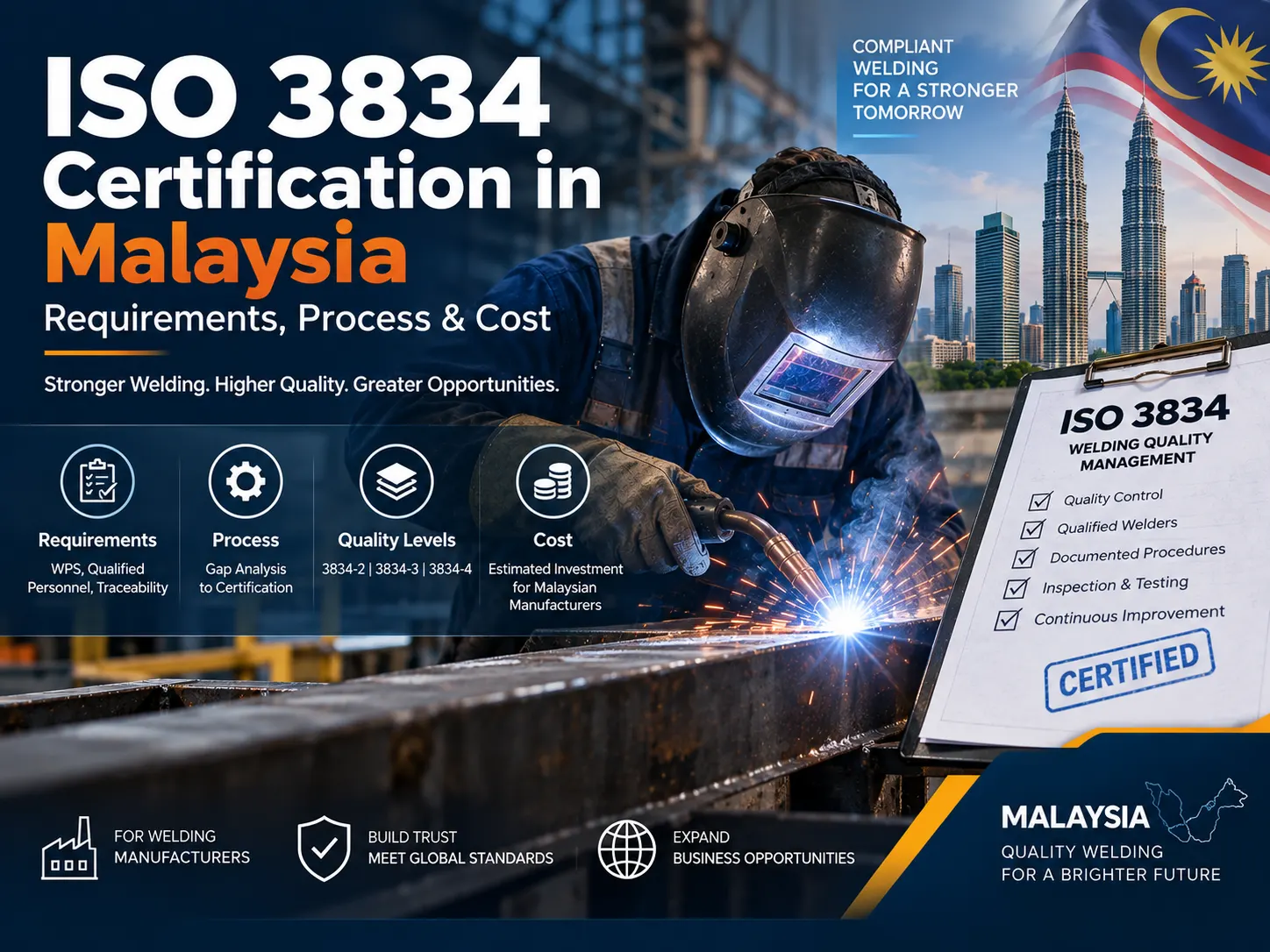
ISO 3834
REQUIREMENTS
PROCESS
MALAYSIA
16 Sep 2026
ISO 3834 Certification in Malaysia: Requirements, Process & Cost for Welding Manufacturers
By Editorial Team
Related Blogs
SEP
15
Which Industries and Manufacturers Need ISO 3834 Certification in India and International Markets? Top 10 Sectors That Need It
SEP
12
Best Standard for Fusion Welding Quality Control: Why ISO 3834 Is Required for EN 1090 & EN 15085
SEP
08
ISO 3834 Latest Edition 2026: 2021 Revision, Current Status & What Welding Manufacturers Need to Know
AUG
24
ISO 3834 Certification Cost in India: Factors, Fees & Budget Guide
JLY
30
EN ISO 3834 Certification Requirements: What Welding Manufacturers Need to Know in 2026
See Also.....
Executive Summary
ISO 3834 is an international standard that sets rules for quality control in welding. Malaysian welding companies can get ISO 3834 certification through organizations like SIRIM QAS International to show they follow strict welding standards. The standard has three levels: 3834-2, which is the most detailed, 3834-3, which is standard, and 3834-4, which is the simplest. To get certified, a company needs to have written welding procedures, trained and qualified welders and coordinators, track materials used, and have a system in place for managing welding quality.The process starts with a gap analysis to check where the company stands, followed by a two-part audit. This usually takes several months to complete. The cost depends on the size of the company, how much of the process is checked, and which level of quality they choose.
ISO 3834: Overview and Levels
Welding Quality Standard: ISO 3834 sets up rules for a quality system that focuses on welding. It applies to any company that does or manages welding of metals, whether in a workshop or at a job site. ISO 3834 works with ISO 9001 to make sure welding is handled properly.The LL‑C site says it “helps make sure welds are of the best quality and are safe.”
- Quality Levels: Part 1 of ISO 3834 helps pick the right level; the real check decides which of the three levels a company meets:
- ISO 3834-2 (Comprehensive): Used for welding that is complex or very important for safety, like in petrochemical, pressure vessel, or nuclear projects.
It needs the tightest rules and control. - ISO 3834-3 (Standard): For regular welding with some risk, like building machines or structures.
It keeps a good balance between control and being efficient. - ISO 3834-4 (Elementary): For simple welding jobs with low risk, like small repairs.
It has the fewest rules. - Big manufacturers or projects that are important often go for ISO 3834-2 to follow what customers or laws require. Smaller jobs might only need the lower levels.
Key Requirements
Certified companies need to show they have a full system for making sure welds are good quality.
All welders and their bosses must be properly trained and certified.
Welders should have a valid certificate for steel (ISO 9606-1) or aluminum (ISO 9606-2).There should also be a qualified person in charge of welding, following ISO 14731. They need written plans for each type of weld, called Welding Procedure Specifications (WPS) and Procedure Qualification Records (WPQR).
These plans must be checked and reviewed regularly. All the materials used, like the metal being welded and the welding rods or gas, must have proof of quality, such as Material Test Certificates (MTCs).
They also need to keep track of each batch or lot of material so they can find out exactly what was used in every weld. The welding machines and tools must be checked and working correctly.
The conditions during welding, like how hot the metal is before and after welding, also need to be controlled properly according to standards.
They must check and test each weld using the right methods like non-destructive testing or breaking parts to test strength. They also need to keep records of all these checks.Plus, they must do regular internal checks and reviews of their entire welding system to make sure everything is working well.
| ISO 3834 Part | Quality Level | Typical Use |
|---|---|---|
| 3834-2 | Comprehensive (highest) | High-risk industries (pressure vessels, offshore, nuclear) |
| 3834-3 | Standard | General fabrication (machinery, structural steel) |
| 3834-4 | Elementary | Simple/low-risk welding, small workshops |
Certification Process
- Gap Analysis: Check your current welding quality management system against ISO 3834.Find out if there are missing welding procedure specifications, not enough records, or training that is not up to date.
- Documentation Prep: Make any needed documents like new welding procedure specifications, train your staff on ISO 14731 and inspection processes, and collect welder certifications.
- Stage 1 Audit: The certification body, such as SIRIM QAS, looks at your documents and checks if you are ready.
They make sure that important parts like welding procedure specifications, welder qualifications, and weld coordinators are in place. - Stage 2 Audit: A site visit is done to check how welding operations are carried out.
Auditors watch the welding and inspections, ensure that the processes match the approved welding procedure specifications or weld procedure qualification records, and check that all required records are being properly kept. - Certification Decision: If everything meets the standards, the certificate is given out, and it is usually valid for three years.
- Surveillance Audits: Regular checks are done each year to make sure you are still following the requirements. If there are any big changes in products or processes, you need to inform the auditor.
Timeline: With proper preparation, the whole certification process usually takes between 4 to 10 weeks from the start of the audit until the certificate is issued.
Having an existing ISO 9001 system can help speed up the process.
Cost Considerations
- No Fixed Rate: ISO 3834 cost depends on many factors. Key cost drivers include:
| Factor | Impact |
|---|---|
| Company size & scope | More welders, multiple sites or product lines => more audit days |
| Quality level | Level 2 audits are longer and involve more testing than Level 3/4 |
| Existing Documentation | Well-documented WPS/WPQR and QA systems reduce audit prep time |
| Number of Processes | More welding processes (SMAW, GMAW, etc.) and material types increase audit complexity |
Estimate Range: As a general idea, small companies might spend between RM 10,000 and RM 30,000 in total, including preparation, for ISO 3834 certification.Larger fabricators or those needing Level 2 certification may need RM 50,000 or more.These are just rough estimates – always ask for detailed quotes.
Budget Items: Include costs for gap analysis (either through a consultant or internal staff time), creating procedures, updating welder certifications, and the fees for the certification audit (charged per day).
Also, plan for the annual surveillance fees.
FAQ
Is ISO 3834 mandatory in Malaysia?
Not by law for general welding, but it’s often required contractually in industries like petrochemical or pressure equipment. ISO 3834 shows you meet international welding norms, which many clients demand.
Which level should we choose (2, 3 or 4)?
ISO 3834-1 provides criteria for selecting. Typically, if you fabricate safety-critical or heavy-industry equipment, go for 3834-2. For ordinary structural work, 3834-3 is common. 3834-4 is only for very simple, low-risk welding. Review your product type and risk to decide.
How long does certification take?
From starting preparations to certificate, expect a few months. The Stage 1 and 2 audits themselves usually take 1–3 days. After passing, you get a 3-year certificate with annual surveillance.
Who certifies ISO 3834 in Malaysia?
Accredited bodies such as SIRIM QAS International (accredited by Standards Malaysia), Lloyd’s Register, TUV, RINA, and others offer ISO 3834 certification. Choose one experienced in welding standards.
Can we combine ISO 3834 audit with ISO 9001?
Yes. Since ISO 3834 is a supplement to ISO 9001, many firms arrange a joint audit. Overlapping requirements (like management review, document control) can save time. Discuss combined audit options with your CB.