
Welding Operator Qualification
Welder Qualification Certification
Pressure Equipment Welding
Welding Operator Qualification in UAE: How Manufacturing Companies Verify Welder Qualification Certification for Pressure Equipment Production
By First Welding Certification Technical Editorial Team
6 Min Read Time
05 Nov 2026
Table of Content
- Introduction
- Welder Qualifications
- Welder or Welding Operator
- Why Welder Qualifications are important
- Relevant Standards
- Welding Supervisor and Qualification Examiner
- Welding Performance Qualification
- How to check welder qualifications
- Keeping welders qualified during manufacturing
- Common Errors
- Practical Example - Pressure Vessel Manufacturing in the UAE
- Documentation and Traceability
- Frequently Asked Question
- Related Searches
- Conclusion
Welding Operator Qualification in UAE for Pressure Equipment Manufacturing
Welding Operator Qualification in UAE for Pressure Equipment Manufacturing
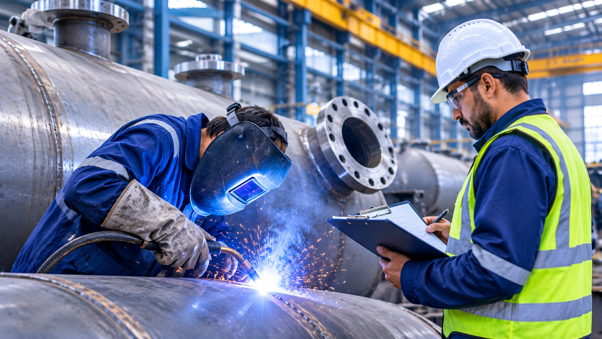
Introduction
Pressure equipment manufacturing must be controlled. This means welders must be qualified, welds must be recorded in a good quality system. Pressure equipment such as pressure vessels, tanks, heat exchanger, boilers and piping systems can be made under demanding pressures and temperatures, therefore weld quality becomes a key factor in manufacturing. Manufacturers supplying pressure equipment to Oil & Gas, Petrochemical, Energy, Water Treatment and Industrial projects within the United Arab Emirates must demonstrate that welders have the appropriate qualifications.
key areas are welder and welder qualifications : welder qualification certification and welding operator qualification.
A welder generally performs welding tasks manually or using processes that are directly controlled by the welder. The welding operator uses or controls mechanised or automatic welding equipment.
Manufacturers will need to ensure that the correct qualification is being used by checking with the welding supervisor or responsible examiner that welders have the appropriate qualifications for the welding process, material, joint, thickness, position and other factors.
This article will explain how manufacturers can control welder qualifications when manufacturing pressure equipment.
Welder Qualifications
Welder qualifications are to prove that a person can carry out welding within a certain scope. Weld quality is influenced by many factors when manufacturing pressure equipment.
These can include;
- Welding process.
- Material and type.
- Joint design and weld position.
- Thickness and qualification range.
- Consumables
- Equipment and manufacturing.
- Applicable construct standard and project requirements.
Qualification testing must be carried out to prove a welder can carry out the required practical work. However, welder qualifications are not a general permit; they are specific to the standard, test conditions and qualification variables. Manufacturers should always check the scope of welder qualifications.
Welder or Welding Operator
Understanding the differences between welder and welding operators is important when assigning welders.
2.1 Welder
A welder will carry out welding tasks using the appropriate manual or semi-automatic welding process. They are responsible for carrying out the weld to the approved welding procedure.
They will have qualifications for;
- Welding process.
- Applicable material group.
- Filler material.
- Applicable pipe diameter.
- Weld position.
- Joint type and other qualification variables.
A manufacturer may assign a qualified welder to complete manual welding. For example, on shell to head joints of a pressure vessel. The welder will have qualifications for the conditions within the production. EN ISO 9606 is a recognised standard for welder qualification testing. It contains different parts for different materials.
2.2 Welding Operator
A welding operator will use mechanised or automatic welding equipment. They will setup, operate or oversee the welding process according to defined parameters.
Examples could include;
- Mechanised Submerged Arc.
- Automatic Longitudinal Seam.
- Automatic Circumferential.
- Mechanised welding for pressure vessel manufacturing.
- Automated welding for repetitive joints.
Welder qualifications must be chosen according to the equipment, process and standard. EN ISO 14732 covers welding operator and weld setter qualification.
Why Welder Qualifications are important
Welds in pressure equipment can experience high pressures, thermal stresses, cyclic stresses and demanding conditions. Wrong welding could lead to defects such as cracking, lack of fusion, lack of penetration, porosity and other discontinuities. By having welders with qualifications you will be able to prove that welds are being assigned to those with the right qualifications within the defined scope.
3.1 Maintain Weld Quality
Qualified welders will have shown that they can produce acceptable welds. With the right procedures in place weld quality can be maintained.
3.2 Appropriate Project Requirements
Some pressure equipment projects will specify what welder qualification standards and requirements are needed. Manufacturers must identify what is required.
3.3 Inspections
Having records of welders will help with identifying who carried out the weld and proving that they had the right qualification.
3.4 Traceability
By linking welds to welder/welding operator ID numbers manufacturers can trace back to the correct qualifications.
3.5 Reduce Non-Conformances
Using incorrect welder qualifications, out of date or unverified qualifications and assigning welders outside of their qualification can cause issues with audits. Having a clear process will help to reduce issues.
Relevant Standards
The correct standard must be chosen depending on the applicable standard, customer specification, project and welding type.
Below are some key standards.
EN ISO 9606 Series – Welder Qualification Testing
This covers welder qualification testing for fusion welding.
There are different parts for different material groups;
- EN ISO 9606-1 – Steel.
- EN ISO 9606-2 – Aluminium and Aluminium Alloys.
- EN ISO 9606-3 – Copper and Copper Alloys.
- EN ISO 9606-4 – Nickel and Nickel Alloys.
- EN ISO 9606-5 – Titanium and Zirconium and their Alloys.
The correct part must be identified based on the material being welded.
EN ISO 14732 – Welding Operator and Weld Setter.
This covers welding operator and weld setter qualification testing. This is particularly relevant if the manufacturer is using equipment that controls or carries out welding via mechanised/automatic methods.
ISO 3834 – Weld Quality Requirements.
This provides quality requirements for fusion welding of metallic materials. It covers general weld quality requirements, welder knowledge, welding coordination, procedures and records. ISO 3834 is not the same as welder qualifications. Having a weld quality certification doesn’t mean welder qualifications don’t need to be verified.
Construct Standards and Project Specification.
Manufacturers may manufacture pressure equipment according to different standards. Some projects may require pressure equipment to be manufactured according to European or International standards. The manufacturer will need to identify what national/customer requirements apply. Some projects may specify what welder qualification standards, welding procedure qualification route, inspection and acceptance criteria. Manufacturers shouldn’t assume welder qualifications will be accepted.
Welding Supervisor and Qualification Examiner
The welding supervisor and qualification examiner will have key responsibilities.
5.1 Check Requirements.
The welding supervisor should identify what qualifications are required according to the applicable standard, customer requirements, WPS and weld scope.
5.2 Check Welder Qualifications.
Ensure that the welder or welding operator has the appropriate qualifications.
5.3 Arrange Testing.
If new welders are being recruited or additional qualifications are required the organisation should arrange welding according to the applicable standard.
5.4 Check Test Conditions.
Test should be carried out according to the test conditions. The test piece, welding process, position, material and other relevant factors should be identified and recorded.
5.5 Arrange Examination.
The welder should be examined and assessed according to the examination and testing requirements. The examiner/testing organisation should ensure that the results are recorded.
5.6 Keep Records.
The supervisor should ensure that certificates, test records and confirmation records are kept. Exact responsibilities will depend on the organisations management system, standard and project requirements.
Welding Performance and Qualification
Welding performance is important to ensure that individuals are qualified.
Generally the following steps are carried out;
Step 1: Identify Qualification Required.
Identify what type of welding is required. The workshop may require welders to carry out manual welding on shell/nozzle joints and welding operators to carry out mechanised welding on longitudinal seams. Or automatic welding on repetitive circumferential joints. Qualifications should be chosen based on what is being done.
Step 2: Identify Applicable Standard.
The organisation will identify what standard and qualification variables are required. For example welders may require EN ISO 9606 and welding operators/weld setters may require EN ISO 14732.
Step 3: Setup Test.
Setup the test with the correct materials, dimensions, joint type, welding process and position. The test should be carried out according to the qualification scope.
Step 4: Carry out Test.
The welder should carry out the welding task according to the test conditions. The test should be controlled and recorded to allow for the welder to be identified and linked to the correct test piece.
Step 5: Examine Test Piece.
Depending on the applicable standard and test requirements the weld will be examined. This could include visual inspection and other destructive/non-destructive testing. The examination should be carried out according to the qualification standard.
Step 6: Analyse Results.
Results should be analysed against the applicable acceptance criteria. If the test was satisfactory then the qualification documents can be created according to the applicable certification/examination.
Step 7: Issue and Verify Records.
The qualification record should clearly identify who the welder was, what test conditions were used, what qualification scope was used, standard and what requirements for validity/confirmation. The manufacturer should check the document to ensure the welder is assigned to the correct tasks.
How Manufacturers in the UAE Check Qualifications.
Having a certificate is not enough. Manufacturers should check that the welders have the correct qualification.
The following should be checked;
7.1 Check Name and ID.
Check that the welder has the correct name and ID according to the personnel records. The certificate should clearly identify who was carrying out the work.
7.2 Check Applicable Standard.
Check that the certificate was issued according to the applicable standard. Welder and welding operator certificates should not be interchangeable.
7.3 Check Welding Process.
Check the welding process stated in the qualification. This should match the WPS being used in production.
7.4 Check Material and Thickness Range.
Ensure the welder has the correct qualification for the intended use according to the applicable standard.
7.5 Check Weld Position and Joint.
Where applicable check that the weld position and joint type matches the qualification.
7.6 Check Validity and Continuity.
Some standards will require welders to have welder qualifications confirmed on a regular basis. Or that they have carried out the relevant welding. The manufacturer should check what requirements apply.
Don’t assume the certificate is valid based on the date printed.
7.7 Check Issued by and Examined by.
Check that the certificate was issued by the correct organisation and that the welder was examined by the correct examiner/responsible body. Check any test documentation.
Where required obtain confirmation from the issuing organisation
Keeping Welders Qualified
Once welders have been issued with their qualification it is important to have a system in place to ensure they remain qualified and assigned to the correct welding.
Key controls include;
- Unique ID – Give each welder and welding operator a unique ID number.
- Correct Welding – Ensure welders are assigned to tasks within their qualification.
- Correct WPS – Ensure the correct WPS is available.
- Qualification Tracking – Track when they should be confirmed.
- Weld Records – Ensure welders can be linked to welds/components.
- Change Control – Check if welder qualifications are required based on changes to welding processes, materials, positions or tasks.
- Non-Conformance – Investigate any weld defects and see if this indicates any issues with welder knowledge, procedure selection, equipment or manufacturing.
This will ensure welder qualifications are actively managed.
Common Errors
There are a few common errors that can occur.
9.1 Confusion Between Welder and Welding Operator.
A welder with manual qualifications won’t automatically qualify them to use all mechanised/automatic systems. The correct qualification must be chosen.
9.2 Assigning Outside of Qualification Scope.
A welder may not be qualified for certain processes, materials, positions or thicknesses. This could cause issues with compliance.
9.3 Not Checking Confirmation Requirements.
Manufacturers should track what requirements apply to welder qualifications. Don’t assume old certificates are acceptable.
9.4 Wrong Standard.
The qualification standard must match the project requirements and applicable standard. Don’t assume certificates issued under one standard will be acceptable under another.
9.5 Lack of Test Details.
If there aren’t enough details on the test, it is hard to identify who was carrying out the weld and qualify them.
9.6 No Link to Welders.
Manufacturers may struggle to identify who carried out the weld due to poor identification.
Practical Example - Pressure Vessel Manufacturing in the UAE
A manufacturer in the UAE is manufacturing pressure vessels with welds. The scope of work includes manual welding of certain shell/nozzle joints and mechanised welding of longitudinal seams. The manufacturer will check the construct standard and project specification and identify what welder qualifications are required.
They will check that welders have the correct qualifications for manual welding according to the welder standard. They will check the welding operator and weld setter qualifications according to the applicable standard. The welding supervisor will check that the welders have the correct qualifications according to the WPS. Before manufacturing begins they will record each welders ID. They will assign welders to the correct tasks.
During manufacturing weld records will identify welders responsible for joints. This will allow inspection teams to link the weld to the correct WPS, welder qualifications and inspection reports. If welders are found to be out of scope or not confirmed according to their requirements they should be resolved before being assigned to the task.
This will help the manufacturer keep track of welder knowledge and show welding is being carried out to control. This is just an example and will depend on the construct standard, project specification, material, welding process and regulations
Documentation and Traceability
A manufacturer in the UAE is manufacturing pressure vessels with welds. The scope of work includes manual welding of certain shell/nozzle joints and mechanised welding of longitudinal seams. The manufacturer will check the construct standard and project specification and identify what welder qualifications are required.
They will check that welders have the correct qualifications for manual welding according to the welder standard. They will check the welding operator and weld setter qualifications according to the applicable standard. The welding supervisor will check that the welders have the correct qualifications according to the WPS. Before manufacturing begins they will record each welders ID. They will assign welders to the correct tasks.
During manufacturing weld records will identify welders responsible for joints. This will allow inspection teams to link the weld to the correct WPS, welder qualifications and inspection reports. If welders are found to be out of scope or not confirmed according to their requirements they should be resolved before being assigned to the task.
This will help the manufacturer keep track of welder knowledge and show welding is being carried out to control. This is just an example and will depend on the construct standard, project specification, material, welding process and regulations
Frequently Asked Questions
What is welding operator qualification?
Welding operator qualification demonstrates that an individual can operate or control mechanised or automatic welding equipment according to the applicable qualification requirements.
What is the difference between welder qualification and welding operator qualification?
Welder qualification focuses on manual or applicable semi-automatic welding performance, whereas welding operator qualification focuses on operating or setting mechanised and automatic welding equipment
Which standards are used for welder and welding operator qualification?
EN ISO 9606 is used for welder qualification testing, while EN ISO 14732 covers welding operator and weld setter qualification
How can UAE manufacturers verify welder qualification certificates?
Manufacturers should check the welder’s identity, applicable standard, welding process, material, thickness range, welding position, qualification scope and validity or confirmation requirements
Related Searches
- How to Control Subcontracted Welding Work: Quality Responsibilities, Inspection Records and Certification Readiness
- ISO 9712 NDT Inspection Welding Quality Control Industrial Manufacturing How ISO 9712-Certified NDT Personnel Support EN 15085, EN 1090 and PED Compliance
- EN ISO 3834 Welder and Wlding Operator Manufacturer Welder and Welding Operator Roles in EN ISO 3834 Certification for Manufacturing Companies in Chennai – What Are the Requirements?
- EN 15085-4 Documentations Qualifications 15085-4 Welding Preparation Documents: How Do Welder Qualifications Support Quality Railway Production Worldwide?
Conclusion
Welding operator qualifications and welder qualification certificates are an important part of controlled pressure equipment manufacturing. Choosing the correct qualification standard for welders, checking welder qualifications and assigning welders can help improve weld quality management. The welding supervisor plays an important role in verifying welder knowledge, tracking welder qualifications and keeping records traceable.
However welder knowledge is only one part of pressure equipment quality. Qualified welding procedures, correct materials, welder coordination and inspection and applicable construct requirements must also be in place.
Having a controlled qualification and verification system will improve control over welding. This will prove welder knowledge is in place to support pressure equipment manufacturing
Planning to manufacture pressure equipment for international markets?
First Welding Certification Pvt Ltd (PRVÁ ZVÁRAČSKÁ, a.s.) can help you understand relevant welding qualification, welder certification, NDT, and material documentation requirements associated with your compliance planning.
Contact our team to discuss your project requirements and identify the documentation and certification assessment you may need.