
EN ISO 3834
Welder and Wlding Operator
Manufacturer
Welder and Welding Operator Roles in EN ISO 3834 Certification for Manufacturing Companies in Chennai – What Are the Requirements?
By First Welding Certification Technical Editorial Team
6 Min Read Time
23 Oct 2026
Table Of Contents
Welder vs Welding Operator in EN ISO 3834 Certification
ISO 9606
The requirements for the qualification testing of welders for fusion welding of steels
ISO 14732
Qualification testing of welding operators and weld setters for mechanized and automatic welding of metallic materials
EN ISO 3834
An international standard that specifies quality requirements for the fusion welding of metallic materials.
Introduction
Welding quality plays a critical role in manufacturing industries, including structural steel fabrication, pressure equipment, railway components, and industrial machinery. Poor welding practices can lead to defects, structural failures, rework, and compliance issues.
EN ISO 3834 certification helps manufacturing companies establish appropriate quality controls for fusion welding. A key part of this system is ensuring that welders and welding operators have the qualifications and competence required for their assigned work.
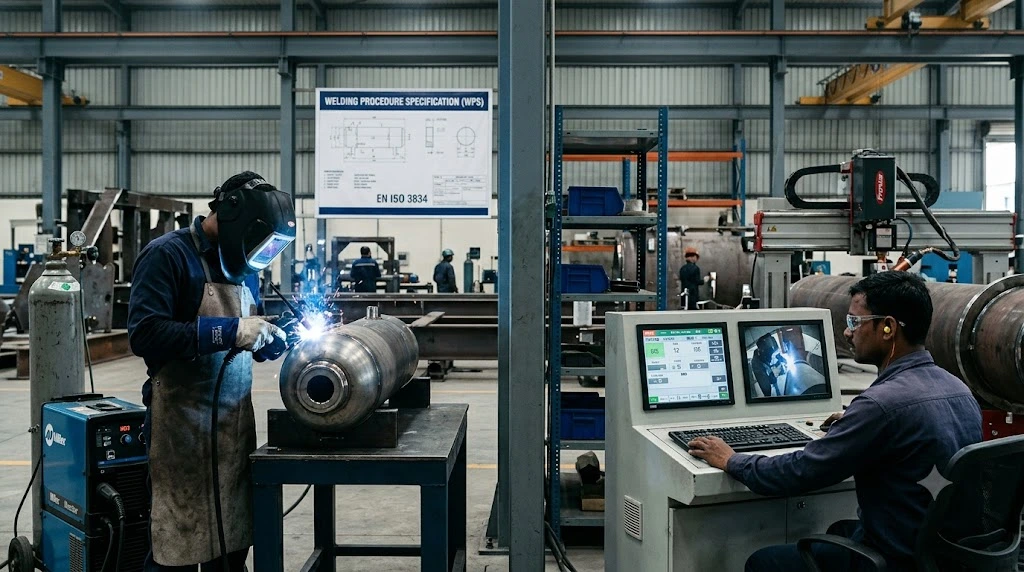
Although both roles contribute to weld quality, their responsibilities differ. Welders generally perform manual or partly mechanized welding, while welding operators control or set up mechanized and automatic welding equipment. Understanding these differences helps manufacturers select the appropriate qualifications and maintain reliable welding production.
What Is EN ISO 3834 Certification?
EN ISO 3834 specifies quality requirements for fusion welding of metallic materials. It helps manufacturers control welding-related activities, maintain consistent production quality, and demonstrate that appropriate welding procedures and personnel controls are in place.
The standard has different parts covering comprehensive, standard, and elementary quality requirements, along with requirements for specific applications.
For manufacturers seeking EN ISO 3834 certification, the applicable requirements depend on the selected part, product specifications, contractual obligations, and relevant construction standards.
Personnel competence is an important element of welding quality management because even a properly qualified welding procedure requires competent people to execute it correctly.
What Is the Role of a Welder in EN ISO 3834?
A welder performs welding operations by manually manipulating an electrode, torch, or other welding equipment to create a sound weld.
Under an EN ISO 3834 quality system, manufacturing companies should ensure that welders possess suitable qualifications for the welding work assigned to them.
Key responsibilities include:
- Following the approved Welding Procedure Specification (WPS).
- Preparing joints and checking materials before welding.
- Using the specified welding process and parameters.
- Maintaining correct welding technique and bead quality.
- Following applicable safety and inspection requirements.
- Reporting defects and production issues to the responsible personnel.
Welder qualification standard: ISO 9606 certification provides qualification testing requirements for welders. ISO 9606-1 specifically addresses fusion welding of steels.
A qualification must cover the relevant scope of work. Companies should verify the applicable process, material, welding position, joint type, and qualification validity requirements rather than assuming that one certificate covers every welding activity.
What Is the Role of a Welding Operator?
A welding operator works with mechanized or automatic welding equipment. Depending on the process, the operator may set up equipment, adjust welding parameters, monitor production, and ensure that the equipment follows the approved welding procedure.
Typical responsibilities include:
- Setting up mechanized or automatic welding systems.
- Verifying the required welding parameters and equipment settings.
- Monitoring welding operations and production consistency.
- Identifying equipment abnormalities and process deviations.
- Maintaining production and inspection records.
- Coordinating with welding supervisors and quality personnel.
Welding operator qualification standard: ISO 14732 certification addresses qualification testing for welding operators and weld setters working with mechanized and automatic welding processes.
The 2025 edition of ISO 14732 is the current published international edition. Its scope excludes personnel who neither control or adjust welding parameters nor participate in setting up welding equipment.
For manufacturing companies, the appropriate qualification should therefore reflect the actual equipment, process, and responsibilities of the operator.
Welder vs Welding Operator: Key Differences
| Comparison | Welder | Welding Operator |
|---|---|---|
| Main role | Performs welding directly | Operates mechanized or automatic welding equipment |
| Working method | Manual or applicable partly mechanized processes | Mechanized or automatic processes |
| Key competence | Manual welding technique | Equipment setup, control, and process operation |
| Qualification reference | ISO 9606, where applicable | ISO 14732, where applicable |
| Quality responsibility | Produces welds according to the approved procedure | Maintains controlled operation of the welding system |
Both roles support welding quality, but their qualifications are not interchangeable. Companies must identify the actual work performed before determining the relevant qualification requirements.
Qualification Requirements for Manufacturing Companies in India
Manufacturing companies pursuing EN ISO 3834 certification should establish a documented approach to personnel competence.
Step 1: Identify welding activities
List the welding processes, materials, product types, and production methods used at the facility.
Step 2: Determine the applicable qualification standard
Select the relevant welder or welding operator qualification requirements according to the process, product standard, and contractual specifications.
Step 3: Verify qualification records
Check certificates, qualification ranges, supporting test records, and validity or continuity requirements applicable to the qualification scheme.
Step 4: Implement approved welding procedures
Ensure that personnel follow the applicable WPS and that the supporting welding procedure qualification documentation is available where required.
Step 5: Maintain production and inspection records
Retain relevant personnel qualifications, welding records, inspection results, and records of corrective actions according to the applicable quality requirements.
Step 6: Review competence during quality audits
Evaluate whether personnel qualifications match their assigned tasks and whether welding activities follow documented procedures.
Companies should also address welding coordination, equipment maintenance, material traceability, and inspection controls as required by the applicable EN ISO 3834 part and product specification.
Frequently Asked Questions
Is welder qualification mandatory for EN ISO 3834 certification?
The applicable quality requirements and product standards determine the necessary qualification and competence controls. Companies must identify and meet the requirements relevant to their scope rather than assume that every situation has identical requirements.
Which standard is used for welder qualification?
ISO 9606 provides qualification testing requirements for welders. ISO 9606-1 covers fusion welding of steels.
Which standard covers welding operator qualification?
ISO 14732 covers qualification testing for welding operators and weld setters involved in mechanized and automatic welding of metallic materials.
Can a welder certificate replace a welding operator certificate?
Not automatically. The qualifications address different activities. The applicable standard and scope must match the person’s actual welding responsibilities.
Why is personnel competence important for EN ISO 3834 certification?
Competent personnel help manufacturers follow approved welding procedures, control defects, maintain production consistency, and provide evidence of welding quality.
Does EN ISO 3834 cover only welders?
No. Welding quality management can involve welding coordination, procedures, equipment, inspection, documentation, and other controls, depending on the applicable requirements.
Related Searches
- What Are the EN ISO 3834-3 Requirements for Welded Products? Welding Quality Certification in Pune
- What Are the ISO 3834 Welding Coordinator Requirements, Qualifications & Responsibilities in India?
- Welders & Welding Operators – Welder Qualification and Certification
- EN 15085-4 Welding Preparation Documents: How Do Welder Qualifications Support Quality Railway Production Worldwide?
- Welding Documentation Checklist: 25 Records Every Fabricator Should Maintain
Conclusion
Welder and welding operator qualification competence are important elements of a reliable welding quality system. While welders focus on producing welds using the applicable welding technique, welding operators manage the operation of mechanized and automatic welding systems.
For manufacturing companies in India, understanding the distinction between EN ISO 3834 quality requirements, ISO 9606 welder qualification, and ISO 14732 welding operator qualification supports better documentation, audit preparation, and production control.
The correct approach is to assess the applicable standard, verify personnel qualifications, implement approved welding procedures, and maintain the records required for the company’s products and certification scope.
Looking for EN ISO 3834 certification guidance for your manufacturing company?
First Welding Certification Pvt Ltd (PRVÁ ZVÁRAČSKÁ, a.s.) can assist you to understand the applicable welding quality requirements and prepare for the certification process.
Contact our team to discuss your manufacturing activities, welding documentation, personnel qualification records, and applicable certification requirements.