
CE MARKING
CHECKLIST
FAQ
1 Aug 2026
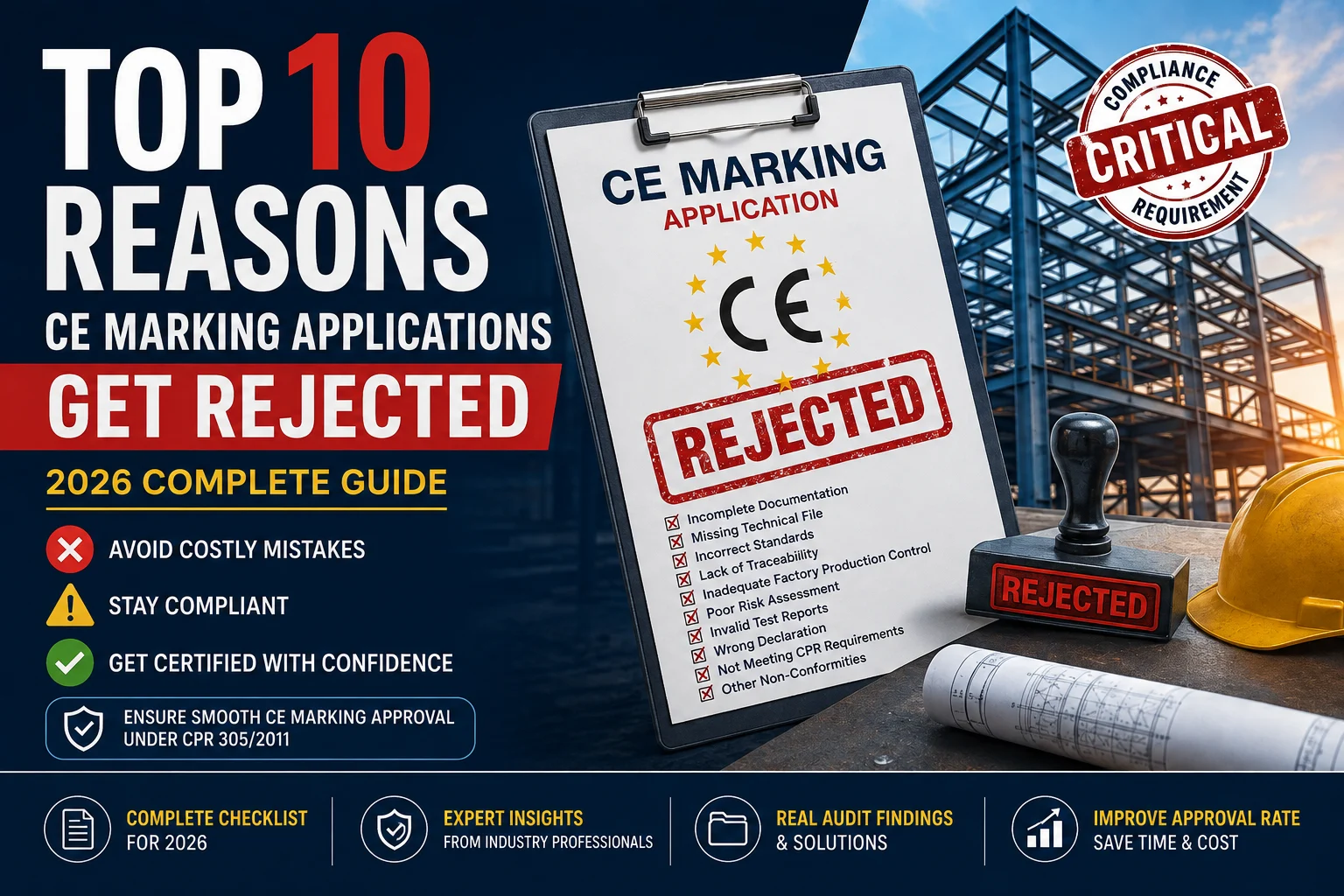
Top 10 Reasons CE Marking Applications Get Rejected (2026 Complete Guide)
By Editorial Team
Table Of Contents
- Understanding CE Marking Before You Apply
- Why Do CE Marking Applications Get Rejected?
- The Cost of a Rejected CE Marking Application
- Reason #1 – Incomplete Technical Documentation
- Reason #2 – Choosing the Wrong EU Directive or Regulation
- Reason #3 – Inadequate or Missing Risk Assessment
- Reason #4 – Product Testing Does Not Meet Harmonized European Standards
- Common Testing Mistakes
- Best Practices
- Reason #5 – Poorly Prepared Declaration of Conformity (DoC)
- Common Declaration Errors
- Reason #6 – Inconsistent Product Information
- How to Prevent Inconsistencies
- Reason #7 – Poor Product Traceability
- Essential Traceability Records
- Reason #8 – Using Outdated Harmonized Standards
- Best Practices
- Reason #9 – Weak Manufacturing Quality Control
- Reason #10 – Attempting CE Marking Without Expert Guidance
- CE Marking Submission Checklist
- Best Practices for Successful CE Marking
- FAQ
- Conclusion
Related Blogs
AUG
18
Digital Product Passport vs CE Marking: What Steel Manufacturers Need to Know
AUG
14
CE Marking Declaration of Performance Errors: 10 Common DoP Mistakes
JLY
20
CE Marking vs EN 1090: Key Differences Every Manufacturer and Exporter Should Know (2026 Guide)
See Also.....
Exporting products to the European Union presents enormous growth opportunities for manufacturers across industries. Whether you manufacture pressure equipment, steel structures, industrial machinery, construction products, electrical equipment, or fabricated components, obtaining CE Marking is often the key requirement for legally placing your products on the European market.
However, many manufacturers assume that CE Marking is simply a certificate issued after product testing. In reality, it is a comprehensive compliance process that requires technical documentation, product evaluation, risk assessment, quality assurance, and conformity with applicable European Union legislation.
Every year, numerous CE Marking applications face delays, requests for additional information, or outright rejection—not because the products themselves are unsafe, but because the supporting documentation fails to demonstrate compliance adequately.
A rejected application can have serious business consequences, including delayed product launches, missed export deadlines, increased testing costs, loss of customer confidence, regulatory investigations, additional documentation expenses, supply chain disruptions, and lost revenue opportunities.
The encouraging news is that the majority of these issues are preventable. Manufacturers who understand the compliance process and prepare their documentation correctly can significantly improve their approval success rate while reducing both time and certification costs.
This comprehensive guide explains the top 10 reasons CE Marking applications get rejected, how these mistakes occur, and the practical steps manufacturers can take to avoid them.
Failure to identify the correct legislative framework from the beginning often leads to documentation errors, incorrect testing, and application rejection.
Understanding CE Marking Before You Apply
CE Marking is not simply a product certification. It is the manufacturer’s legal declaration that a product complies with applicable European Union legislation covering safety, health, environmental protection, and performance requirements. Depending on the product category, compliance may involve one or more regulations such as EN 1090, PED 2014/68/EU, SPVD 2014/29/EU, the Machinery Regulation, the Low Voltage Directive, or the EMC Directive.
Failure to identify the correct legislative framework from the beginning often leads to documentation errors, incorrect testing, and application rejection.
Why Do CE Marking Applications Get Rejected?
Regulatory authorities and Notified Bodies evaluate far more than the physical product. They review technical documentation, product design, manufacturing processes, material specifications, laboratory test reports, risk assessments, labeling, user manuals, declarations of conformity, factory production controls, and traceability records. Even one missing document or inconsistency can significantly delay approval.
Failure to identify the correct legislative framework from the beginning often leads to documentation errors, incorrect testing, and application rejection.
The Cost of a Rejected CE Marking Application
Reason #1 – Incomplete Technical Documentation
The Technical File is the foundation of every CE Marking application. It contains the evidence demonstrating compliance with European legislation. A complete file typically includes product descriptions, engineering drawings, assembly drawings, material specifications, bills of materials, manufacturing processes, design calculations, welding procedures where applicable, inspection reports, factory production control documents, risk assessments, user manuals, installation instructions, maintenance manuals, test reports, material certificates, declarations of conformity, and a list of harmonized standards applied.
Common mistakes include missing drawings, outdated revisions, incomplete certificates, missing inspection reports, poor document organization, and no revision history. The best practice is to build and maintain the Technical File throughout the project instead of assembling it at the end.
Reason #2 – Choosing the Wrong EU Directive or Regulation
Selecting the correct legislation is one of the most misunderstood aspects of CE Marking. Many products fall under multiple directives or regulations simultaneously. Using outdated legislation, applying incorrect standards, or relying on previous project documentation without verifying applicability can invalidate the conformity assessment.
Manufacturers should define the intended use of the product, identify all applicable EU legislation, review the latest harmonized standards, determine whether a Notified Body is required, and document the legislative framework before testing begins.
Common mistakes include missing drawings, outdated revisions, incomplete certificates, missing inspection reports, poor document organization, and no revision history. The best practice is to build and maintain the Technical File throughout the project instead of assembling it at the end.
Reason #3 – Inadequate or Missing Risk Assessment
Risk assessment demonstrates that the manufacturer has systematically identified hazards, evaluated risks, and implemented appropriate control measures. Typical hazards include mechanical, electrical, thermal, fire, pressure, chemical, ergonomic, noise, vibration, maintenance, misuse, transportation, and installation risks.
Many manufacturers rely on generic templates or fail to update assessments after design changes. A product-specific risk assessment that evolves throughout the product lifecycle is essential for successful CE Marking.
Reason #4 – Product Testing Does Not Meet Harmonized European Standards
One of the most critical stages of the CE Marking process is product testing. Even if a product is well-designed and manufactured to a high standard, using incorrect testing methods or outdated standards can result in an immediate compliance issue.
Many manufacturers wrongly think that any lab test report is enough for CE Marking. But actually, the test reports need to show that the product follows the most up-to-date European Standards (EN Standards) that apply to it.
These standards set out safety rules, how well the product should work, how to test it, how to inspect it, what limits are acceptable, and what documents are needed.
Using these standards gives a strong sign that the product meets the rules and makes the approval process easier.
A lot of manufacturers use general test templates or don’t update their checks when they change the product design.
It’s important to have a detailed risk assessment that changes as the product develops through its whole life cycle to get CE Marking right.
Common Testing Mistakes
- Testing against withdrawn or obsolete standards.
- Conducting only partial testing.
- Using laboratories unfamiliar with EU compliance.
- Failing to retain original laboratory reports.
- Submitting reports without calibration records.
- Ignoring environmental or durability testing.
- Not verifying laboratory competence or accreditation.
Example: A structural steel manufacturer tested fabricated components using an outdated version of EN 1090. Although the products met design requirements, the revised harmonized standard required additional testing. The result was an eight-week delay, higher laboratory costs, revised documentation, and postponed deliveries.
Best Practices
- Verify the latest harmonized standards before testing.
- Use accredited laboratories experienced in EU regulations.
- Keep signed laboratory reports and calibration certificates.
- Repeat testing after major product design changes.
- Review all reports before submitting the Technical File.
Reason #5 – Poorly Prepared Declaration of Conformity (DoC)
The EU Declaration of Conformity (DoC) is one of the most important legal documents in the CE Marking process. By signing it, the manufacturer accepts legal responsibility for product compliance with all applicable EU legislation.
A valid Declaration of Conformity confirms that conformity assessment procedures have been completed, the correct harmonized standards have been applied, the Technical File has been prepared, required testing has been performed, and the manufacturer accepts responsibility for compliance.
Common Declaration Errors
- Incorrect manufacturer information.
- Missing directives or regulations.
- Wrong harmonized standards.
- Unsigned declarations.
- Incorrect product identification.
- Outdated references.
- Missing authorized representative details.
Every detail must match the Technical File, product label, manuals, and supporting documents. Even small inconsistencies can delay approval or trigger additional regulatory questions.
Reason #6 – Inconsistent Product Information
Regulatory authorities expect complete consistency across every document submitted during the CE Marking process. Differences between product labels, manuals, technical files, packaging, and declarations often indicate weak document control.
Common inconsistencies include different model numbers, serial numbers, manufacturer names, product descriptions, or revision dates. Such discrepancies reduce confidence in the manufacturer’s quality management system.
How to Prevent Inconsistencies
- Implement document revision control.
- Use standardized document templates.
- Review every document before submission.
- Verify labels, manuals, packaging, and technical files match exactly.
Reason #7 – Poor Product Traceability
Traceability is essential for demonstrating manufacturing control. Manufacturers should be able to trace raw materials, purchased components, suppliers, production batches, inspections, testing records, and final product identification.
Without effective traceability, regulators may question whether products are consistently manufactured according to approved specifications.
Essential Traceability Records
- Material certificates
- Supplier approvals
- Batch records
- Inspection reports
- Production logs
- Calibration records
- Final inspection reports
- Shipment records
A written tracking system helps with meeting CE Marking requirements and also makes it easier to handle product recalls, builds trust with customers, ensures good quality, and helps follow rules over time.
Reason #8 – Using Outdated Harmonized Standards
European harmonized standards are reviewed and updated regularly to reflect new technology, safety expectations, and regulatory requirements. Many manufacturers unknowingly rely on withdrawn or superseded standards because they reuse documentation from previous projects. Even when the product itself is safe, demonstrating compliance against an obsolete standard can delay or invalidate a CE Marking application.
Manufacturers should routinely verify the latest harmonized standards published for their product category and update technical documentation whenever revisions affect compliance.
Best Practices
- Monitor updates to EN, ISO and IEC standards.
- Review standards before every new project.
- Update technical documentation after standard revisions.
- Train engineering and quality teams on regulatory changes.
Reason #9 – Weak Manufacturing Quality Control
CE Marking does not only evaluate the finished product—it also assesses whether products are manufactured consistently. Weak quality control systems increase the risk of variation between production batches and reduce confidence in product conformity.
Manufacturers should maintain documented inspection procedures, calibration records, production controls, non-conformance management, corrective actions, and regular internal audits. Quality systems such as ISO 9001 and Factory Production Control (where applicable) help demonstrate consistent manufacturing performance.
Reason #10 – Attempting CE Marking Without Expert Guidance
Many companies try to finish the CE Marking process without really knowing the laws that apply, how to check if their product meets the standards, what documents they need to prepare, and what testing they must do.Even though this might save money at first, it usually leads to needing more testing, having to change documents again and again, waiting longer for approvals, and ending up spending more money overall.
CE Marking Submission Checklist
- Complete Technical File
- Applicable EU Directives and Regulations identified
- Latest Harmonized Standards applied
- Valid Product Test Reports
- Comprehensive Risk Assessment
- Signed EU Declaration of Conformity
- Correct Product Labeling
- Updated User Manuals
- Manufacturing & Inspection Records
- Traceability Documentation
Best Practices for Successful CE Marking
Begin compliance planning during the product design stage rather than after production. Maintain documentation throughout the project lifecycle, perform testing using the latest harmonized standards, implement effective document control, verify consistency across all records, and establish strong manufacturing quality systems. Regular internal compliance reviews significantly reduce the likelihood of application rejection.
Frequently Asked Questions
Why are CE Marking applications rejected?
Most rejections occur because of incomplete documentation, incorrect directives, outdated standards, inadequate testing, weak risk assessments, or inconsistent information.
Can I reapply after rejection?
Yes. After addressing the identified non-conformities and updating the required documentation, manufacturers can generally resubmit their application.
Is CE Marking mandatory?
Yes, for products covered by applicable EU legislation before they are placed on the European market.
Does every product require a Notified Body?
No. The requirement depends on the applicable legislation and conformity assessment procedure.
Conclusion
CE Marking is a legal demonstration of compliance rather than a simple certification. Most application rejections are preventable with proper planning, complete technical documentation, updated standards, robust risk assessments, consistent product information, and effective quality management. By following the recommendations outlined throughout this guide, manufacturers can reduce delays, control certification costs, and improve their success when entering the European market.
Still Have Questions?
Our certification experts are ready to help you navigate the certification process.