
CE MARKING
COMMON MISTAKES
CHECKLIST
CE Marking Declaration of Performance Errors: 10 Common DoP Mistakes
By Technical Editorial Team
8 Min Read
14 Aug 2026
Table Of Contents
Key Takeaways
Documentations
Process Flow
Tips
Checklist
Introduction
A Declaration of Performance (DoP) is an important document for construction products that are marked with the CE symbol. It explains how well the product performs compared to the technical standards it needs to meet, and it helps with the process of getting the CE mark.
If there is an error in the DoP, it can cause mismatches between the product, the test results, the technical files, and the CE marking.
Common mistakes include using the wrong standard, stating incorrect performance levels, giving old information, or not updating the documents when the product changes.
For manufacturers making products for the European market, it is very important to check the DoP carefully before selling the product.
This guide talks about 10 common mistakes when using the CE marking Declaration of Performance and how to avoid them.
2026 update: The EU rules for construction products are changing under Regulation (EU) 2024/3110.
This new rule includes a revised system that uses the Declaration of Performance and Conformity (DoPC). Manufacturers should check what rules and changes apply to their products.
What Is a Declaration of Performance?
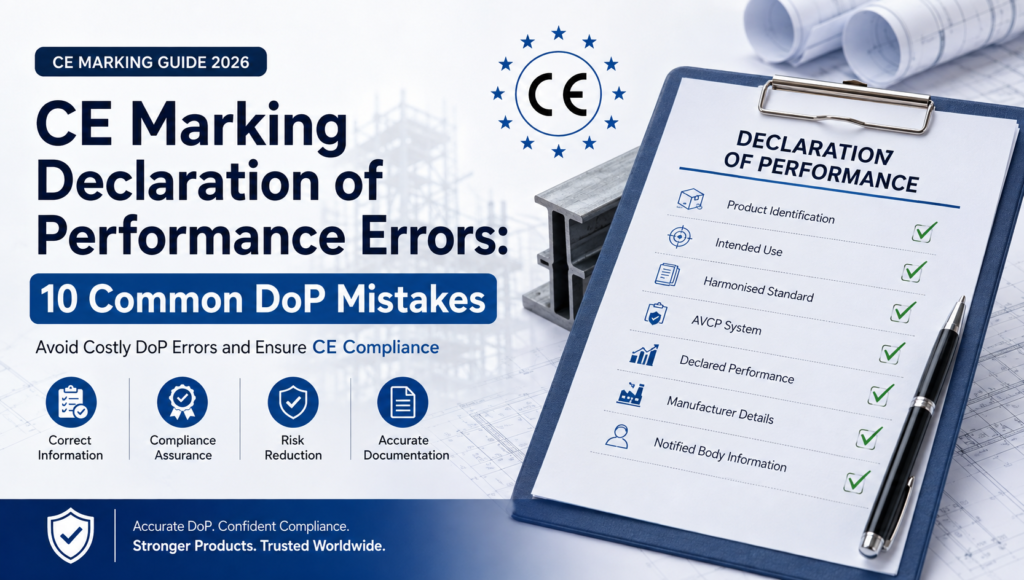
A Declaration of Performance (DoP) is a statement made by a manufacturer about how well a construction product meets certain important features and technical standards.
Depending on the product and the route it takes, the DoP might include details like:
– What the product is
– What it is meant to be used for
– Which technical standard it follows
– How its performance was checked and confirmed
– The performance it claims to have
– Information about the manufacturer
– Details about a notified body, if needed
The DoP needs to be backed up with proper technical papers and proof that the performance was checked.
In simple terms:
Product → Check its performance → Declare how well it performs → Make a DoP → Put a CE Mark on it
If any part of this process is wrong, it could cause a problem with following the rules.
10 Common CE Marking Declaration of Performance Errors
1 Incorrect Product Identification
The product mentioned in the Declaration of Performance (DoP) needs to match the actual product sold on the market.
Common mistakes are:
– Wrong product name
– Incorrect model number
– Wrong product type
– Outdated product reference
– Inconsistent product identification
For example, the product name in the DoP may not match the name on the test report or CE marking.
How to avoid it
Use the same product identification across:
Technical Documentation → Test Reports → DoP → Product Label → CE Marking
2 Wrong Harmonised Standard
Using the wrong technical standard is a serious mistake in the DoP.
Manufacturers often:
– Pick a standard for a similar product
– Use an old reference
– Mix up a product standard with a test standard
– Fail to check the correct harmonised specification
Before writing the DoP, make sure you know the exact technical specification for the product and how it will be used.
3 Incorrect Intended Use
The intended use stated in the declaration should match how the product is actually used, according to the technical rules.
Problems happen when manufacturers:
– Use unclear descriptions
– Copy the intended use from another product
– Use marketing terms instead of technical terms
– State uses that are not supported by the assessment
– The intended use should be the same across the relevant standard, technical documents and the DoP.
4 Incorrect Declared Performance
The declared performance is one of the most important parts of the DoP.
Errors can be:
– Wrong values
– Incorrect performance classes
– Wrong units
– Results from the wrong product
– Old test results
– Typing mistakes
Each declared value must be backed up by proper testing or assessment.
Simple check
Declared Performance = Supporting Evidence
If the evidence doesn’t back up the declaration, the DoP needs to be checked.
5 Incorrect AVCP System
The Assessment and Verification of Constancy of Performance (AVCP) system is how product performance is checked and confirmed.
A manufacturer may use the wrong AVCP system because of:
– An old template
– Misunderstanding the standard
– Copying another product’s DoP
– Confusing notified-body roles
Always check the correct AVCP system against the relevant technical standard.
6 Incorrect Notified Body Information
If a notified body is involved, the information must be correct.
Common errors are:
– Wrong notified-body number
– Incorrect certificate reference
– Expired certificate
– Certificate not relevant to the product
– Using old notified-body details
The DoP, certificate and other documents should all show the right assessment path and third-party details.
7 DoP Does Not Match Technical Documentation
The DoP should not be treated as a separate document.
For example:
— DoP Technical Documentation
– -Product A Product B
–Class 2 Class 3
–Standard X Standard Y
–Such differences can lead to questions about whether the declared performance is properly supported.
Best practice
Compare the DoP with:
– Technical documentation
– Test reports Certificates
– Product specifications
– FPC records
– CE marking
8 Using Outdated DoP Information
Old declarations should not be reused automatically.
Information can become old because of:
– Changes in standards
– Product changes
– New test results
– Certificate changes
– Regulatory changes
– New manufacturing methods
This is especially important in 2026, as the EU construction-products rules are changing under Regulation (EU) 2024/3110.
Manufacturers should regularly check their templates and supporting documents.
9 Failing to Update the DoP After Product Changes
A product change needs a compliance review.
Examples include:
– Changes in materials
– Changes in suppliers
– Product redesign
– Changes in manufacturing process
– Changes in production location
– New product variations
– Changes affecting product performance
The key question is: Does this change affect the product’s declared performance or the evidence supporting it?
If yes, the DoP and related technical documents should be reviewed.
10 Inconsistent CE Marking Information
The DoP and CE marking must be consistent parts of the compliance package.
Check that the relevant information about:
– Product identification
– Manufacturer
– Declaration
– Technical specification
– Notified body, if used
-Required marking information
is accurate and matches across all documents.
Under the new CPR framework, CE marking is still directly connected to the required declaration of performance and conformity.
CE Marking DoP Compliance Checklist
Before you approve a Declaration of Performance, check the following:
Product
– Make sure the product identification is correct
– Ensure the product type is correct
– Confirm the intended use is correct
– Check that the product information matches the technical documentation
Technical Requirements
– Use the correct harmonized technical specification
– Apply the correct assessment methods
– Ensure the correct AVCP system is in place
– Verify that all applicable requirements have been checked
Performance
– Confirm that declared values are supported by evidence
– Use the correct performance classes
– Use the correct units
– Make sure test reports match the product
Documentation
– Ensure the Declaration of Performance matches the technical documentation
– Check that the Declaration of Performance matches the certificates
– Review any product changes
– Control outdated documents
CE Marking
– Make sure product identification is consistent
– Ensure all required information is present
– Verify that declaration information is correct
– Check that notified-body information is correct where needed
How to Prevent DoP Errors
A simple five-step process can help cut down on documentation issues.
Step 1: Know the Product
Make sure you clearly understand the exact type, model, and purpose of the product.
Step 2: Check the Technical Info
Find out which standard or technical specification applies and which testing method is used.
Step 3: Check Performance Claims
Make sure each performance claim has proper evidence to back it up.
Step 4: Check All Documents Together
Compare the Declaration of Performance with test reports, technical files, certificates, and the CE marking.
Step 5: Keep an Eye on Changes
Review the Declaration of Performance whenever there are changes to the product, how it’s made, tested, or regulated.
DoP Errors vs CE Marking Problems
A DoP error doesn’t always make the whole CE marking process invalid.
How important the error is depends on what kind of mistake it is.
Administrative error
Examples:
– A spelling mistake
– A wrong date
– An error in technical documents
Examples:
– Citing the wrong test report
– Choosing the incorrect product category
– Performance error
Examples:
– The stated performance isn’t backed by the right evidence
– The more an error affects the technical foundation or the declared performance, the more important it is to look into and fix it.
DoP and the 2026 CPR Transition
Manufacturers need to pay close attention to Regulation (EU) 2024/3110, which is the new Construction Products Regulation.
This regulation brings a new way of looking at construction products and includes a Declaration of Performance and Conformity (DoPC).
It also changes how digital product information is handled and sets new rules for environmental sustainability.
Because of this, manufacturers shouldn’t just use an old DoP template for their 2026 compliance process.
Instead, they should check:
– Which regulation applies
– Which technical standard applies
– Whether there are any transition rules
– What kind of declaration is needed
– If previous test results are still valid
– If any documents need to be updated
Frequently Asked Questions
What are the most common Declaration of Performance errors?
The most common errors are incorrect product identification, wrong standards, incorrect intended use, unsupported performance values, incorrect AVCP information, outdated documentation and inconsistencies between the DoP and technical documentation.
Can a DoP error affect CE marking?
Yes. The DoP is an important part of the CE marking documentation for construction products. An error can create a compliance issue, particularly where it affects the declared performance or technical basis.
Should the DoP match the test report?
Yes. The product and relevant declared performance should be supported by appropriate technical evidence.
Can manufacturers use an old DoP?
Only after verifying that the information remains applicable. Manufacturers should review old declarations against current product specifications, technical requirements and applicable regulatory provisions.
What is the difference between DoP and DoPC?
DoP means Declaration of Performance under the previous CPR framework. DoPC means Declaration of Performance and Conformity, introduced under Regulation (EU) 2024/3110 as part of the revised construction-products framework.
Conclusion
A Declaration of Performance is more than just a form you have to fill out.It links how well a product works, what it claims to do, and the paperwork needed for the CE mark.
The most common mistakes are:
– Choosing the wrong product for the right standard
– Not matching the product to its intended use
– Declaring the wrong performance levels
– Using the incorrect AVCP
– Providing wrong or incomplete documents
– Applying the CE mark incorrectly
Manufacturers can lower these risks by checking their Declaration of Performance carefully before selling the product.
Starting in 2026, this check is even more important because of changes in the EU’s construction products rules, under Regulation (EU) 2024/3110.
Before you finish your CE marking paperwork, make sure that the product, its technical details, evidence of testing, declared performance, Declaration of Performance, and the CE mark all match up and tell the same story about the product’s performance.