
EN 1090
CE MARKING
PREPARATION GUIDE
EN 1090 CE Marking Audit: Complete Checklist, Common Non-Conformities & Preparation Guide
By Technical Editorial Team
10 Min Read
14 Aug 2026
Table Of Contents
- Introduction
- What Is an EN 1090 CE Marking Audit?
- When Does EN 1090 Apply?
- What Does an EN 1090 Audit Examine?
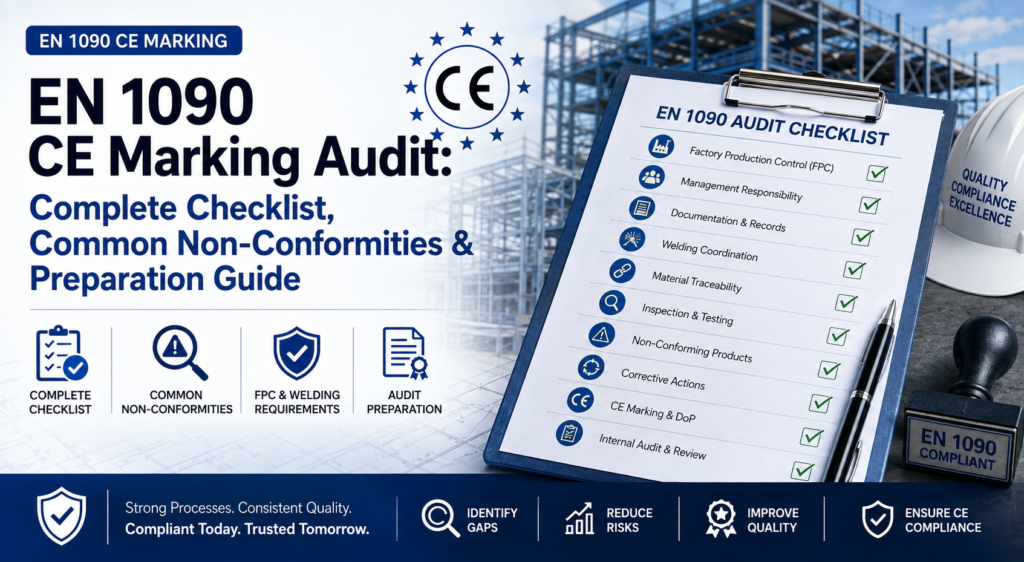
- EN 1090 CE Marking Audit Whole Checklist
- Common EN 1090 Audit Non-Conformities
- EN 1090 Audit Preparation: What to Do Before the Auditor Arrives
- EN 1090 CE Marking Audit Checklist
- What Happens During an EN 1090 Audit?
- How to Pass an EN 1090 CE Marking Audit
- 7 Mistakes Manufacturers Should Avoid Before an EN 1090 Audit
- EN 1090 Audit: Documentation vs Implementation
- FAQ
- Conclusion
Key Takeaways
Documentations
Process Flow
Tips
Checklist
Introduction
For manufacturers who make structural steel and aluminium components, getting the CE mark under EN 1090 requires more than just putting the CE logo on a product.
They need a proper system to manage their production process and show that the product’s claimed performance is consistently met.
If the product fits within EN 1090-1 and the relevant Construction Products Regulation (CPR) route, the certification process may involve checking the Factory Production Control (FPC) system and other related conformity assessments.
The European Commission says that AVCP sets out how the performance of construction products is evaluated and how the results of that evaluation are kept consistent.
An EN 1090 CE marking audit looks at whether the manufacturer’s written procedures and real production activities are enough to control the product quality.
This guide covers:
– What an EN 1090 CE marking audit includes
– What auditors usually check
– Common issues found during EN 1090 audits
– FPC audit requirements
– Checks on welding documents
– Traceability of materials
– How to get ready for an EN 1090 audit
– A practical EN 1090 audit checklist
Important: Whether EN 1090 applies depends on the product, how it will be used, its structural role, and the relevant technical and regulatory rules.
The European Commission says that CE marking under EN 1090-1:2009+A1:2011 is required if the product is within the standard’s scope, is a structural construction product under CPR, and is not covered by a more specific European product standard.
What Is an EN 1090 CE Marking Audit?
An EN 1090 CE marking audit checks if a manufacturer has the right production controls and technical processes to make structural parts according to the required standards.
A big part of this is called Factory Production Control, or FPC.
The audit doesn’t just ask:
“Do you have the right documents?”
It also asks:
“Are those documented procedures actually being used in your production?”
This is a key difference.
A manufacturer might have:
– An FPC manual
– Welding procedures
– Inspection procedures
– Material certificates
– Calibration records
But they can still get non-conformities if these documents aren’t properly followed or controlled.
When Does EN 1090 Apply?
EN 1090-1 applies to the making of structural steel and aluminium parts.
The European Commission’s CPR guidance says that if you want to put the CE mark on a product based on EN 1090-1:2009+A1:2011, the product must be covered by this standard and be a structural construction product meant to be part of a building or structure in a permanent way.
So, before starting the certification process, manufacturers need to check if their product fits these requirements.
Important questions to consider are:
– What exactly is being made?
– Is it a structural part?
– Will it be part of a building or structure for good?
– Does it fall under the scope of EN 1090-1?
– Is there another specific harmonized standard that applies to this product?
If there is another European standard that applies, that could be the one used for the CE marking instead.
What Does an EN 1090 Audit Examine?
An EN 1090 audit usually looks at the whole production control system of the manufacturer.
Key areas that are checked include:
– Factory Production Control
– Management responsibility
– Product specifications
– Material purchasing
– Material identification
– Material traceability
– Welding coordination
– Welder qualifications
– Welding Procedure Specifications and Welding Procedure Qualification Reports
– Welding consumables
– Manufacturing processes
– Inspection and testing
– Measuring and test equipment
– Non-conforming products
– Corrective actions
– Technical documentation
– CE marking and declaration documentation
The specific things covered in the audit depend on the relevant rules and the type of certification being used.
EN 1090 CE Marking Audit Checklist
1 Factory Production Control
Factory Production Control (FPC) is a key part of EN 1090 compliance.
The manufacturer should have written procedures that cover all important production steps.
Auditors might check:
– The FPC manual
– Quality procedures
– Production steps
– Inspection steps
– Who is responsible and what their roles are
– How documents are managed
– Records kept
– How non-conformities are handled
– Corrective actions taken
– Any audit questions
They will ask if the manufacturer can show that the production control system is used regularly.
An FPC system should not just be on paper.It should be clearly visible in everyday production.
2 Management Responsibility
The auditor might check if responsibilities are clearly defined.
The manufacturer should decide who is in charge of:
– Quality control
– Production
– Welding coordination
– Inspection
– Material control
– Documentation
– Handling non-conforming products
– Corrective actions
These roles should be clear to everyone involved.
3 Common problem
A procedure might say one person is responsible for a task, but production records show someone else did it without proper authority or training.
Material Purchasing and Control
The materials used are very important for structural components.
An EN 1090 audit will check how the manufacturer manages incoming materials.
Records might include:
– Purchase specifications
– Material types
– Supplier info
– Inspection documents
– Material certificates
– Incoming inspection records
– Material identification
– Traceability records
The manufacturer should be able to prove that the materials they use meet the required standards.
4 Material Traceability
Material traceability is a big part of the audit.
The manufacturer must have a way to track materials from their origin to the finished product, if needed.
For example:
Material Certificate
↓
Heat / Batch Number
↓
Incoming Materials
↓
Cutting / Processing
↓
Component
↓
Final Record
If traceability is lost during production, it could be hard to show which material went into a certain part.
Common issues
– Missing material identification
– Hard-to-read markings
– Uncontrolled material transfers
– Missing certificates
– Traceability broken after cutting
– Finished parts not linked to material records
5 Welding Coordination
Welding is a key area in steel and aluminum fabrication.
The manufacturer needs proper arrangements for managing and overseeing welding.
Auditors may check:
– Responsibilities of the welding coordinator
– Qualifications of welders
– Welding procedures
– Welding processes
– Welding consumables
– Welding parameters
– Inspection records
– Welding equipment
– Welding documentation
The specific requirements depend on the welding and execution standards.
6 WPS and WPQR
A big part of preparing for an EN 1090 audit is managing:
– WPS (Welding Procedure Specification)
– WPQR (Welding Procedure Qualification Record)
The manufacturer should show that the welding procedures are qualified and controlled.
Auditors may check:
– WPS identification
– Materials used
– Welding process
– Joint type
– Welding parameters
– Thickness range
– Welding position
– Consumables
– Preheat and interpass temperatures
– Supporting WPQR
Common problem
A manufacturer might have a WPS but can’t show it’s supported by a proper qualification.
This leads to missing documentation.
7 Welder Qualification
Welders involved in production must be qualified for the work they do.
An audit might check:
– Welder ID
– Qualification certificate
– Welding process
– Material type
– Thickness range
– Welding position
– Validity of the certificate
– Assignments to current projects
Practical check
Select a few welders from production records and check their qualification documents.
This is a useful internal check to make sure the system works as intended.
8 Welding Consumables
The manufacturer must manage welding consumables properly.
Depending on the process and requirements, records might include:
– Consumable specifications
– Batch or lot numbers
– Storage conditions
– Drying needs
– Issue records
– Expiry dates
Common issue
Consumables might be right but not properly managed.
Examples:
– Unmarked consumables
– Improper storage
– Missing batch details
– No controlled issuing system
These can become audit findings.
9 Manufacturing Process Control
The audit should look at the actual manufacturing process.
Depending on the component, this may include:
– Cutting
– Drilling
– Forming
– Machining
– Assembly
– Welding
– Surface preparation
– Coating
Final inspection
The manufacturer should have controls to make sure the final product meets the design requirements.
10 Inspection and Testing
Inspection and testing should be planned and properly documented.
The auditor may look at the following:
– Inspection plans
– Inspection criteria
– Dimensional checks
– Visual inspection
– Weld inspection
– NDT records if needed
– Final inspection
– Acceptance criteria
– Inspection reports
The records should show:
– What was checked
– Who did the inspection
– When it was done
– Which acceptance standards were used
– The outcome
– How to identify the product or component
11 Measuring and Test Equipment
The measuring tools used for quality control should be properly managed.
Examples are:
– Measuring tapes
– Vernier calipers
– Micrometers
– Welding gauges
– Devices to measure temperature
– Pressure gauges
– Electrical measuring tools
– Other inspection tools
If calibration or checking is needed, the company should keep proper records.
The auditor may ask:
– What tools are used?
– How are they labeled?
– When was the last calibration or check?
– What are the standards for acceptable results?
– What happens if a tool is not working properly?
12 Non-Conforming Products
A good FPC system should explain what to do when a product doesn’t meet the requirements.
The manufacturer must have a process that includes:
Identify → Separate/Control → Evaluate → Fix → Check Again → Release
Records may include:
– Non-conformity reports
– Rework records
– Repair records
– Results of rechecks
– Final decision on the product
– Common issues
Some companies fix faulty parts but don’t write about the problem or the solution.
An auditor might find that the issue was fixed, but the quality system didn’t show proper control.
13 Corrective Action
If a problem happens again and again, the manufacturer should find the root cause.
A good corrective action process should include:
– The problem
-The reason it happened
– An immediate fix
– A long-term solution
– Who is responsible
– When it will be done
– Checking if the solution works
Just writing “operator error” is usually not enough to find the real reason.
14 Document Control
EN 1090 certification depends on controlled technical documents.
The manufacturer should manage:
– FPC procedures
– WPS
– WPQR
– Drawings
– Inspection plans
– Material specifications
– Forms
– Records
– Certificates
– Older versions of documents
Common audit problem:
An old WPS is still being used in production, while a new version has already been approved.
This creates a document control risk.
15 CE Marking and Declaration Documentation
The final step is making sure the CE marking documentation matches the product and the certification process.
The European Commission says that CE marking for construction products means they meet the stated performance and were assessed using the right European standard or European Technical Assessment.
So, manufacturers should check:
– Product identification
– Which technical specification applies
– Declared performance
– Which assessment method was used
– Certificate details if needed
– Documentation for the declaration
– CE marking details
Common EN 1090 Audit Non-Conformities
Some recurring problem areas include:
| Audit Area | Common Non-Conformity |
|---|---|
| FPC | Procedures not implemented |
| Material Control | Missing material identification |
| Traceability | Material cannot be traced to component |
| Welding | Inadequate welding documentation |
| WPS | WPS not properly controlled |
| WPQR | Qualification does not support production |
| Welders | Qualification records incomplete |
| Consumables | Poor storage or identification |
| Inspection | Missing inspection records |
| Calibration | Equipment status not controlled |
| NCR | Non-conforming products not properly controlled |
| Corrective Action | No effective root-cause analysis |
| Documents | Obsolete procedures in use |
| CE Documentation | Inconsistencies between product and documentation |
EN 1090 Audit Preparation: What to Do Before the Auditor Arrives
A manufacturer should do an internal check before the official certification check.
Step 1: Look at the FPC system
Make sure that:
– The procedures are up to date
– Who is responsible for what is clear
– Records are kept properly
– Controls are in place during production
Step 2: Do a traceability test
Pick one finished part and ask:
– Can we follow this part back to the materials, production, and inspection records?
– If not, find out why before the audit.
Step 3: Check welding documents
Take some recent welds and check:
– Weld → Welder → WPS → WPQR → Material → Inspection Record
This is a very helpful real-world check.
Step 4: Check calibration
Make sure that all important measuring and testing tools are either calibrated or checked recently.
Step 5: Look at non-conformities
Check past NCRs and ensure that:
– The fix was done
– The cause was found
– The fix worked
Step 6: Check for old documents
Remove any outdated documents from the work areas.
Step 7: Check CE documentation
Make sure that the declaration and CE mark match the correct certification and product.
EN 1090 CE Marking Audit Checklist
Use this checklist as a final check before the audit.
FPC
– The FPC manual is up to date
– Roles and responsibilities are clearly stated
– Production processes are properly controlled
– Inspection procedures are in place
– Quality records are kept
Materials
– Approved suppliers are managed
– Material specifications are clear
– Certificates for materials are available
– Incoming materials are properly labeled
– Traceability of materials is maintained
Welding
– Welding coordinator’s duties are defined
– Welding staff are properly trained and qualified
– WPS documents are current
– WPQR supports the welding methods used
– Welding materials are controlled
– Welding records are kept
Production
– Drawings are properly controlled
– Production steps are clearly defined
– Identification of items is maintained
– Inspection points are set
– Final inspection is recorded
Equipment
– Measuring tools are labeled
– Calibration and verification status is tracked
– Records of calibration are available
– Equipment that is not calibrated is handled
– Non-conformities are managed
Non-Conformities
– A process for handling non-conformities is in place
– Non-conforming products are identified
– Rework is controlled
– Reinspection is documented
– Corrective actions are recorded
Documentation
– All documents have revision control
– Obsolete documents are removed
– Records are kept for the required time
– Technical documents can be traced
CE Marking
– The correct standard is used
– The right certification path is followed
– Certification details are up to date
– Declaration documents are correct
– CE marking information matches all other details
What Happens During an EN 1090 Audit?
The exact steps can be different depending on the certification body and what is being checked, but an audit usually goes through several steps.
1.Opening Meeting
The auditor talks about:
– What will be checked
– The main goals of the audit
– The production processes
– The rules that must be followed
– The plan for the audit
2.Document Review
The auditor looks at important procedures and records to check if they match the rules.
3.Production Inspection
The auditor may go to the production area and watch how things are made to see if they follow the rules.
4.Personnel Interviews
Workers may be asked questions about their jobs and how things are done.
For example:
“How do you check the materials that come in?”
“How do you know which welding process to use for this job?”
“What do you do if a part doesn’t pass inspection?”
5.Record Sampling
The auditor might pick some samples and follow them through the production process to check if everything is tracked properly.
6.Findings
Any issues or observations are written down following the procedures of the certification body.
7.Corrective Action
If needed, the company must fix the issues within the time given by the certification body.
How to Pass an EN 1090 CE Marking Audit
The goal shouldn’t just be to make documents for the day of the audit.
Instead, create a system that works every day.
The best way is:
Written procedures
↓
Trained employees
↓
Actual production process
↓
Checking products
↓
Keeping records
↓
Taking action when problems happen
↓
Always improving
When the written system and how things are actually done match, preparing for an audit becomes much easier.
7 Mistakes Manufacturers Should Avoid Before an EN 1090 Audit
1 Creating Documents at the Last Minute
Auditors can spot systems that are only written down but not actually in use.
2 Ignoring Material Traceability
If you can’t track a finished part back to its original materials, look into the issue before the audit happens.
3 Using Outdated WPS Documents
Ensure that the people working in production only have access to the latest approved procedures.
4 Ignoring Welder Qualification Status
Check the qualification records against what’s actually being done in production.
5 Missing Inspection Records
If an inspection is needed, make sure the results are written down and can be followed back.
6 Treating NCRs as Paperwork
A corrective action should fix the real problem, not just the obvious issue.
7 Focusing Only on Documentation
An auditor will want to see that the procedures are actually being used in real situations.
EN 1090 Audit: Documentation vs Implementation
One of the most important things to remember when preparing for an audit is:
Having a procedure doesn’t mean it’s being followed.
For example: A document says:
“All incoming materials must be identified and checked.”
An auditor might ask:
“Show me the records from the last three material deliveries.”
Another example: A document says:
“Only qualified welders can do production welding.”
An auditor might ask:
“Show me the qualification record for the welder who did this job.”
This is why having clear, real evidence is so important during an EN 1090 audit.
Frequently Asked Questions
What is an EN 1090 CE marking audit?
It is an assessment of whether a manufacturer has the required production-control and technical systems to consistently manufacture structural steel or aluminium components within the applicable EN 1090/CPR framework.
What is checked during an EN 1090 audit?
Typical areas include FPC, material control, traceability, welding, WPS, WPQR, welder qualifications, inspection, calibration, non-conformity control and CE-marking documentation.
Is Factory Production Control important for EN 1090?
Yes. FPC is a central part of the conformity-assessment framework for construction products. The applicable AVCP system determines how performance and constancy are assessed.
Are WPS and WPQR checked during an EN 1090 audit?
Where applicable to the manufacturing and welding scope, auditors can review welding procedures and qualification records to verify that production welding is appropriately controlled.
Is material traceability checked?
Material identification and traceability are important parts of controlling structural-component production. The exact traceability requirements depend on the applicable product and execution requirements.
What happens if an auditor finds a non-conformity?
The certification body’s process will determine how the finding is classified and what corrective action or follow-up is required. The manufacturer should identify the cause, implement appropriate corrective action and provide objective evidence where required.
How can I prepare for an EN 1090 audit?
Perform an internal pre-audit covering:
FPC → Materials → Traceability → Welding → WPS/WPQR → Inspection → Calibration → NCR → Documentation → CE Marking
Do not review documents alone. Verify that the procedures are actually being followed on the shop floor.
Conclusion
An EN 1090 CE marking audit is all about showing that a company has control over its processes.
A manufacturer needs to be able to clearly show the link between:
Material
→ Production
→ Welding
→ Inspection
→ Traceability
→ Factory Production Control
→ Declared Performance
→ CE Marking
The biggest issues found during audits are not usually due to complex technical problems.
They are more often related to missing links in traceability, poor document control, incomplete welding records, lack of inspection evidence, improper calibration, weak factory production control, and poor management of corrective actions.
The best way to prepare is by doing a real, hands-on internal audit that checks both the documents and how well the processes are actually carried out.
If your procedures say something should be done, make sure you can show clear proof that it actually happened.