
EN 1090
ALUMINIUM FABRICATORS
GUIDE
EN 1090 Material Traceability & Inspection: Complete Guide for Steel and Aluminium Fabricators
By PZVAR Technical Editorial Team
10 Min Read
12 Aug 2026
Table Of Contents
Key Takeaways
Documentations
Process Flow
Tips
Checklist
Introduction
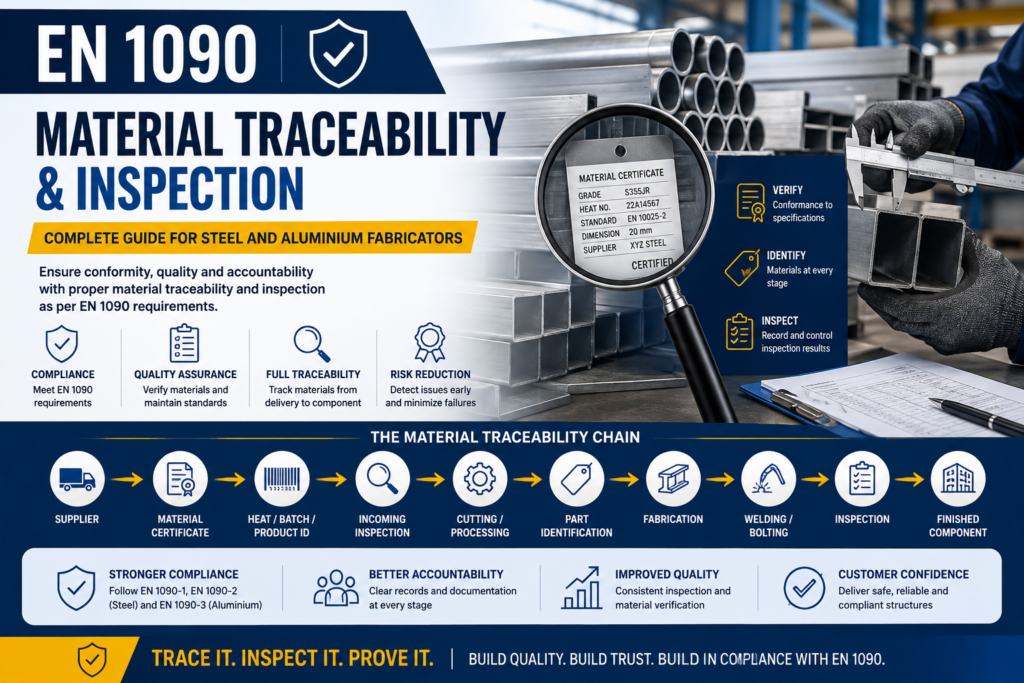
Material traceability and inspection are fundamental parts of EN 1090 compliance. A manufacturer must be able to demonstrate that the constituent products used in structural components conform to the specified requirements and can be correctly traced through production.
Under EN 1090-1 Clause 6.3.5, manufacturers are required to implement a written inspection procedure for checking and recording that constituent products conform to the specification and for tracing how they are used in component manufacture. EN 1090-1 also makes clear that the detailed traceability requirements come from EN 1090-2 for steel and EN 1090-3 for aluminium, and that the level of traceability depends on the execution class.
For manufacturers preparing for EN 1090 certification, this means that simply keeping material certificates in a folder is not enough. The manufacturer needs a controlled system connecting the material certificate, material identification, production process, inspection records and finished component.
What Is Material Traceability Under EN 1090?
Material traceability is the ability to establish a documented connection between a constituent product and the structural component in which it is ultimately used.
A simplified traceability chain looks like this:
Supplier
↓
Material Certificate
↓
Heat / Batch / Product Identification
↓
Incoming Inspection
↓
Cutting / Processing
↓
Part Identification
↓
Fabrication
↓
Welding / Bolting
↓
Inspection
↓
Finished Structural Component
The objective is to ensure that the manufacturer can identify what material was used, where it was used and whether it conformed to the applicable specification.
EN 1090-1 specifically requires written inspection procedures covering both conformity checking and traceability of constituent products.
Why Is Material Traceability Important?
Structural components are designed with specific material properties in mind.
For example, a structural drawing may specify a particular:
- Steel grade
- Aluminium alloy
- Temper
- Thickness
- Product standard
- Mechanical-property requirement
If the manufacturer substitutes the wrong material without appropriate control, the finished component may no longer correspond to the design specification.
Traceability provides evidence that the material used during fabrication corresponds to the material specified for the component.
It also helps when:
- A material defect is discovered
- A customer requests documentation
- An auditor samples a finished component
- A supplier issue is identified
- A non-conformity needs investigation
- A component needs to be repaired or replaced
EN 1090 Material Traceability Requirements
EN 1090-1 places the overall FPC responsibility on the manufacturer.
Clause 6.3.5 requires the manufacturer to have a written inspection procedure for:
- Checking constituent products against their specification
- Recording the inspection
- Tracing the products through component manufacture
The standard also states that the traceability requirements specified in EN 1090-2 and EN 1090-3 must be followed.
This distinction is important:
EN 1090-1 establishes the FPC requirement, while EN 1090-2 and EN 1090-3 provide the detailed execution requirements for steel and aluminium respectively.
Steel Material Traceability Under EN 1090-2
For structural steelwork, EN 1090-2 provides the technical execution requirements.
The manufacturer’s traceability system should be appropriate to the applicable execution class and project requirements.
Typical information that may need to remain identifiable includes:
- Material grade
- Product form
- Heat number
- Batch or cast identification
- Dimensions
- Material certificate
- Supplier
- Component/job identification
The manufacturer should establish a practical method of maintaining this identification during processing.
For example:
Steel plate received
→ Heat number recorded
→ Plate marked
→ Cutting performed
→ Pieces receive transferred identification
→ Pieces assigned to fabrication job
→ Finished component retains traceability
The exact method can vary between manufacturers, provided it achieves the required level of traceability.
Aluminium Material Traceability Under EN 1090-3
For aluminium structures, the applicable technical execution standard is EN 1090-3.
EN 1090-3:2019 covers aluminium structural components made from products including:
- Rolled sheet
- Strip
- Plate
- Extrusions
- Cold-drawn rod, bar and tube
- Forgings
- Castings
It also establishes requirements related to execution classes and links them to consequence classes.
The traceability requirements become particularly important at higher execution classes.
For example, EN 1090-3 specifies that for EXC3 and EXC4, constituent products are to be traceable at all stages of execution between delivery and incorporation into the structure.
For EXC2, EXC3 and EXC4, where different alloys and/or tempers of a constituent product are in circulation together, the standard requires identification of each material item by a mark identifying its alloy and temper.
This is particularly important for aluminium fabrication because visually similar materials may have substantially different alloy or temper designations.
Material Certificates and EN 1090
Material certificates provide important evidence about the constituent products supplied to the manufacturer.
Depending on the product and applicable requirements, documentation can include:
- Product identification
- Material designation
- Dimensions
- Chemical composition
- Mechanical properties
- Heat/batch information
- Manufacturing standard
- Inspection document type
- Supplier/manufacturer information
A manufacturer should not simply file certificates without checking them.
What Should Be Checked During Incoming Material Inspection?
A practical incoming inspection can include checking:
- Material identification
Does the material designation match the purchase order and component specification?
- Dimensions
Are thickness, width, length, diameter or section dimensions correct?
- Quantity
Has the correct quantity been received?
- Material certificate
Is the required inspection document available?
- Heat or batch number
Does the identification on the material correspond to the certificate?
- Physical condition
Is the material visibly damaged, corroded or otherwise unsuitable?
- Alloy/temper
For aluminium, does the material correspond to the specified alloy and temper?
- Product standard
Does the supplied product comply with the specified product standard?
- Identification
Can the material remain identifiable during production?
The exact checks should be defined by the manufacturer’s FPC and the applicable EN 1090/project requirements.
The incoming-material inspection process should establish that the certificate corresponds to the material actually received.
Material Certificate vs Material Identification
These are two different things.
A material certificate tells you about the supplied product.
Material identification allows you to connect that certificate to the physical material.
For example:
Certificate
Heat No. H12345
Steel Grade: Specified Grade
Thickness: 12 mm
The physical plate should have an identification system that allows the manufacturer to establish that the plate came from Heat No. H12345.
If the certificate is stored but the physical material cannot be connected to it, traceability has been broken.
How Should Material Identification Be Maintained?
There are several practical methods.
Depending on the material and production process, identification may involve:
- Stamping
- Paint marking
- Tags
- Labels
- Barcodes
- QR codes
- Production numbers
- Heat-number transfer
- Digital traceability systems
The chosen method should be appropriate for the product and should not compromise the component or violate applicable technical requirements.
For example, a manufacturer could use:
Material ID: ST-0245
linked to:
Heat No.: H12345
linked to:
Material Certificate: MTC-2026-015
linked to:
Production Order: PO-7845
linked to:
Component: C-104
This creates a traceable digital or documentary chain.
Traceability During Cutting
One of the most common practical problems occurs during cutting.
Imagine a plate arrives with a clearly marked heat number.
The plate is then cut into 30 individual components.
If the heat number is not transferred to the cut pieces, the manufacturer may no longer know which certificate belongs to which component.
Therefore, the traceability procedure should explain:
- How identification is transferred
- Who performs the transfer
- When it is performed
- How it is recorded
- How identification is checked
This is especially important where different grades or heats are processed simultaneously.
Traceability During Fabrication
Traceability should not stop after cutting.
The identification needs to remain connected to the component through relevant production stages.
For example:
Raw material
→ Cutting
→ Drilling
→ Forming
→ Assembly
→ Welding
→ Inspection
→ Painting
→ Final assembly
At each stage, the manufacturer should have a method of maintaining the required identification.
The exact traceability method will depend on the execution class, product type and applicable EN 1090 requirements.
What Happens If Material Identification Is Lost?
Lost identification should be treated as a traceability problem, not simply ignored.
The manufacturer should have a procedure for dealing with the situation.
- Possible actions may include:
- Stop further processing
- Identify the affected material
- Review production records
- Check available documentation
- Determine whether the material can be positively identified
- Raise a non-conformity where appropriate
- Establish disposition based on applicable requirements
- Re-establish identification only when adequately justified
Simply guessing the material grade or heat number is not an acceptable traceability method.
EN 1090 Material Inspection Process
A practical material inspection system can be divided into several stages.
Stage 1: Purchasing
The purchase order specifies:
- Material grade
- Product standard
- Dimensions
- Quantity
- Required inspection documentation
- Other project requirements
Stage 2: Receiving
The material arrives at the factory.
Stage 3: Incoming Inspection
The manufacturer verifies the material against the purchase and component requirements.
Stage 4: Certificate Verification
The material certificate is reviewed.
Stage 5: Identification
The material receives or retains the required identification.
Stage 6: Storage
Different grades, alloys, tempers and batches are controlled to prevent unintended mixing.
Stage 7: Production
Material identification is transferred/maintained through manufacturing.
Stage 8: Final Verification
The manufacturer confirms that required material traceability is available.
Material Storage and Segregation
Traceability can easily be lost if materials are stored without adequate identification.
For example, a fabrication shop may have:
- Multiple steel grades
- Different thicknesses
- Several heat numbers
- Different aluminium alloys
- Different aluminium tempers
If materials are stacked together without clear identification, the possibility of incorrect material selection increases.
A good storage system can use:
- Clearly identified storage locations
- Material tags
- Heat-number markings
- Alloy/temper markings
- Separate storage areas
- Digital inventory records
The storage procedure should be consistent with the traceability requirements applicable to the manufacturer.
EN 1090 Inspection and Test Plan
Material inspection should be connected to the manufacturer’s Inspection and Test Plan (ITP) or equivalent documented inspection controls.
An ITP can define:
| Stage | Inspection | Responsibility | Record |
|---|---|---|---|
| Material receipt | Grade and certificate | QC/Stores | Material Inspection Report |
| Identification | Heat/batch verification | Stores/QC | Traceability Record |
| Cutting | Identification transfer | Production | Cutting Record |
| Fabrication | Component verification | QC | Inspection Report |
| Welding | Weld inspection | QC/Welding Inspector | Weld Inspection Report |
| NDT | Required NDT | Qualified personnel | NDT Report |
| Final inspection | Component conformity | QC | Final Inspection Report |
The actual ITP should be adapted to the component and project requirements.
EN 1090 Component Specification and Inspection
EN 1090-1 requires manufacturing to be controlled using a component specification containing sufficient information to manufacture the component and evaluate its conformity.
The component specification should include the applicable execution class, and the manufacturer must implement a written inspection and test plan for checking and recording conformity.
This creates an important relationship:
Design information
↓
Component specification
↓
Material requirements
↓
Production
↓
Inspection and testing
↓
Conformity evidence
Therefore, material traceability should not be treated as an isolated stores activity. It is part of the overall component-control system.
How Execution Class Affects Traceability
Execution class is important because traceability requirements can vary.
The requirements are not simply:
“EN 1090 means everything must always have individual traceability.”
Instead, the required level depends on the applicable execution class and the relevant EN 1090 execution standard.
For aluminium, EN 1090-3 provides a clear example: EXC3 and EXC4 require traceability of constituent products through the execution stages, while other classes have different requirements.
For steel, the manufacturer should refer to the applicable requirements of EN 1090-2 for the project’s execution class.
This is why the manufacturer should establish the EXC before finalizing its traceability system.
Material Traceability for Welding Consumables
Material traceability is not limited to structural steel and aluminium.
Where applicable, welding consumables also need controlled handling.
A manufacturer may need to control:
- Consumable type
- Batch/lot identification
- Storage
- Drying/baking where applicable
- Issue to welders
- Return procedures
- Expiry/storage conditions
- Traceability to welding operations where required
This can be integrated into the welding-control procedure.
A strong system can connect:
Consumable batch → WPS → Welder → Component → Welding record
Inspection of Bolting Materials
For structural bolting, the manufacturer should also establish controls appropriate to the specified bolting system.
Depending on the project, this may include:
- Bolt identification
- Bolt grade/class
- Lot/batch information
- Certificates
- Nut and washer compatibility
- Storage
- Installation requirements
- Inspection records
The applicable requirements should be determined from EN 1090-2 and the project specification.
Inspection of Finished Components
Material traceability is only one part of final conformity.
The finished component may also need inspection for:
- Dimensions
- Geometry
- Weld quality
- Bolt installation
- Surface condition
- Coating
- Marking
- Identification
- Required NDT
- Other project-specific characteristics
The final inspection should be linked to the component specification and applicable inspection plan.
EN 1090 Material Traceability Audit: What Will an Auditor Look For?
During an EN 1090 audit, an auditor may select a finished component and work backwards through the records.
For example:
Finished Component C-104
↓
What material was used?
↓
Material ID ST-0245
↓
What is its heat/batch?
↓
Heat H12345
↓
Where is the certificate?
↓
Material Certificate MTC-2026-015
↓
Was the material inspected?
↓
Incoming Material Inspection Record
↓
Was it used according to the component specification?
↓
Production/Traceability Records
This is a practical demonstration of whether the FPC system actually works.
The auditor may also compare documented procedures with actual shop-floor practices.
EN 1090 certification assessments include review of FPC and production-facility controls; certification bodies such as RINA describe initial inspection and ongoing surveillance of the production facility and FPC.
Common Material Traceability Non-Conformities
- Missing material certificates
The manufacturer cannot provide the required certificate for material used in a component.
Corrective action: Strengthen receiving controls and certificate verification.
- Heat number does not match the certificate
The physical material identification and certificate contain different information.
Corrective action: Investigate the discrepancy and control the affected material until conformity is established.
- Identification disappears after cutting
The original plate is traceable, but individual cut parts are not.
Corrective action: Establish a controlled identification-transfer procedure.
- Different materials are mixed
Different grades, alloys or tempers are stored together without sufficient identification.
Corrective action: Improve segregation, identification and storage controls.
- Traceability records are incomplete
The manufacturer has material certificates but cannot demonstrate which component used which material.
Corrective action: Connect material IDs with production orders and component records.
- Uncontrolled substitutions
Production uses a different material from the specified material without documented evaluation/approval.
Corrective action: Establish a material-substitution and non-conformity procedure.
- Damaged or illegible markings
Material identification becomes unreadable during production.
Corrective action: Define acceptable marking methods and verification points.
EN 1090 Material Traceability Checklist
Use the following checklist before an EN 1090 audit.
Purchasing
- Material specifications are clearly defined
- Purchase orders identify applicable requirements
- Suppliers provide required documentation
Receiving
- Incoming materials are inspected
- Certificates are checked
- Material grade is verified
- Dimensions are verified where required
- Heat/batch numbers are recorded
Identification
- Material is physically identified
- Identification corresponds to documentation
- Different grades are segregated
- Aluminium alloy/temper identification is controlled where applicable
Production
- Material identification survives cutting
- Identification is transferred when required
- Components remain traceable
- Production records connect materials to components
Inspection
- Incoming inspection records are maintained
- Inspection and test plans are implemented
- Final inspection is documented
- NDT records are available where required
Non-Conformity
- Unidentified material is controlled
- Wrong material is prevented from unintended use
- Material discrepancies are documented
- Corrective actions are recorded
Audit Preparation
- Material certificates can be retrieved quickly
- Finished components can be traced backwards
- Procedures match actual factory practices
- Personnel understand the traceability process
Practical Example of an EN 1090 Traceability System
Consider a structural steel beam manufactured for a project.
Step 1 – Purchase
The company orders the required steel grade and section.
Step 2 – Receive
The material arrives with its required inspection documentation.
Step 3 – Inspect
The QC team checks:
- Grade
- Section
- Dimensions
- Certificate
- Heat number
- Step 4 – Identify
The beam is assigned an internal material ID:
MAT-2026-0087
Step 5 – Production
The beam is assigned to:
Project PZ-26015
Step 6 – Fabrication
Cutting and fabrication records reference:
MAT-2026-0087
Step 7 – Welding
The applicable WPS and welding records reference the relevant component.
Step 8 – Inspection
The component receives the required dimensional and welding inspection.
Step 9 – Final release
The final documentation connects the finished component to its material and inspection records.
This creates a traceability chain that can be demonstrated during an audit.
How to Improve Material Traceability Using Digital Systems
Manufacturers do not necessarily need sophisticated software.
A well-designed spreadsheet can already provide significant control.
For example:
| Material ID | Heat No. | Grade | Certificate | Project | Component |
|---|---|---|---|---|---|
| MAT-001 | H12345 | Specified Grade | MTC-001 | PZ-2601 | C-001 |
| MAT-002 | H12346 | Specified Grade | MTC-002 | PZ-2601 | C-002 |
Larger manufacturers can use:
- ERP systems
- Barcode systems
- QR codes
- Digital material registers
- Production-management software
- Document-management systems
The technology is secondary.
The essential requirement is that the system reliably maintains the required traceability.
Material Traceability vs Material Inspection
These terms are related but not identical.
Material Inspection
Answers:
Does the material conform to the specified requirements?
Material Traceability
Answers:
Can we prove which material was used in this component?
You need both.
For example, a manufacturer may have correctly inspected a steel plate but later lose its heat-number identification.
The material may have been conforming when received, but the manufacturer can no longer demonstrate traceability.
Frequently Asked Questions
Is material traceability mandatory under EN 1090?
Yes, EN 1090-1 requires manufacturers to establish written inspection procedures for checking constituent products and tracing their correct use in component manufacture. The detailed traceability requirements are provided by EN 1090-2 and EN 1090-3 and depend on execution class.
Do I need a material certificate for every component?
The documentation required depends on the constituent product, execution class, applicable standard and project requirements. Manufacturers should not assume that one generic certificate arrangement applies to every product.
Is a 3.1 certificate always required?
Not universally. The required inspection document depends on the applicable product and execution-class requirements. For example, EN 1090-3 specifies different inspection-document requirements by execution class for aluminium constituent products.
What happens if I lose material traceability?
The affected material/component should be controlled and evaluated according to the manufacturer’s non-conformity procedure and applicable requirements. The manufacturer should not simply assume the material identity.
Is traceability the same for EXC1, EXC2, EXC3 and EXC4?
No. Traceability requirements can vary according to execution class and the applicable execution standard. EN 1090-1 explicitly notes that traceability requirements in EN 1090-2 and EN 1090-3 depend on execution class.
Does EN 1090 require digital traceability software?
No general requirement means that a specific software system must be used. A paper-based or spreadsheet-based system may be suitable if it effectively meets the applicable requirements and is properly controlled.
Does traceability apply to aluminium?
Yes. EN 1090-3 contains specific requirements for traceability of aluminium constituent products, including enhanced requirements for higher execution classes.
Conclusion
Material traceability and inspection are essential elements of EN 1090 compliance.
A manufacturer needs more than a collection of material certificates. It needs a controlled process that demonstrates:
Correct material → Correct identification → Correct component → Correct production → Correct inspection → Correct records
EN 1090-1 requires the manufacturer to establish written procedures for checking constituent products and tracing their use in component manufacture. The detailed requirements then come from the relevant execution standard—EN 1090-2 for steel and EN 1090-3 for aluminium—with requirements influenced by the applicable execution class.
For manufacturers, the practical objective should be simple:
At any point during an EN 1090 audit, you should be able to select a finished component and trace it back to the material, certificate, production records and inspection evidence that support its conformity.
A strong material-control and inspection system not only supports EN 1090 certification—it also gives manufacturers better control over production quality, non-conformities and customer documentation.
If your company is preparing for EN 1090 certification, PZVAR can help review your material traceability, inspection procedures, FPC documentation and audit readiness against the applicable requirements.