
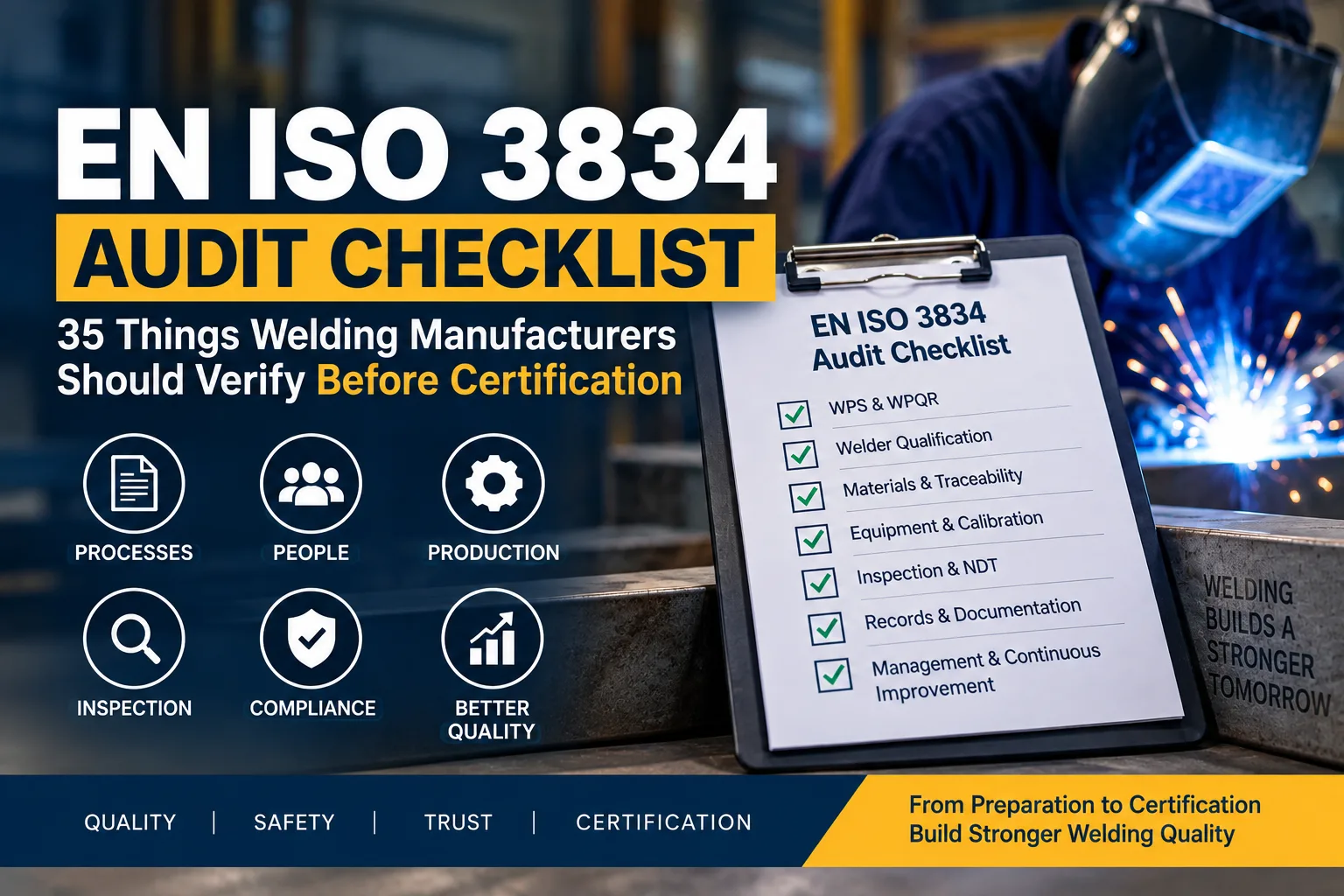
EN ISO 3834
CHECKLIST
DOCUMENTATION
07 Sep 2026
EN ISO 3834 Audit Checklist: 35 Things Welding Manufacturers Should Verify Before Certification
By Editorial Team
Table Of Contents
- What Does EN ISO 3834 Certification Require?
- EN ISO 3834 Audit Checklist: 35 Verification Points
- EN ISO 3834 Pre-Audit Checklist: Quick Review Table
- Common EN ISO 3834 Audit Findings to Watch For
- How to Prepare for an EN ISO 3834 Certification Audit
- EN ISO 3834 Certification: Documentation vs. Implementation
- Final Takeaway
Related Blogs
SEP
08
ISO 3834 LATEST EDITION ISO 3834 2021 REVISION ISO 3834-6 : 2024 ISO 3834 Latest Edition 2026
AUG
24
WELDING QUALITY CERTIFICATION COST CERTIFICATION COST ISO 3834 Certification Cost in India
JULY
30
EN ISO 3834 CERTIFICATION WELDING MATERIALS EN ISO 3834 Certification Requirements
See Also.....
For welding manufacturers, EN ISO 3834 certification is more than a quality-management exercise. It demonstrates that a company has the processes, personnel, documentation, and controls necessary to consistently produce welded products that meet specified requirements.
However, many manufacturers approach certification audits by focusing heavily on documentation while overlooking practical shop-floor controls.
That can create avoidable nonconformities, audit findings, and certification delays
A structured EN ISO 3834 audit checklist helps manufacturers identify gaps before the certification audit and verify that their welding quality system works in practice—not just on paper.
This checklist covers 35 important areas that welding manufacturers should review before an EN ISO 3834 audit.
What Does EN ISO 3834 Certification Require?
The EN ISO 3834 series specifies comprehensive quality requirements for fusion welding of metallic materials.
Depending on the complexity and application of the welded product, manufacturers may work to different quality levels within the ISO 3834 series:
- ISO 3834-2: Comprehensive quality requirements
- ISO 3834-3: Standard quality requirements
- ISO 3834-4: Elementary quality requirements
- ISO 3834-5: Documents required to claim conformity with ISO 3834-2, ISO 3834-3 or ISO 3834-4
The appropriate level depends on factors such as product requirements, applicable standards, contractual requirements, and welding complexity.
EN ISO 3834 Audit Checklist: 35 Verification Points
Use the following checklist as a pre-audit readiness tool.
- Welding Quality Requirements Are Defined
Verify that the organization has clearly identified the welding quality requirements applicable to its products, projects, and customers.
Requirements should be translated into practical controls throughout the manufacturing process.
- Applicable Standards Are Identified
Check whether applicable welding, product, material, inspection, and regulatory standards are identified and controlled.
Expired or obsolete standards should not remain in active production documentation.
- Contract and Technical Requirements Are Reviewed
Before production begins, verify that customer specifications, drawings, welding requirements, inspection requirements, and acceptance criteria are reviewed.
Changes should also be communicated to relevant personnel.
- Welding Coordination Responsibilities Are Assigned
The manufacturer should have clearly defined responsibility for welding coordination.
The responsible welding coordinator should have appropriate competence for the company’s activities and applicable requirements.
- Welding Personnel Competence Is Verified
Check whether personnel involved in welding activities have the required education, training, experience, and technical competence.
This should include welding coordinators, welders, welding operators, inspectors, and other relevant personnel.
- Welder Qualifications Are Valid
Verify that welders and welding operators hold valid qualifications for the processes and applications they perform.
Check:
- Welding process
- Material group
- Thickness
- Welding position
- Joint type
- Product form
- Qualification validity
- Welder Qualification Records Are Controlled
Qualification certificates should be traceable to individual welders and maintained as controlled records.
Expired or incorrectly scoped qualifications should be identified before the audit.
- WPS Documents Are Available
Verify that approved Welding Procedure Specifications (WPSs) are available at the point of use.
Shop-floor personnel should be able to access the correct WPS without relying on uncontrolled copies.
- WPS Parameters Match Production
Compare actual welding conditions with the applicable WPS.
Important parameters may include:
- Welding current
- Voltage
- Travel speed
- Welding position
- Preheat
- Interpass temperature
- Shielding gas
- Filler material
A WPS should not simply exist—it should reflect what is actually being performed.
- WPQRs Support the WPS
Verify that applicable Welding Procedure Qualification Records (WPQRs) or equivalent procedure qualification evidence support the WPS.
The qualification should cover the essential variables applicable to production.
- Welding Procedure Qualifications Are Within Their Valid Scope
Check whether qualified procedures cover the actual:
- Material
- Thickness
- Diameter
- Welding process
- Joint configuration
- Position
- Filler material
- Heat input requirements
- Welding Consumables Are Controlled
Verify that filler metals and other welding consumables are properly specified, purchased, stored, issued, and controlled.
The consumable used should correspond to the applicable WPS and technical requirements.
- Consumable Storage Conditions Are Suitable
Check storage conditions for moisture-sensitive consumables and consumable manufacturers’ requirements.
Where applicable, verify:
- Drying
- Holding temperatures
- Re-baking
- Exposure control
- Issue and return procedures
- Consumable Identification Is Maintained
Traceability should be maintained from the consumable received through storage and, where required, to the welded component.
Mix-ups between different grades or classifications should be prevented.
- Base Material Identification Is Maintained
Verify that incoming materials remain identifiable throughout production.
Material identification should not disappear after cutting, forming, machining, or other processing.
- Material Certificates Are Available
Check whether required material certificates are available and linked to the relevant material or product.
Where EN 10204 documentation is specified, verify that the required certificate type has been supplied and controlled.
- Material Traceability Is Effective
Test traceability using an actual production item.
Ask:
Can the manufacturer trace this component back to its material certificate?
If the answer is unclear, the traceability system requires attention.
- Welding Equipment Is Suitable
Verify that welding equipment is appropriate for the processes and products being manufactured.
Equipment should be capable of achieving the parameters specified by the applicable welding procedure.
- Welding Equipment Is Maintained
Check maintenance records and the physical condition of welding equipment.
Look for issues involving:
- Welding cables
- Torches
- Earth connections
- Gas systems
- Wire feeders
- Power sources
- Control systems
- Measuring and Monitoring Equipment Is Controlled
Verify that equipment used for measuring or monitoring welding-related parameters is appropriately controlled.
Where calibration is required, records should demonstrate current calibration status.
- Preheating Requirements Are Controlled
Where preheating is specified, verify that:
- Required temperatures are defined
- Suitable measuring equipment is available
- Operators understand the requirements
- Records are maintained where required
- Interpass Temperature Is Controlled
For applicable materials and procedures, confirm that interpass temperatures are monitored and maintained within specified limits.
This is particularly important where excessive heat can affect metallurgical properties.
- Joint Preparation Is Verified
Inspect joint preparation before welding.
Check:
- Joint geometry
- Root gap
- Bevel angle
- Cleanliness
- Alignment
- Surface condition
The preparation should conform to the applicable drawing and WPS.
- Welding Environment Is Controlled
Verify that environmental conditions do not adversely affect welding quality.
Depending on the application, this can include protection against:
- Wind
- Moisture
- Rain
- Excessive humidity
- Contamination
- Inadequate temperature
- Tack Welding Is Controlled
Temporary welds and tack welds should follow appropriate procedures.
Verify that tack welders are qualified where required and that tack welds meet specified quality requirements.
- Welding Sequence Is Defined Where Necessary
For critical fabrications, verify whether welding sequence and distortion-control requirements have been defined.
Poor sequencing can result in:
- Distortion
- Residual stresses
- Dimensional deviations
- Rework
- In-Process Inspection Is Defined
Verify that inspection requirements are established at appropriate manufacturing stages.
Inspection should not be limited to the final product.
- Visual Testing Is Properly Controlled
Check whether visual inspection is performed by competent personnel using defined acceptance criteria.
Inspectors should know what constitutes an acceptable weld and what requires corrective action.
- NDT Requirements Are Clearly Defined
Where non-destructive testing is required, verify that the applicable method, extent, acceptance criteria, and personnel competence are defined.
Methods may include:
- VT
- PT
- MT
- UT
- RT
- NDT Personnel Qualifications Are Current
Verify that NDT personnel have appropriate qualifications and certifications for the techniques they perform.
Certification records should be current and traceable.
- Weld Identification Is Maintained
Welds should be identifiable where traceability is required.
The manufacturer should be able to determine relevant information such as:
- Welder
- Welding procedure
- Material
- Inspection status
- Production batch
- Nonconforming Welds Are Controlled
Verify that defective or nonconforming welds are identified and controlled.
The system should define how the organization handles:
- Repair
- Rework
- Re-inspection
- Acceptance by concession
- Rejection
- Weld Repairs Are Controlled
Repairs should not be performed informally.
Where required, repair procedures should define the appropriate welding method, inspection requirements, and acceptance criteria.
- Welding Quality Records Are Complete
Review a sample production file from start to finish.
Depending on the applicable requirements, records may include:
- WPS
- WPQR
- Welder qualification
- Material certificates
- Consumable records
- Inspection reports
- NDT reports
- Repair records
- Final acceptance documentation
- Internal Audit and Corrective Action Are Effective
Before certification, verify that the organization has identified and addressed weaknesses through internal audits or other systematic reviews.
Corrective actions should address the root cause, not merely correct the immediate problem.
For example:
Weak approach: Replace one missing certificate.
Better approach: Determine why certificates are repeatedly missing and improve the document-control or purchasing process.
EN ISO 3834 Pre-Audit Checklist: Quick Review Table
| No. | Area to Verify | Status | |
|---|---|---|---|
| 1 | Welding quality requirements | ☐ | |
| 2 | Applicable standards | ☐ | |
| 3 | Contract review | ☐ | |
| 4 | Welding coordination | ☐ | |
| 5 | Personnel competence | ☐ | |
| 6 | Welder qualifications | ☐ | |
| 7 | Qualification records | ☐ | |
| 8 | WPS availability | ☐ | |
| 9 | WPS production parameters | ☐ | |
| 10 | WPQR support | ☐ | |
| 11 | Procedure qualification scope | ☐ | |
| 12 | Consumable control | ☐ | |
| 13 | Consumable storage | ☐ | |
| 14 | Consumable identification | ☐ | |
| 15 | Base material identification | ☐ | |
| 16 | Material certificates | ☐ | |
| 17 | Material traceability | ☐ | |
| 18 | Welding equipment | ☐ | |
| 19 | Equipment maintenance | ☐ | |
| 20 | Measuring equipment | ☐ | |
| 21 | Preheat control | ☐ | |
| 22 | Interpass temperature | ☐ | |
| 23 | Joint preparation | ☐ | |
| 24 | Welding environment | ☐ | |
| 25 | Tack welding | ☐ | |
| 26 | Welding sequence | ☐ | |
| 27 | In-process inspection | ☐ | |
| 28 | Visual testing | ☐ | |
| 29 | NDT requirements | ☐ | |
| 30 | NDT personnel | ☐ | |
| 31 | Weld identification | ☐ | |
| 32 | Nonconforming welds | ☐ | |
| 33 | Weld repairs | ☐ | |
| 34 | Quality records | ☐ | |
| 35 | Internal audit & corrective action | ☐ |
Common EN ISO 3834 Audit Findings to Watch For
Although every manufacturer is different, several weaknesses frequently become visible during welding quality audits.
Documentation Does Not Match Actual Production
A WPS may specify one set of parameters while welders use different settings on the shop floor.
Expired Qualifications
Welder or NDT certificates may have expired without the production team noticing.
Weak Traceability
Material certificates exist, but there is no reliable connection between the certificate and the finished component.
Poor Consumable Control
Consumables may be stored incorrectly or issued without adequate identification.
Incomplete Inspection Records
Inspection may be performed correctly, but evidence of the inspection is missing.
Uncontrolled Repairs
Weld repairs may be performed without an approved procedure or documented re-inspection.
Corrective Actions That Treat Symptoms
Organizations sometimes close audit findings by fixing individual errors without addressing the process that caused them.
How to Prepare for an EN ISO 3834 Certification Audit
A strong pre-audit preparation process should follow the actual manufacturing workflow, rather than simply checking whether documents exist.
A practical approach is:
Contract Review → Material → WPS/WPQR → Welder → Consumables → Welding → Inspection → NDT → Repair → Final Records
Select a completed production order and follow it from beginning to end.
Ask:
Can we prove that every critical welding activity was performed according to the applicable requirements?
If the answer is yes, your system is likely much better prepared for the certification audit.
If the answer is “we normally do this, but we don’t have the record,” that gap should be addressed before the auditor identifies it.
EN ISO 3834 Certification: Documentation vs. Implementation
One of the most important principles for manufacturers is that certification readiness is not achieved by documentation alone.
A company may have excellent procedures but still experience audit findings if employees do not follow them.
Conversely, experienced welders may produce high-quality welds while the organization lacks the documented controls necessary to demonstrate conformity.
The objective is therefore to establish alignment between:
Requirements → Procedures → Personnel → Production → Inspection → Records
That alignment is what makes a welding quality system robust
Final Takeaway
An EN ISO 3834 audit checklist can help welding manufacturers identify gaps before the certification audit and reduce the risk of preventable nonconformities.
The 35 checks above cover the critical areas manufacturers should review, including welding coordination, WPS/WPQR, welder qualification, materials, consumables, equipment, welding parameters, inspection, NDT, traceability, repairs, records, and corrective action.
Most importantly, don’t treat the checklist as a paperwork exercise.
Walk onto the shop floor. Pick a real welded product. Trace it from material receipt to final inspection.
If the documentation, personnel qualifications, welding procedures, production controls, inspection results, and traceability all connect correctly, you are in a much stronger position for your EN ISO 3834 certification audit.