
ISO 9606
GUIDE
CERTIFICATION
Welder Certification (ISO 9606): Complete Guide to Testing, Certification and Qualification range (2026)
By Technical Editorial Team
9 Min Read
8 Aug 2026
Table Of Contents
- What is ISO 9606 Welder Certification?
- Why Manufacturers Need Qualified Welders?
- ISO 9606 Welder Qualification Process
- Qualification Variables
- Qualification Range
- Validity & Renewal
- Relationship Between WPS, WPQR & Welder Qualification
- Common Mistakes During Welder Qualification
- Welder Qualification Records
- Industries Using Qualified Welders
- ISO 9606 and Welding Quality Management
- Conclusion
- Frequently Asked Questions
Key Takeaways
Qualified Welders
Verified Competence
Recognized Qualification
International Recognition
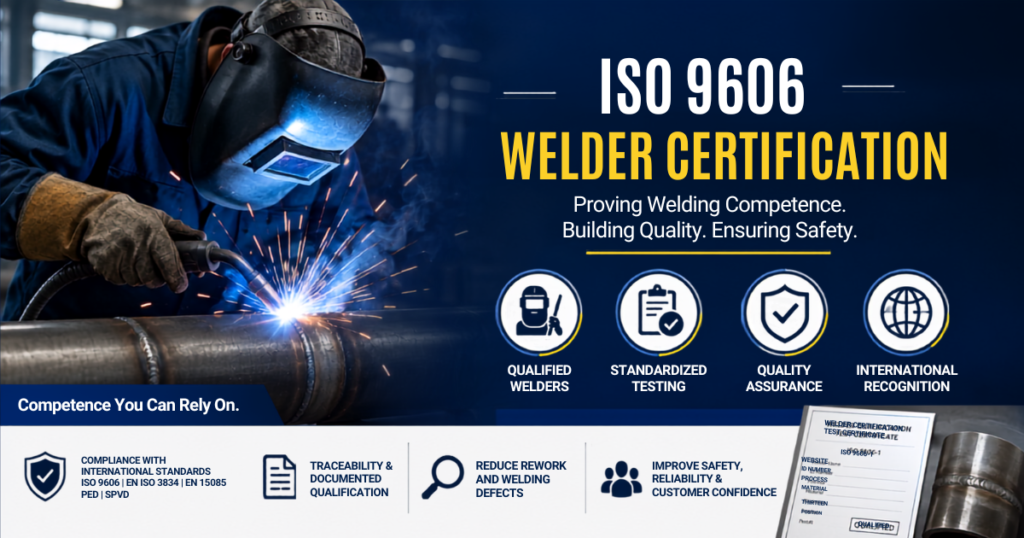
ISO 9606 is a set of international standards used to test and qualify welders who do fusion welding.These standards set out the rules for showing that a welder can make a good weld under certain conditions.
For companies that make things like machinery, pressure vessels, steel structures, rail systems, energy equipment, heavy industry products, and other welded items, having skilled welders is key to maintaining a strong quality control system.
The qualification process involves a real welding test done under set conditions.
After the test, there are checks and inspections carried out.The welder’s qualification is valid within the limits set by the specific part of ISO 9606 and the conditions noted during the test.
What is ISO 9606 Welder Qualification?
ISO 9606-1:2012 sets out the rules for testing welders who do fusion welding on steel.Other parts of the ISO 9606 series cover different materials.
This test shows that a welder can actually make a weld that meets the required standards.
An ISO 9606 qualification is not the same as just having a training record or showing up for a class.
It is about how well a welder can do the job in real life, and it depends on specific welding factors and what the welder is allowed to do.
A welder’s qualification can cover different conditions like:
– The welding method used
– The type of product being welded
– The kind of joint
– The main material being used
– The welding materials
– The thickness of the material
– The outside size of the pipe
– The position of the weld
– The specific details of the weld
The exact conditions and what is allowed depend on which part of ISO 9606 is being used and what test was done.
Why is Welder Qualification important?
The quality of a welded product depends on more than just the welding method—it also depends on the skill and ability of the person doing the welding.
A qualified welder has proof that they can perform the required welding tasks under specific test conditions.
Welder qualification is important for:
– Keeping welding quality consistent
– Managing welding processes effectively
– Minimizing welding problems
– Tracking the production process
– Following required welding standards
– Meeting customer and project needs
– Conducting welding quality checks
– Maintaining proper manufacturing records
However, just having a qualified welder doesn’t guarantee that every weld in production will be perfect.
To ensure quality, production welding must follow proper procedures, use approved materials and supplies, include proper inspections, and take place under the right conditions.
| Without Qualified Welders | With Qualified Welders |
|---|---|
| Higher risk of weld defects | Consistent weld quality |
| Increased rework | Improved productivity |
| Customer concerns | Greater customer confidence |
| Audit observations | Better documented compliance |
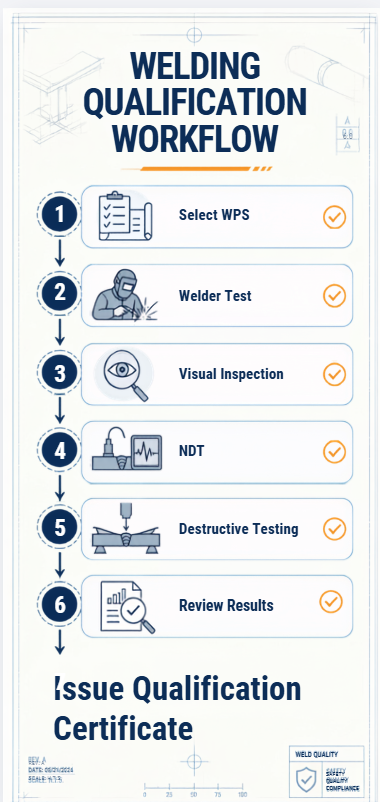
ISO 9606 Welder Qualification Process
The process for qualifying a welder usually happens in a clear, step-by-step way.
1. Find the Right Standard
First, figure out which part of ISO 9606 applies. This depends on the type of material being welded and how it’s used.
For steel, the right part is ISO 9606-1. Other factors like the product standard, project specs, customer needs, or rules from regulators might add more requirements.
2. Choose the Welding Method
Before testing, pick a proper Welding Procedure Specification (WPS) or other correct welding plan. The WPS tells you what conditions the test should follow.
3. Decide on the Variables
Before the test, list the important factors, such as:
– The welding method
– The type of product
– The joint shape
– The base material
– The welding rod or filler metal
– The thickness
– The pipe size, if needed
– The welding position
– The welding technique
– Any other factors from the standard
4. Make the Test Sample
Prepare the test piece according to the joint setup and size set out in the plan. Make sure the material and the welding rod can be traced back to the qualification records.
5. Do the Welding Test
The welder performs the test using the set conditions.
Keep a record of key details like:
– The welding method
– The welding position
– The welding rod used
– The material type
– The thickness
– The pipe size, if needed
– The welding settings
– The preheat and between-pass conditions, if they apply
6. Check and Test the Sample
After the weld is done, check the sample according to the required tests. Depending on the qualification rules, some tests might include:
– Visual inspection
– X-ray testing
– Ultrasonic testing, if needed
– Bend tests
– Fracture tests
– Macro testing
– Other tests required by the standard
Remember, the testing needs don’t have to be the same for every ISO 9606 qualification.
7. Review the Results
Look at all the test and check results to see if they meet the acceptance rules. If everything is okay, the welder’s qualification can be documented.
8. Write the Qualification Report
The record should show all the test conditions, results, and the range of what the qualification covers. It needs to clearly link the welder, the test, the welding conditions, the checks, and the qualification result.
ISO 9606 Qualification Variables
A welder isn’t automatically able to work on every type of welding job just because they passed one test.Their qualification is only good for specific conditions.
This qualification is limited to a certain range of conditions.
Important factors that affect this range include:
Welding Process
The type of welding used during the test determines the qualification range.
For example:
– 111: Manual Metal Arc Welding
– 121: Submerged Arc Welding
– 131: MIG welding
– 135: MAG welding
– 136: MAG welding with flux-cored wire
– 141: TIG welding
You should check the relevant ISO 9606 standard to find the right process designations and qualification rules.
Product Type
The test may be done on plates, pipes, or other materials.
The qualification range for each product type is based on the standard that applies.
Joint Type
A welder’s qualification can cover butt welds, fillet welds, or other joint types.
The qualification range depends on what type of joint was tested and the standard used.
Parent Material
The type and group of material used during testing are key factors.
The qualified material range must be based on the ISO 9606 standard and the material used in the test.
Material Thickness
The thickness of the test piece affects the qualification range.
Being qualified for one thickness doesn’t mean you’re qualified for all thicknesses.
Pipe Outside Diameter
For pipe welding, the size of the test piece can influence the qualification range.
The correct diameter range is found in the qualification standard.
Welding Position
The position in which the weld was made is also important.
Different positions like PA, PB, PC, PD, PE, PF, and PG may have different qualification rules based on the test and the standard used.
ISO 9606 Qualification Range
The qualification range shows the welding conditions where a welder is considered qualified.
For example, qualification is checked based on:
Process → Type of Product → Type of Joint → Material → Thickness → Diameter → Position → Other Relevant Factors
Before putting a welder to work on a specific welding task, the qualification certificate or record should be checked.
A welder should not be used for welding under conditions that are not covered by their qualification unless it is confirmed that they need extra training or certification.
Welder Continuity and Validity
ISO 9606 qualification needs to be looked at along with the rules for keeping welding work going and proving that the qualification is still good.
A qualification isn’t always valid forever without any conditions.
The part of ISO 9606 that applies says what needs to be done to keep the qualification up to date and prove it’s still valid.
Employers or the people in charge should keep proper records showing that the welder has kept up with their welding work when needed.
These records about continuity should be kept in a way that can be traced back to the correct welder and welding method.
If the rules are no longer met or if there’s a new welding situation that isn’t covered by the existing qualification, then more qualification or requalification might be needed.
Always check the exact rules for how long the qualification is valid and how to confirm it against the right version of the ISO 9606 standard and any other project or certification rules that apply.
Relationship Between WPS, WPQR & Welder Qualification
WPS, WPQR, and welder qualification are connected but each has a different role.
WPQR stands for Welding Procedure Qualification Record.
It keeps a record of the welding conditions and test results from a test done to qualify a welding method.It shows that the welding method meets the required standards.
WPS is the Welding Procedure Specification.
It explains the exact welding conditions and settings that should be used during actual welding work.
ISO 9606 is a standard that checks if a welder can make a good weld under certain conditions.
It shows the welder’s skill level.
The way these things work together is:
WPQR → Approved Welding Method → WPS → Real Welding Work
And
Welder Qualification → Shows the welder’s ability to do the job well.
So, a qualified WPS and a qualified welder focus on different parts of the welding process.
Together, these steps help manufacturers make better welds, keep the welding process consistent, and meet standards like EN ISO 3834 and others like EN 15085.
| Document | Purpose | Why It Matters |
|---|---|---|
| WPQR | Qualifies and validates the welding procedure | Demonstrates the procedure can produce acceptable welds |
| WPS | Provides approved welding instructions | Ensures consistent production welding |
| ISO 9606 Welder Qualification | Qualifies the welder's practical skills | Confirms the welder can perform welding within the approved qualification range |
Common Welder Qualification Mistakes
Several mistakes can happen in the process of qualifying a welder.
Common issues include:
– Wrong identification of the material
– Wrong welding method listed
– Wrong welding position used
– Wrong thickness or diameter values
– Missing or incomplete test coupon details
– Wrong description of welding materials used
– No records showing where the welder’s work came from
– Incomplete reports on the testing done
– Wrong range of qualifications listed
– Not keeping proper records over time
– Using a welder who isn’t qualified for the job
– Discrepancies between the test record and the qualification document
These problems can impact how valid and trackable the welder’s qualification documents are.
Welder Qualification Records
A controlled welder qualification record should have enough information to show that the welder is qualified.
Depending on the rules that apply, the record might include:
– The welder’s name or ID
– Qualification number
– Type of welding process used
– Type of material
– Thickness of the material
– Pipe size, if relevant
– Type of joint
– Welding position
– Details about the welding materials used
– Information about the test coupon
– Welding settings and parameters
– Results of the tests and examinations
– The range of qualifications
– Date when the test was done
– The standard that was followed
– Details about the examiner, testing organization, or certification, if needed
It’s important to keep track of how the welder, test coupon, welding method, test reports, and qualification document are connected.
Industries Using Qualified Welders
ISO 9606 is a standard used in many industries where it’s important to have high quality and safe welding.Welders who are qualified under this standard can help manufacturing companies show that their welding skills are good and that the products made are consistent in quality.
Industries that need qualified welders include:
– Making railway vehicles and parts
– Producing pressure equipment
– Fabricating structural steel
– Heavy engineering projects
– Building industrial machinery
– Setting up oil and gas facilities
– Power generation systems
– Renewable energy projects
– Ship building and marine structures
– Process industry applications
ISO 9606 and Welding Quality Management
Welder qualification is part of a larger welding quality system.
For companies following EN ISO 3834, having skilled and qualified welders is a key part of managing welding quality.
For railway work under EN 15085, it’s also important to look at the necessary qualifications for welders, along with the proper welding coordination and production standards.
Before setting qualification rules, it’s important to know which product and welding standards apply.
Conclusion
ISO 9606 welder qualification gives proof that a welder can make a good weld under certain conditions.This qualification is based on real welding work and has limits depending on factors like the welding method, material, thickness, type of product, size, kind of joint, and welding position.
A good welding quality system shows clear links between:
Welding Procedure → WPS → WPQR → Welder Qualification → Actual Welding → Testing and Inspection → Traceability
Having proper qualification records, ongoing records, correct WPS documents, and controlled production conditions is important for keeping welding quality consistent and showing that it meets the necessary standards.
Frequently Asked Questions
What is ISO 9606 Welder Certification?
ISO 9606 Welder Certification is an internationally recognized qualification that verifies a welder’s practical ability to produce quality welds under specified welding conditions.
Who needs ISO 9606 welder qualification?
It is commonly required by manufacturers in industries such as railway, structural steel, pressure equipment, heavy engineering, and industrial fabrication.
What is the difference between WPS, WPQR, and Welder Qualification?
A WPS provides welding instructions, a WPQR validates the welding procedure, and ISO 9606 Welder Qualification confirms the welder’s competence to follow the approved procedure.
What tests are carried out during welder qualification?
Depending on the qualification requirements, testing may include visual inspection, bend testing, radiographic testing (RT), ultrasonic testing (UT), fracture testing, or macro examination.
How long is an ISO 9606 welder qualification valid?
The qualification remains valid when continuity requirements are maintained and confirmed in accordance with the applicable ISO 9606 standard.
Which industries commonly require qualified welders?
Industries include railway, pressure equipment, structural steel, oil and gas, power generation, heavy engineering, and industrial manufacturing.
How does ISO 9606 support welding quality?
It provides a standardized method for qualifying welders, helping manufacturers maintain consistent welding quality and documented competence.
Ready to Qualify Your Welders?
Show your welding skills by getting ISO 9606 certification and build trust in your manufacturing methods with a globally accepted certificate.