
ISO 9712
RE-PREPRATION
COMMON MISTAKES
03 Nov 2026
ISO 9712 Examination Failure: Common Mistakes, Retake Requirements and How to Prepare for Your Next Attempt
By Editorial Team
Table Of Contents
- What Happens If You Fail an ISO 9712 Examination?
- Common Reasons for ISO 9712 Exam Failure
- ISO 9712 Retake Requirements: How Many Attempts Are Allowed?
- What If You Fail Twice?
- Written Examination vs Practical Examination Failure
- How to Prepare for Your Next ISO 9712 Examination
- A Simple ISO 9712 Examination Retake Flowchart
- How Your NDT Method Affects Examination Preparation
- Common ISO 9712 Certification Mistakes to Avoid
- Conclusion
Related Blogs
SEP
05
Do You Need a Level 3 NDT Inspector or Can a Level 2 Handle Your Quality System?
SEP
05
Cost vs Capability: Do Smaller Manufacturers Really Need a Full-Time NDT Level 3?
SEP
04
How to Verify an NDT Certificate Is Genuine: A Quality Manager’s Due-Diligence Checklist
SEP
03
How to Renew or Recertify Your ISO 9712 Certificate Before It Expires (Continuity, Maintenance & Revalidations Rules)
SEP
02
ISO 9712 vs ASNT SNT-TC-1A: Which NDT Certification Should Indian Technicians Choose?
Experiencing a failure on an NDT certification examination, while potentially disheartening, does not sever one’s trajectory toward professional certification. In accordance with ISO 9712:2021, candidates retain the opportunity to re-examine following an unsuccessful attempt, provided they adhere to the specific regulations established by the certifying body. It is imperative to comprehend the root causes of such failures and to formulate a disciplined preparation strategy tailored to the complexities of ultrasonic, radiographic, magnetic, or penetrant testing. This guide delineates the protocols governing ISO 9712 exam failures, clarifies the prerequisites for re-examination, identifies prevalent pitfalls, and outlines a comprehensive roadmap to ensure future success.
What Happens If You Fail an ISO 9712 Examination?
ISO 9712 certification assesses the theoretical knowledge and practical competencies of candidates within the non-destructive testing (NDT) framework across diverse levels and industries. These examinations typically encompass general, specific, and practical components. It is possible for a candidate to fail one or more individual elements without incurring a failure across the entire assessment, thereby demonstrating proficiency in theoretical domains while encountering difficulties in practical applications. Identifying these specific areas of deficiency is paramount for formulating an effective strategy for future exam preparation.
Common Reasons for ISO 9712 Exam Failure
| Examination Area | Common Mistake | How to Improve |
|---|---|---|
| General examination | Weak understanding of NDT principles | Revise fundamental concepts and terminology |
| Specific examination | Difficulty interpreting technical requirements | Study the applicable standards, procedures and specifications |
| Practical examination | Incorrect equipment setup or testing technique | Practise the complete inspection process |
| Indication evaluation | Incorrect interpretation of test results | Work with representative samples and verified reference results |
| Reporting | Missing or inaccurate inspection details | Practise preparing complete, technically correct reports |
| Time management | Spending too long on individual questions | Complete timed practice examinations |
These represent prevalent obstacles encountered during preparation, rather than a definitive enumeration of all official grounds for failure; the ultimate outcome remains contingent upon both the specific mandates of the examination and the candidate’s individual performance.
ISO 9712 Retake Requirements: How Many Attempts Are Allowed?
Pursuant to ISO 9712:2021 Clause 8.5, candidates who do not successfully complete specific examination elements are permitted to retake the failed components a maximum of two times, contingent upon adherence to the stipulated conditions governing re-examinations.
| Requirement | ISO 9712:2021 Provision |
|---|---|
| Number of re-examinations | A maximum of two re-examinations for failed examination elements under the standard’s provisions. |
| Minimum waiting period | At least one month after the previous examination. |
| Possible reduction in waiting period | The interval may be reduced if further training acceptable to the certification body has been satisfactorily completed. |
| Deadline for re-examination | No later than two years after the initial examination. |
| Failure of two re-examinations | Further training acceptable to the certification body is required, followed by re-examination of all examination elements. |
| Unethical examination conduct | A candidate failing for unethical behaviour must wait at least 12 months before reapplying under the relevant provisions. |
Prospective candidates are required to consult their certification body to confirm compliance with ISO 9712:2021 standards prior to any rescheduling, taking into account the relevant administrative protocols and stipulated conditions.
What If You Fail Twice?
If a candidate fails two re-examinations, they are mandated to complete supplementary training sanctioned by the certifying authority and subsequently retake the entire examination, rather than merely repeating the sections in which they previously failed. It is imperative that candidates focus on rectifying deficiencies in their theoretical knowledge or practical skills, avoiding the futile strategy of repeatedly attempting only the components they have already failed.
Written Examination vs Practical Examination Failure
Preparation methodologies must correspond precisely to the format of the failed examination: written assessments evaluate theoretical knowledge, whereas practical examinations gauge applied competencies.
| Area | Written Examination | Practical Examination |
|---|---|---|
| Main focus | Knowledge and understanding | Practical application |
| Typical challenge | Incorrect answers or misunderstood concepts | Incorrect testing technique or equipment setup |
| Preparation method | Topic revision and mock questions | Hands-on practice and complete test simulations |
| Key skill | Technical understanding | Accurate testing, evaluation and reporting |
| Improvement approach | Review incorrect answers and weak topics | Identify procedural errors and repeat practical exercises |
Candidates who succeed in the written examination yet falter during the practical assessment must direct their efforts toward honing practical competencies. Conversely, individuals who encounter difficulties with technical inquiries are advised to review the underlying principles pertinent to those subjects.
How to Prepare for Your Next ISO 9712 Examination
Achieving success on a retake demands a comprehensive analysis of previous shortcomings; consequently, rather than undertaking a broad re-enrollment of the entire curriculum, it is strategically superior to focus exclusively on the critical domains requiring enhancement.
Step 1: Review Your Examination Results
Scrutinize the examination center’s feedback to isolate failed components, specifically determining whether the root cause stems from deficiencies in theoretical understanding, proficiency in equipment operation, inadequacies in testing methodologies, errors in the evaluation of indications, or shortcomings in the final reporting process.
Step 2: Strengthen Your NDT Fundamentals
Revising the foundational principles of your non-destructive testing methodology demands a comprehensive grasp of its practical applications, inherent capabilities, and specific constraints, rather than relying on rote memorization of responses.
Step 3: Practice the Practical Examination Workflow
Candidates should conduct a comprehensive rehearsal of the entire inspection protocol under supervision, encompassing the scrutiny of directives, verification of apparatus, system configuration, adherence to operational procedures, assessment of indications, documentation of observations, and the compilation of final reports.
Step 4: Take Mock Examinations
Mock exams help with time management and identifying weaknesses. After each mock, review mistakes and focus on difficult tasks for improvement.
Step 5: Confirm Your Retake Eligibility
Prior to arranging a subsequent attempt, it is imperative to consult the certification body regarding the specific components requiring re-examination, the earliest permissible date for re-entry, all applicable deadlines, any mandated supplementary training, and the requisite registration documentation and associated fees.
This procedural diligence guarantees a seamless retake experience
A Simple ISO 9712 Examination Retake Flowchart
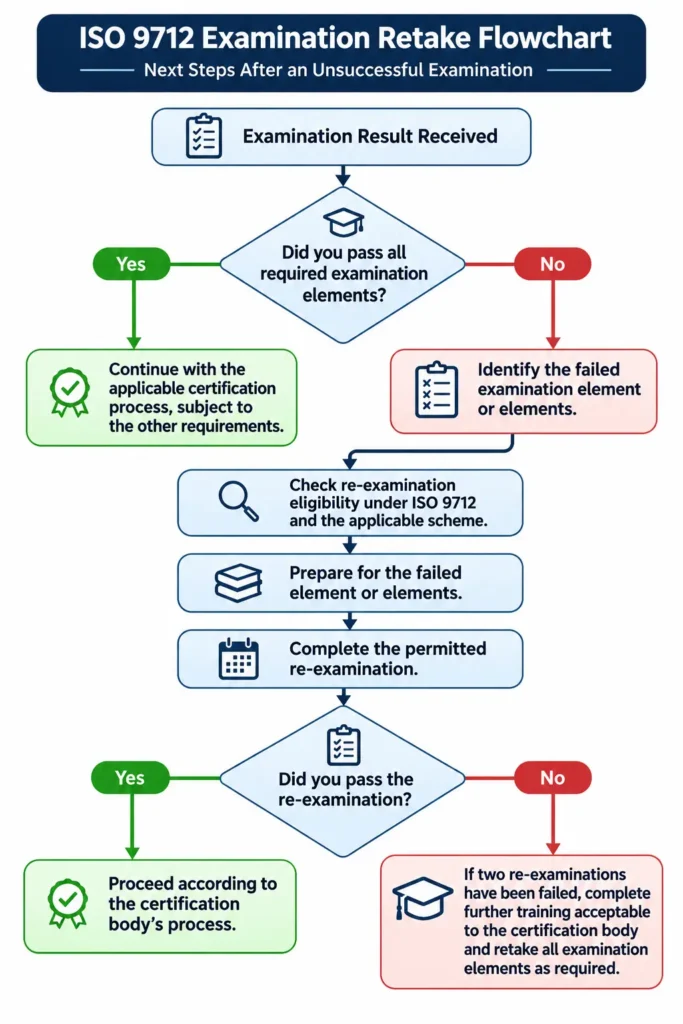
Crucially, you must verify your examination standing and subsequent procedural requirements directly with the pertinent certification authority; never presuppose that scheduling a retake is permissible without further authorization.
How Your NDT Method Affects Examination Preparation
ISO 9712 encompasses a range of industrial non-destructive testing methodologies, and candidate preparation must be meticulously aligned with the specific practical demands of the particular method under which certification is sought.
| NDT Method | Main Preparation Focus |
|---|---|
| Ultrasonic Testing (UT) | Equipment setup, calibration or checks as applicable, scanning technique, interpretation and reporting. |
| Radiographic Testing (RT) | Radiographic principles, applicable procedures, image quality, interpretation and radiation safety. |
| Magnetic Testing (MT) | Magnetisation techniques, equipment checks, relevant indications and evaluation. |
| Penetrant Testing (PT) | Surface preparation, penetrant application, processing stages and indication evaluation. |
| Eddy Current Testing (ET) | Probe selection, equipment settings, signal interpretation and relevant testing variables. |
| Visual Testing (VT) | Systematic examination, applicable acceptance requirements, observation and reporting. |
Please note that this table serves as a general preparatory framework and should not be construed as a replacement for the official examination syllabus.
Applicants are advised to scrutinize the stipulations applicable to their specific methodology, certification tier, technical approach, and the corresponding industrial domain or product category.
Common ISO 9712 Certification Mistakes to Avoid
- Prioritize the cultivation of genuine expertise over the mere attainment of academic credentials.
- Avoid memorizing answers; understand principles and methods.
- Practical training must never be disregarded, as theoretical knowledge in itself is insufficient to ensure competent performance in Non-Destructive Testing.
- Cultivate rigorous precision and exactitude in documenting inspection outcomes.
- Adhere strictly to all examination directives concerning procedural protocols and safety measures.
- Prioritize addressing vulnerabilities before scheduling a retake to ensure that prior errors are not perpetuated.
- Comprehend the regulations governing retakes, encompassing the allowable number of attempts, mandatory waiting intervals, and stipulated deadlines.
- While training is dedicated to the acquisition of competencies, certification serves to evaluate proficiency against established standards; consequently, the mere completion of a training program does not ensure the attainment of certification.
Frequently Asked Questions About ISO 9712 Exam Failure
Can I retake an ISO 9712 examination if I fail?
Under ISO 9712:2021, candidates who fail to meet the requirements for specific examination elements are permitted to undergo re-examination, subject to defined limits on the number of attempts, mandatory waiting intervals, and stipulated conditions.
How many times can I retake an ISO 9712 examination?
Pursuant to ISO 9712:2021, candidates who fail an examination component are permitted two subsequent attempts; however, upon incurring a second failure, further mandatory training and a complete re-examination become obligatory.
How long must I wait before retaking an ISO 9712 examination?
A mandatory one-month interval is standard, though this period may be shortened contingent upon the successful completion of supplementary training; please verify all logistical arrangements prior to confirming a booking.
Do I need to repeat the entire examination if I fail one section?
In accordance with ISO 9712:2021, candidates are permitted to retake failed assessment elements twice; however, upon incurring two failures, mandatory remedial training followed by a complete re-examination becomes compulsory.
Can I retake an examination immediately after failing?
Immediate re-examination should not be assumed permissible; the standard mandates a minimum waiting interval, with the sole exception being acceptable additional training. Your certification body is the authoritative source for confirming your earliest eligible date.
What should I study after failing an ISO 9712 examination?
Initiate the process by pinpointing the source of failure, then recalibrate the pertinent technical doctrines and operational protocols. Simultaneously, refine proficiency through the rigorous execution of mandated practical exercises, elevate the caliber of reporting, and culminate the training cycle by undertaking simulated assessments.
Does failing an ISO 9712 examination mean I cannot become certified?
An unsuccessful attempt does not inherently preclude future certification; rather, candidates must fulfill the requisite re-examination, training, and certification mandates to proceed.
Are ISO 9712 examination fees refundable after failure?
Refund and retake fee structures are determined by the specific terms and conditions outlined by each certification body or examination centre; therefore, it is imperative to verify the applicable charges prior to making a reservation.
Conclusion
A failed examination serves as a diagnostic tool, pinpointing specific deficiencies in Non-Destructive Testing (NDT) competencies. By meticulously analyzing the results, engaging in targeted practical exercises, and clarifying the provisions governing retakes, candidates can significantly enhance their readiness for a subsequent attempt. This preparatory phase should prioritize a rigorous, structured regimen dedicated to mastering specialized methodologies such as ultrasonic, radiographic, magnetic particle, or penetrant testing. For comprehensive guidance on ISO 9712 personnel certification, consult the dedicated page on the First Welding Certification Pvt Ltd.