
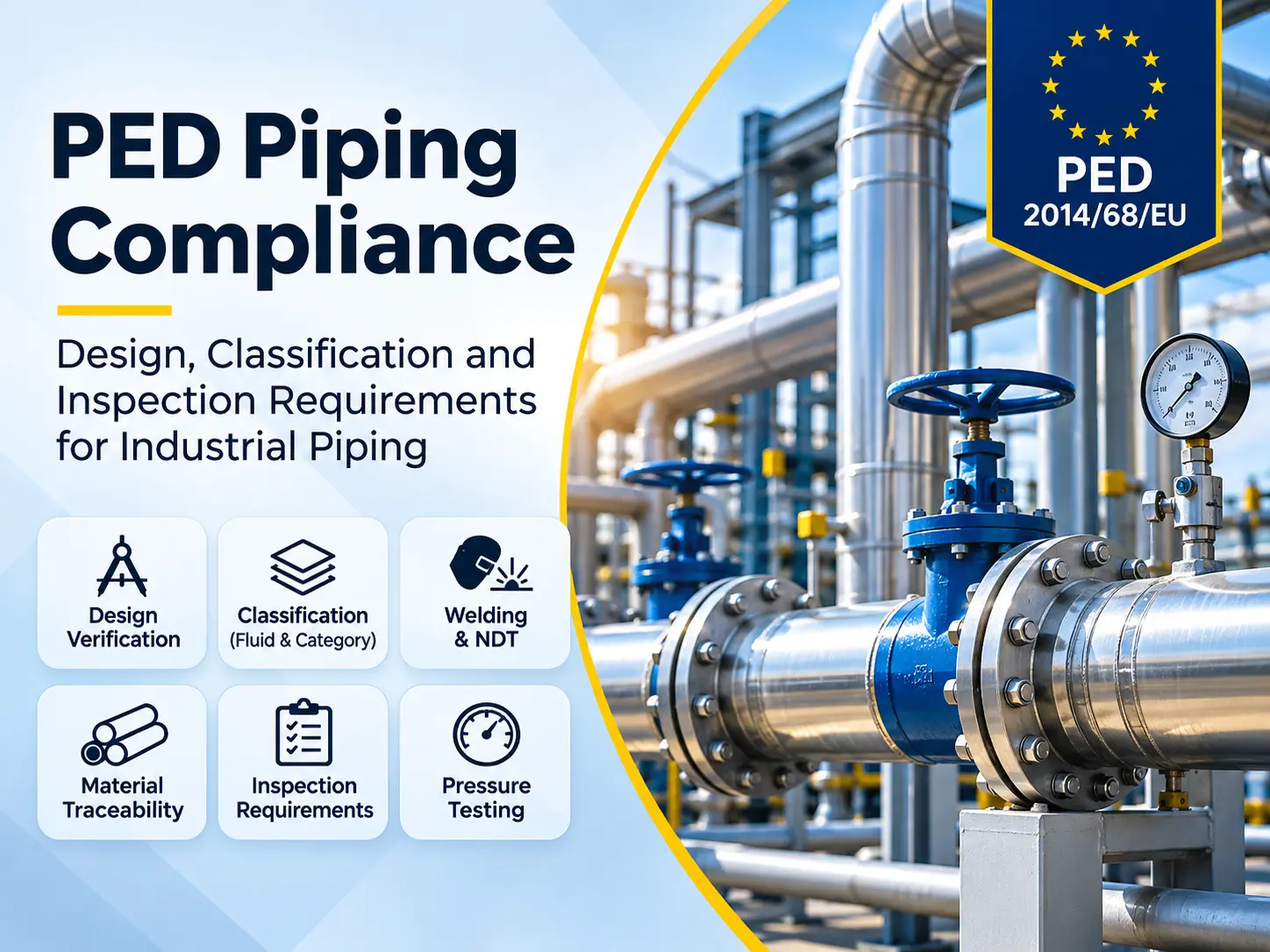
PED 2014/68/EU
REQUIREMENTS
COMPLIANCE
07 Nov 2026
PED Piping Compliance: Design, Classification and Inspection Requirements for Industrial Piping
By Editorial Team
Table Of Contents
- What Is PED Piping Compliance?
- PED Fluid Group Classification
- PED Category Classification for Industrial Piping
- PED Piping Classification at a Glance
- PED Design Verification and Calculation Requirements
- Material Inspection and Traceability
- Welding Coordination and NDT Requirements
- PED Inspection Planning and Pressure Testing
- PED Module Selection and Conformity Assessment
- PED Piping Compliance Checklist
- Common PED Piping Compliance Mistakes
- Frequently Asked Questions
- Conclusion
Related Blogs
SEP
11
What Are the Latest PED 2014/68/EU Pressure Vessel Regulations, Design Standards, Safety Factors and Certification Requirements in 2026 for Indian and Global Manufacturers?
SEP
10
ASME Section VIII vs EN 13445 for PED 2014/68/EU: CE Marking Requirements for Indian Manufacturers in 2026
See Also.....
Industrial piping systems, which serve as the critical infrastructure for conveying pressurized fluids, mandate strict adherence to European safety and conformity protocols upon commercialization. The Pressure Equipment Directive (PED) 2014/68/EU establishes the comprehensive regulatory framework governing the design, fabrication, and conformity assessment of pressure equipment, explicitly encompassing piping systems. This guide delineates the requisite measures for PED compliance, addressing equipment classification, design verification, manufacturing controls, inspection protocols, fluid categorization, and pressure testing.
What Is PED Piping Compliance?
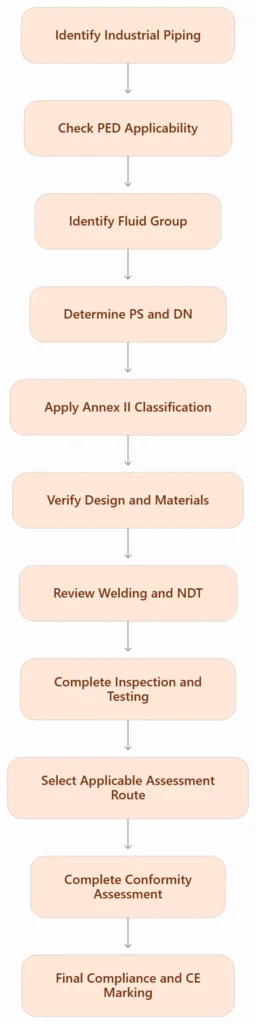
PED Piping Compliance mandates strict adherence to Directive 2014/68/EU regarding piping systems utilized for the transport of pressurized fluids. Under Article 2(3), the regulatory definition of piping encompasses an integrated array of connected components, including pipes, fittings, and hoses. The directive’s applicability is predicated on pressure equipment possessing a maximum allowable pressure (PS) exceeding 0.5 bar, contingent upon specific scope delineations and exclusions. Conversely, equipment classified under Article 4(3) is governed by Sound Engineering Practice (SEP), thereby necessitating a distinct set of compliance obligations.
PED Fluid Group Classification
The categorization of fluids constitutes a critical prerequisite for establishing the relevant Pressure Equipment Directive (PED) mandates.
Pursuant to Article 13, fluids are bifurcated into two distinct categories.
| Fluid Group | Classification |
|---|---|
| Group 1 | Fluids classified as hazardous under the applicable EU chemical classification rules |
| Group 2 | Fluids that do not fall under Group 1 |
The categorization is determined by the fluid’s inherent characteristics and the relevant hazard classifications, rather than being solely contingent upon whether the substance exists in a gaseous or liquid state.
Manufacturers should identify:
- Fluid composition and classification
- Gas or liquid state
- Maximum allowable temperature (TS)
- Maximum allowable pressure (PS)
- Applicable fluid group
Mishandling the categorization of fluids may lead to the erroneous selection of an inappropriate PED classification table.
PED Category Classification for Industrial Piping
The PED Category Classification scheme for pressure equipment dictates the requisite conformity assessment levels for piping systems by evaluating key parameters including maximum allowable pressure, nominal diameter, fluid group, and substance state, all in accordance with the specific classification tables detailed in Annex II for distinct piping applications.
PED Piping Classification at a Glance
| PED Classification | General Assessment Level |
|---|---|
| Article 4(3) – SEP | Sound Engineering Practice |
| Category I | Lowest regulated category |
| Category II | Intermediate category |
| Category III | Higher category |
| Category IV | Highest category |
Determination of the requisite classification necessitates consultation of the specific Annex II table in conjunction with its explanatory notes, given that manufacturers are expressly barred from assuming uniform categorization across all piping systems.
PED Design Verification and Calculation Requirements
Compliance with the Essential Safety Requirements outlined in Annex I mandates that piping system design rigorously accounts for critical parameters, including maximum permissible pressure and temperature, fluid properties, material specifications, dimensional constraints, external loading conditions, and corrosion potential. Manufacturers are obligated to retain comprehensive design calculations and associated technical documentation to substantiate these specifications. Furthermore, a robust Process Equipment Design Verification is imperative to confirm the integrity of the piping system under its designated operating regime.
Material Inspection and Traceability
The caliber of materials chosen fundamentally dictates the structural integrity, longevity, and pressure-retention capabilities of piping systems. Manufacturers are obligated to verify that selected materials are unequivocally compatible with operational service conditions while adhering to the stringent mandates of the Pressure Equipment Directive (PED). Essential verification protocols encompass a rigorous assessment of material grades, test certificates, and identification markers, alongside a comprehensive evaluation of intrinsic properties and full traceability. Furthermore, any material substitutions require explicit approval, and the preservation of identification markers must be maintained throughout all fabrication stages.
Welding Coordination and NDT Requirements
Welding serves as the critical method for establishing permanent joints within piping systems. Consequently, manufacturers are mandated to enforce rigorous welding controls, which encompass the implementation of appropriate Welding Procedure Specifications (WPS), the maintenance of Welding Procedure Qualification Records (WPQR), the engagement of qualified welders, comprehensive welding coordination, the regulation of repair activities, and adherence to relevant Non-Destructive Testing (NDT) inspection protocols. Furthermore, as stipulated by PED Annex I, specifically Sections 3.1.2 and 3.1.3, permanent joining procedures and the NDT personnel designated for categories II, III, and IV must obtain third-party approval.
PED Inspection Planning and Pressure Testing
The formulation of an Inspection and Test Plan delineates the sequential stages and assigns specific responsibilities for both manufacturing and testing operations. This comprehensive document meticulously outlines the requisite checks, non-destructive testing methodologies, acceptance criteria, hold points, witness points, and the stipulations governing final inspections.
PED Pressure Testing
Pressure testing serves to validate the pressure-bearing capacity of piping systems. Manufacturers are mandated to institute rigorous testing protocols, accurately ascertain the requisite test pressure, deploy appropriate calibrated instrumentation, document all findings, and scrutinize any instances of failure. In accordance with PED Annex I, Section 3.2.2, proof testing is conventionally executed via hydrostatic methods, though alternative approaches remain permissible provided that specific safety precautions are duly observed.
PED Module Selection and Conformity Assessment
Upon classification, manufacturers are required to delineate the appropriate conformity assessment procedure, a determination dictated by the specific equipment category outlined in Annex III. The divergent assessment modalities inherent to Category II, as opposed to Category IV, exert a profound influence on the scope of internal controls, the implementation of quality system evaluations, the rigor of testing protocols, and the delineation of third-party involvement. Furthermore, when the engagement of a Notified Body is requisite, it is imperative to rigorously verify the scope of their authorization.
PED Piping Compliance Checklist
Use this preliminary checklist to review important manufacturing and compliance controls.
| Verification Area | What to Check |
|---|---|
| PED applicability | Pressure and scope requirements |
| Fluid classification | Group 1 or Group 2 |
| Equipment classification | PS DN and Annex II table |
| Design verification | Calculations and drawings |
| Material inspection | Grades and certificates |
| Traceability | Heat numbers and component identification |
| Welding | WPS WPQR and personnel approvals |
| NDT | Applicable methods and personnel qualifications |
| Inspection planning | ITP and acceptance criteria |
| Pressure testing | Proof test procedure and results |
| Final assessment | Applicable conformity assessment records |
This checklist serves solely for preliminary preparation and must not be construed as a substitute for a formal PED conformity assessment.
Common PED Piping Compliance Mistakes
Manufacturers ought to accord particular scrutiny to these prevalent concerns.
- Incorrect fluid group classification.
- The application of an incorrect Annex II classification table.
- Inadequate design calculations.
- Missing material traceability.
- Execution of welding operations beyond the parameters of the established qualification scope.
- The maintenance of NDT and inspection documentation remains incomplete.
- Insufficient protocols for pressure testing.
- The selection of an inappropriate conformity assessment procedure.
Timely identification of such challenges serves to mitigate preventable delays within the certification process.
Frequently Asked Questions
Does PED 2014/68/EU apply to all industrial piping?
Whether a particular piping system is subject to these requirements is contingent upon the Directive’s defined scope, as well as the specific pressure ratings and classification criteria in question. Certain piping installations are indeed encompassed by Article 4(3), wherein they are deemed to constitute Sound Engineering Practice.
How is industrial piping classified under PED?
The classification is determined by the piping material, the fluid’s state, its designated group, the maximum permissible pressure (PS), and the nominal diameter (DN), in accordance with the applicable table specified in Annex II.
Is welding procedure approval required for PED piping?
For categories II, III, and IV, the implementation of relevant permanent joining protocols and the assignment of necessary personnel are subject to mandatory authorization from a competent third party, as stipulated in Annex I, Section 3.1.2.
Is hydrostatic testing required for PED piping?
Hydrostatic testing serves as the standard verification procedure mandated by Annex I, Section 3.2.2, though alternative methods of recognized validity may be employed when such testing poses undue risk or is practically unfeasible, provided that supplementary safety measures are implemented.
Does PED piping require Notified Body involvement?
The requisite degree of third-party engagement varies contingent upon the specific equipment classification and the chosen conformity assessment protocol; consequently, no two piping systems necessitate an identical extent of external oversight.
Conclusion
Adherence to PED piping mandates necessitates a methodical framework encompassing equipment categorization, design validation, material provenance, weld integrity, rigorous inspection protocols, and pressure testing. Manufacturers are compelled to guarantee that every phase of production aligns precisely with the stipulations of Directive 2014/68/EU. The demonstration of conformity, alongside the preservation of safety and operational reliability within industrial piping networks, hinges on meticulous documentation, the deployment of certified personnel, and robust quality assurance mechanisms. A comprehensive grasp of PED imperatives enables manufacturers to mitigate compliance deficiencies, circumvent protracted delays, and institute uniform benchmarks for the fabrication of pressure equipment.
Related Searches
- How to Select a Notified Body for PED Certification Globally: 10 Things Manufacturers Should Check
- How ISO 9712-Certified NDT Personnel Support EN 15085, EN 1090 and PED Compliance
- How Bhutanese Pressure Equipment Manufacturers Can Prepare Material Traceability Records for PED Compliance
- PED Certification for Pressure Equipment Manufacturers: How to Achieve CE Marking Under EU Requirements from India?
- When Is an EN 10204 Type 3.2 Certificate Required for PED Pressure Equipment Globally?