
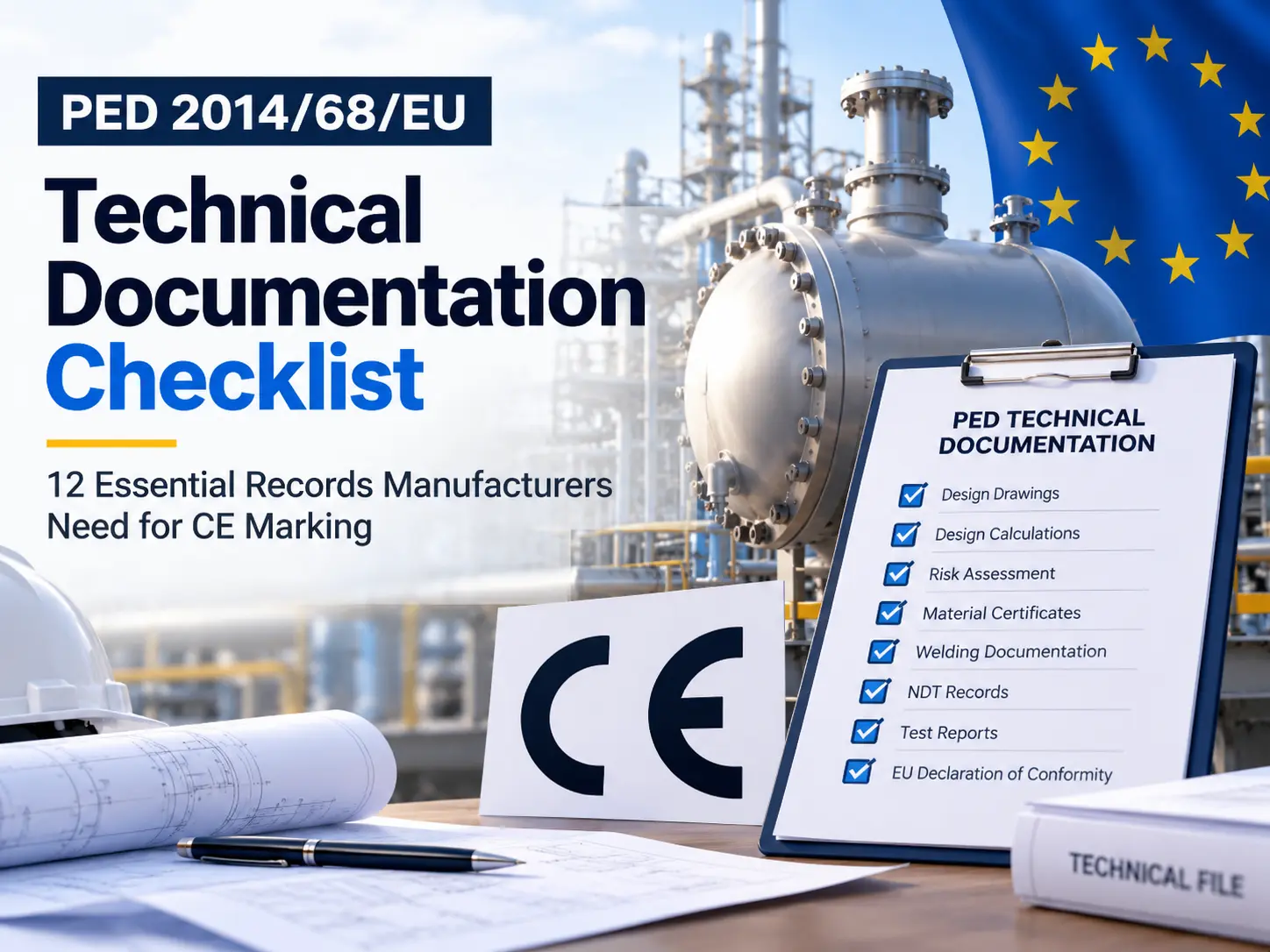
PED 2014/68/EU
CHECKLIST
DOCUMENTATION
17 Oct 2026
PED 2014/68/EU Technical Documentation Checklist: 12 Essential Records Manufacturers Need for CE Marking
By Editorial Team
Related Blogs
SEP
11
What Are the Latest PED 2014/68/EU Pressure Vessel Regulations, Design Standards, Safety Factors and Certification Requirements in 2026 for Indian and Global Manufacturers?
SEP
10
ASME Section VIII vs EN 13445 for PED 2014/68/EU: CE Marking Requirements for Indian Manufacturers in 2026
See Also.....
Introduction
Preparing pressure equipment for the European market means more than just making a safe product. Manufacturers also need to show they follow all the required rules by creating proper technical documents.
The Pressure Equipment Directive (PED) 2014/68/EU covers the design, making, and checking of stationary pressure equipment that has a maximum allowable pressure higher than 0.5 bar, as long as it falls within the Directive’s rules and isn’t excluded.
Having a clear and organized technical file helps manufacturers prove their product meets the necessary standards, supports the use of the CE marking, and prepares them for the conformity assessment process.
In this guide, we look at 12 important records to check before a PED assessment.
The exact documents needed depend on the equipment category, the chosen conformity assessment module, and the relevant essential safety requirements.
What is PED technical documentation?
PED technical documentation is the proof that pressure equipment follows the necessary safety rules.
According to Annex III of PED 2014/68/EU, this documentation must help check if the equipment meets the required safety standards and must include important details about how it is designed, made, and used.
Official reference: Directive 2014/68/EU — EUR-Lex.
PED technical documentation checklist: 12 essential records
Use the following checklist to review your documentation before a conformity assessment.
Important: This is a practical list to help you prepare, not a statement that all 12 records are needed in every situation. For example, evidence of welding qualification is useful when it applies, and documentation from a notified body depends on the conformity assessment process used.
- Product description and identification
Begin by clearly knowing what equipment you have and what it is used for. Note down the manufacturer’s information, the model number, the identification number, and any important design details. The specific details you need may depend on the type of equipment, such as maximum pressure (PS), volume (V), and the highest and lowest temperatures (TS) it can handle, along with the type of fluid it works with. Having accurate information helps determine the correct PED requirements and avoids mixing up different versions of the product.
- Design drawings and technical specifications
Make sure the drawings are up-to-date and clearly show how the equipment is set up and built. Include general arrangement drawings, detailed component drawings, how parts connect, measurements, and design rules. The documents should match exactly what is being made. Using old or conflicting drawings can lead to unnecessary problems during a technical check.’
- Design calculations
Keep the calculations that show the equipment meets the required design standards.
Depending on the type of equipment and the design method used, these calculations may cover things like wall thickness, pressure handling, loads, stresses, and other important design factors.
Write down all the assumptions, input values, design rules used, and the results of the calculations so that someone else can understand and follow the evaluation process.
- Risk assessment and safety analysis
Find the possible dangers that could happen while using the equipment as planned and in situations that might happen. Write down the main safety rules that must be followed and explain how the design and safety features help meet those rules. Make sure the analysis is suitable for the specific equipment and not just a general risk checklist.
- Applicable standards and compliance mapping
List the technical standards that help ensure conformity, and note which specific standards or parts were used.
If harmonized standards are not used where relevant, explain the technical solutions used to meet the necessary safety requirements.
Make sure to check the latest references published in the Official Journal of the European Union instead of using an outdated list of standards.
- Material specifications and certificates
Material traceability is important for ensuring the safety of pressure equipment. Keep track of the correct material specifications, purchase records, identification details, and inspection documents. Make sure the material grades and their properties match what was designed for the equipment. When needed, check the material certificates according to EN 10204 and the material-related rules in PED Annex I. The type of certificate needed and the supporting documents depend on the equipment and the conformity assessment process.
- Welding documentation
When welding is used in structures that carry pressure, check the relevant welding procedure specifications (WPS), welding procedure qualification records (WPQR), and welder qualification records.
PED Annex I includes rules about how to join parts permanently and the skills needed for the workers.
Based on the equipment type and the rules that apply, approval from a qualified third party might be needed. The records must match the real materials, welding methods, and the actual work being done.
- Non-destructive testing (NDT) records
Make sure to keep the right NDT procedures, test reports, and proof that staff are qualified.
Depending on how the product is made and what needs to be checked, different methods might be used like radiographic testing (RT), ultrasonic testing (UT), magnetic particle testing (MT), or liquid penetrant testing (PT).
Write down what was tested, the standards for approval, the results, and any fixes that need to be done. Not all testing methods are needed for every product.
- Manufacturing and quality records
Technical documents must show the real equipment that was made. Check the inspection and testing plans, records from manufacturing, where materials came from, how parts were joined, and the quality control results.
Make sure any problems are written down and fixed properly, and that the final product matches the approved technical details.
- Pressure and final test reports
Gather reports for all necessary pressure tests, final checks, and other required verification steps. Each report must clearly state what equipment or product was tested, the method used, the conditions under which the test was done, the standards it had to meet, and the results obtained.
Make sure that all testing and verification processes are done according to the required rules and procedures for approval.
- Instructions, safety information and equipment marking
Make sure to prepare the operating instructions and safety information for the equipment.
Check the proper identification and marking requirements, such as the manufacturer’s details, equipment identification, and other important technical information.
If the equipment needs a PED CE marking, confirm that the marking is added only after all the necessary conformity assessment steps have been completed.
- Conformity assessment and declaration records
Find the right PED conformity assessment module and keep the related proof. Depending on the path, this might involve notified body certificates, examination reports, quality system approvals, or other conformity assessment documents.
The manufacturer needs to create the EU Declaration of Conformity when needed and make sure it refers to the correct equipment.
Under PED, the technical documents and the declaration should usually be kept available to national authorities for 10 years after the equipment is sold on the market, as long as the relevant rules apply.
PED documentation workflow: from design to CE marking
Use this easy process to organize the review.
Step 1: Find out what equipment you have and check if PED (Pressure Equipment Directive) applies to it.
↓
Step 2: Figure out the rules that apply, the classification level, and the method to check if the equipment is safe.
↓
Step 3: Gather all the design information, calculations, standards you follow, and a risk analysis.
↓
Step 4: Collect records about materials used, welding, how it was made, non-destructive testing, and any tests done.
↓
Step 5: Finish the conformity assessment process. If the rules say you need one, involve a notified body.
↓
Step 6: Write the final EU Declaration of Conformity and put the CE mark on the product if needed.
↓
Step 7: Keep all the technical documents safe and ready to show to the right authorities if they ask.
Note: This is just an example. The real steps depend on the specific module that applies.
Common PED technical documentation gaps
Frequently asked questions
1. What documents are required for PED 2014/68/EU certification?
The technical file needs to include the correct product description, drawings, design calculations, information about standards followed, and test results. Extra documents might also be needed like records showing where materials came from, proof of welding skills, non-destructive testing records, risk assessments, and documents showing the equipment meets requirements, depending on the type of equipment and the process used.
2. Is a technical file mandatory for PED CE marking?
Manufacturers need to create technical documents that help determine if their pressure equipment meets the required standards. The specific information needed depends on the relevant rules from the PED and the chosen method for checking conformity.
3. How long must PED technical documentation be retained?
PED usually asks makers to keep the needed technical papers and the EU Declaration of Conformity ready for national authorities for 10 years after the product is sold in the market. You should look into the exact rules that apply to your equipment and the process for checking it.
4. Are WPS and WPQR documents required for every pressure equipment product?
It’s not always required. Welding records are important when welding is part of the manufacturing process and there are specific requirements that need proof. The needed qualifications and approvals depend on the equipment used and the relevant PED rules.
5. Does every pressure equipment product require a notified body?
No. The right way to check if something follows the rules depends on things like how the equipment is classified and which parts of the PED apply. Some methods need a special organization to check, while others let the manufacturer do the check themselves.
Conclusion
A fully prepared and well-organized PED technical file helps manufacturers show they meet the requirements, support the CE marking process, and avoid unnecessary delays during the assessment.
Before sending pressure equipment for review, check its classification, the correct conformity assessment module, and the documents needed.
Make sure the technical file matches the final product and that all important evidence is easy to find.
Need help with PED conformity assessment?
First Welding Certification Pvt. Ltd. can assist you in understanding the certification and inspection requirements for your pressure equipment.