
SPVD Certification
NDT Personnel
Requirements
How Does SPVD Certification Define NDT Personnel Requirements for Pressure Vessels in India?
By First Welding Certification Technical Editorial Team
6 Min Read Time
21 Oct 2026
Table of Contents
Review Plan
Confirm NDT Personnel Qualification
Examine Welds
Record Findings
Corrective Action
Documentation
Introduction
Manufacturers exporting pressure vessels to European markets must understand the applicable product safety and conformity assessment requirements. The Simple Pressure Vessels Directive (SPVD), 2014/29/EU, establishes essential safety requirements for specific welded vessels designed to contain air or nitrogen.
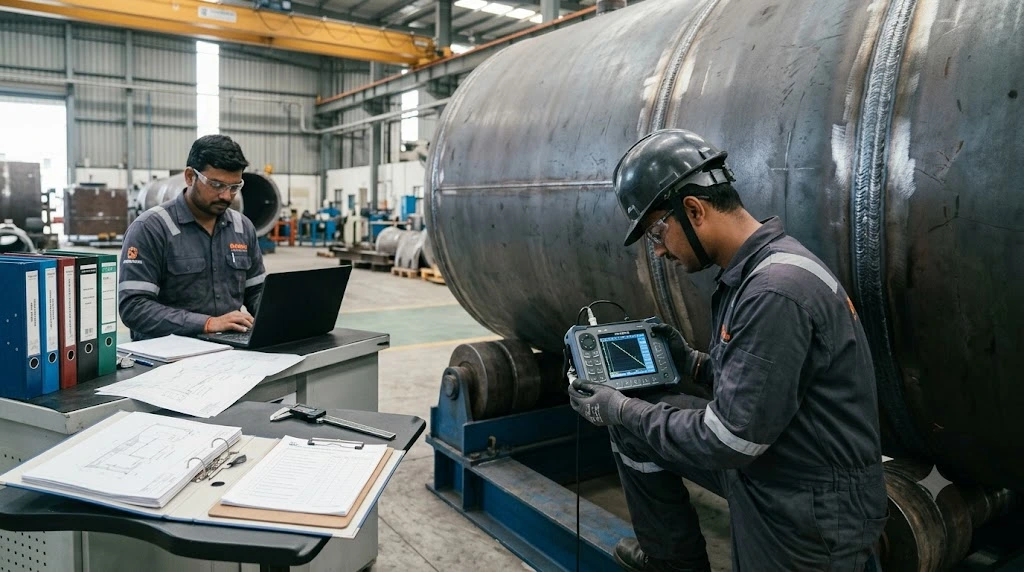
NDT personnel can support pressure vessel manufacturing by examining welds and identifying defects that may affect structural integrity. Their work contributes to weld quality verification, inspection records and manufacturing quality control.
For Indian manufacturers supplying simple pressure vessels to the European market, understanding the relationship between SPVD certification and NDT personnel helps improve inspection planning, documentation and product conformity. However, the specific NDT methods and personnel qualification requirements must be determined from the applicable standards, specifications and conformity assessment route.
What Is SPVD Certification?
SPVD refers to the Simple Pressure Vessels Directive (2014/29/EU). It covers the design, manufacture and conformity assessment of simple pressure vessels within its defined scope.
The directive generally applies to series-manufactured welded vessels containing air or nitrogen, with an internal gauge pressure greater than 0.5 bar, subject to specified material, temperature, pressure and capacity limits.
SPVD compliance involves meeting the applicable essential safety requirements, following the relevant conformity assessment procedure and maintaining appropriate technical documentation.
Manufacturers in India intending to place covered products on the EU market must assess the directive’s applicability and identify the relevant harmonised standards and conformity assessment requirements.
What Is the Role of NDT Personnel?
Non-destructive testing (NDT) involves examining materials, components or welds without impairing their intended usability.
Qualified NDT personnel may perform or support inspection activities such as:
- Visual testing (VT): Identifying visible weld irregularities and surface imperfections.
- Ultrasonic testing (UT): Detecting internal discontinuities using high-frequency sound waves.
- Radiographic testing (RT): Examining welds using X-rays or gamma rays.
- Magnetic particle testing (MT): Detecting surface and near-surface discontinuities in suitable ferromagnetic materials.
- Penetrant testing (PT): Identifying surface-breaking defects in non-porous materials.
The appropriate method depends on the material, weld configuration, defect type, applicable acceptance criteria and inspection requirements.
NDT personnel must have qualifications and authorisation appropriate to the method and applicable inspection scheme. Inspection results should be recorded and traceable to the relevant component or weld.
How Are NDT Personnel Connected to SPVD Compliance?
SPVD requires welds on pressurised parts to have suitable characteristics and to be free from surface or internal defects detrimental to vessel safety. It also requires approved welding processes, appropriately qualified welders or operators, and suitable manufacturing tests documented in reports.
NDT personnel can support these objectives by carrying out specified examinations and documenting the results.
A practical workflow may include:
- Reviewing the inspection plan, drawings and applicable acceptance criteria.
- Confirming the required NDT method and personnel qualifications.
- Examining designated welds or components.
- Recording findings and identifying non-conformities.
- Supporting corrective action and reinspection where required.
- Maintaining reports within the vessel’s manufacturing documentation.
What Is the Role of EN 10204 Type 3.2?
EN 10204 Type 3.2 is an inspection certificate for metallic products. It involves validation by the manufacturer’s authorised inspection representative, independent of the manufacturing department, and the purchaser’s authorised inspection representative or an inspector designated under applicable regulations.
The certificate provides specified test results and confirmation that the supplied products meet the requirements of the order.
For pressure vessel manufacturers, material traceability and inspection documentation help demonstrate that the materials used are consistent with the specified requirements.
However, EN 10204 Type 3.2 is not a universal SPVD requirement. The necessary material inspection document must be established from the directive’s applicable provisions, relevant standards, contractual specifications and conformity assessment requirements.
NDT reports and Type 3.2 certificates serve different purposes: NDT reports document examinations, while Type 3.2 certificates address metallic product inspection documentation.
How Can Manufacturers Prepare for Inspection?
Manufacturers should establish a documented quality process before production begins.
- Identify the applicable SPVD requirements and harmonised standards.
- Verify welding procedure and welder qualification documentation.
- Define inspection stages, NDT methods and acceptance criteria.
- Confirm NDT personnel competence for the assigned work.
- Maintain material identification and traceability records.
- Retain examination reports, test results and corrective action records.
- Verify the required material inspection documents.
- Ensure the prescribed conformity assessment and pressure tests are completed.
For Indian manufacturers, early coordination between production, quality assurance, NDT personnel and the conformity assessment body can help prevent missing records and unnecessary rework.
Frequently Asked Questions
Does SPVD require NDT personnel certification?
SPVD does not establish one universal NDT personnel certification requirement for every vessel. Personnel competence and qualification should be assessed against the applicable standards, inspection methods and project requirements.
Is NDT mandatory for every SPVD pressure vessel?
Not universally. Required examinations depend on the applicable technical requirements and conformity assessment route. Manufacturers should verify the relevant inspection plan and standards.
Is EN 10204 Type 3.2 mandatory for SPVD certification?
Not automatically. The required material inspection documentation must be determined from the applicable requirements, standards and purchase specifications.
Can Indian manufacturers obtain SPVD compliance for products exported to Europe?
Yes. Manufacturers in India can supply products covered by SPVD, provided the applicable EU requirements and conformity assessment procedures are satisfied.
Why are NDT reports important for pressure vessel manufacturing?
NDT reports provide evidence of the examinations performed, their results and any identified discontinuities. They support quality control and traceability when required by the inspection plan.
Related Searches
- SPVD Certification 2026: Latest 2014/29/EU Update, EN 286-1, Documents & CE Marking for Indian Manufacturers
- SPVD Certification: Complete Guide to the Simple Pressure Vessels Directive (2014/29/EU)
- SPVD Scope: 10 Questions to Determine Whether Your Pressure Vessel Is Covered
- ISO 9712 – Qualification and Certification of NDT Personnel
- ISO 9712 NDT Personnel Certification: The Complete 2026 Guide for Manufacturers and Inspectors
- How to Renew or Recertify Your ISO 9712 Certificate Before It Expires (Continuity, Maintenance & Revalidations Rules)
Conclusion
SPVD compliance and NDT personnel are connected through the need to verify weld quality, document examinations and support safe pressure vessel manufacturing.
For Indian manufacturers targeting European markets, understanding the applicable inspection methods, personnel qualifications, material traceability and conformity assessment requirements can strengthen manufacturing quality and documentation control.
NDT reports, material inspection certificates and welding records serve complementary purposes. Their exact requirements should always be confirmed against the applicable directive, harmonised standards and project specifications.
Need guidance for NDT personnel requirements or pressure vessel compliance documentation?
First Welding Certification Pvt Ltd (PRVÁ ZVÁRAČSKÁ, a.s.) can help you explore the relevant welding quality and certification requirements for your application.