
Table Of Contents
- What is ISO 9606 Welder Certification?
- Why Manufacturers Need Qualified Welders?
- ISO 9606 Welder Qualification Process
- Qualification Variables
- Testing Methods
- Qualification Range
- Validity & Renewal
- Relationship Between WPS, WPQR & Welder Qualification
- Common Mistakes During Welder Qualification
- Industry Applications
- Conclusion
- Ready to Qualify Your Welders?
- Frequently Asked Questions
Key Takeaways
Qualified Welders
Verified Competence
Recognized Qualification
International Recognition
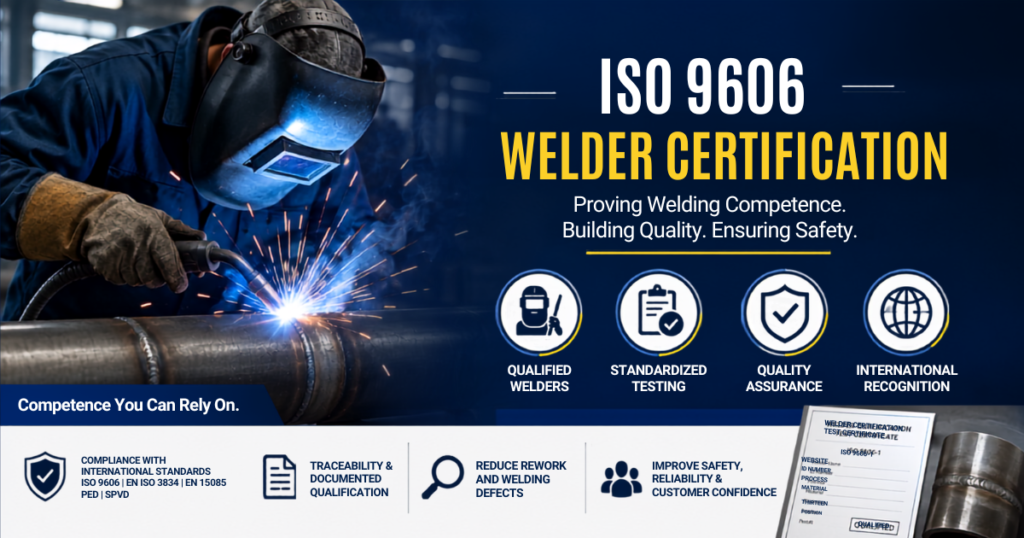
ISO 9606 is an internationally recognized series of standards for the qualification testing of welders for fusion welding. It establishes requirements for demonstrating a welder’s ability to produce an acceptable welded joint under specified conditions.
For manufacturers involved in fabrication, pressure equipment, structural steel, railway applications, energy, heavy engineering, and other welded products, qualified welders are an important part of an effective welding quality system.
The qualification is based on a practical welding test. The test is performed under specified conditions, followed by the applicable examination and testing. The resulting qualification applies within the limits established by the relevant part of ISO 9606 and the variables recorded during the qualification test.
What is ISO 9606 Welder Qualification?
ISO 9606-1:2012 specifies requirements for qualification testing of welders for fusion welding of steels. Other parts of the ISO 9606 series address different material groups.
The qualification demonstrates that a welder has the practical ability to produce a welded joint meeting the specified acceptance requirements.
ISO 9606 qualification is different from a general training record or attendance certificate. It is based on practical welding performance and is linked to defined welding variables and qualification ranges.
A welder qualification may cover specific conditions such as:
Welding process
Product type
Joint type
Parent material
Welding consumable
Material thickness
Pipe outside diameter
Welding position
Welding details
The exact variables and qualification ranges depend on the applicable part of ISO 9606 and the qualification test performed.
why is Welder Qualification important?
The quality of a welded product depends not only on the welding procedure but also on the ability of the person performing the welding.
A qualified welder provides documented evidence that the welder has demonstrated the required welding performance under specified test conditions.
Welder qualification is relevant to:
Consistent welding quality
Control of welding operations
Reduction of welding defects
Production traceability
Compliance with applicable welding requirements
Customer and project requirements
Welding quality audits
Manufacturing documentation
However, welder qualification alone does not demonstrate that every production weld will automatically conform. Production welding must also be performed using applicable procedures, qualified materials and consumables, appropriate inspection controls, and the required production conditions.
| Without Qualified Welders | With Qualified Welders |
|---|---|
| Higher risk of weld defects | Consistent weld quality |
| Increased rework | Improved productivity |
| Customer concerns | Greater customer confidence |
| Audit observations | Better documented compliance |
ISO 9606 Welder Qualification Process
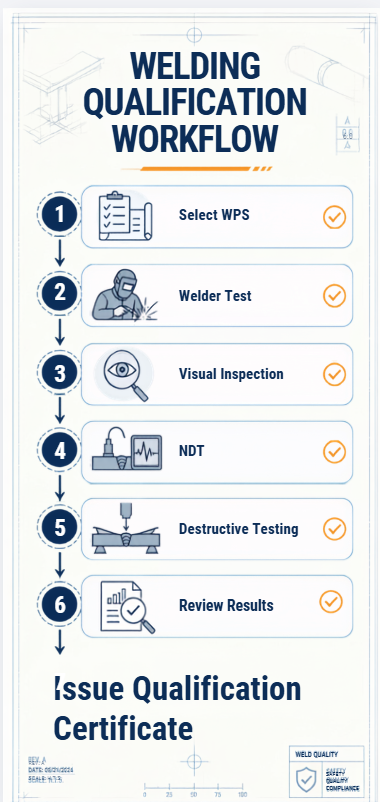
The qualification process generally follows a structured sequence.
1. Determine the Applicable Standard
The applicable part of ISO 9606 should first be identified based on the material and welding application.
For steel, ISO 9606-1 is applicable.
The relevant product standard, project specification, customer requirement, or regulatory requirement may also impose additional conditions.
2. Select the Welding Procedure
The welding test should be performed using a suitable Welding Procedure Specification (WPS) or other applicable welding procedure documentation.
The WPS establishes the welding conditions under which the test is performed.
3. Identify the Qualification Variables
Before the test, the relevant variables should be identified, including:
Welding process
Product type
Joint type
Parent material
Consumable
Thickness
Pipe diameter, where applicable
Welding position
Welding technique
Other variables specified by the applicable standard
4. Prepare the Test Coupon
The test coupon is prepared according to the specified joint configuration and dimensions.
The material and consumable identification should be traceable to the qualification documentation.
5. Welding Test
The welder performs the test under the specified welding conditions.
Important information should be recorded, such as:
Welding process
Welding position
Consumable designation
Material
Thickness
Diameter, where applicable
Welding parameters
Preheat and inter pass conditions, where applicable
6. Examination and Testing
After welding, the test coupon is examined using the applicable examination and testing requirements.
Depending on the qualification conditions, applicable methods may include:
Visual Testing (VT)
Radiographic Testing (RT)
Ultrasonic Testing (UT), where applicable
Bend testing
Fracture testing
Macro examination
Other examinations specified by the applicable requirements
The exact testing requirements should not be assumed to be identical for every ISO 9606 qualification.
7. Evaluation of Results
The examination and test results are evaluated against the applicable acceptance criteria.
If the results satisfy the relevant requirements, the welder qualification can be documented.
8. Issue of Qualification Documentation
The qualification documentation records the test conditions, results, and applicable qualification range.
The record should provide sufficient information to establish the relationship between the welder, test, welding conditions, examinations, and qualification result.
ISO 9606 Qualification Variables
A welder is not qualified for every possible welding condition simply because the welder has passed one test.
The qualification applies within a defined qualification range.
Important variables can include:
Welding Process
The welding process used during qualification affects the qualification range.
Examples include:
111 – Manual Metal Arc Welding
121 – Submerged Arc Welding
131 – MIG welding
135 – MAG welding
136 – MAG welding with flux-cored wire
141 – TIG welding
The applicable process designations and qualification requirements should be verified against the relevant ISO 9606 part.
Product Type
The test may involve plate, pipe, or other applicable product forms.
The qualification range for product type is determined according to the applicable standard.
Joint Type
The qualification can be associated with butt welds, fillet welds, or other applicable joint configurations.
The qualification range depends on the test performed and the requirements of the applicable standard.
Parent Material
Material classification and material group are important qualification variables.
The qualified material range should be determined from the applicable ISO 9606 requirements and the material used during the test.
Material Thickness
The thickness of the test coupon affects the qualification range.
A welder qualified on one thickness is not automatically qualified for every thickness.
Pipe Outside Diameter
For pipe welding, the outside diameter of the test piece can affect the qualification range.
The applicable diameter range should be determined from the qualification standard.
Welding Position
Welding position is another important qualification variable.
Positions such as PA, PB, PC, PD, PE, PF, and PG may have different qualification implications depending on the test and applicable standard.
ISO 9606 Qualification Range
The qualification range defines the welding conditions within which the welder is considered qualified.
For example, qualification may be evaluated according to:
Process → Product Type → Joint Type → Material → Thickness → Diameter → Position → Other Applicable Variables
The qualification certificate or record should therefore be reviewed before assigning a welder to a particular production welding activity.
A welder should not be assigned to conditions outside the applicable qualification range without determining whether additional qualification is required
Welder Continuity and Validity
ISO 9606 qualification should be considered together with the applicable requirements for continuity of welding activity and confirmation of qualification.
A qualification is not simply treated as permanently valid without conditions.
The applicable part of ISO 9606 specifies requirements concerning the maintenance and confirmation of qualification. Employers or responsible organizations should maintain appropriate records demonstrating the welder’s continued welding activity where required.
Continuity records should be controlled and traceable to the relevant welder and welding process.
Additional qualification or requalification may become necessary where the applicable requirements are no longer satisfied or where a new welding condition falls outside the existing qualification range.
The exact validity and confirmation requirements should always be checked against the applicable edition of the relevant ISO 9606 standard and any applicable project or certification requirements.
Relationship Between WPS, WPQR & Welder Qualification
WPS, WPQR, and welder qualification are related but perform different functions.
WPQR
A Welding Procedure Qualification Record (WPQR) records the welding conditions and examination/test results from a procedure qualification test. It provides evidence that the welding procedure has been qualified according to the applicable procedure qualification standard.
WPS
A Welding Procedure Specification (WPS) defines the welding variables and conditions to be followed during production welding.
ISO 9606 Welder Qualification
ISO 9606 qualification demonstrates the welder’s ability to produce an acceptable weld under the specified qualification conditions.
The relationship can be represented as:
WPQR → Qualified Welding Procedure → WPS → Production Welding
and
Welder Qualification → Demonstrated Welder Performance Capability
A qualified WPS and a qualified welder therefore address different aspects of welding control.
Together, these elements help manufacturers improve weld quality, maintain process consistency, and support compliance with quality requirements such as EN ISO 3834 and industry-specific standards like EN 15085.
| Document | Purpose | Why It Matters |
|---|---|---|
| WPQR | Qualifies and validates the welding procedure | Demonstrates the procedure can produce acceptable welds |
| WPS | Provides approved welding instructions | Ensures consistent production welding |
| ISO 9606 Welder Qualification | Qualifies the welder's practical skills | Confirms the welder can perform welding within the approved qualification range |
Common Welder Qualification Mistakes
Several documentation and technical errors can occur during welder qualification.
Common examples include:
- Incorrect material identification
- Incorrect welding process designation
- Incorrect welding position
- Incorrect thickness or diameter information
- Incomplete test coupon identification
- Incorrect consumable designation
- Missing traceability records
- Incomplete examination reports
- Incorrect qualification range
- Failure to maintain continuity records
- Using a welder outside the applicable qualification range
- Inconsistent information between the test record and qualification document
These errors can affect the technical validity and traceability of the qualification documentation.
Welder Qualification Records
A controlled welder qualification record should provide sufficient information to establish the qualification.
Depending on the applicable requirements, records may include:
Welder identification
Qualification number
Welding process
Material
Material thickness
Pipe diameter, where applicable
Joint type
Welding position
Consumable information
Test coupon details
Welding parameters
Examination and test results
Qualification range
Date of test
Applicable standard
Examiner, testing body, or certification details, where applicable
Traceability between the welder, test coupon, welding procedure, examination reports, and qualification document should be maintained.
Industries Using Qualified Welders
ISO 9606 welder qualification is extensively used in the industries where there is the need for quality and safety of the welding work. Qualified welders can assist the manufacturing companies to prove welding proficiency and ensure the consistency of the quality of production.
Industries that Require Qualified Welders
- Railway vehicles and parts
- Manufacturing of pressure equipment
- Fabrication of structural steel
- Heavy engineering
- Industrial machinery
- Oil and gas facilities
- Power generation
- Renewable energy projects
- Ship building and marine fabrication
- Process industries
ISO 9606 and Welding Quality Management
Welder qualification is one element of a broader welding quality system.
For organizations working under EN ISO 3834, welding personnel competence and qualification are important elements of welding quality management.
For railway applications under EN 15085, applicable welding personnel qualification requirements may also need to be considered together with the relevant welding coordination and production requirements.
The applicable product and welding standards should always be identified before establishing qualification requirements.
Conclusion
ISO 9606 welder qualification provides documented evidence of a welder’s ability to produce an acceptable welded joint under specified qualification conditions.
The qualification is based on practical welding performance and is limited by the applicable qualification range, including relevant variables such as welding process, material, thickness, product form, diameter, joint type, and welding position.
A complete welding quality system should maintain clear relationships between:
Welding Procedure → WPS → WPQR → Welder Qualification → Production Welding → Inspection and Testing → Traceability
Correct qualification records, continuity records, applicable WPS documentation, and controlled production conditions are essential for maintaining consistent welding quality and demonstrating conformity with applicable requirements.
Frequently Asked Questions
What is ISO 9606 Welder Certification?
ISO 9606 Welder Certification is an internationally recognized qualification that verifies a welder’s practical ability to produce quality welds under specified welding conditions.
Who needs ISO 9606 welder qualification?
It is commonly required by manufacturers in industries such as railway, structural steel, pressure equipment, heavy engineering, and industrial fabrication.
What is the difference between WPS, WPQR, and Welder Qualification?
A WPS provides welding instructions, a WPQR validates the welding procedure, and ISO 9606 Welder Qualification confirms the welder’s competence to follow the approved procedure.
What tests are carried out during welder qualification?
Depending on the qualification requirements, testing may include visual inspection, bend testing, radiographic testing (RT), ultrasonic testing (UT), fracture testing, or macro examination.
How long is an ISO 9606 welder qualification valid?
The qualification remains valid when continuity requirements are maintained and confirmed in accordance with the applicable ISO 9606 standard.
Which industries commonly require qualified welders?
Industries include railway, pressure equipment, structural steel, oil and gas, power generation, heavy engineering, and industrial manufacturing.
How does ISO 9606 support welding quality?
It provides a standardized method for qualifying welders, helping manufacturers maintain consistent welding quality and documented competence.
Ready to Qualify Your Welders?
Demonstrate welding competence through ISO 9606 qualification and strengthen confidence in your manufacturing processes with internationally recognized certification.