
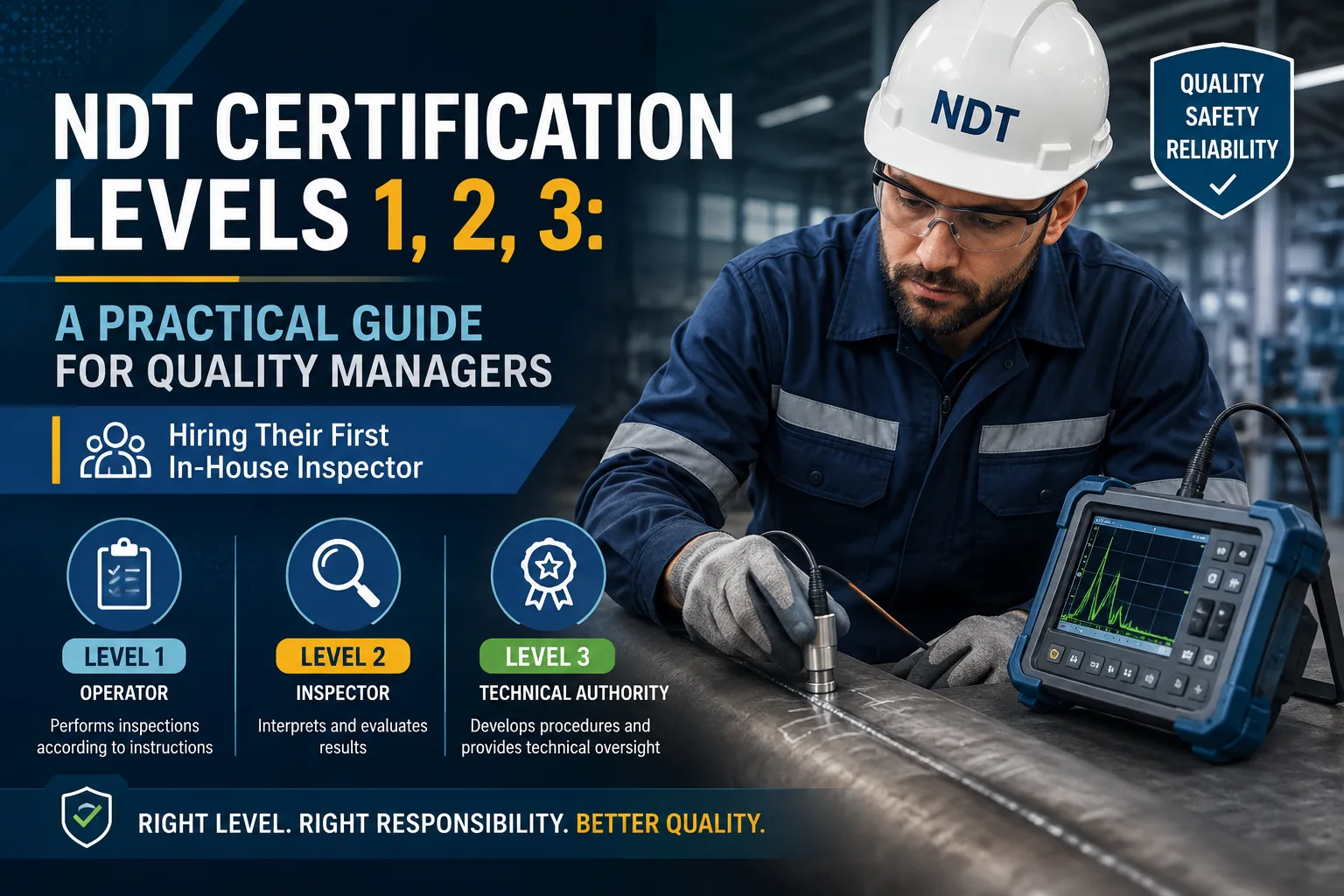
NDT CERTIFICATION
CHECKLIST
GUIDE
03 Sep 2026
NDT Certification Levels 1, 2, 3: A Practical Guide for Quality Managers Hiring Their First In-House Inspector
By Editorial Team
Table Of Contents
- What Are NDT Levels 1, 2 and 3?
- Level 1: The Operator
- When should you hire Level 1?
- Level 2: The Inspector
- Why Level 2 is often the practical choice
- Level 3: The Technical Authority
- The Most Important Question: What Are You Actually Inspecting?
- Level 1 vs Level 2 vs Level 3: Quick Decision Guide
- The 7 Things to Check Before Hiring
- Don't Make This Hiring Mistake
- Certification is not equal to authorization
- Should You Hire One Inspector or Build a Team?
- Your First In-House NDT Hiring Checklist
- Final Takeaway
Related Blogs
SEP
05
Do You Need a Level 3 NDT Inspector or Can a Level 2 Handle Your Quality System?
SEP
04
Cost vs Capability: Do Smaller Manufacturers Really Need a Full-Time NDT Level 3?
SEP
04
How to Verify an NDT Certificate Is Genuine: A Quality Manager’s Due-Diligence Checklist
SEP
01
AI-Powered Weld Inspection: Benefits, Limitations & Future of NDT
See Also.....
Hiring your first NDT inspector?Don’t begin with the resume.Start with the certification.
Many manufacturers make a mistake by hiring an NDT professional based on how long they’ve been working or their job title, without checking if their ISO 9712 certification matches the specific tasks they’ll be doing.
For a quality manager setting up an internal inspection team, the differences between NDT Level 1, Level 2, and Level 3 are important.
Here’s a simple explanation of each.
What Are NDT Levels 1, 2 and 3?
ISO 9712 sets up a system to qualify and certify people who do industrial non-destructive testing (NDT). The three levels of certification show more responsibility as you go up. more responsibility as you go up. But the key question for a quality manager is:
What level does your company really need?
| Level | Primary Role | Typical Responsibility |
|---|---|---|
| Level 1 | NDT Operator | Performs examinations according to instructions |
| Level 2 | NDT Inspector | Performs interprets and evaluates examinations |
| Level 3 | NDT Technical Authority | Develops procedures and provides technical oversight |
Level 1: The Operator
A Level 1 NDT technician mainly does inspections based on set guidelines or steps.
Common tasks include:
– Putting up NDT equipment
– Doing checks
– Following approved directions
– Writing down findings
– Spotting signs as per given rules
– Sharing the inspection results with the right people
When should you hire Level 1?
Level 1 can be appropriate if your manufacturing process already has:
– Qualified Level 2 supervision
– Set up NDT procedures
– Clear inspection instructions
– Simple, repeated inspection tasks
The limitation
A Level 1 technician should not be used in place of a Level 2 inspector when the work needs independent judgment and analysis of results.
Think of Level 1 as doing the job—not being responsible for the technical decisions.
Level 2: The Inspector
For many manufacturers who are hiring their first in-house NDT professional, Level 2 is the most important level to grasp.
A Level 2 professional has more responsibilities than a Level 1 and can usually carry out and assess NDT work within their certified area.
Depending on the certification system that applies, their duties may include:
– Choosing the right NDT methods
– Setting up the necessary equipment
– Doing the inspections
– Understanding the findings
– Checking the results against the right standards
– Overseeing Level 1 staff
– Writing NDT instructions when allowed
– Sharing the results of the inspections
Why Level 2 is often the practical choice
Imagine your company gets welded parts every day.
You need someone who can:
Check → Understand → Judge → Record → Decide if more action is needed.
Hiring just a Level 1 technician might miss some important details.
A properly certified Level 2 professional can work more independently within their allowed limits.
For most new in-house inspection teams:
Start by checking if you need a Level 2.
Level 3: The Technical Authority
Level 3 is not just Level 2 with more experience.
It’s a much higher level of technical responsibility.
People at Level 3 can take charge of tasks like:
– Choosing the right NDT methods
– Creating and checking NDT procedures
– Understanding and using standards and specifications
– Setting or approving technical needs when allowed
– Giving technical advice
– Managing NDT work
– Training and helping other NDT workers
Do you need a Level 3 as your first hire?
Usually not as a full-time first hire—unless your company has a lot of technical challenges.
A Level 3 might be needed if:
– You create your own NDT procedures
– You use complicated or advanced NDT methods
– You work in several different manufacturing areas
– You have strict customer requirements
– You need an internal expert in NDT
– You manage a big inspection team
– You need strong NDT engineering support
For smaller companies, it might be better to get Level 3 support from outside instead of hiring someone full-time.
The Most Important Question: What Are You Actually Inspecting?
Don’t pick the certification level first.
Instead, decide based on what the inspection job requires.
Ask yourself these five questions:
– Who will do the inspection?
If the person just follows a set list of steps, Level 1 could be enough. But if they need to think on their own and decide what the results mean, then Level 2 might be better.
– Who checks the findings?
This is really important. If the inspector has to decide if a finding meets the rules, you need to make sure they are allowed and trained to do that.
– Who makes the inspection plan?
If your company wants the inspector to create or control the NDT procedures, Level 3 skills might be needed.
– What NDT methods do you use?
Don’t just go for someone with a Level 2 certificate.
Look at which specific methods they are qualified for:
– UT
– MT
– PT
– RT
– VT
– ET
– LT
– TT
Other methods that apply
A Level 2 UT inspector isn’t automatically a Level 2 RT inspector.
Each certification is for specific methods.
– What industry do you work in?
The scope of the certification matters.
The person’s experience and training should match the type of work you do, the products you make, and the way you use inspections.
Level 1 vs Level 2 vs Level 3: Quick Decision Guide
| Your Requirement | Likely Level |
|---|---|
| Perform inspections using written instructions | Level 1 |
| Interpret and evaluate NDT results | Level 2 |
| Supervise Level 1 personnel | Level 2 |
| Prepare NDT instructions within permitted scope | Level 2 |
| Develop/approve complex NDT procedures | Level 3 |
| Provide technical NDT authority | Level 3 |
| Manage advanced NDT applications | Level 3 |
Important: The specific duties allowed can vary based on the certification scheme, employer permission, procedures, industry, and relevant rules or standards.
The 7 Things to Check Before Hiring
A certificate by itself shouldn’t be the end of your hiring process.
– Certification Standard
Check that the candidate has a certification based on the ISO 9712 standard.
– Certification Level
Find out if it’s Level 1, Level 2, or Level 3.
– NDT Method
Look at the exact testing methods included. Remember, UT, MT, PT, and RT are different.
– Sector and Scope
Ensure the certification matches the type of work your company does.
– Certificate Validity
Check if the certificate is still valid and active.
– Vision Requirements
Some NDT roles may require certain vision abilities, like near-vision or color-vision, depending on the certification and method used.
– Practical Experience
Don’t mix up certification with real job skills.
Ask:
“Has this person actually inspected parts like the ones we make?”
A certified inspector with experience in your industry can be much more useful than someone with a good-looking certificate but little experience with your products.
Don't Make This Hiring Mistake
One of the biggest mistakes is creating a job description like:
“NDT Inspector – ISO 9712 certified.”
That’s not clear enough.
Instead, you should include:
NDT Level 2, the specific testing methods needed, the industry or area the work applies to, the standards that apply, and the experience with manufacturing.
For example:
NDT Level 2 – UT, MT, and PT, working in the industrial sector, with experience in welded fabrications and understanding of acceptance criteria.
This helps attract better candidates right away.
Certification ≠ Authorization
This difference is very important for quality managers.
An ISO 9712 certification shows that a person has met the standards of a certification program.
But having this certification doesn’t automatically mean the person can do every type of inspection your company needs.
The employer still needs to check several things:
– Their ability to do the specific job
– Their experience in that area
– The right procedures to follow
– What the customer expects
– Which rules and standards apply
– The equipment they will use
– The conditions at the workplace
– Whether the employer has given them permission
In simple terms:
Certification shows what the person is trained to do.
Authorization shows what the person is allowed to do for your company.
Should You Hire One Inspector or Build a Team?
For a manufacturer starting from scratch, a practical setup could be like this:
Small manufacturing setup
1 × Level 2 Inspector
- Level 3 technical support is outsourced when needed
Growing inspection team
Level 2 Inspectors
- Level 1 Technicians
- Level 3 support is provided either internally or externally.
Large or complex manufacturing setup
Multiple Level 2 staff members
- Level 3 Technical Authority
- Specialized NDT staff for different testing methods.
The best setup depends on how much is being produced, how complicated the inspections are, what the customers need, and how many NDT methods are used.
Your First In-House NDT Hiring Checklist
Before making an offer, ask:
Certification
– Is the certificate still valid?
– Which organization gave the certification?
– What level of certification is it?
– Which non-destructive testing methods does it cover?
– Which industries or areas does it apply to?
Technical Competence
– Can the person understand test results?
– Can they assess findings?
– Do they know the standards for accepting results?
– Can they follow your specific standards?
Experience
– Have they tested similar items before?
– Do they know how your products are made?
– Have they worked with your materials and welding types?
Quality System
– Can they keep proper records of their inspections?
– Can they follow your quality management system?
– Can they know when to ask a higher level or engineering team for help?
Final Takeaway
Hiring your first NDT inspector isn’t about choosing someone with the highest certification.It’s about finding the right level of certification that matches the job’s responsibilities.
Level 1 = perform tests.
Level 2 = perform tests, interpret results, and evaluate them within a specific scope.
Level 3 = offer more advanced technical guidance and take on greater responsibility.
For many manufacturers starting to build their own NDT team, a Level 2 inspector is usually the best first choice.
They can handle most routine tasks, and when more complex technical needs come up, they can rely on a Level 3 inspector for support.
The best question to ask isn’t:
“Is this person ISO 9712 certified?”
It’s:
“Is this person certified, experienced, and allowed to do the exact NDT work needed for our manufacturing process?”
If you get that right, your first NDT hire can become a strong part of your quality system—not just someone with a certificate.