
WPQR
CHECKLIST
REQUALIFICATION
04 Sep 2026
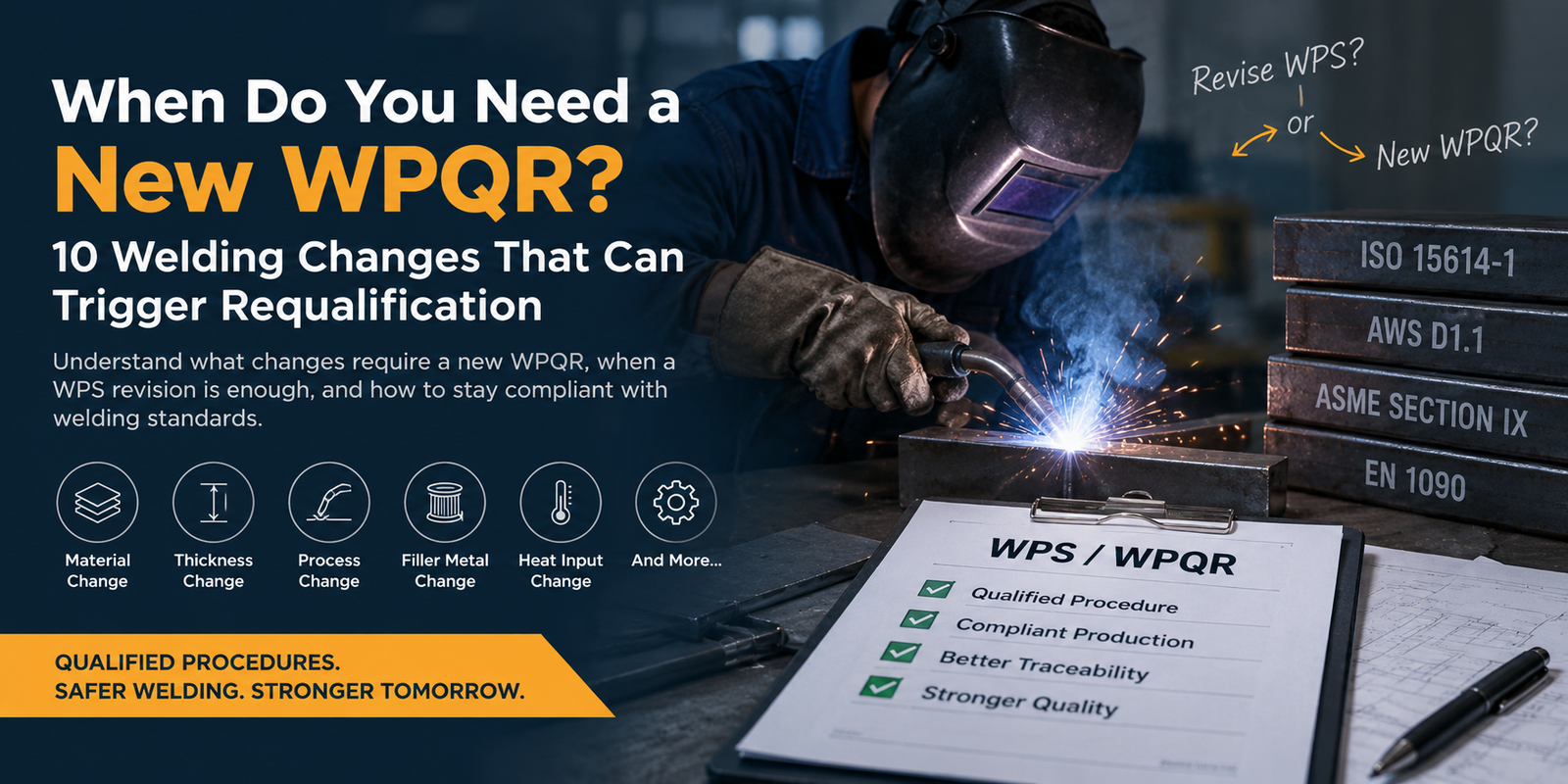
When Do You Need a New WPQR? 10 Welding Changes That Can Trigger Requalification
By Editorial Team
A welding method might be approved today, but that doesn’t mean every future change can be made using the same approval.If there’s a change in the material, welding technique, thickness, filler metal, heat input, or another controlled factor, it could take the production out of the range covered by the current approval.
So, the important question for manufacturers is:
Does this change need just an update to the WPS, or does it need a new WPQR test?
The answer depends on the welding approval standard being used, what changed, and the range of conditions covered by the existing WPQR.
This guide explains the most common situations manufacturers should check before changing a qualified welding process.
Upcoming Events
JLY
25
Welding Quality Webinar
Online
AUG
8
EN 15085 Transition Seminar
Berlin
SEP
14
India Certification Summit
Gurugram
See Also.....
Certification Alerts
- EN ISO 3834-4 transition deadline: 31 Dec 2024
- NABCB accreditation renewal — Updated requirements
What Is a WPQR?
A WPQR (Welding Procedure Qualification Record) keeps track of the real welding conditions and the results from the qualification tests.This helps show that a welding method can create a joint that meets the required standards.
In the ISO 15614-1 system, procedure qualification sets the conditions and limits for welding in actual production.
The steps are simple:
pWPS → Welding Test → Testing and Evaluation → WPQR → Production WPS
The WPS tells the welder how to make the weld in production.
The WPQR shows the proof that this method is qualified.
We already explained this link between WPS and WPQR in our special service material.
The Golden Rule: Check the Qualified Range Before Changing the WPS
Before making changes to a production WPS, don’t just ask:
“Can we change this parameter?”
Instead, ask:
– What exactly is changing?
– Which standard was used to approve the original process?
– Is this variable important according to that standard?
– What were the limits that were tested and approved?
– Is the new value still within those limits?
– If the rules allow the change and it stays within the approved range, updating the WPS might be enough.
But if the new value goes outside the approved range for an important variable, you might need to do more testing.
This difference is important because it helps save money by avoiding unnecessary tests and ensures that the welding you do in production is safe and approved.
10 Welding Changes That Can Trigger WPQR Requalification
1 Changing the base material can impact the procedure qualification.
For example, switching to a different material group or qualification category might move the production weld outside the limits covered by the current WPQR.
This is particularly important when manufacturers switch between:
– Different material grades
– Different material groups
– Carbon and low-alloy steels
– Stainless steels
– Different material families
Before changing the material, check the material grouping and the qualification range allowed by the relevant standard.
2 Thickness is another important factor that affects qualification.
A WPQR does not automatically cover all thicknesses a manufacturer might work with in production.
For example, a test done at one thickness sets a specific range of acceptable thicknesses according to the standard used.
This range can vary based on the standard, the material, the welding method, and the test conditions.
So, if you go from a thickness that’s already qualified to one that is very different, you should check the qualification range again.
Don’t think:
“We qualified 10 mm, so we can weld any thickness.”
Instead:
Look at the actual thickness range that was approved in the WPQR.
4 Changing the welding method can completely change how the welding is done.
Examples are:
– SMAW to GMAW
– GMAW to GTAW
– FCAW to SAW
– Manual welding to mechanized or automated welding, if possible
Just because someone is qualified for one welding method doesn’t mean they’re automatically qualified for another. The specific standard being used decides how the welding process and any mix of processes are approved.
Production rule: If the welding method changes, you should check the WPQR before using the updated WPS in production.
4 Filler metal changes can also impact qualification.
Manufacturers might switch filler materials for several reasons, such as:
– Availability from suppliers
– Cost considerations
– Production needs
– Requirements for mechanical properties
– Needs related to corrosion resistance
– Compatibility with other materials
However, changing the filler metal isn’t just about making a purchase decision. The manufacturer needs to check if the new filler classification is still allowed under the relevant standard.
Important distinction
Switching the brand of a filler metal doesn’t automatically mean the classification is the same. For example, two different manufacturers could offer filler metals with the same classification. But whether this substitution is allowed still needs to be confirmed based on the applicable rules.
5 Heat input is a key factor to manage when you need to meet impact toughness or other mechanical property standards.
Changes in:
– Welding current
– Arc voltage
– Travel speed
– Welding technique
can all affect the heat input. Adjusting heat input might go beyond the acceptable range specified in the relevant standard.
This often leads to a common issue in production:
The welder increases travel speed to work faster, but this changes the heat input and takes it outside the approved range. As a result, the Welding Procedure Specification (WPS) might no longer be fully supported by the existing qualification. Before increasing welding speed or altering electrical settings, check the approved heat-input range.
6 The temperature of the metal before and between weld passes affects how quickly the weld cools down.This can change the metal’s structure and strength.
A manufacturer might adjust the preheat temperature because:
– The welding process is taking too long
– The outside temperature has changed
– The thickness of the material has changed
– A different type of metal is being welded
– The workers want to make the process faster
Even if a change seems small during the actual work, it might have a big effect on the welding results.
You should check the welding standards to see if the change is allowed. Don’t lower the preheat just because the weld looks okay.
7 Gas changes can impact several important factors:
– Arc stability
– Penetration
– The makeup of the weld metal
– The presence of porosity
– The look of the weld surface
– The strength and other mechanical qualities of the weld
For processes that use gas shielding, it’s important to check if a new gas choice is still approved under the current qualifications. This is especially important when making changes to:
– The type of gas used
– The mix of gases
– The makeup of the gas
– The setup for the backing gas
The specific effects on approval depend on the standard being followed and the type of material and welding process being used.
8 The way a weld is made can affect several things:
– How the welder works
– How the molten metal flows
– How deep the weld goes into the metal
– How much metal is added
– How heat is spread
– How easy it is to reach the weld area
If a welder is qualified for one position, it doesn’t mean they are qualified for all other positions.
So, before switching production from one welding position to another, manufacturers need to check the range of positions covered in the welding procedure qualification record (WPQR) according to the relevant standard. This is particularly important when working on projects that involve complicated structures, pipes, railway parts, or pressure vessels.
9 Joint design is more than just a drawing detail.
Changes to the type of joint, how the groove is shaped, the root gap, the root face, the backing, and how the backing is arranged can affect whether a procedure is suitable for use, depending on the standard that applies.
For example, a manufacturer can’t assume that a procedure approved for one type of butt joint works for all other joint designs. Before approving any changes in production, check the qualified joint design that was originally approved.
10 Changes in the electrical settings or welding method can also influence the qualification of a welding procedure.
Examples include:
– Switching from alternating current to direct current
– Changing from direct current electrode positive to direct current electrode negative
– Using conventional welding instead of pulsed welding
– Making big changes to the waveform
– Significant alterations in the welding technique
– Whether or not these changes require requalification depends on the standard being used and the specific level of qualification.
This is especially important because manufacturers are using more:
– Digital welding machines
– Advanced waveform controls
– Automated welding systems
– Robotic welding
– High-efficiency welding methods
New technology does not always mean that old qualifications are still valid.
What Changes Usually Don't Mean “Start a New WPQR”?
Not every change needs a new qualification test.
Depending on the standard that applies, some changes can be managed through revising the WPS and using document control, as long as the change stays within the allowed qualification limits.
Examples might include:
– Changing a supplier but keeping the needed filler type
– Adjusting settings that are still within the approved range
– Changing how a document looks
– Fixing information like addresses or contact details
– Making changes to variables that are not essential
But you should never decide a variable is non-essential just because you think it doesn’t matter.
First, check the qualification standard that applies.
WPS Revision vs New WPQR: The Decision Process
Use this simple process before approving a welding change:
Step 1 — Find out what has changed
Look closely at the details. Check if the material, thickness, process, filler, gas, heat input, or position has changed.
Step 2 — Find the correct standard
For example:
– ISO 15614-1
– AWS D1.1
– ASME Section IX
Or another rule for a specific project or product
AWS D1.1 covers welding for structural steel and sets rules for qualifying welding procedures and workers.
ASME Section IX also sets rules for qualifying welding and lists different variables used in the welding process.
Step 3 — Check if the variable is important
Do not just go by what is commonly done in welding. Look at the exact rules from the standard you are using.
Step 4 — Compare with the WPQR
Look at the actual values used during testing and the allowed range from the standard.
Step 5 — Decide what to do
If it’s within the allowed range, you may only need to update the WPS. If it’s outside the allowed range, you might need new testing.
Step 6 — Write down the decision
Keep records of:
– The updated WPS
– The WPQR it refers to
– A history of changes
– The technical reasons for the change
– Approval records
– Any test or qualification documents used
This helps show how the approved method connects to the tested one.
Why Uncontrolled WPS Changes Create Audit Problems
One of the biggest risks in welding isn’t always bad welding—it’s welding without enough proof that the method is still good.
Think about a company that has a welding procedure that’s been approved.
Then, during production, someone says, “Let’s make the welding faster.”
The welder changes the settings.
The weld looks fine.
Production keeps going.
Later, during a check, the company is asked to show that the changes they made are allowed.
If the settings they’re using aren’t in the approved list, they might break the rules even if the weld looks good. That’s why making sure the weld is good isn’t just about the final look—it’s also about proving that the whole welding process was properly checked and approved.
How Digital Welding Management Can Help
More and more modern manufacturers are using digital systems to link these steps together:
WPS → WPQR → Welder → Material → Welding Parameters → Inspection → Final Product
This helps them easily see if a weld is being made using the right approved process.
Digital welding traceability can also help manufacturers find issues like:
– Using the wrong version of a WPS
– Using old or uncontrolled documents
– Setting incorrect welding parameters
– Having unqualified welders work
– Using mismatched materials
– Missing inspection records
For companies with big welding teams, this can greatly improve how ready they are for audits and how well they control their production process.
WPS/WPQR Compliance Checklist
Before approving a welding procedure change, ask:
| Question | Check |
|---|---|
| What parameter is changing? | |
| Which standard governs the qualification? | |
| Is the variable essential? | |
| What value was recorded on the WPQR? | |
| What qualification range applies? | |
| Does the new value remain within that range? | |
| Does the WPS need revision? | |
| Is a new qualification test required? | |
| Has the change been technically reviewed? | |
| Is the latest WPS available to production? | |
| Are obsolete WPS versions controlled? | |
| Is the decision properly documented? |
The Bottom Line
A welding procedure qualification record (WPQR) should not be seen as a certificate that lets a manufacturer make any changes they want to their welding procedure. It serves as proof that the welding process meets the requirements of a specific qualification system and the range of conditions it covers.
When there are changes in production, manufacturers need to follow a careful process:
– First, identify what has changed.
– Then, check which standard applies.
– Next, find out which variable is affected.
– Compare this with the qualified range.Then, update the welding procedure specification (WPS) or requalify the procedure if needed.
The biggest mistake can be not doing a WPQR test when it’s not necessary.
This can happen when a WPS is used outside the range that was approved during qualification, only to find out later during production or an audit that there’s a problem.
For manufacturers following standards like ISO 15614-1, EN 1090, AWS D1.1, ASME Section IX, EN 15085, or other welding requirements, having a controlled system for WPS and WPQR is essential in showing that their welding process is capable and meets the required standards.