
ISO 3834
TRACEABILITY CHECKLIST
DOCUMENTATION
27 Oct 2026
EN ISO 3834 Material Substitution: Risks, Approval and Traceability
By Editorial Team
Table Of Contents
- What Is Material Substitution in Welding?
- Why Is Material Substitution a Risk?
- 5 Steps to Control Material Substitution Under EN ISO 3834
- Material Substitution Approval Flowchart
- How Material Substitution Connects to Other ISO 3834 Controls
- Common Material Substitution Mistakes to Avoid
- Material Substitution Checklist
- Frequently Asked Questions
- Conclusion
Related Blogs
SEP
19
Can One WPQR Cover Multiple WPS? Understanding WPQR-to-WPS Qualification Scope
SEP
15
Which Industries and Manufacturers Need ISO 3834 Certification in India and International Markets? Top 10 Sectors That Need It
SEP
12
Best Standard for Fusion Welding Quality Control: Why ISO 3834 Is Required for EN 1090 & EN 15085
SEP
08
ISO 3834 Latest Edition 2026: 2021 Revision, Current Status & What Welding Manufacturers Need to Know
AUG
24
ISO 3834 Certification Cost in India: Factors, Fees & Budget Guide
JLY
30
EN ISO 3834 Certification Requirements: What Welding Manufacturers Need to Know in 2026
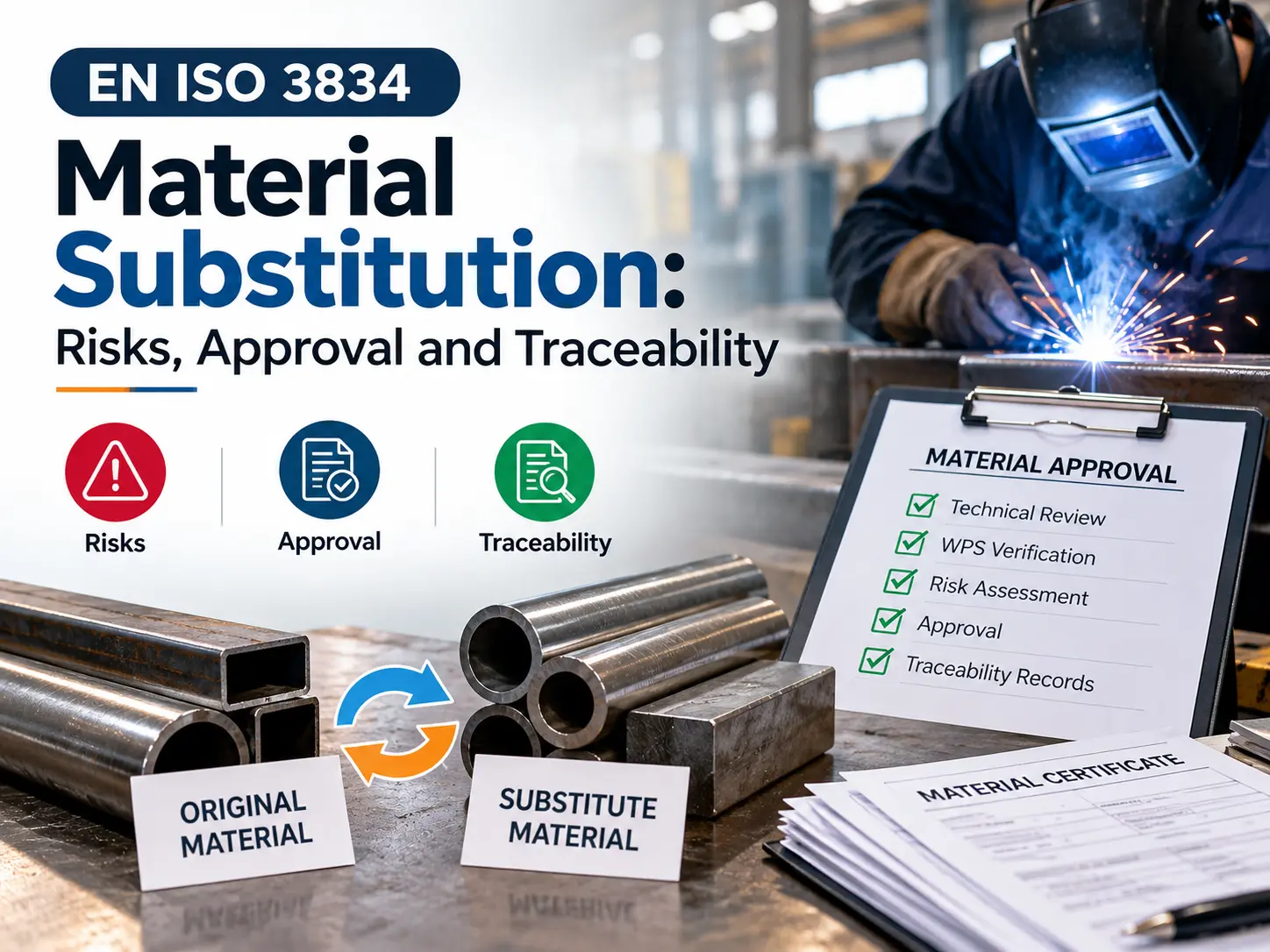
Changing materials without a technical review can affect the quality of the weld, how well the product works, and whether it meets standards. According to EN ISO 3834, any change in materials needs to be checked, recorded, and confirmed before it’s used. Even though materials with similar names or properties might seem like a good swap, they can have different compositions and performance levels. Following a controlled process helps keep the welding quality safe, reduces the need for rework, and ensures that the production records are trustworthy.
What Is Material Substitution in Welding?
Material substitution means using a different material or welding consumable instead of the original one because of issues like supplier problems, customer requests, or delays. The new material needs to be checked to make sure it works well with the component’s needs and meets all the required standards, not just how it looks.
Why Is Material Substitution a Risk?
Using a bad replacement can harm the quality of a welded part, even if the welding process is done correctly.
| Risk | Possible consequence | Recommended control |
|---|---|---|
| Different thickness or dimensions | Joint preparation or fit-up problems | Confirm dimensions and design suitability |
| Missing material identification | Incorrect material may enter production | Maintain identification and traceability |
| Different chemical composition | Increased cracking risk or reduced weldability | Review material certificates and chemistry |
| Unapproved supplier change | Requirements may not be fulfilled | Review purchasing and technical requirements |
| Different weldability | Existing welding procedure may not be suitable | Review the applicable WPS and qualification range |
| Different mechanical properties | Component may not meet design requirements | Verify specified strength and toughness |
The exact checks depend on the material, application, governing specifications, and consequences of failure.
5 Steps to Control Material Substitution Under EN ISO 3834
1. Review the Original Material Requirements
Check the drawings, purchase specifications, product standards, and customer requirements. Make sure to confirm the material grade, dimensions, delivery condition, mechanical properties, and required tests. Also include ISO 3834 Technical Review and Quality Planning if they apply.
2. Assess the Proposed Alternative
Check the suggested material against the original requirements. Look at the material certificate, its makeup, its features, how well it can be welded, and the conditions it will be used in. Make sure the welding materials used are suitable. Just because the strength or description is similar doesn’t mean it’s acceptable.
3. Obtain the Required Approval
Before using a substitute material in production, it’s important to document the technical evaluation and get approval from the right people. You might need permission from outside sources if the contract, design authority, or relevant standards require it, especially when safety and compliance are involved.
4. Verify the Welding Procedure and Production Plan
Make sure the proposed material is suitable according to the relevant Welding Procedure Specification (WPS) and its supporting qualification documents.
If the material change goes beyond the qualified range or alters a key welding parameter, additional evaluation, requalification, or formal approval might be needed before starting the welding process.
Update the ISO 3834 Production Planning and any necessary work instructions. Ensure that welding coordinators and production staff are aware of the approved material change.
5. Update Records and Maintain Traceability
After getting approval for the substitution, update the material records, production documents, and inspection plans. Include details like the approved material, its source, who made the decision, and which parts are affected. Using ISO 3834 Weld Traceability helps check how materials were used and tackle any quality problems that may come up later.
Material Substitution Approval Flowchart
Use this process to handle suggested material replacements in a consistent way.
Suggested material replacement
↓
Check the drawings, contract, and material specifications
↓
Compare the original material with the proposed alternative
↓
Evaluate weldability, properties, and technical risks
↓
Is the alternative material acceptable from a technical standpoint?
- No: Disapprove the substitution and find a material that meets the requirements.
- Yes: Get the necessary technical and customer approvals.
↓
Check if the welding procedure specification (WPS) is suitable and within the qualified range
↓
Update production and inspection documents
↓
Track the material and ensure proper traceability
↓
Approve for production and confirm compliance
Note: This is a practical process, not a replacement for the relevant standard, contract, design approval, or official change control process.
How Material Substitution Connects to Other ISO 3834 Controls
Changing materials doesn’t just affect one part of the process. It can impact buying materials, joining parts together, checking for quality, keeping records, and taking steps to fix any problems that come up.
| Related keyword | How it connects to material substitution |
|---|---|
| ISO 3834 Consumables Control | Verify consumable suitability, identification, storage, and handling. |
| ISO 3834 Weld Repairs | Assess whether a material issue has affected completed welds and whether an approved repair is needed. |
| ISO 3834 Welder Continuity | Keep welder continuity records current; assess any separate qualification implications if the change affects welding arrangements. |
| ISO 3834 Distortion Control | Review whether changed material properties or dimensions affect distortion risk and fabrication planning. |
| ISO 3834 Subcontracting | Communicate approved material requirements to subcontractors and verify supplied records. |
| ISO 3834 Welding Defects | Investigate defects that may be associated with material suitability or incorrect identification. |
| ISO 3834 Acceptance Criteria | Evaluate the product against the applicable acceptance requirements; do not treat material approval as proof that a weld is acceptable. |
| ISO 3834 Internal Audits | Check whether substitution approvals, material identification, and records are being controlled. |
| ISO 3834 Welding Records | Retain relevant certificates, approvals, inspection results, and production records. |
| ISO 3834 Corrective Actions | Address unauthorized substitutions and prevent similar issues from recurring. |
| ISO 3834 Audit Findings | Record and resolve nonconformities identified during audits, as appropriate. |
| ISO 3834 Repair Welding | Ensure any repair follows an approved procedure and applicable requirements. |
| ISO 3834 Supplier Audits | Evaluate supplier controls where supplier performance or material conformity is a concern. |
| ISO 3834 Contract Changes | Review whether a proposed substitution requires a formal contract or design change. |
| ISO 3834 Material Storage | Preserve material identification and prevent mixing, damage, or deterioration. |
| ISO 3834 Process Validation | Verify that relevant welding processes and procedures remain suitable where the substitution affects their applicability. |
| ISO 3834 Production Errors | Investigate incorrect material selection, issuing, or use during fabrication. |
| ISO 3834 Customer Complaints | Use complaints to identify weaknesses in material approval or traceability controls. |
These topics are related quality control activities, not separate rules that all manufacturers must follow in the same way. Whether they apply depends on the ISO 3834 quality level that’s relevant, the specific product needs, and the organization’s overall work scope.
Common Material Substitution Mistakes to Avoid
- Similar grades do not guarantee the same level of performance.
- Keep records of verbal approvals along with the reasons given.
- Check all proposed materials against the qualifications stated in the Welding Procedure Specification (WPS).
- Ensure that the identity of the material is clearly connected to its certificates and components.
- Notify purchasing, stores, production, welding, and inspection teams about any approved changes.
- Review any unauthorized changes; take steps to control, evaluate, and implement corrective measures if needed.
Material Substitution Checklist
Before using a substitute material in production, make sure that:
- The original material’s specifications and requirements have been checked.
- The alternative material’s certificates and properties have been reviewed.
- Technical risks and how well it can be welded have been evaluated.
- Necessary approvals from customers, designers, and internal teams have been received.
- The weld procedure specification (WPS) and its qualification requirements have been looked at.
- Production, inspection, and purchasing documents have been updated as needed.
- The material’s identification and traceability are kept properly.
- All relevant staff and subcontractors have been told about the change.
- Any issues or problems have been noted and fixed.
Frequently Asked Questions
Does EN ISO 3834 allow material substitution?
A substitution may be acceptable if it meets the relevant technical, contractual, design, and regulatory requirements and is properly controlled. EN ISO 3834 should not be seen as general permission to replace specified materials without review or approval.
Who should approve a material substitution?
Approval is based on the organization’s rules, the contract, the person who has the authority to design, and the specific needs for the product. It might require input from welding coordinators, engineers, quality control teams, the customer, or another approved group.
Does a material substitution require a new WPS or WPQR?
No, it’s not automatic. The manufacturer has to check if the new material is already covered by the existing welding procedure qualification. They also need to see if any changes affect the qualification variables that are important. If the current qualification doesn’t include the new material or the welding conditions, then more testing or qualification might be required.
Why is material traceability important?
Traceability connects the identification of materials and their certificates to the specific parts and production records. It allows for checking, examining, and looking into things if there’s a problem with quality.
What should a manufacturer do if an unapproved material has already been used?
Identify and isolate the impacted work, evaluate the technical and contractual consequences, inform the relevant parties, and record the decision. Decide if further inspection, repair, replacement, or other steps are needed before the product is approved or delivered.
Conclusion
Effective material substitution requires technical assessments, approvals, checks on welding procedures, updated records, and tracking of materials. Including these steps helps manufacturers reduce risks and maintain steady production according to EN ISO 3834 standards. For help with welding quality and certification, First Welding Certification Pvt Ltd can assist in understanding the requirements and preparing for inspections. Visit pzvar.in.