
GLOBAL NEWS
EN ISO CERTIFICATION
REQUIREMENTS
1 Sep 2026
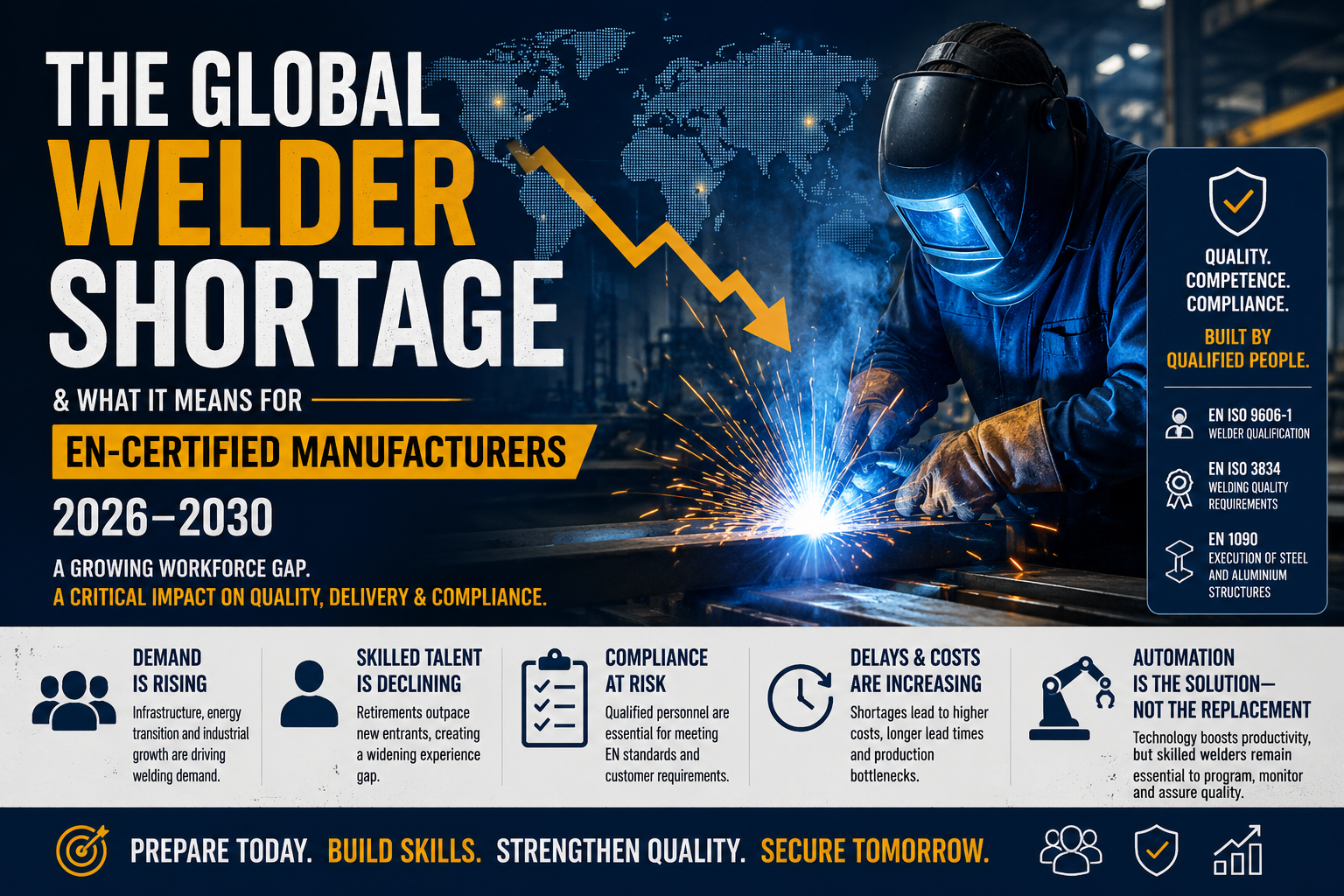
The Global Welder Shortage & What It Means for EN-Certified Manufacturers (2026–2030)
By Editorial Team
The global shortage of skilled welders is becoming a strategic manufacturing challenge. For EN-certified manufacturers, the issue is bigger than recruitment—it directly affects production capacity, welding quality, qualification management, traceability, and compliance.
Across Europe and other major manufacturing markets, demand for skilled welding professionals continues to rise while experienced workers retire and fewer young workers enter the trade. The European Union has identified welders and flame cutters among occupations facing widespread shortages, while the American Welding Society estimates that the U.S. welding industry will need approximately 320,500 new welding professionals by 2029.
For manufacturers working to EN 1090, EN ISO 3834, EN ISO 9606-1 and related requirements, this workforce shortage could become one of the most important operational risks between 2026 and 2030.
Upcoming Events
JLY
25
Welding Quality Webinar
Online
AUG
8
EN 15085 Transition Seminar
Berlin
SEP
14
India Certification Summit
Gurugram
See Also.....
Certification Alerts
- EN ISO 3834-4 transition deadline: 31 Dec 2024
- NABCB accreditation renewal — Updated requirements
Why Is the Global Welder Shortage Growing?
Several structural factors are driving the shortage.
- Experienced Welders Are Retiring
Welding depends heavily on practical experience. Many experienced welders, supervisors, and welding specialists are approaching retirement, creating a knowledge-transfer gap.
AWS has highlighted both the aging welding workforce and the difficulty of attracting younger workers into the profession.
The challenge is therefore not simply finding more workers. Manufacturers need people who can consistently produce welds that meet defined quality and acceptance criteria.
- Industrial Demand Is Increasing
Welding remains essential across:
- Structural steel
- Heavy engineering
- Rail and transportation
- Shipbuilding
- Energy infrastructure
- Construction equipment
- Renewable energy
- Pressure equipment
- Automotive manufacturing
- Industrial machinery
Infrastructure investment, manufacturing expansion and the energy transition are sustaining demand for welding skills.
- Certification Requirements Are Becoming More Important
Modern manufacturing increasingly requires documented competence rather than simply welding experience.
For European projects, manufacturers may need to demonstrate compliance through systems involving:
- EN ISO 9606-1 — welder qualification
- EN ISO 3834 — welding quality requirements
- EN 1090 — execution of steel and aluminium structures
- Qualified welding procedures and supporting documentation
- Welding coordination
- Inspection and traceability records
This creates an additional challenge: the available workforce must not only be capable of welding but also work within a controlled and documented welding quality system.
What Does the Welder Shortage Mean for EN-Certified Manufacturers?
The impact will extend beyond HR departments.
- Higher Production Costs
When qualified welders become harder to find, manufacturers may face:
- Higher wages
- Recruitment costs
- Overtime
- Temporary labor expenses
- Longer training periods
- Increased subcontracting
For export-oriented manufacturers, these costs can directly affect margins and delivery competitiveness.
- Longer Production Lead Times
A shortage of qualified welding personnel can create bottlenecks even when raw materials and machinery are available.
A manufacturer may have the production capacity on paper but still struggle to meet delivery schedules because qualified personnel are unavailable for specific welding activities.
- Greater Compliance Risk
This is particularly important for EN-certified manufacturers.
A company cannot simply replace a qualified welder with an unqualified operator when a specific qualification is required.
The manufacturer must ensure that personnel performing relevant welding work have the appropriate qualifications and that the welding process remains within the approved procedures and quality system.
The workforce shortage therefore becomes a compliance risk—not just a staffing problem.
- Loss of Manufacturing Knowledge
When experienced welders leave, companies can lose valuable practical knowledge about:
- Material behavior
- Welding parameters
- Distortion control
- Joint preparation
- Defect prevention
- Repair procedures
- Welding sequence
- Troubleshooting
If this knowledge exists only with individual workers, retirement can create a significant operational vulnerability.
Automation Will Help—But It Won't Replace Qualified Welders
One of the strongest trends for 2026–2030 will be the integration of robotic welding, cobots, digital weld monitoring and AI-assisted quality control.
AWS is already highlighting automation and robotics as strategic responses to the welding workforce challenge.
However, automation does not remove the need for welding expertise.
Manufacturers still need people who can:
- Select and validate welding procedures
- Program and supervise robotic systems
- Set welding parameters
- Handle complex or variable joints
- Inspect welds
- Manage nonconformities
- Maintain traceability
- Interpret standards
- Control welding quality
The future workforce will therefore increasingly combine welding expertise + digital skills + quality knowledge.
The New Competitive Advantage: A Scalable Welding Quality System
Between 2026 and 2030, manufacturers that depend entirely on individual welders will become increasingly vulnerable.
A stronger strategy is to build a system-driven welding operation.
This means converting individual knowledge into controlled processes through:
Standardized Welding Procedures
Maintain controlled WPS/PQR documentation and ensure production personnel work within approved parameters.
Welder Qualification Management
Track qualifications, processes, materials, positions, validity and applicable ranges under EN ISO 9606-1.
Digital Traceability
Connect welding records with:
- Welder identification
- WPS
- Material certificates
- Consumables
- Weld numbers
- Inspection results
- NCRs and repairs
- Continuous Training
Instead of recruiting only fully experienced welders, manufacturers can develop internal talent through structured training and qualification programs.
Automation for Repetitive Work
Robotic and automated welding can reduce dependence on manual labor for repetitive, high-volume welds while allowing skilled welders to focus on more complex operations.
What EN-Certified Manufacturers Should Do Before 2030
Manufacturers should treat workforce planning as part of their welding quality and business-continuity strategy.
A practical roadmap is:
| Priority | 2026–2030 Action |
|---|---|
| Workforce | Build a pipeline of trained welding personnel |
| Qualification | Maintain a live welder qualification matrix |
| Knowledge | Document critical knowledge from experienced welders |
| Quality | Strengthen EN ISO 3834-based welding controls |
| Procedures | Standardize WPS and production practices |
| Automation | Automate repetitive welding operations |
| Digitalization | Introduce digital welding and traceability systems |
| Training | Upskill welders in robotics inspection and digital tools |
| Compliance | Regularly review EN and ISO requirements |
| Contingency | Develop backup personnel for critical welding processes |
The 2026–2030 Outlook
The global welder shortage is unlikely to disappear simply through increased recruitment.
Instead, the welding industry is moving toward a hybrid workforce model where skilled welders work alongside automation, digital quality systems and AI-enabled technologies.
For EN-certified manufacturers, this transition is particularly significant.
The companies best positioned for 2030 will not necessarily be those with the largest welding workforce. They will be those that can produce more consistent quality with fewer critical dependencies on individual workers while maintaining full compliance and traceability.
The strategic question is therefore changing:
Can we find enough welders?
to:
Can our welding system remain productive, qualified and compliant even when skilled labor is limited?
Manufacturers that begin addressing this question now can reduce production risks, protect certification status and improve their competitiveness in European and global markets.
Conclusion
The global welder shortage is becoming a manufacturing resilience issue.
For EN-certified manufacturers, the solution is not to reduce welding standards because skilled labor is scarce. Instead, manufacturers should combine workforce development, welder qualification management, standardized welding procedures, digital traceability and targeted automation.
From 2026 to 2030, welding competitiveness will increasingly depend on the ability to combine skilled people with smarter processes and technology.
Companies that make this transition early will be better positioned to meet growing demand while maintaining the quality and compliance expected by international customers.