
ISO 3834-2
Welding Quality Management
Manufacturing Process Control
ISO 3834-2 Explained: How Manufacturers Apply Comprehensive Welding Quality Requirements in Production
By First Welding Certification Technical Editorial Team
6 Mins Read Time
30 Oct 2026
Table Of Content
- Introduction
- What is ISO 3834-2?
- When should manufacturers consider full quality requirements?
- Step 1 – Review Customer and Technical Requirements
- Step 2 – Plan Welding Activities
- Step 3 – Define Responsibilities and Competence
- Step 4 – Material and Welding Consumables Control
- Step 5 – Production Management
- Step 6 – Inspection and Testing
- Step 7 – Managing Non-Conformities and Repairs
- Step 8 – Production Records
- Example – Applying ISO 3834-2 to a Fabricated Assembly
- Common Issues when implementing
- Frequently asked questions
- Related Searches
- Conclusion
How Manufacturers Apply ISO 3834-2 in Production
Technical Review
Review customer specifications, drawings, applicable standards and welding requirements.
Welding Planning
Plan welding sequences, qualified procedures, resources and welding coordination.
Production Control
Control materials, consumables, equipment, welder qualifications and production activities.
Inspection & Records
Perform required inspections and testing, manage non-conformities and maintain quality records.
Introduction
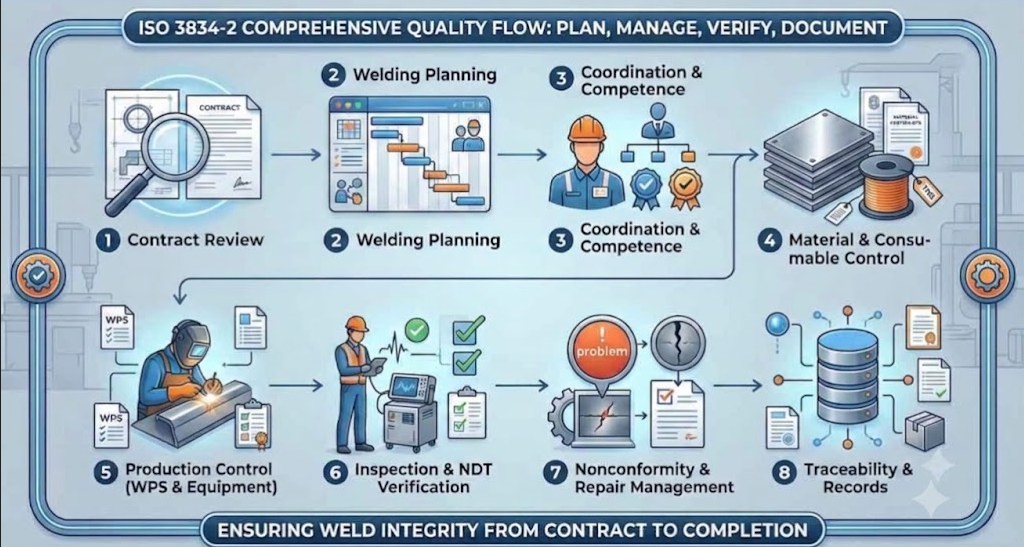
There may be weaknesses within the manufacturing process of a welded product. These may be due to a lack of appropriate welding procedure, loss of material identification or failure to demonstrate inspections. Manufacturers with critical or technically complex welded products need to implement controls to mitigate these risks and ensure welding quality is properly planned, managed and verified. ISO 3834-2 sets out the requirements for implementing full quality requirements for the fusion welding of metallic materials. It sets out how welding activities should be managed and controlled including technical review, personnel, welding procedures, material control, production management, inspection and quality records.
This guide will give you an overview of how to apply ISO 3834-2 requirements to a manufacture process.
What is ISO 3834-2?
ISO 3834 is a series of standards which set out quality requirements for the fusion welding of metallic materials. 3834-2 covers full quality requirements. It ensures that the entire welding process is considered and not just the appearance of the finished joint. Manufacturers need to ensure they have controls in place for planning, carrying out, inspecting and recording welding work in line with the applicable requirements.
ISO 3834-2 may be relevant to manufacturers involved in:
- Structural Steel / Aluminium Fabrication
- Pressure Equipment / Industrial Vessels
- Rail Vehicles / Welded Rail Components
- Heavy Engineering / Machinery Manufacture
- Pipeline / Plant
- Crane / Bridge / Industrial Equipment Fabrication
- Offshore / Other Complex Applications
Additional requirements may be set out in the applicable product standard, customer specification and regulatory requirements. ISO 3834-2 should be implemented in conjunction with the relevant technical requirements.
When should manufacturers consider full quality requirements?
The correct level of quality will depend on the product, application, complexity of manufacture, contractual requirements and applicable standards. ISO 3834-1 outlines criteria for selecting the correct level. Manufacturers may need to consider full quality requirements if the welding activity is complex with high inspection requirements or high levels of record keeping.
This should not just depend on the size of your company. A small manufacturer with a complex welded assembly may require high levels of controls. Other manufacturers may have different requirements.
Review:
- What type of product will be welded and what it will be used for
- What welding processes and materials will be used
- Applicable product and execution standards
- Customer specifications and contractual requirements
- Inspection, testing and record requirements
- Applicable certification scheme
- Use manufacturing requirements to decide what level is applicable.
Step 1 – Review Customer and Technical Requirements
Welding quality should be planned before beginning manufacture. You need to understand what your customer is asking for and what technical requirements apply to your work.
This may include reviewing:
- Engineering drawings
- Material requirements
- Welding details
- Tolerances
- Applicable standards
- Inspection requirements
- Delivery documentation
Your customer may require a specific grade of steel, weld detail, welding procedures to be qualified and some joints to be tested. If you do not identify this during your initial review you may end up using an inappropriate welding procedure or incomplete inspection requirements.
Document your review to ensure:
- The technical requirements are complete and consistent
- What welding procedures and qualifications are required
- What materials and consumables can be used
- What inspection and testing is required
- Whether there are specific controls required during manufacture or by subcontractors
- What records are required with the finished product
Any uncertainties should be addressed before manufacture. Any changes to drawings, materials or welding requirements should be reviewed.
Step 2 – Plan Welding Activities
Once you understand the requirements you need to plan how you will carry out your welding activity.
This can include identifying:
- What processes are required to manufacture
- What welding procedures are required
- Who will be required for the welding work
- When inspections will occur
Having a practical plan will ensure that the right controls are in place for each stage of manufacture. For example ensuring material identification is checked prior to cutting, joint preparation has been inspected prior to welding and welds will have the required inspections. If any activities will be carried out by a subcontractor you should plan this. If welding, heat treating or inspection is to be carried out by a subcontractor you should have a process in place to ensure requirements are communicated and work reviewed.
This will ensure that you know what requirements are required during manufacture.
Step 3 – Define Responsibilities and Competence
Welding quality will be determined by those responsible for planning, managing, carrying out and inspecting. Manufacturers should ensure roles are clear and people have the required competence.
Welding Coordination
Welding Coordination involves technical management and ensuring appropriate welding activities are taking place. You may have someone responsible for reviewing welding requirements, ensuring welding procedures are suitable and managing controls during manufacture. They may also be responsible for addressing technical welding issues. They should have the appropriate level of competence and authority to do this. They should know when to seek technical review.
Welders / Welding Operators
Those carrying out welding should have appropriate qualifications for the process, material, joint and requirements. Manufacturers should ensure they have valid qualifications for the work they are doing. Qualifications should be controlled to ensure supervisors can confirm they have the right qualifications.
Inspection
Those carrying out inspections should have appropriate competence for the work they are doing. If formal qualifications or certifications are required this should be confirmed. Having clear roles will help ensure there is no gap between manufacture, welding coordination and inspection.
Step 4 – Material and Welding Consumables Control
Material control is important to ensure that the finished weld and product meets the technical requirements. Using incorrect grades of material, incorrect batch of material or incorrect welding consumables can cause issues that can be difficult to rectify.
You should have a system to control your material. This will include:
- Purchase requirements
- Inspection upon receipt
- Review of certificates
- Identification
- Storage
- Issue to manufacture
If you have traceable material you should ensure that identification remains with the component during cutting and manufacture. If marking is required this should be done in a way that maintains traceability back to the material records. Welding consumables should be controlled in accordance with their requirements. Depending on the type and specification they may require identification, storage, handling and issue records.
Manufacturers should have processes in place to manage damaged, unidentifiable or non-conforming materials. These should not be used until they have been assessed and issues resolved.
Step 5 – Production Management
Welding should be carried out in accordance with the instructions and approved technical requirements.
Welding Procedure Control
A Welding Procedure Specification (WPS) will provide instructions for welding within the specified range. The procedure and basis for qualifying the procedure should be appropriate for the application. If the procedure needs to be qualified ensure you have the relevant records such as a Welding Procedure Qualification Record (WPQR).
Manufacturers should ensure that the correct WPS is being used by production personnel and that parameters and essential instructions are being followed.
Equipment Control
Equipment used for welding should be appropriate for the process and in good condition for manufacture. Measuring, monitoring and inspection equipment should be controlled in accordance with the requirements.
Any issues with the equipment should be identified and resolved. Having records of maintenance and verification can help show that controls are being applied.
Production Supervision
Supervisors should be able to confirm that materials, personnel, procedures and equipment are in line with the requirements. If they are not they should be referred to your technical/quality process. Any changes to the method of manufacture should not be applied informally if they may affect the validity of the welding procedure, conformity of the product or inspection requirements.
Step 6 – Inspection and Testing
Inspection and testing will provide evidence that manufacturing activities have produced results to the required acceptance criteria.
You should plan inspection requirements. This will include:
- What needs to be inspected
- When it needs to be inspected
- Who will be responsible
- How the results will be recorded
Depending on the product and requirements you may have:
- Joint preparation inspection
- In-process inspection
- Visual inspection
- Dimensional Inspection
- Non-Destructive Testing (NDT)
- Destructive testing (if required)
Review of required manufacturing and testing records
Not all welding products will require all of these inspections. The extent of inspection and acceptance criteria should be obtained from the applicable product standards, design, specifications and contractual requirements. Inspection records should include what product/joint was inspected, what method was used, what the result was and any relevant acceptance criteria. If the result is not acceptable you should follow your defined non-conformity process before releasing the product.
Step 7 – Managing Non-Conformities and Repairs
Issues can occur during manufacture even with a quality system in place. It is important to identify issues and ensure that work is controlled. This will ensure that products that are not suitable are not released.
These may include:
- Unacceptable weld indication
- Incorrect material identification
- Out of range welding parameters
- No evidence of inspection
This should be controlled by:
- Identifying what requirement has not been met
- Identifying what product/component/manufacture is affected
- Whether work needs to be held/identified
- Who has authority to assess the issue
- What actions can be taken to correct/repair
- What additional inspections/testing are required
- Are records complete and reviewed
If repairs are required they should be carried out using an appropriate approved method. Re-inspection/re-testing should be carried out in accordance with the requirements. Ensure that the issue and resolution are documented. If you identify any repeated issues you should look at the root cause. Corrective actions may be required to change training, work instructions, material handling, equipment controls or production supervision.
Step 8 – Production Records
Records will help to show that welding was controlled and the required inspections were carried out. Records should be accurate, identifiable, accessible and kept for the required period of time.
Depending on the product and extent of manufacture you may have:
- Technical/contract review records
- Drawings and approved amendments
- WPS/WPQR
- Welder/Welding Operator Qualifications
- Welding coordination
- Material and consumables records
- Equipment maintenance/verification
- Inspection/NDT reports
- Non-conformity/repair/re-inspection
- Final verification records
Traceability should be planned for. This may include linking material certificates, component identification, weld location, personnel, inspection results and the final assembly.
As a practical example can you pick a finished component and find the relevant records?
Example – Applying ISO 3834-2 to a Fabricated Assembly
A manufacturer is making a steel support frame using welding. The customer has provided drawings, material requirements and inspection requirements. The manufacturer reviews these requirements and identifies what welding procedures are required, what welding personnel should be qualified, what materials are required and what inspections are required. Upon receipt of material they check that the correct grades are being used and record the identification. During cutting any identification is transferred. The supervisor confirms that the correct WPS is available, the welders have the appropriate qualifications and that the joints have been prepared correctly. During manufacture the work is monitored and required inspections recorded.
Following welding the manufacturer completes the required visual and dimensional inspections. Additional testing is arranged in accordance with the product specification. If the weld does not meet the acceptance criteria the area is controlled, repaired using the defined process and the required re-inspection documented.
The quality team review the relevant records from production and inspection. They confirm that any issues have been resolved. This shows how welding quality controls are linked throughout the project. The aim is not just to have documentation but to ensure that everything is consistent.
Common Issues
Common issues when implementing full welding quality controls may include:
- Starting manufacture without reviewing requirements – This may result in using the incorrect procedures, missing inspections or late technical changes.
- Using unqualified personnel – Ensure that those carrying out work and procedures are suitable.
- Loss of material identification – This may cause issues with traceability.
- Only carrying out inspections at the end – Some inspections may need to be carried out before welding, during manufacture or before the component is no longer accessible.
- Incomplete records – Even if inspection was carried out the records may be incomplete or unclear.
- Not investigating repeated issues – If there are repeated defects there may be an issue with your planning, supervision, training or controls.
- Having a structured review internally can help identify any gaps.
Frequently Asked Questions
What does ISO 3834-2 cover?
ISO 3834-2 sets out full quality requirements for the fusion welding of metallic materials. It sets out how welding activities should be managed and controlled including technical review, personnel, procedures, materials, production, inspection and quality records.
Is ISO 3834-2 suitable for all welding manufacturers?
Not necessarily. The correct level of quality should be chosen depending on the product, complexity of manufacture, applicable standards and contractual requirements. ISO 3834-1 sets out criteria for choosing the correct level.
Does ISO 3834-2 require welders to be qualified?
Manufacturers should ensure that welding personnel have the correct level of competence and qualifications. The required qualification will depend on the welding process, product requirements and applicable standards.
What is the difference between ISO 3834-2 and ISO 3834-3?
ISO 3834-2 sets out full quality requirements whilst ISO 3834-3 sets out standard quality requirements. The correct level will depend on the application.
Is ISO 3834-2 the same as ISO 9001?
No. ISO 9001 refers to the overall quality management system for an organisation whilst ISO 3834 refers specifically to quality requirements for fusion welding. The two can compliment each other if relevant.
Related Searches
- ISO 3834 Certification Cost in India: Factors, Fees & Budget Guide
- ISO 3834 Latest Edition 2026: 2021 Revision, Current Status & What Welding Manufacturers Need to Know
- Which Industries and Manufacturers Need ISO 3834 Certification in India and International Markets? Top 10 Sectors That Need It
- ISO 3834 Certification for Structural Steel Fabricators in Malaysia
Conclusion
ISO 3834-2 provides a framework for managing full welding quality throughout manufacture. By linking technical requirements, competent personnel, controlled procedures, material identification, production management, inspection and records. Manufacturers should start by having a clear understanding of the product and requirements. Welding controls can then be included in the manufacture process. Roles should be defined and records kept to show how work was carried out and verified.
By having a systematic approach you can identify issues earlier, improve consistency and be better prepared for customer reviews.
Are you looking to plan how to assess your welding quality requirements?
First Welding Certification Pvt Ltd (PRVÁ ZVÁRAČSKÁ, a.s.) works in conformity assessment and certification. Understand the inspection documentation, material traceability and validation requirements relevant to your steel products and customer orders.