
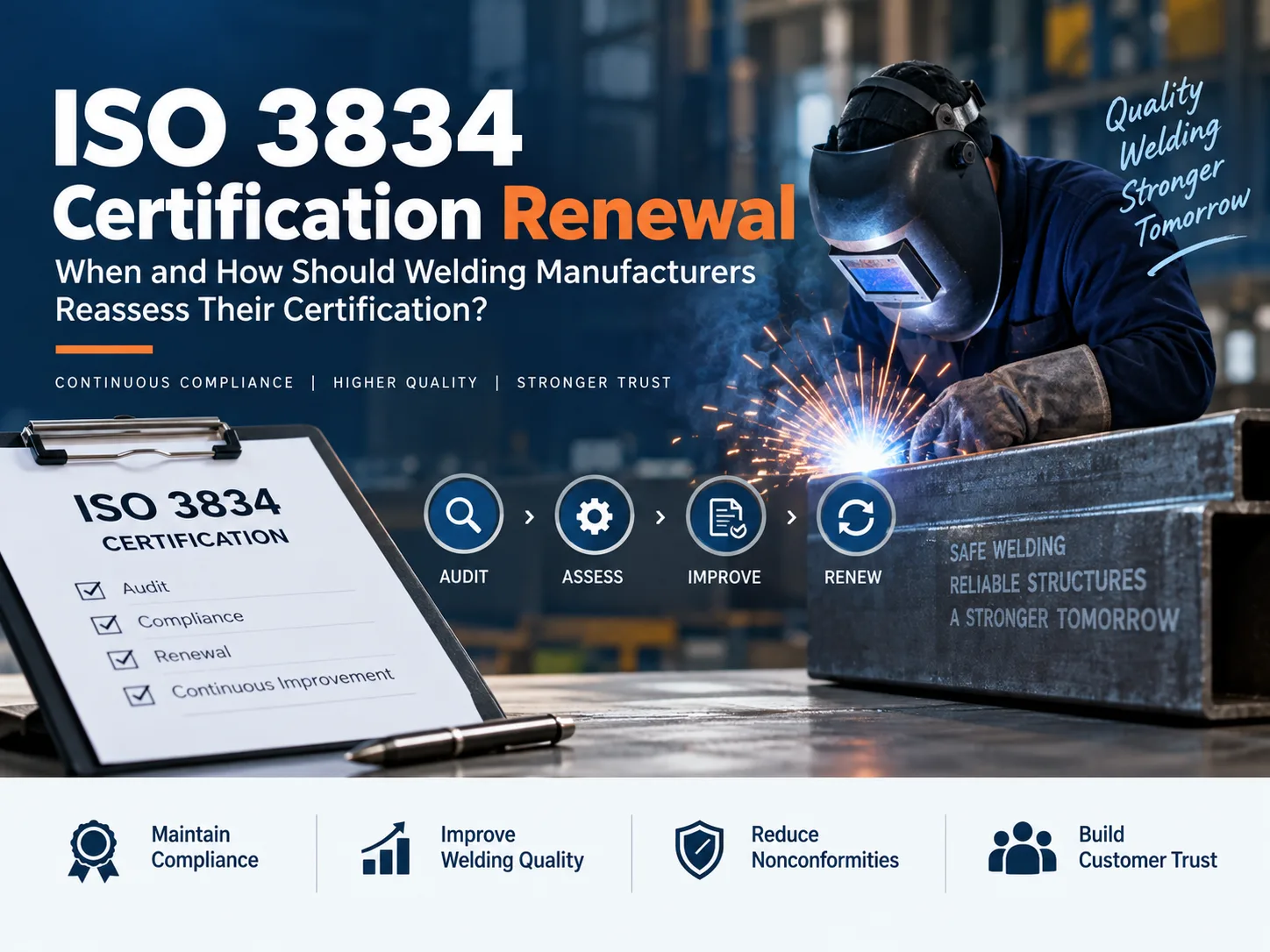
ISO 3834
RENEWAL
REASSESSMENT
17 Sep 2026
ISO 3834 Certification Renewal: When and How Should Welding Manufacturers Reassess Their Certification?
By Editorial Team
Table Of Contents
Related Blogs
SEP
15
Which Industries and Manufacturers Need ISO 3834 Certification in India and International Markets? Top 10 Sectors That Need It
SEP
12
Best Standard for Fusion Welding Quality Control: Why ISO 3834 Is Required for EN 1090 & EN 15085
SEP
08
ISO 3834 Latest Edition 2026: 2021 Revision, Current Status & What Welding Manufacturers Need to Know
AUG
24
ISO 3834 Certification Cost in India: Factors, Fees & Budget Guide
JLY
30
EN ISO 3834 Certification Requirements: What Welding Manufacturers Need to Know in 2026
See Also.....
ISO 3834 certification usually takes several years to complete. During this time, companies have yearly checks and a full review every three years. Some systems can extend this period to up to five years. If there are major changes in products or processes, serious issues found during audits, new laws, company mergers, or changes in the supply chain, the certification may need to be reviewed again. To prepare for renewal, businesses should do detailed internal checks, fix any problems found, and may also do a practice audit before the official one. Typical issues found during audits include missing records of welders, missing welding procedure specifications, poor tracking of materials, and repairs that aren’t properly documented. Manufacturers need to keep all welding records complete, such as welding procedure specifications, procedure qualification reports, welder and non-destructive testing certificates, material certificates, and inspection reports. It’s important to have a system that actively solves problems. They should also track key performance measures like how often welds are accepted and how often rework is needed. These should be reviewed regularly and discussed in management meetings. This guide covers basic information on ISO 3834, its purpose, timeframes, reasons for reassessments, steps for renewal, common issues, and key performance indicators.
ISO 3834 Overview: Parts, Scope & Applicability
ISO 3834 is a group of standards that focus on the quality of welding, and it’s different from ISO 9001. It covers rules for people, how welding is done, the tools used, checking the work, and keeping records.ISO 3834 has several parts:
ISO 3834-1: Helps choose the right quality level (Comprehensive, Standard, or Elementary) depending on how risky the product is; this part was updated to ISO 3834-1:2021.
ISO 3834-2: For high-quality welding that is very important, needing detailed plans and good records.
ISO 3834-3: For welding that is a bit complex but not extremely important, with controlled steps.
ISO 3834-4: For basic welding tasks that are simple and not very risky.
ISO 3834-5: Lists other important standards like ISO 9606, 14731, 15614, and 9712.
| Part | Title | Scope/Key Focus | Citation |
|---|---|---|---|
| ISO 3834-1 | Criteria for selecting level | How to choose between Parts 2 3 4 (based on product type and risk). | |
| ISO 3834-2 | Comprehensive quality requirements | Highest level (for critical/high-responsibility welding); demands thorough QA and records. | |
| ISO 3834-3 | Standard quality requirements | Mid-level (for medium complexity welds); adequate controls. | |
| ISO 3834-4 | Elementary quality requirements | Basic level (for simple or low-risk welds). | |
| ISO 3834-5 | Documents for conformity | References relevant welding standards (ISO 9606 etc.) required to implement Parts 2–4. |
ISO 3834 applies to both workshop and on-site welding. It is needed in certain situations, such as when welding structural steel that is CE-marked under EN 1090 or welding pressure equipment as required by the European PED. Although it is not legally required in industries like energy, automotive, rail, and oil & gas, clients often ask for it to ensure quality.To follow ISO 3834, companies must set up control systems, use approved welding methods, make sure welders are trained, keep track of materials, and plan inspections. This standard usually works with ISO 9001 quality management systems and includes specific rules for welding processes.
Certification Lifecycle & Renewal Timeline
Certification to ISO 3834 requires a series of audits. It starts with an initial audit that has two parts: the first part checks the written documents, and the second part is a visit to the workplace to check how things are done. After that, yearly audits are done to make sure the organization keeps following the rules. The certification lasts for three years. Organizations like Pacific Certifications and SQS require an annual audit and a full check at the end of the three years. LRQA offers a longer option, which is five years. The audit steps are:
Stage 1 Audit (Checking Documents): The certifier looks at the welding quality manual, procedure documents like WPS and PQR, staff qualifications, and the plan for making sure they follow the rules.
Stage 2 Audit (Checking On-site): The auditor visits the workplace, checks how welding is done, makes sure it follows the right procedures, looks at weld samples, reviews records like NDT results, material details, and equipment checks, and talks to the staff.
Surveillance Audits (Years 1 and 2): These are done each year and last about a day.
They check if the system is working well and document any changes made.
Recertification Audit (Year 3): This is a full check similar to the first one.
It ensures any issues are fixed before a new ISO 3834 certificate is issued for the next cycle.

A Gantt chart shows the ISO 3834 audit schedule. The first audit happens in January 2026. Then there are smaller audits in January 2027 and January 2028. The final audit, called the recertification audit, takes place in January 2029. After that, the cycle starts again. The exact dates may change depending on when the company is ready and when the auditor is available.
| Audit Type | Purpose | Approx. Timing | Notes |
|---|---|---|---|
| Initial Stage 1 | Review docs (WPS, qualifications, plans) | Before Stage 2 (could be combined) | Checks completeness, readiness. |
| Initial Stage 2 | On-site evaluation of implementation | Months 0–2 (after Stage 1) | Tests system on the shop floor. |
| Surveillance (Year 1) | Verify maintenance of system | ~12 months after certification | Annual check (often ~1 day) |
| Surveillance (Year 2) | Verify continued compliance | ~24 months after certification | Annual check (often ~1 day) |
| Recertification (Year 3) | Full re-audit for renewal | ~33–36 months after certification start | Similar scope to Stage 2; certificate renewed. |
Getting the final certificate usually takes 1 to 3 months. Pacificcert says it might take 4 to 10 weeks if all the documents are ready. If a company has complicated processes, it might take even longer.ISO 3834 requires an annual check and a re-certification audit at the end of the certification period. It’s important to plan a review 6 to 12 months before the certificate expires to make improvements and schedule the audit on time.
Triggers for Reassessment
Certain events may require a special check of the ISO 3834 system, even if there’s a regular schedule for updates.Let your certifier know if:
Scope Changes: Adding new products or welding methods can make your current certificate not complete.
For example, if you switch from working with structural steel to pressure vessels, you might need to change from ISO 3834-3 to ISO 3834-2.
Facility/Organizational Changes: Starting a new plant, working with subcontractors, or combining different fabrication sites means you need to review your quality management system again.
Personnel Changes: If you lose your qualified Welding Coordinator or someone important for NDT procedures or WPS, you must document this and do a new assessment based on ISO 3834.
Process Changes: Using any new technology, like automated systems or updated NDT techniques, should be reported because they affect process validation.
Major Nonconformities: Big issues found during an audit, such as poor control of procedures, could lead to quick action or a new audit.
Regulatory or Standards Updates: If there are changes in key rules or standards, like EN 1090 or ISO 3834, you need to update your system and possibly get checked by your certifier.
Customer/Supply-Chain Demands: If a major customer asks for higher certification standards, you may need to adjust.
Certificate Near Expiry: Start the renewal process six months before your certificate expires to make sure you get the audit on time.
In short, if there’s any big change that affects your welding quality system, you should let your certifier know.
They need to be informed so they can decide if more review is needed.
Renewal Process Step-by-Step
The process for renewing ISO 3834 is similar to other management systems, but it has special steps related to welding.
Management Review and Planning: – Meet with top management and important welding team members 6 to 12 months before the certificate ends.
– Look at internal audit results, customer feedback, process changes, and current welding activities.
Check for any missing parts and what resources are needed to renew.
Internal Audit: – Do a detailed check of the welding quality system using an ISO 3834 checklist.
– Make sure each Welding Procedure Specification (WPS) has a matching Welding Procedure Qualification Record (WPQR), check welder certifications, and keep material certificates.
– Find any problems and areas to improve.
Update procedures, records, or training as needed.
Pre-Assessment (Optional): – Think about doing a trial audit or hire an outside expert to do a practice audit.
This can show hidden issues like missing records.
– Do a self-audit with an ISO 3834 checklist to get ready for the real audit.
This step is not required.
Document Updates: – Change welding procedures, control plans, and the Welding Quality Manual to show what has changed since the last certification.
– Make sure all documents, like welder qualifications, equipment calibration records, and NDT certificates, are up to date and well-organized.
Stage 1 Audit (Document Review): – The certification body looks at updated documents, procedures, and records to check if the company is ready for the audit.
– Fix any small problems before moving to Stage 2.
Stage 2 Audit (On-site Evaluation): – Auditors visit the site and talk to welders and inspectors. They watch how WPS is used and check completed welds and records.
– Make sure the welding quality management system is being used properly.
Common issues might be missing records or not following the right procedures.
Corrective Actions: – Deal with nonconformity reports (NCRs) by finding the cause and writing down the fixes.
This often means updating procedures and retraining staff.
Certification Decision: – Renew the certificate after fixing major NCRs.
If everything is good, the certificate is sent out in a few weeks.
Post-Audit Follow-up: – Use the auditor’s feedback to improve the quality system.
Keep up with annual check-ups and update audit and management review plans.
Expert Tip:– Make a schedule for certification, assign someone to track each step, and use an audit checklist to manage everything better.
Common Audit Findings & Mitigation Strategies
ISO 9606-1/ASME IX
– Missing records or expired certificates are often discovered.
Solution: Keep a signed record showing each welder has done at least one weld within six months; use machines that track welding time by welder ID.
WPS Accessibility Failures:
– Approved welding plans (WPS) must be available on-site while welding is happening.
– Auditors often find WPSs kept in offices or not properly managed.
Solution: Keep printed or digital WPSs easily accessible on the shop floor; clearly label revision dates; use digital tools to send settings to welding machines.
Material Traceability Issues:
– It is common for materials or parts not to be properly connected to the final weld.
– Missing links between filler wire lots and jobs or base metal certificates are often found.
Solution: Label materials with unique IDs; link certificates to spools or plates; use traceability forms or barcodes; connect weld details with batch numbers using software.
– Undocumented Repairs/Nonconformances:
– Weld repairs sometimes lack proper documentation.
– Auditors require documented instructions and inspection reports.
Solution: Set up a repair control process; keep detailed records; ensure quality plans include “repair checks.”
Incomplete Welding Records:
– Auditors often find missing parts in production files, like incomplete PQRs or missing NDT reports.
Solution: Use a complete weld-pack system; collect all required documents after the job is done; use PZVAR’s checklist to ensure everything is included.
Ineffective Internal Audit/CAPA:
– Frequent internal audits and slow problem resolution are major concerns.
Solution: Plan yearly internal audits specifically for welding; track and fix audit findings; show effective issue handling during management reviews.
Conclusion: Keeping good records, proper planning, and a culture of documenting issues make external audits easier; using digital welding management tools helps with compliance and reporting.
Cost & Time Estimates; Resource Checklist
Estimating the resources needed to renew ISO 3834 depends on how big the operation is, how much work there is, and how mature the system is.Important factors include how many welders there are, what welding methods are used, where the work is done, and how complicated the products are.
Timeframe: Preparing internally usually takes 4 to 10 weeks, assuming all documents are ready and the operation is small or medium in size.
Things can go faster if procedures are already in place and welders are properly qualified.Larger companies with more than 50 welders and complex Procedure Qualification Records (PQRs) need more time, more audit days, and more documents.It’s best to start planning at least 6 months before the certificate expires to allow time for internal audits and fixing any issues.
Certification Fees: Costs for an external audit vary depending on the location and the certifier.
Usually, a 2- to 4-day audit with two 1-day follow-up visits costs between $5,000 and $15,000 USD.The cost goes up if there are many welding methods or multiple locations, or if the audit covers several standards.Combining ISO 3834 with another audit can help save money.
Internal Resources: Choose a project leader, like the Quality or Welding Coordinator, to handle internal audits, updating documents, and tracking Corrective and Preventive Actions (CAPA).
Get department leaders involved early and set aside money for internal preparation and external audit fees.
Resource Checklist: Before the audit starts, make sure these are all in place:
Welding Quality Management System Documentation:
– A Welding Quality Manual that explains the ISO 3834 system, including its scope, who is responsible, and how it works.
– Updated Welding Procedure Specifications (WPS) and Procedure Qualification Records (WPQR/PQR).
– Plans for inspection and testing activities.
– A document that identifies and confirms the qualifications of the Responsible Welding Coordinator.
Personnel Qualifications:
– Valid certificates for welders and operators, including ISO 9606, ASME IX, or equivalent national standards.
– Certifications for Non-Destructive Testing personnel, such as ISO 9712.
– Records showing welders have at least six months of experience.
– Proof that the appointed Welding Coordinator has the right qualifications, like IWE, IWT, IWS, or equivalent.
– Records of required training updates and completions.
Equipment and Material Records:
– Logs of calibration and maintenance for welding machines and tools.
– Material test certificates (EN 10204 3.1/3.2) for base metals.
– Certified test reports for filler materials and electrodes with traceability information.
– Records of environmental controls for moisture-sensitive materials.
Inspection and Test Records:
– Completed reports for non-destructive testing methods like Visual Testing (VT), Magnetic Particle Testing (MT), Penetrant Testing (PT), Ultrasonic Testing (UT), and Radiographic Testing (RT).
– Records of dimensional checks if included in the audit scope.
– Logs of in-process and final inspection reports.
Traceability Documentation:
– Job records that connect each weld with the welder, WPS used, consumables, material certificates, and inspection results.
Nonconformance and Repair Records:
– Reports on faulty welds and the corrective actions taken.
– Records of weld repairs, rechecks, and approvals.
Internal Audit and CAPA Records:
– Internal audit schedules, reports, and minutes from management reviews related to welding processes.
– Logs of corrective actions taken from previous audits to address nonconformances.
Management Review Outputs:
– Action plans and decisions from recent management reviews.
– Evidence that resource needs have been addressed and that the Quality Management System is meeting its goals.
Closure of Previous Audit Findings:
– Confirmation that issues found in past ISO 3834 audits have been resolved.
– Assurance that past nonconformances have been properly handled and will not happen again.
– Pacificcert focuses on managing documentation, qualifying personnel, and ensuring that processes work correctly to be ready for audits.
KPIs and Monitoring Cadence
To keep the ISO 3834 system working well, it’s important to set up and regularly check certain welding-related KPIs that match quality and process goals.These KPIs should be checked at least every quarter and during management meetings. Here are some examples:
Weld Quality Metrics: Look at the percentage of welds that pass the first inspection (either VT or UT) and count how many welding defects or reworks happen each month.
The goal is to have a first-pass yield of more than 98%.
Welder and Procedure Metrics: Keep track of how many welders are qualified versus those whose qualifications are about to expire.
Also check if welders are up to date with their training and how many active WPS/PQRs are in use.The aim is to make sure all welders are ready and able to do their jobs.
Inspection and NDT Results: Watch the number of welds rejected during NDT inspections and record any major problems.
The target is to have zero critical rejections and to quickly fix any minor issues that come up.
Process and Equipment: Note how much time equipment is not working and how often it gets properly calibrated.
Make sure all key machines are fully and on time calibrated.Also ensure that process settings like voltage and current are always followed correctly.
Audit and CAPA: Keep an eye on the results of internal audits over time, especially how fast non-conformities are fixed and how well the audit plan is followed.
The goal is to achieve 100% compliance.
Supply Chain: Check how many incoming material certificates are accepted versus returned, and how many suppliers have passed welding system assessments.
This helps in making sure that materials are properly traced and that suppliers are certified.
All these KPIs should be shown in a dashboard or spreadsheet.
They should be discussed during monthly or quarterly meetings, and trends should be reviewed during annual management reviews.If any KPIs show a negative trend, quick actions should be taken to show continuous improvement, especially for external audits.
Case Studies & Hypothetical Scenarios
A steel bridge company needed to move from ISO 3834-3 to ISO 3834-2 because new contracts required better welding for thicker steel. Six months before their certification ended, they did a check inside the company, found they needed more WPQR tests, and updated their welding quality manual. They looked at their processes first and fixed small problems. When they got recertified, the auditor saw that the changes were done, like doing new PQR tests and training welders for thicker plates.The renewal went well. The main point was that it’s important to make sure your certification level matches what your products need and to get ready for any changes in scope early on.
In a merger, Company A had ISO 3834-2 and Company B had ISO 3834-3.
They wanted one certification. They chose to bring the less detailed scope up to ISO 3834-2.Both companies did checks together, combined their welding quality management system documents, and trained their staff. The external auditor visited both places in one go and gave the merged company a single ISO 3834-2 certificate.
In another example, a fabrication shop found out about new EN 1090-1:2026 rules that needed more welding control, even though they had ISO 3834-4.
They moved up to ISO 3834-3, improved their training, and added a welding coordinator. They showed they were following the rules during the next audit. The main lesson was to keep up with changes in the rules so you’re not caught off guard.