
ISO 9001 CERTIFICATION
CERTIFICATION PROCESS
ASSESSMENT
ISO 9001 Certification: Requirements, Process, Assessment, Audit & 2026 Revision
By Technical Editorial Team
9 Min Read
10 Aug 2026
Table Of Contents
- What Is ISO 9001 Certification?
- What Is a Quality Management System?
- Who Can Be Certified to ISO 9001?
- ISO 9001 Principles and Requirements
- ISO 9001 Clauses 4 to 10
- ISO 9001 Certification Scope
- ISO 9001 Certification Process
- ISO 9001 Certification Timeline
- What Is Assessed During ISO 9001 Certification?
- ISO 9001 Documented Information and Objective Evidence
- Stage 1 vs Stage 2 Audit
- Nonconformity, Corrective Action
- ISO 9001 Certification Readiness Checklist
- ISO 9001 Certification cost, Duration and Benefits
- ISO 9001 and Other Industrial Standards
- ISO 9001:2015 and the 2026 Revision
- Conclusion
- Frequently Asked Questions
Key Takeaways
Implemented QMS
QMS Assessment
Defined Certification Scope
Requirements Fulfilled
A Quality Management System is not just about filling out forms.To get ISO 9001 certification, the system must be properly set up and checked in the areas that are being certified.
ISO 9001 is a globally recognized quality management standard.
It works for businesses of all sizes and across many industries, like manufacturing, engineering, and fabrication.
The latest version of the standard is ISO 9001:2015, and it has been updated with the 2024 Climate Action Amendment.
The next edition is currently in development and is expected to be released in September 2026.
Getting ISO 9001 certified is not just about applying and getting a certificate.
It involves checking the entire Quality Management System, including how processes work, the documented information, how the system is implemented, the proof of results, how performance is reviewed, and how improvements are made over time.
First Welding Certification Pvt Ltd offers ISO 9001 certification with IAF accreditation, following the proper assessment process.
The certificate is issued once all the required standards are checked and met.
For more information about accreditation, you can visit PZVAR Accreditation & Recognition and the International Accreditation Forum (IAF).
What is ISO 9001 Certification?
ISO 9001 certification is when an organization’s Quality Management System (QMS) is reviewed by an outside group to check if it follows the rules set by the ISO 9001 standard in a particular area.
The ISO 9001 standard provides clear guidelines on how to set up, use, maintain, and improve a QMS.
This standard outlines what a QMS must include and how it should work.
Getting ISO 9001 certified means that an independent expert checks whether the organization is actually following these rules.
Just having paper documents isn’t enough.
The company must show that it is actually using the system and can provide clear evidence that it works in key areas like leadership, purchasing, production, quality control, staff skills, product testing, supplier management, internal audits, performance reviews, problem solving, and continuous improvement.
The QMS should cover all important parts of the organization, not just the quality department.
What Is a Quality Management System?
A Quality Management System (QMS) is a collection of processes, roles, resources, and controls that help meet necessary requirements and increase customer satisfaction.
A manufacturing QMS can link these steps together:
Management → Purchasing → Production → Inspection → Delivery → Customer Feedback → Improvement
ISO 9001 uses a process-based approach that includes thinking about risks and using the PDCA cycle.
Important parts of a QMS are setting quality goals, assigning responsibilities, ensuring people have the right skills, managing operations, checking performance, doing internal audits, reviewing management decisions, taking corrective actions, and constantly improving.
Who Can Be Certified to ISO 9001?
ISO 9001 works for any size or kind of organization.
The area covered by the certification is based on the organization’s work, steps, and places.
Customer needs, agreements, and legal rules are also taken into account.
The organization has to show that it has carried out its processes and has real proof within the set area.
| Organization | Typical QMS Application |
|---|---|
| Manufacturing company | Production and process control |
| Engineering company | Engineering and operational processes |
| Fabrication company | Fabrication and quality control |
| MSME | Defined and controlled business processes |
| Large manufacturer | Integrated process management |
| Railway manufacturer | QMS and applicable customer requirements |
| Structural manufacturer | Manufacturing and technical processes |
| Pressure equipment manufacturer | Production and applicable product requirements |
ISO 9001 Principles and Requirements
ISO has identified seven key ideas for managing quality:
Customer Focus – Knowing what customers need and making sure those needs are met.
Leadership – Setting a clear direction and showing support for the quality management system.
Engagement of People – Making sure everyone involved is skilled and takes part actively.
Process Approach – Looking at connected processes as a whole system to manage them better.
Improvement – Always working to make the quality management system better.
Evidence-Based Decision Making – Making decisions based on useful data and information.
Relationship Management – Keeping good relationships with important outside partners.
ISO 9001 Clauses 4 to 10
| Clause | Main Area | Focus |
|---|---|---|
| 4 | Context | Organization, interested parties, QMS scope and processes |
| 5 | Leadership | Leadership, policy and responsibilities |
| 6 | Planning | Risks, opportunities and quality objectives |
| 7 | Support | Resources, competence and documented information |
| 8 | Operation | Operational planning and process control |
| 9 | Performance Evaluation | Monitoring, internal audit and management review |
| 10 | Improvement | Nonconformity, corrective action and improvement |
The seven principles form the basis for good quality management, and Clauses 4 to 10 explain the main requirements of ISO 9001 that companies must include in their quality management system.
ISO 9001 Certification Scope
The certification scope explains which activities, processes, and places are included in the QMS certification.
It may include:
– The organization’s activities
– The products and services they offer
– The processes they use
– The locations and departments involved
– The specific requirements that apply
– Any outsourced processes
– Any parts that are not covered or do not apply
The scope needs to clearly show what the organization’s QMS actually covers.
Organization → Activities → Processes → Locations → Certification Scope
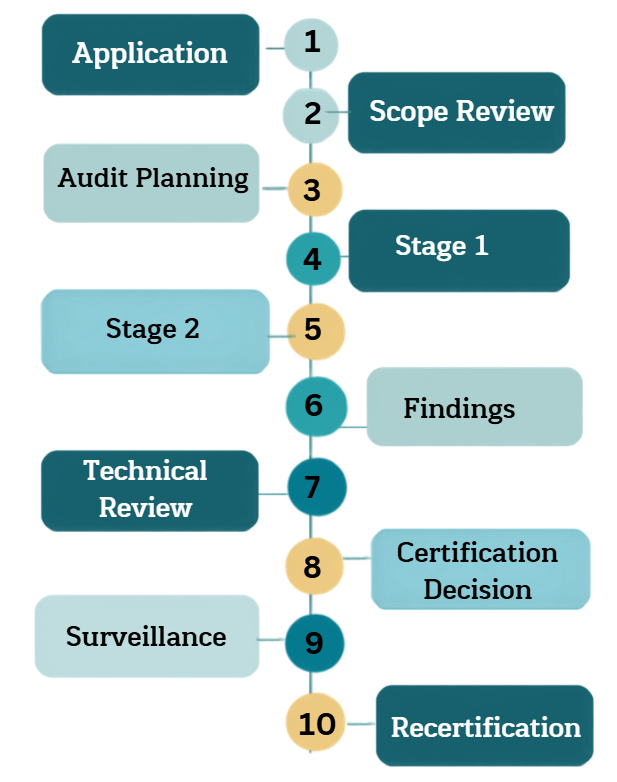
ISO 9001 certification is a process that follows a clear and organized path from the start to the end.
- First, the organization submits information about itself and its quality management system.
- Next, there is a review to check the details of the organization and the areas that will be covered by the certification.
- Then, the audit schedule and time frame are set.
- Stage 1 of the audit checks if the organization has the necessary information and is ready for the audit.
- Stage 2 of the audit looks at how well the quality management system is actually being used and whether it is working effectively.
- Any issues found during the audit are written down and fixed.
- The audit records are then checked to make sure they are correct and complete.
- After all the requirements are met, a decision is made by someone authorized to grant the certification.
- Surveillance audits are done regularly to make sure the system continues to meet the standards.
- Finally, for recertification, the system is checked again to ensure it still works well and meets the needed standards.
ISO 9001 Certification Timeline
What Is Assessed During ISO 9001 Certification?
An ISO 9001 audit looks beyond just paperwork.The auditor checks real examples of how the processes are actually being carried out within the certified area.
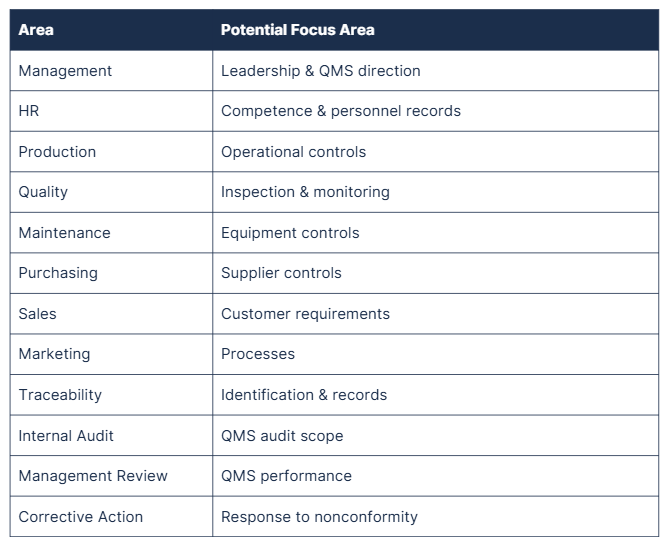
The evaluation might include important areas like management, human resources, production, quality control, maintenance, sales, marketing, buying, and product tracking, based on what is covered by the certification.
Assessment Framework
First, there is a clear process, then the process is put into action, followed by collecting real proof of what is done.
Then, there is ongoing checking, looking at how well things are going, and making changes to improve.
So, when getting ready, it’s important to focus on the actual processes that are in place and the proof you have, not just the paperwork alone.
ISO 9001 Documented Information and Objective Evidence
Documented information is important, but just having documents isn’t enough to show that a quality management system is working well.
Depending on the area being covered, the records might include things like:
– The organization’s quality policy and goals
– Process and customer needs
– Records about purchasing and suppliers
– Records from production, inspection, and equipment calibration
– Records showing staff competence and training
– Records from internal audits and management reviews
– Records of customer complaints and problems
– Records of corrective actions and performance results
– Records for traceability
The main question to ask is:
“Can the organization show, with real evidence, that its quality management system is properly carried out and works well?”
If there are extra requirements, other standards may also apply, such as ISO 15614 for welding processes, ISO 9606-1 for welder qualifications, and ISO 9712 for non-destructive testing personnel.
| Stage 1 | Stage 2 |
|---|---|
| Review QMS information | Evaluate QMS implementation |
| Review organizational context | Evaluate process effectiveness |
| Review interested parties | Examine operational control |
| Review certification scope | Evaluate customer requirement |
| Review quality policy/objectives | Review monitoring and measurement |
| Review internal audit status | Review internal audit implementation |
| Review management review status | Review management review |
Nonconformity, Corrective Action
A nonconformity happens when a requirement isn’t met.
During an ISO 9001 audit, the findings are checked against the relevant requirements and supported by real evidence.
Some common places where nonconformities might happen include:
– Not having complete records
– Not controlling documented information properly
– Not having clear responsibilities
– Not enough monitoring
– Problems with controlling suppliers
– Missing inspection records
– Not doing internal audits properly
– Not keeping good records of management reviews
– Not fixing identified nonconformities
The organization needs to find out why the nonconformity happened, take proper steps to fix the issue, and keep proof of what was done, as required by the certification standards.
Fixing the problem should focus on why it happened and how to prevent it from happening again, not just on fixing one record.
ISO 9001 Certification Readiness Checklist
Before an ISO 9001 certification audit, an organization can review:
Area | Check |
QMS scope | ☐ |
Organizational context | ☐ |
Interested parties | ☐ |
Quality policy | ☐ |
Quality objectives | ☐ |
Process identification | ☐ |
Risks and opportunities | ☐ |
Customer requirements | ☐ |
Contract/order review | ☐ |
Supplier control | ☐ |
Production/operation control | ☐ |
Competence records | ☐ |
Monitoring and measurement | ☐ |
Calibration, where applicable | ☐ |
Internal audit | ☐ |
Management review | ☐ |
Nonconformity control | ☐ |
Corrective action | ☐ |
Performance evaluation | ☐ |
Continual improvement | ☐ |
Required documented information | ☐ |
Objective evidence | ☐ |
The checklist should be adapted to the organization’s activities and certification scope.
ISO 9001 Certification Cost, Duration and Benefits
ISO 9001 Certification Cost
There is no one-size-fits-all cost for ISO 9001 certification.
The price depends on several factors like:
– Size of the organization
– Number of employees
– Certification scope
– Number of locations
– Complexity of processes
– Length of the audit
– Specific certification requirements
So, the cost should be based on the actual details of the organization, not a standard price.
How Long Does ISO 9001 Certification Take?
The time it takes depends on how ready the organization is with its quality management system, the scope of certification, its size, number of locations, and how complex the processes are.
The general process includes:
Application → Scope Review → Audit Planning → Stage 1 → Stage 2 → Findings (if any) → Technical Review → Certification Decision
After certification, there are regular checks called surveillance assessments to make sure the organization continues to follow the standards.
Then, recertification happens according to the set schedule.
Benefits of ISO 9001 Certification
ISO 9001 certification can help organizations by:
– Providing clear and controlled processes for their quality management system.
– Building customer trust with independent proof that they meet ISO 9001 standards.
– Enhancing control over important processes through better monitoring and review.
– Supporting ongoing improvement through organized ways to fix problems and get better results.
– Opening up new business chances, as some customers or contracts may require this certification.
ISO 9001 and Other Industrial Standards
ISO 9001 offers a general framework for a quality management system.It does not automatically take the place of specific requirements related to products, welding, personnel certification, or regulations.
Standard | Primary focus |
ISO 9001 | Quality Management System |
EN ISO 3834 | Welding quality requirements |
EN 1090 | Structural steel and aluminium execution |
Railway welding | |
Pressure equipment | |
Simple pressure vessels | |
Structural steel products | |
Inspection documents | |
NDT personnel | |
Welding procedure qualification | |
Welding personnel qualification |
Welding manufacturers should look into EN ISO 3834 certification.
Structural manufacturers need EN 1090 certification.
Railway organizations should check EN 15085 certification.
For pressure equipment, PED certification and SPVD certification apply.
Structural steel products require EN 10025-1 certification.
For inspection documentation, EN 10204 3.2 certification is needed.
Welding personnel must obtain Welder Certification.
ISO 9001:2015 and the 2026 Revision
As of August 2026, ISO 9001:2015 is still the officially published fifth edition of the standard.
In February 2024, ISO released ISO 9001:2015/Amd 1:2024, which includes changes related to climate action.
ISO currently lists the sixth edition of ISO 9001 as being in the publishing process, with a planned release date of September 2026.
Because of this, organizations should be aware of the difference between:
Current published standard:
ISO 9001:2015 with the 2024 amendment
Upcoming edition:
ISO 9001, sixth edition, set to be published in September 2026
Organizations that are currently certified to ISO 9001:2015 will need to take into account the transition arrangements once the updated standard is released and the transition requirements are made clear.
ISO has stated that certified organizations will be given a transition period to move to the new edition.
Conclusion
ISO 9001 certification offers an independent check on how well an organization’s Quality Management System works, based on the specific areas covered by the certification.
For companies that make products, design engineering solutions, or create fabricated parts, good quality management depends on how well they set up, carry out, check, and improve their processes throughout the whole organization.
A strong Quality Management System brings together people, the steps involved, who is responsible for what, the resources used, and clear proof of results.
This helps create a well-organized way to manage quality.
As the ISO 9001 standard prepares for its next version in 2026, businesses should keep working on making their current Quality Management System work well and stay updated with any changes to the new requirements.
In the end, ISO 9001 certification isn’t just about having written procedures.
It’s about showing that the organization’s Quality Management System is actually put into action, controlled, checked, and kept improving within the areas it’s certified for.
Frequently Asked Questions
Is ISO 9001 the same as a Quality Management System?
No.
ISO 9001 specifies requirements for a Quality Management System. The QMS is the organization’s established system of processes, responsibilities, controls and documented information used to manage quality.
Is ISO 9001 certification mandatory?
ISO 9001 certification is not universally mandatory. Its applicability may arise from customer requirements, contracts, tenders, supply-chain requirements, regulatory conditions or organizational decisions.
Can a small manufacturing company obtain ISO 9001 certification?
Yes. ISO 9001 can be applied to organizations of different sizes and sectors. The QMS scope and processes should reflect the organization’s actual activities.
Is documentation alone sufficient for ISO 9001 certification?
No.
The organization must demonstrate implementation and conformity through appropriate objective evidence.
Planning for ISO 9001 Certification?
First Welding Certification Pvt Ltd (PRVÁ ZVÁRAČSKÁ, a.s.) offers ISO 9001 certification that is recognized by IAF, following the proper assessment process.
The certification is given once the organization’s Quality Management System has been checked against the required standards and all necessary certification conditions have been met.
If your company is thinking about getting ISO 9001 certification, please share your business activities, locations, and the areas you want to be certified in.
This helps us figure out the right steps for your certification.