
ISO 9001
CHECKLIST
MALAYSIA
22 Sep 2026
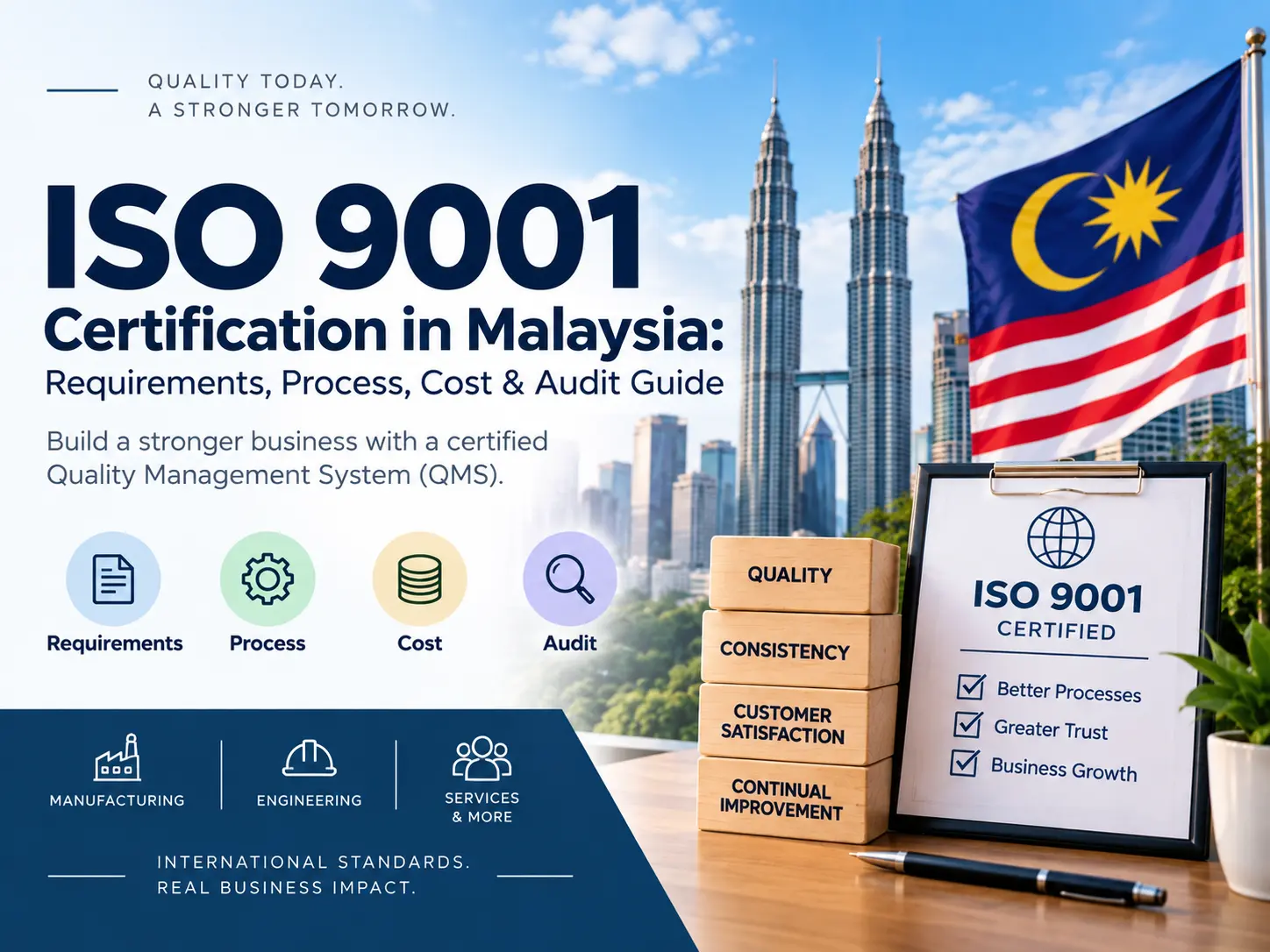
ISO 9001 Certification in Malaysia: Requirements, Process, Cost & Audit Guide
By Editorial Team
Table Of Contents
- What Is ISO 9001 Certification?
- Why Is ISO 9001 Important for Malaysian Companies?
- ISO 9001:2026 in Malaysia
- ISO 9001 Requirements
- ISO 9001 Certification Process in Malaysia
- ISO 9001 Audit Preparation
- ISO 9001 Certification Cost in Malaysia
- How to Choose a Certification Body in Malaysia
- ISO 9001 for Malaysian Manufacturers
- Conclusion
- Frequently Asked Questions
Related Blogs
SEP
17
How Does Documented Information Help With ISO 9001 Certification for Manufacturing Companies?
See Also.....
ISO 9001 certification in Malaysia helps companies set up a clear Quality Management System (QMS) to consistently meet customer needs, manage their processes better, and improve how well their business performs.
This standard is useful for many types of businesses, including those in manufacturing, engineering, construction, automotive, logistics, technology, and services.
Now that ISO 9001:2026 has been released, Malaysian companies should also take the new requirements into account when setting up a new QMS or moving from ISO 9001:2015.
What Is ISO 9001 Certification?
ISO 9001 is an international standard that sets guidelines for Quality Management Systems. To get certified, an organization goes through an independent check to see if their QMS meets the standard’s requirements.
Having a certified QMS helps organizations create clear and organized ways to:
– Control quality
– Keep customers happy
– Handle risks
– Keep an eye on processes
– Fix problems when they happen
– Keep improving over time
ISO 9001 certification is usually optional, but some customers, contracts, or supply chain rules might require it.
Why Is ISO 9001 Important for Malaysian Companies?
For Malaysian businesses that work with both local and global customers, ISO 9001 can help show they have a reliable way of managing quality.
Some main advantages are:
– Having more consistent processes
– Building more trust with customers
– Managing risks more effectively
– Keeping better control over suppliers and processes
– Handling issues or mistakes more efficiently
– Always looking for ways to improve
– Being recognized around the world
For companies that make products, ISO 9001 can also help with controlling production, checking quality, tracking products, managing suppliers, and dealing with customer complaints.
ISO 9001:2026 in Malaysia
ISO 9001:2026 came out on September 16, 2026, and it replaces ISO 9001:2015. This new version keeps the main ideas of quality management but adds more focus on certain areas like:
– Leadership and creating a culture of quality
– Identifying risks and opportunities
– Understanding the organization’s context
– Improving performance
– Keeping up with continuous improvement
If your company is already certified under ISO 9001:2015, you should check your quality management system and work with your certification body to move to the new standard.
ISO 9001 Requirements
The main ISO 9001 requirements cover:
| Area | Key Focus |
|---|---|
| Context | Organization, interested parties and QMS scope |
| Leadership | Quality policy and management commitment |
| Planning | Objectives, risks and opportunities |
| Support | Resources, competence and documented information |
| Operation | Process planning and operational control |
| Performance Evaluation | Monitoring, measurement, audits and management review |
| Improvement | Corrective action and continual improvement |
The quality management system should show the real processes and risks of the organization, not just use standard documents.
ISO 9001 Certification Process in Malaysia
The certification process usually includes:
First, you figure out what parts of the organization will be included in the quality management system.
This means deciding which activities, products, services, and locations are covered.
Next, you check how your current processes match up with the ISO 9001 standards.
This helps you find any areas where you’re not meeting the requirements.
Then, you set up the quality management system.
This involves creating the necessary processes, controls, goals, records, and written information.
After that, you do an internal audit to see if the QMS is working well and to find any areas that need improvement.
Top management then looks at how well the QMS is performing, the results of the audit, customer feedback, and any chances to improve.
There are two main audits.
The first one checks if the organization is ready and if the QMS documents are in place.The second one checks if the QMS is actually being used and how well it’s working.
Finally, any issues found during the audits are fixed before the certification decision is made and the certificate is issued.
ISO 9001 Audit Preparation
Before a Malaysia ISO 9001 audit, companies should check:
– Quality management system documents
– Quality goals
– Internal audit results
– Management review records
– Customer comments
– Actions taken to fix problems
– Staff skills and training
– Control of suppliers
– Records of process performance
Auditors check for real proof that the QMS is actually used, not just that papers are there.
ISO 9001 Certification Cost in Malaysia
There is no single set price for ISO 9001 certification in Malaysia.
The cost can vary depending on several factors such as:
– The number of employees
– The scope of the certification
– The number of locations
– How complex the processes are
– The level of quality management system maturity
– How long the audit takes
– Which certification body is used
– The requirements for surveillance and recertification
Because of these differences, organizations should ask for a quote that matches their specific needs and scope.
How to Choose a Certification Body in Malaysia
When choosing an ISO 9001 certification body, think about these things:
– Make sure the body is properly accredited.
– Check what areas the certification covers.
– Ensure the auditors are qualified and skilled.
– Look for experience in your industry.
– Understand how the audit process works.
– Review how certification and ongoing checks are handled.
– Check if the pricing is clear and fair.
The Department of Standards Malaysia (JSM) offers details about approved conformity-assessment organizations, which can help businesses check if a certification body is trustworthy.
ISO 9001 for Malaysian Manufacturers
ISO 9001 can help Malaysian manufacturers improve:
– Production control
– Inspection and testing
– Material traceability
– Supplier management
– Employee competence
– Handling of nonconformities
– Managing customer complaints
– Taking corrective actions
– Process performance
This makes ISO 9001 especially useful for manufacturers who supply products to customers both within Malaysia and in other international markets.
Conclusion
ISO 9001 certification in Malaysia helps companies set up a clear system for managing quality, making their processes better, and meeting what customers need.
For businesses working towards certification, the main steps are:
Set the scope → Check for gaps → Set up the quality management system → Do an internal review → Have management check on progress → First stage of certification → Second stage of certification → Fix any issues found → Get certified
Since the new ISO 9001:2026 has been released, companies in Malaysia should look at their current quality management system and plan for the changes.
If your company is getting ready for ISO 9001 certification or moving to ISO 9001:2026, PZVAR can help you through the process with a clear plan and assessment.
Frequently Asked Questions
Is ISO 9001 certification mandatory in Malaysia?
Generally, no. However, customers, contracts or industry requirements may require certification.
How much does ISO 9001 certification cost in Malaysia?
There is no fixed cost. It depends on factors such as organization size, scope, locations and audit requirements.
How long does ISO 9001 certification take?
The timeline varies depending on QMS readiness, organization size, process complexity and audit findings.
What is ISO 9001:2026?
ISO 9001:2026 is the latest edition of the Quality Management Systems standard, published on 16 September 2026.
Can manufacturers in Malaysia obtain ISO 9001 certification?
Yes. ISO 9001 is applicable to manufacturing companies as well as organizations across many other industries.