
Table Of Contents
- What Is ISO 9001 Certification?
- What Is a Quality Management System?
- Who Can Be Certified to ISO 9001?
- ISO 9001 Principles and Requirements
- ISO 9001 Clauses 4 to 10
- ISO 9001 Certification Scope
- ISO 9001 Certification Process
- ISO 9001 Certification Timeline
- What Is Assessed During ISO 9001 Certification?
- ISO 9001 Documented Information and Objective Evidence
- Stage 1 vs Stage 2 Audit
- Nonconformity, Corrective Action
- ISO 9001 Certification Readiness Checklist
- ISO 9001 Certification cost, Duration and Benefits
- ISO 9001 and Other Industrial Standards
- ISO 9001:2015 and the 2026 Revision
- Conclusion
- Frequently Asked Questions
Key Takeaways
Implemented QMS
QMS Assessment
Defined Certification Scope
Requirements Fulfilled
A Quality Management System is more than documents. To obtain ISO 9001 certification, the QMS should be implemented and evaluated within the certified scope.
ISO 9001 is an internationally recognized Quality Management System standard applicable to organizations of different sizes and fields, including manufacturing, engineering and fabrication.
The latest version is ISO 9001:2015, supplemented by the 2024 Climate Action Amendment. The sixth edition is in preparation, with publication scheduled for September 2026.
ISO 9001 certification is not simply an application and certificate. It involves assessment of the QMS, including processes, documented information, implementation, objective evidence, performance evaluation and continual improvement.
First Welding Certification Pvt Ltd provides ISO 9001 Certification with IAF Accreditation following the applicable assessment process. The certificate is issued when the relevant requirements are evaluated and fulfilled.
For accreditation details, visit PZVAR Accreditation & Recognition and the International Accreditation Forum (IAF).
What is ISO 9001 Certification?
ISO 9001 certification is the independent certification of an organization’s Quality Management System (QMS) against applicable ISO 9001 requirements within a defined scope.
ISO 9001 sets requirements for establishing, implementing, maintaining and continually improving a QMS.
ISO 9001 Standard: Defines QMS requirements.
ISO 9001 Certification: Independently assesses conformity with those requirements.
Documents alone are not enough. The organization must demonstrate implementation and objective evidence across relevant processes, such as leadership, purchasing, production, quality, competence, inspection, supplier control, internal audit, management review, corrective action and continual improvement.
The QMS should operate across relevant organizational processes, not only within the quality department.
What Is a Quality Management System?
A Quality Management System (QMS) is a set of processes, responsibilities, resources and controls used to meet applicable requirements and improve customer satisfaction.
A manufacturing QMS can connect:
Management → Purchasing → Production → Inspection → Delivery → Customer Feedback → Improvement
ISO 9001 uses a process approach supported by risk-based thinking and PDCA.
Key QMS elements include quality objectives, responsibilities, competence, operational control, monitoring, internal audit, management review, corrective action and continual improvement.
Who Can Be Certified to ISO 9001?
ISO 9001 is applicable regardless of organization size or type.
The certification scope depends on the organization’s activities, processes and locations.
Customer, contractual and statutory requirements are also considered.
The organization must demonstrate implemented processes and objective evidence within the defined scope.
| Organization | Typical QMS Application |
|---|---|
| Manufacturing company | Production and process control |
| Engineering company | Engineering and operational processes |
| Fabrication company | Fabrication and quality control |
| MSME | Defined and controlled business processes |
| Large manufacturer | Integrated process management |
| Railway manufacturer | QMS and applicable customer requirements |
| Structural manufacturer | Manufacturing and technical processes |
| Pressure equipment manufacturer | Production and applicable product requirements |
ISO 9001 Principles and Requirements
ISO identifies seven quality management principles:
- Customer Focus – Understanding and meeting customer requirements.
- Leadership – Establishing direction and commitment to the QMS.
- Engagement of People – Ensuring competent and involved personnel.
- Process Approach – Managing interconnected processes as a system.
- Improvement – Continually improving QMS effectiveness.
- Evidence-Based Decision Making – Using relevant data and information.
- Relationship Management – Managing relevant external relationships.
ISO 9001 Clauses 4 to 10
| Clause | Main Area | Focus |
|---|---|---|
| 4 | Context | Organization, interested parties, QMS scope and processes |
| 5 | Leadership | Leadership, policy and responsibilities |
| 6 | Planning | Risks, opportunities and quality objectives |
| 7 | Support | Resources, competence and documented information |
| 8 | Operation | Operational planning and process control |
| 9 | Performance Evaluation | Monitoring, internal audit and management review |
| 10 | Improvement | Nonconformity, corrective action and improvement |
The seven principles provide the foundation for effective quality management, while Clauses 4–10 define the core ISO 9001 requirements that organizations need to address within their QMS.
ISO 9001 Certification Scope
The certification scope defines the activities, processes and locations covered by the QMS certification.
It may consider:
- Organizational activities
- Products and services
- Processes
- Locations and departments
- Applicable requirements
- Outsourced processes
- Relevant exclusions or non-applicability
The scope should accurately reflect the organization’s actual QMS coverage.
Organization → Activities → Processes → Locations → Certification Scope
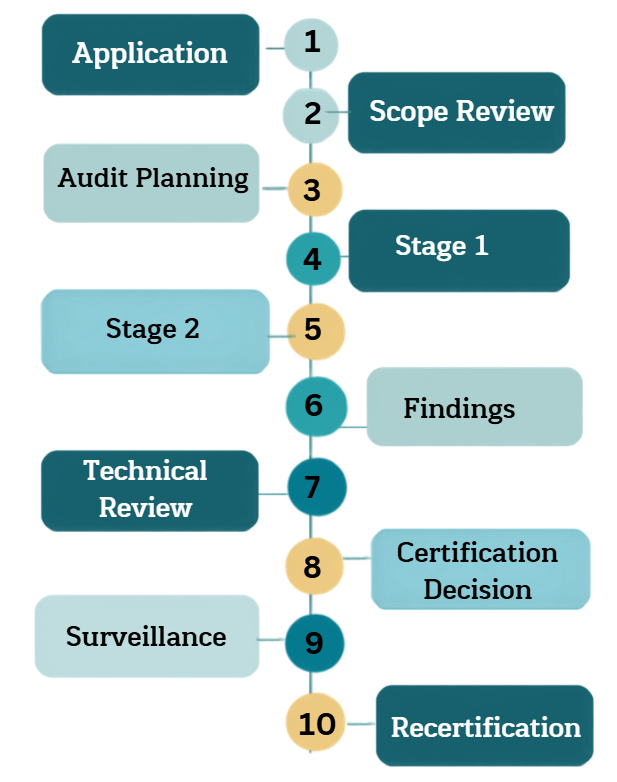
ISO 9001 certification involves a structured assessment process from application through surveillance and recertification.
- Application – Organization and QMS details are submitted.
- Scope Review – Organization details and certification scope are reviewed.
- Audit Programme – Audit duration and programme are determined.
- Stage 1 – QMS information and readiness are evaluated.
- Stage 2 – QMS implementation and effectiveness are assessed.
- Findings & Corrective Action – Applicable findings are recorded and addressed.
- Technical Review – Audit documentation is technically reviewed.
- Certification Decision – An authorized decision is made after requirements are fulfilled.
- Surveillance – Continued conformity and implementation are evaluated.
- Recertification – Continued suitability, adequacy and effectiveness are evaluated.
ISO 9001 Certification Timeline
What Is Assessed During ISO 9001 Certification?
An ISO 9001 assessment goes beyond documents. The assessor evaluates objective evidence of implemented processes within the certification scope.
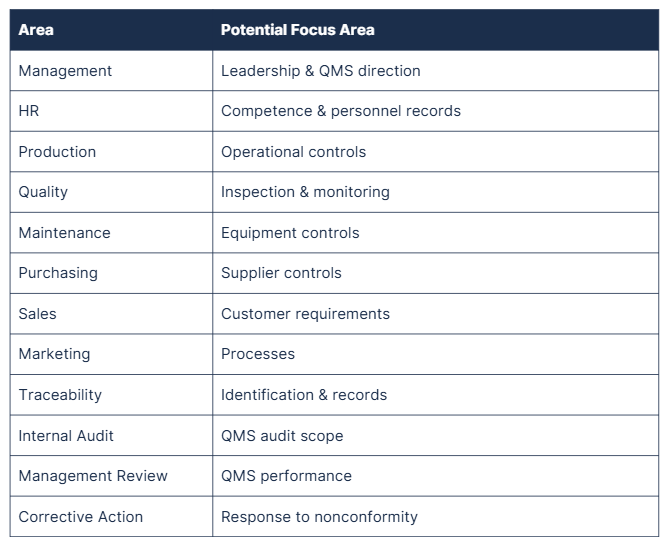
The assessment may cover relevant functions such as management, HR, production, quality, maintenance, sales, marketing, purchasing and traceability, depending on the certification scope.
Assessment Framework
Defined Process → Implementation → Objective Evidence → Monitoring → Evaluation → Improvement
Therefore, preparation should focus on implemented processes and evidence, not documents alone.
ISO 9001 Documented Information and Objective Evidence
Documented information is important, but documents alone do not demonstrate effective QMS implementation.
Depending on the scope, records may include:
- Quality policy and objectives
- Process and customer requirements
- Purchasing and supplier records
- Production, inspection and calibration records
- Competence and training records
- Internal audit and management review records
- Customer complaints and nonconformities
- Corrective action and performance records
- Traceability records
The key question is
“Can the organization demonstrate that its QMS processes are implemented and effective through objective evidence?”
Where additional requirements apply, other standards may also be relevant, such as ISO 15614 for welding procedures, ISO 9606-1 for welder qualification and ISO 9712 for NDT personnel.
| Stage 1 | Stage 2 |
|---|---|
| Review QMS information | Evaluate QMS implementation |
| Review organizational context | Evaluate process effectiveness |
| Review interested parties | Examine operational control |
| Review certification scope | Evaluate customer requirement |
| Review quality policy/objectives | Review monitoring and measurement |
| Review internal audit status | Review internal audit implementation |
| Review management review status | Review management review |
Nonconformity, Corrective Action
A nonconformity occurs when a requirement is not fulfilled.
During an ISO 9001 audit, findings are evaluated against the applicable requirements and objective evidence.
Examples of areas where nonconformities may occur include:
- Incomplete records
- Uncontrolled documented information
- Unclear responsibilities
- Inadequate monitoring
- Supplier control issues
- Missing inspection records
- Incomplete internal audit implementation
- Inadequate management review records
- Failure to address identified nonconformities
The organization should determine the cause of relevant nonconformities, implement appropriate corrective action and retain evidence of the action taken according to the applicable certification requirements.
Corrective action should address the identified problem and its cause rather than simply correcting an individual record.
ISO 9001 Certification Readiness Checklist
Before an ISO 9001 certification audit, an organization can review:
Area | Check |
QMS scope | ☐ |
Organizational context | ☐ |
Interested parties | ☐ |
Quality policy | ☐ |
Quality objectives | ☐ |
Process identification | ☐ |
Risks and opportunities | ☐ |
Customer requirements | ☐ |
Contract/order review | ☐ |
Supplier control | ☐ |
Production/operation control | ☐ |
Competence records | ☐ |
Monitoring and measurement | ☐ |
Calibration, where applicable | ☐ |
Internal audit | ☐ |
Management review | ☐ |
Nonconformity control | ☐ |
Corrective action | ☐ |
Performance evaluation | ☐ |
Continual improvement | ☐ |
Required documented information | ☐ |
Objective evidence | ☐ |
The checklist should be adapted to the organization’s activities and certification scope.
ISO 9001 Certification Cost, Duration and Benefits
ISO 9001 Certification Cost
There is no fixed ISO 9001 certification cost for every organization. The applicable cost depends on factors such as:
- Organization size
- Number of employees
- Certification scope
- Number of locations
- Process complexity
- Audit duration
- Applicable certification requirements
Therefore, the certification arrangement should be determined based on the organization’s actual details rather than a standard price.
How Long Does ISO 9001 Certification Take?
The duration varies according to the organization’s QMS readiness, scope, size, locations and process complexity.
The overall process generally follows:
Application → Scope Review → Audit Planning → Stage 1 → Stage 2 → Findings, if applicable → Technical Review → Certification Decision
After certification, surveillance assessments are conducted to evaluate continued conformity and implementation, followed by recertification according to the applicable certification cycle.
Benefits of ISO 9001 Certification
ISO 9001 certification can provide organizations with:
- Structured Processes – Clearly defined and controlled QMS processes.
- Customer Confidence – Independent evidence of conformity to ISO 9001 requirements.
- Better Process Control – Improved monitoring and evaluation of relevant activities.
- Continual Improvement – A structured approach to corrective action and improvement.
- Business Opportunities – Certification may be required by customers, contracts, tenders or supply chains.
ISO 9001 and Other Industrial Standards
ISO 9001 provides a general Quality Management System framework. It does not automatically replace product-specific, welding-specific, personnel-certification or regulatory requirements.
Standard | Primary focus |
ISO 9001 | Quality Management System |
EN ISO 3834 | Welding quality requirements |
EN 1090 | Structural steel and aluminium execution |
Railway welding | |
Pressure equipment | |
Simple pressure vessels | |
Structural steel products | |
Inspection documents | |
NDT personnel | |
Welding procedure qualification | |
Welding personnel qualification |
For welding manufacturers, see EN ISO 3834 certification.
For structural manufacturers, see EN 1090 certification.
For railway organizations, see EN 15085 certification.
For pressure equipment, see PED certification and SPVD certification.
For structural steel products, see EN 10025-1 certification.
For inspection documentation, see EN 10204 3.2 certification.
For welding personnel, see Welder Certification.
ISO 9001:2015 and the 2026 Revision
As of August 2026, ISO 9001:2015 remains the published fifth edition of the standard.
ISO published ISO 9001:2015/Amd 1:2024 – Climate action changes in February 2024.
ISO currently lists the sixth edition, ISO 9001, as under publication with a publication date of September 2026.
Therefore, organizations should distinguish between:
Current published standard:
ISO 9001:2015 + 2024 Amendment
Upcoming edition:
ISO 9001, sixth edition, scheduled for publication in September 2026
Organizations certified to ISO 9001:2015 will need to consider the applicable transition arrangements once the revised standard is published and the transition requirements are established. ISO states that certified organizations will receive a transition period to migrate to the new edition.
Conclusion
ISO 9001 certification provides an independent assessment of an organization’s Quality Management System within its defined certification scope.
For manufacturers, engineering companies and fabrication organizations, effective quality management depends on how processes are established, implemented, monitored and improved across the organization.
A strong QMS connects people, processes, responsibilities, resources and objective evidence to create a structured approach to quality management.
As the ISO 9001 standard moves toward its next edition in 2026, organizations should continue to focus on effective implementation of their existing QMS while following official updates regarding the revised requirements.
Ultimately, ISO 9001 certification is not only about having documented procedures. It is about demonstrating that the organization’s QMS is implemented, controlled, evaluated and continually improved within its certified scope.
Frequently Asked Questions
Is ISO 9001 the same as a Quality Management System?
No.
ISO 9001 specifies requirements for a Quality Management System. The QMS is the organization’s established system of processes, responsibilities, controls and documented information used to manage quality.
Is ISO 9001 certification mandatory?
ISO 9001 certification is not universally mandatory. Its applicability may arise from customer requirements, contracts, tenders, supply-chain requirements, regulatory conditions or organizational decisions.
Can a small manufacturing company obtain ISO 9001 certification?
Yes. ISO 9001 can be applied to organizations of different sizes and sectors. The QMS scope and processes should reflect the organization’s actual activities.
Is documentation alone sufficient for ISO 9001 certification?
No.
The organization must demonstrate implementation and conformity through appropriate objective evidence.
Planning for ISO 9001 Certification?
First Welding Certification Pvt Ltd (PRVÁ ZVÁRAČSKÁ, a.s.) provides ISO 9001 certification with IAF accreditation following the applicable assessment process.
Certification is issued after the organization’s Quality Management System has been assessed against the applicable requirements and the relevant certification requirements have been fulfilled.
If your organization is considering ISO 9001 certification, provide your company activities, locations and intended certification scope to determine the applicable certification arrangements.