
Singapore
Stainless steel process piping
Stainless steel
ISO 9606-1 Welder Qualification in Singapore: How Fabrication Supervisors Plan Qualification Coverage for Stainless Steel Process Piping
By First Welding Certification Technical Editorial Team
6 Min Read Time
03 Nov 2026
Table of Contents
- Introduction
- Review your drawings/specifications
- Determine the correct welding process
- Determine the pipe size and thickness
- Consider the welding positions and joints
- Review welder’s qualification documentation
- Ensure welders follow the approved WPS
- Plan your coverage
- Common mistakes
- Example
- Frequently Asked Question
- Related Searches
- Conclusion
Introduction
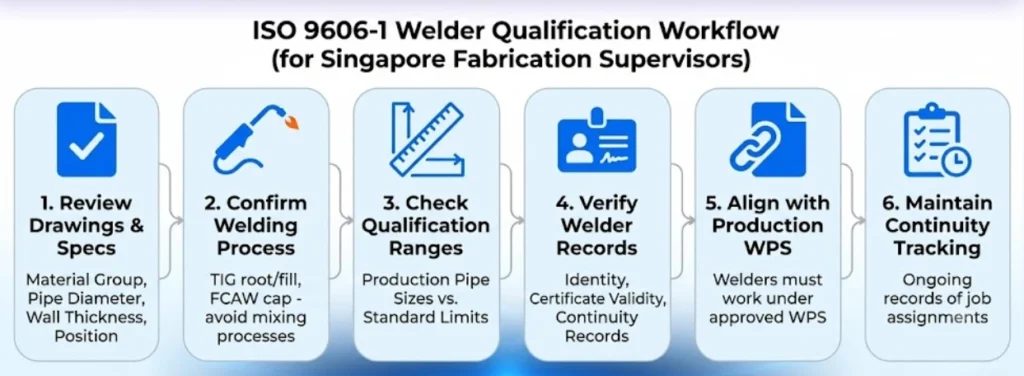
Stainless steel process piping can be commonly found in industrial environments and for fabrication companies in Singapore it is important that welders have the right qualification to reduce welding defects, prevent rework and ensure quality standards are met. ISO 9606-1 welder qualification testing will assess welders who carry out fusion welds on steels. Fabrication supervisors should plan the coverage required to match the welds being carried out.
Review your drawings/specifications
The supervisor should review the drawings, specifications and requirements of the project to determine the type of welds required.
Key information includes:
- Stainless steel material type and group.
- Outside diameter and thickness of the pipe.
- Welding process.
- Joint type and welding position.
- Back up and filler material if required.
Determine the correct welding process
Depending on the fabrication process, welders may use different welding processes. For example, TIG may be used for root passes on the pipe, but a different process may be used for fill and cap passes depending on the specification.
The supervisor should check that the welder has the required qualification. Don’t assume welders will have the qualification for other processes. A qualification for one welding process should not automatically be treated as approval for another process.
Determine the pipe size and thickness
In terms of coverage, it is important to know the size of the pipe the welder will be using. The test piece will have an outside diameter and thickness which will determine the coverage the welder has under the correct standard.
Compare the pipe sizes and thickness to that of the welder’s coverage. Don’t assume that a welder will have coverage for all pipe sizes.
Consider the welding positions and joints
When fabricating pipes welders may have to weld in fixed positions or rotate the pipe. Different joint types may also be required. The supervisor should determine what welding positions and joint types will be required and make sure the welder has coverage for these.
Review welder’s qualification documentation
Before assigning welders to fabricate they should review their qualification documentation.
Ensure the welder has:
- Their ID and certificate details.
- The welding process and test piece used.
- Material, size and welding position. This will show what coverage they have.
- Test results and approvals.
- Validity and continuity.
Ensure welders follow the approved WPS
Welder qualification is a completely separate process to welding procedure qualification. ISO 9606-1 focuses around ensuring the welder can weld to an acceptable quality based on the test conditions. A Welding Procedure Specification (WPS) will be used to determine the welding procedure to be followed. This will have an appropriate procedure qualification record(WPQR).
Fabrication supervisors should ensure welders with the correct qualifications follow the approved WPS.
Plan your coverage
Once you have carried out the test, you should plan your coverage. Keep records of welders assigned, what they are fabricating and any continuity that needs to be followed. Having good documentation will make it easier to prove welders had the correct qualification.
Common mistakes
Fabrication companies should avoid the following:
- Not checking what coverage the welder has.
- Assuming welders have the right qualification for all processes.
- Ignoring pipe sizes and thickness.
- Ignoring welding positions and joint types.
- Confusing welder’s qualification with WPS/WPQR.
- Not keeping the required continuity.
Example
A Fabrication company in Singapore are fabricating stainless steel process piping for an industrial environment. Before starting fabrication the supervisor will look at the piping sizes, materials, joint types and welding processes.
The supervisor will check what welder qualifications are available and ensure there are no gaps. They will then organise the correct tests to be carried out. Only once the relevant individuals and welding procedures are in place and meet the project requirements will fabrication start.
This will help improve traceability, reduce rework and ensure quality welds.
Frequently Asked Questions
What is ISO 9606-1 welder qualification?
ISO 9606-1 outlines the requirements for welder qualification testing for fusion welds on steels.
Will it apply to stainless steel pipes?
As long as the correct material groups, welding process and qualification requirements are considered then it can apply to stainless steel welds.
Does the welder have coverage for all pipe sizes?
No, it will depend on the test conditions and requirements of the standard.
What is the difference between welder qualification and WPQR?
Welders will be assessed for their welding skills. WPQR will show the results of the welding procedure being qualified.
Related Searches
- Can a Qualified Welder Perform Any Welding Job? ISO 9606-1 Qualification Limits Explained
- Welder Certification & Welding Operator Qualification: Requirements, Standards and Production Readiness
- ISO 9606-1 Welder Qualification: Validity, Continuity & Renewal Explained (2026)
- How to Read an ISO 9606-1 Welder Qualification Certificate: A Field-by-Field Guide
Conclusion
Planning the coverage for ISO 9606-1 welder qualification can help fabrication companies in Singapore. By looking at welding processes, pipe sizes, material groups, positions and welder’s qualification documentation, supervisors will be able to assign the right people and improve quality during fabrication. Always ensure welders have the correct qualification for the relevant edition of the standard. Keeping a good qualification system in place will help manufacturers prove welders are competent.
Looking to plan your stainless steel process piping in Singapore?
First Welding Certification Pvt Ltd (PRVÁ ZVÁRAČSKÁ, a.s.) can help you explore the relevant welding quality and certification requirements for your application.