
Related Blogs
AUG
22
ISO 9606‑1 vs ISO 14732: Welder vs Welding Operator Qualification
AUG
22
How to Read an ISO 9606-1 Welder Qualification Certificate: A Field-by-Field Guide
AUG
22
ISO 9606-1 Welder Qualification Test: What Happens During the Certification Process?
See Also.....
Certification Alerts
- EN ISO 3834-4 transition deadline: 31 Dec 2024
- NABCB accreditation renewal — Updated requirements
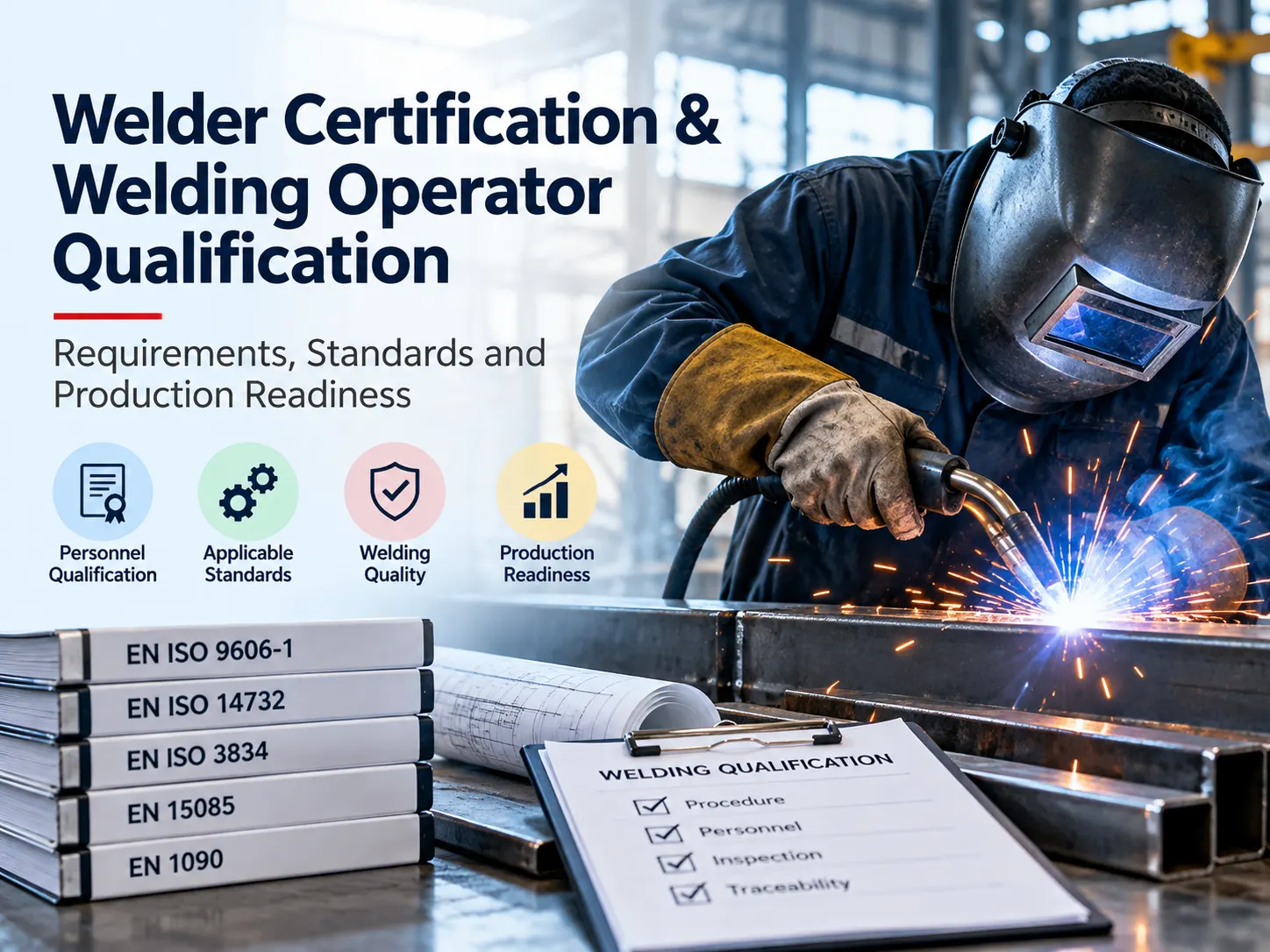
WELDER CERTIFICATION
ISO 9606-1
QUALIFICATION
24 Oct 2026
Welder Certification & Welding Operator Qualification: Requirements, Standards and Production Readiness
By Editorial Team
Table Of Contents
- What Is Welder Certification?
- What Is Welding Operator Qualification?
- Welder Certification vs Welding Operator Qualification
- Which Standards Apply to Welding Personnel?
- How to Verify Welding Personnel Qualifications Before Production
- Welding Personnel Qualification Workflow
- Common Qualification Mistakes That Can Affect Welding Quality
- How Qualification Control Supports Welding Certification
- Welding Personnel Qualification Checklist
- Frequently Asked Questions
- Get Guidance on Welder Certification and Welding Operator Qualification
Welder certification and welding operator qualification are essential for ensuring welding quality and compliance with industry standards. Companies involved in structural steel, railway, pressure equipment, and industrial engineering must ensure that the right qualified personnel are assigned to welding tasks. It’s important to note that a certification alone does not confirm that a person is suitable for a specific task. Therefore, manufacturers must check whether the individual meets the relevant standards, procedures, materials, and qualification scope. This guide explains the distinction between certification and qualification, the applicable standards, and how to effectively manage personnel qualifications to improve welding quality and prepare for audits.
What Is Welder Certification?
Welder certification shows that a welder can make good welds under certain conditions by passing tests that follow specific standards. For instance, EN ISO 9606-1 is about welding steel using fusion methods, and other parts of the ISO 9606 standard cover different materials. The range of what a welder is qualified for depends on things like the welding method, the type of joint, the base material, the product being made, the thickness of the material, the pipe size, the welding position, and the required tests. It’s important for manufacturers to check the real qualification certificate and the standard it follows, instead of thinking a welder can do all kinds of welding.
What Is Welding Operator Qualification?
Welding operator qualification makes sure that people who use mechanized or automatic welding machines are skilled and able to do their job properly. Unlike manual welding, these systems work based on set instructions and controlled settings. The EN ISO 14732 standard sets the rules for testing welding operators and weld setters who work with mechanized and automatic welding of metals. Those who are qualified need to show they can use the equipment correctly, adjust the settings, and follow the right process conditions, which are important for automated setups and mechanized systems in factories that make products repeatedly.
Welder Certification vs Welding Operator Qualification
Understanding the difference helps manufacturers select the right qualification route for each production role.
| Comparison | Welder certification | Welding operator qualification |
|---|---|---|
| Primary responsibility | Performs welding manually or through applicable partly mechanized methods | Operates mechanized or automatic welding equipment |
| Common standard | EN ISO 9606 series | EN ISO 14732 |
| Main focus | Ability to produce acceptable welds within the qualified range | Competence in operating the relevant welding equipment and process |
| Assessment | Practical welding test and required examinations | Assessment appropriate to the equipment process and qualification requirements |
| Production application | Manual and applicable semi-mechanized welding | Mechanized and automatic welding |
| Qualification scope | Process material joint configuration position and other relevant variables | Equipment process operating conditions and other applicable variables |
The correct standard should be chosen based on the welding technique, product specifications, contract terms, and relevant technical guidelines.
Which Standards Apply to Welding Personnel?
Different welding standards cover various areas like skills, methods, and how quality is managed. They aren’t the same and shouldn’t be used as if they are.
| Standard | Purpose | Relevance to manufacturers |
|---|---|---|
| EN ISO 9606-1 | Qualification testing of welders for fusion welding of steels | Verifying the qualification of relevant welding personnel |
| EN ISO 14732 | Qualification testing of welding operators and weld setters for mechanized and automatic welding | Verifying personnel who operate applicable welding systems |
| EN ISO 3834 | Quality requirements for fusion welding of metallic materials | Establishing and maintaining appropriate welding quality controls |
| EN 15085 | Railway applications — welding of railway vehicles and components | Addressing welding quality and personnel requirements relevant to railway manufacturing |
| EN 1090 | Execution of steel and aluminium structures | Meeting applicable execution production control and welding requirements |
These standards have different roles. EN ISO 3834, EN 15085, and EN 1090 do not take the place of figuring out the needed qualifications for the people involved. The exact responsibilities depend on which standard is being used, the product, the work being done, the certification area, and what is agreed in the contract.
How to Verify Welding Personnel Qualifications Before Production
A structured verification process can help prevent incorrect personnel assignments and missing quality records.
- Review the Production Requirements
First, look at the engineering drawing, material specs, joint design, welding process, the right WPS, and what the customer needs. Then figure out if the job needs manual welding, mechanized welding, or automatic welding. This helps decide which qualifications the workers need to have.
- Verify the Qualification Certificate
Check the person’s certificate or qualification records. Make sure you verify their identity, the standard they are certified under, the welding process they are qualified for, the materials they can work with, and the limits of their qualification.
Don’t just look at the certificate name. Two certificates from the same standard might cover different welding situations.
- Check Qualification Validity
Make sure the qualification meets the necessary rules for staying valid, checking again, rechecking, or renewing. For example, ISO 9606-1 qualifications have certain conditions that must be met to keep them valid.
You need to check the correct way to check again or recheck against the standard and the person’s records. A certificate is not automatically valid just because the date on it hasn’t expired.
- Match the Qualification to the WPS
The Welding Procedure Specification (WPS) gives the steps and settings for doing welds in production. The welder must be qualified for the job that is done with that method.
Check the welding type, how the parts are joined, the material used, the position, and other important factors.
Just because a welder is qualified doesn’t mean they can use any welding procedure, and even if a procedure is approved, it doesn’t mean everyone who uses it is qualified.
- Maintain Production Traceability
Keep track of which qualified person did the welding for each job, weld, or batch of products, as required by traceability rules.
Save supporting documents like qualification certificates, WPS references, inspection reports, and job details. These records show that the manufacturer properly assigned welders and can look into any issues that come up.
Welding Personnel Qualification Workflow
This process shows how a manufacturer can manage the checks needed to confirm everything is ready before starting a production job.
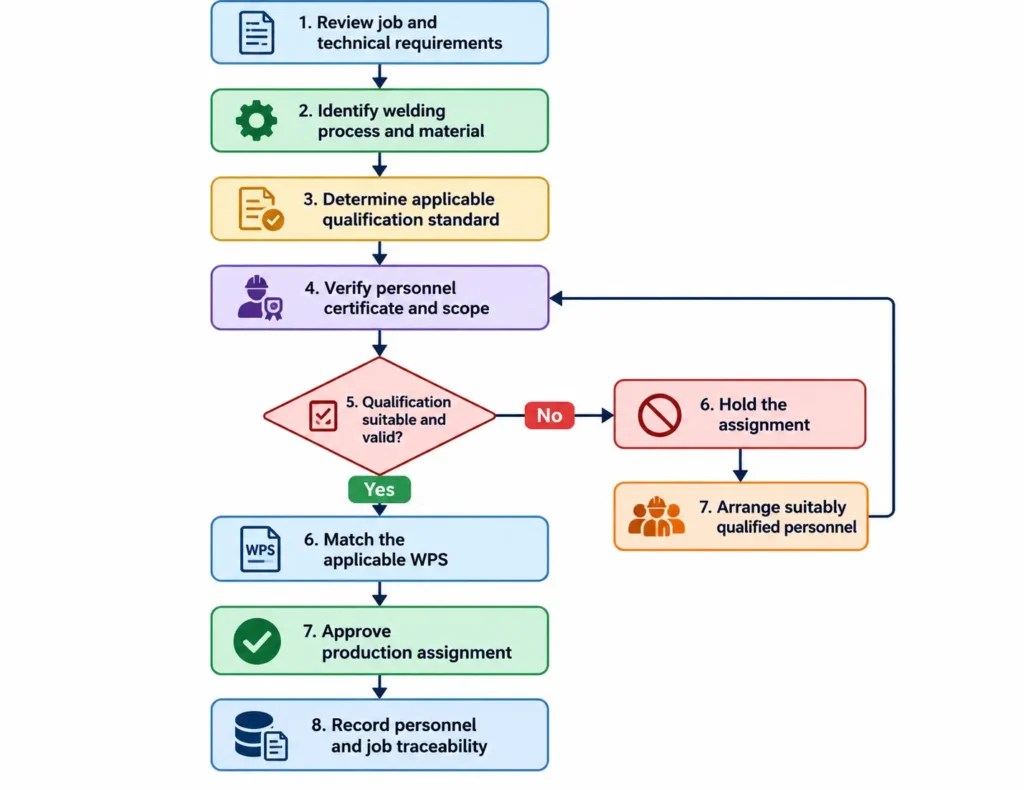
This process should be incorporated into the manufacturer’s current welding quality management system instead of being kept as a separate administrative checklist.
Common Qualification Mistakes That Can Affect Welding Quality
Even experienced manufacturers can face issues if qualification records are not reviewed in a systematic way.
1.Relying solely on experience
While practical experience is valuable, it does not automatically replace the need for a qualification required by a standard, project specification, or contract.
2.Not considering the qualification scope
A certificate may cover specific welding processes, materials, positions, or other defined conditions.
The actual scope must match the work being performed.
3.Confusing welder and operator qualifications
A manual welder qualification does not automatically qualify someone for mechanized or automatic welding operations.
4.Overlooking validity and continuity
Confirmations and continuity records must be kept in line with the applicable standard and qualification route.
5.Failing to link qualifications with production records
Keeping certificates in a folder is not sufficient if the manufacturer cannot show which personnel performed specific welding work when traceability is needed.
6.Mistaking procedure approval for personnel qualification
Welding procedure qualification shows that a procedure meets specified requirements within its qualified range. Personnel qualification shows individual competence within the applicable qualification scope. Both may be necessary.
How Qualification Control Supports Welding Certification
For manufacturers aiming to meet or maintain compliance with standards like EN ISO 3834, EN 15085, EN 1090, or other relevant requirements, the competence of welding personnel is an essential part of a comprehensive quality management system.
Effective personnel qualification helps manufacturers:
- Minimize welding defects and reduce the need for rework.
- Improve planning and efficient use of personnel
- Ensure better documentation and traceability of welding activities.
- Prepare more effectively for customer audits and assessments.
- Show control over welding processes and adherence to technical standards.
However, having qualified personnel alone does not ensure certification.
Manufacturers must also fulfil other requirements related to welding procedures, equipment, inspection, documentation, quality responsibilities, and other applicable aspects within their scope.
Welding Personnel Qualification Checklist
Use this checklist as a starting point when reviewing production readiness.
| Verification item | What to confirm |
|---|---|
| Job requirements | Applicable product standard, drawing, and contract requirements |
| Personnel identity | Correct individual assigned to the task |
| Qualification standard | Appropriate standard and part for the application |
| Qualification scope | Welding process, material, position, and relevant variables |
| Validity | Required confirmations, continuity, and revalidation conditions |
| Welding procedure | Applicable WPS and its requirements |
| Production records | Relevant job, personnel, and weld traceability |
| Quality review | Required inspection and documentation completed |
The checklist should be tailored to fit the real manufacturing process and relevant regulations. It is not a replacement for a proper standards review.
Frequently Asked Questions
Is welder certification the same as welding operator qualification?
Welder qualifications usually cover people who do manual or partially mechanized welding. EN ISO 14732 is for welders and welders setting up machines that use mechanized or automatic welding. The right qualification depends on the welding method and the job being done.
Which standard is used for welder certification?
EN ISO 9606 is an important set of standards used to test and approve welders. EN ISO 9606-1 is part of this series and deals with welding steel using fusion methods. For other types of materials, a different part of the series or another standard might be needed.
What is EN ISO 14732 used for?
EN ISO 14732 covers the testing needed to qualify welders and weld setup personnel who do welding using machines or automatic systems on metal materials. It is important to make sure the testing covers what is actually being used in the equipment and the specific welding job.
Does a valid welder certificate allow a person to perform every welding job?
No, the person’s qualifications need to cover the specific welding conditions and follow the right standard, product requirements, and contract terms. Checking if the certificate is still valid and looking at the qualification scope are two separate things.
Why are welding personnel qualifications important for EN ISO 3834?
Appropriately qualified personnel assist manufacturers in showing they have control over welding processes.
The specific requirements for these personnel depend on the quality level, product standards, and any contractual agreements involved.
How can manufacturers prepare for welding personnel qualification checks?
Make sure to keep qualification records up to date, check the scope and validity before assigning tasks, connect personnel to the appropriate production records, and ensure that the correct WPS and inspection standards are followed.
Get Guidance on Welder Certification and Welding Operator Qualification
Choosing the right qualification path helps manufacturers control welding quality, ensure staff skills are up to standard, and meet necessary certification rules.
First Welding Certification Pvt Ltd assists businesses in understanding the certification needs for their welding staff and related quality standards.
Whether your company works in structural steel, railway welding, or industrial manufacturing, start by figuring out the relevant standard, welding process, material, and the specific scope of qualification.
Need support understanding the certification requirements for your welding team?
Contact PZVAR to talk about your needs and find the correct qualification process for your welding tasks.