
ISO 9606-1
WELDING JOB
QUALIFICATION
16 Sep 2026
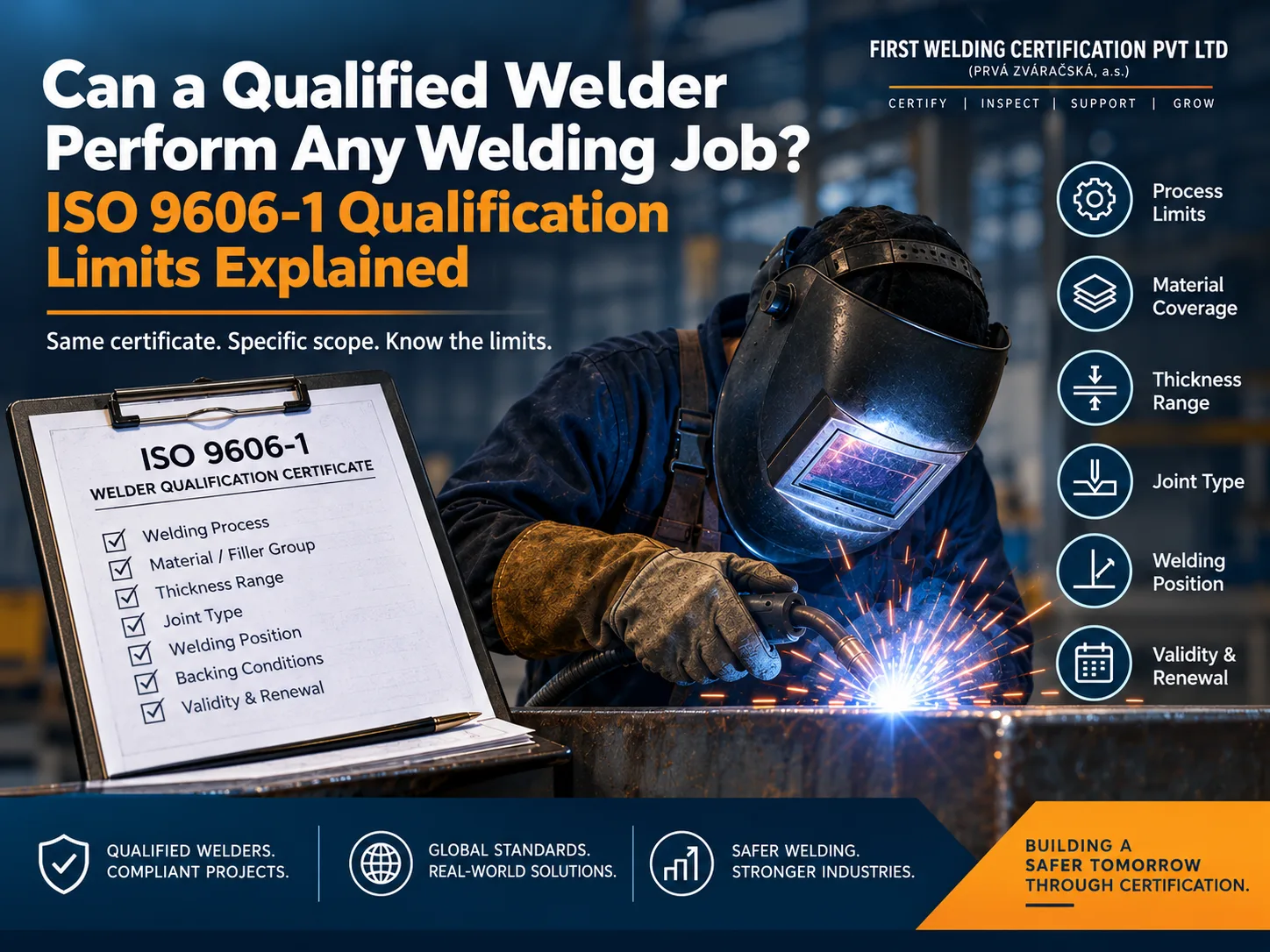
Can a Qualified Welder Perform Any Welding Job? ISO 9606-1 Qualification Limits Explained
By Editorial Team
Table Of Contents
- Executive Summary
- Clear Answer
- ISO 9606-1 Scope and Basics
- Covered Materials and Joints
- Welding Processes and Transfer Modes
- Essential Variables and Qualification Ranges
- Certificate Validity, Continuity and Requalification
- National/Code Adoption and Annexes
- Employer/Site Qualification vs Standard Qualification
- Transferability, Requalification and FAQs
- Implications for Employers, Inspectors and Welders
- Best Practices and Recommendations
Related Blogs
AUG
22
ISO 9606‑1 vs ISO 14732: Welder vs Welding Operator Qualification
AUG
22
How to Read an ISO 9606-1 Welder Qualification Certificate: A Field-by-Field Guide
AUG
22
ISO 9606-1 Welder Qualification Test: What Happens During the Certification Process?
See Also.....
Certification Alerts
- EN ISO 3834-4 transition deadline: 31 Dec 2024
- NABCB accreditation renewal — Updated requirements
Executive Summary
An ISO 9606-1 welder qualification applies only to specific welding conditions, not all types of welds. It outlines the exact conditions under which a welder is approved, including things like the welding method, the kind of metal, its thickness, the type of joint, the filler material used, and the welding position, each with clearly set limits. If any of these factors change, like switching to a different welding method or using a thicker material, the welder needs to be requalified. Certificates are only valid if they are confirmed every six months and renewed regularly. Employers must match welders to the specific job needs and keep accurate records of their qualifications, as this is checked during an ISO 3834 audit.
Clear Answer
A welder who is “qualified” has been certified to do certain jobs according to ISO 9606-1 standards. This certification depends on things like the welding technique, the type of metal, how the pieces are joined, and the position they’re welded in. If any of these factors change, the welder’s qualification no longer applies. For example, a welder who can weld a 10 mm thick plate while it’s flat can’t weld a 30 mm pipe in an overhead position without taking extra tests. This shows that qualifications are only valid under specific conditions.
ISO 9606-1 Scope and Basics
ISO 9606-1: Steels is a worldwide standard that helps check if welders are skilled in fusion welding.It works for welding done by hand or with some automation. The standard includes different types of steel like regular, alloy, and stainless steel, and also has parts for other metals such as aluminum and copper. It covers welding methods like stick, MIG, TIG, flux cored, submerged arc, and oxy-fuel welding. However, it doesn’t include fully automatic welding methods, which are covered by ISO 14732. This standard focuses on the welder’s abilities, especially their control of the welding torch and electrode.After passing the test, the welder gets a Welder Qualification Certificate (WQC) that shows their qualifications.
Covered Materials and Joints
- ISO 9606-1 applies to steel and its alloys, and it groups materials using ISO/TR 15608.
- A welder who is qualified to weld one type of steel can usually weld other types in the same group or with special rules.
- The base metal is less important, especially when welding without adding filler metal; the group of filler metal is more important.
- For example, if a welder passes a test with carbon steel and stainless steel filler, they can weld stainless steel using that same filler.
- The standard defines two main types of joints: butt welds (also called groove joints) and fillet welds (also called angle joints).
- Just because a welder is qualified for one type of joint doesn’t mean they are automatically qualified for the other without doing an extra test.
- Annex C allows for an additional fillet weld test to be done along with a butt weld evaluation.
- For joints like branches or T-joints, the thickness of the thicker metal is taken into account.
- Backing and inserts are important factors; different types of backing are listed in ISO 9606-1.
- Welders who have tested with backing can usually weld without it, but welders who tested without backing cannot weld with it.
- Certificates will show whether tests were done with backing (mb) or without backing (nb); the production welding must match the conditions used during testing.
Welding Processes and Transfer Modes
The process is important because changing from one group to another needs retesting. Some related processes, such as MMAW 111 and FCAW 131/135, might be acceptable for each other under certain conditions. Usually, each process needs its own test. In GMAW, the type of transfer matters; tests done with short-circuit transfer (131/135) can work for spray transfer (138), but tests done with spray transfer can’t cover short-circuit transfer. If you change the shielding gas or the transfer mode, you also need to do retesting.
Essential Variables and Qualification Ranges
- The welding techniques used have to be the same as the ones that have been approved, like MMAW 111, GMAW 135, or GTAW 141.If there’s any change, such as switching from GMAW to GTAW, then new testing is needed.
- The filler metal group (FM1–FM6) is important. FM1 is used for mild steel, FM2 for high-strength steel, FM3 for stainless steel, and FM6 for some nickel alloys. A solid electrode usually works with the same group as a cored wire, but the other way around isn’t true. If you switch between filler metal groups, like from FM1 to FM2, you need to do new testing. The base material group isn’t as important, and tests on one steel group can often apply to others according to ISO 15608, except for autogenous welds. Fillet welds depend on the thickness of the base metal.
- The type of product and the welding position determine which welding positions are allowed according to ISO 6947. The defined positions are PA/1G (flat), PB (fillet in horizontal or vertical), PC (butt in horizontal), PF (vertical-up), PE (overhead), and pipe positions like H-L0xx.Each test position covers a group. For example, flat (PA) tests only include flat positions, while overhead (PE) includes PA, PB, PC, PD, and PE.For pipes, H-L045 covers all positions (PA through PE plus H). Testing should include all the positions needed for production.
| Test Position | Additional Positions Covered | |
|---|---|---|
| PA (flat) | PA only | |
| PB (fillet | horiz-vert) | PA, PB |
| PC (butt | horizontal) | PA, PC |
| PF (vertical-up) | PA, PB, PC, PF | |
| PE (overhead) | PA, PB, PC, PD, PE | |
| H-L045 (pipe | 45° fixed) | PA, PB, PC, PD, PE, PF, H-L045 |
- Qualification in one position qualifies welder for other positions per ISO 9606-1.
- ISO 9606-1 sets the standard for the qualified range of butt welds based on the thickness of the weld metal that is deposited, similar to how the thickness of the planned plate is considered.
- The qualification range depends on the thickness of the material. If the thickness is less than 3 mm, it is considered as 2t. For thickness between 3 mm and 12 mm, the qualification is based on the 3 mm to 2t range. If the thickness is more than 12 mm, retesting is needed. For fillet welds, the thickness of the base metal follows the same 3 mm to 2t qualification rule.
- The outside diameter (OD) of a pipe has certain testing limits.For pipes with OD up to 25 mm, the testing range is from D to 2D.For pipes with OD between 25 mm and 150 mm, the testing range is from 0.5D (but not less than 25 mm) up to any size. For pipes with OD larger than 150 mm, there is no upper limit. When testing a pipe with an OD of 168.3 mm, it includes pipes with OD 84 mm and above. A test on a 21.3 mm pipe covers pipes with OD from 21.3 mm to 42.6 mm. Plate tests do not cover small-diameter pipes.
Certificate Validity, Continuity and Requalification
ISO 9606-1 sets the guidelines for how long welding certificates are valid and how they can be renewed.
To keep a certificate valid continuously, the Welding Coordinator must check the welder’s activity every six months to make sure they are still working in the area they were certified for.
- If this check isn’t done, the certificate becomes invalid, no matter how long the overall validity period is—usually 2 to 3 years.
- Think of the six-month check as a deadline. Make sure to include it in your quality assurance schedule. There are three ways to requalify, as outlined in Clause 9.3:
- Retest every three years: this requires a complete test.
- Production test every two years: this involves two production welds that are checked with non-destructive testing, which can extend the certificate for another two years.
- Unlimited validity under ISO 3834: this applies if you work for the same employer and they have a regularly checked ISO 3834-2 or 3 system.
- You also need to have records showing that the welds were acceptable.
Note: This third method isn’t allowed for projects under PED categories II to IV.
- When renewing a certificate, you must trace it back to the original one.
- Also, keep a qualification matrix as required by ISO 3834, which shows the welder’s tested values and the acceptable ranges.
- Before starting any work, make sure the production welding procedure specification (WPS) matches the welder’s welding quality control (WQC) and any relevant variables.
- Metlab suggests qualifying ranges, not just specific jobs, and planning tests around the yearly work schedule.
- Keep a diary of all confirmations for the six-month checks and two-year revalidations as part of your quality assurance process.
National/Code Adoption and Annexes
ISO 9606-1 is a worldwide welding standard, but how it is used can be different in each country.
- In Europe, it is called EN ISO 9606-1:2017, and it follows the rules set by the EU, such as the Pressure Equipment Directive.
- The older version, EN 287-1:2011, is slowly being replaced, but some ships or equipment still need welders to follow it.
- EN ISO 9606-1 can only be the main standard after it is officially published in the EU’s official journal.
- The main differences between EN 287-1 and EN ISO 9606-1 are that the former uses base metal for qualification, while the latter uses filler metal, and weld thickness is based on the deposited metal.
- Many countries add their own guidelines to the standard, called national annexes, to help with materials and welding positions; for instance, the UK includes Annex ZA/ZB and may ask welders to take knowledge tests.
- Australia and New Zealand use ISO 9606-1 along with AS 1554.1, and they manage welder certifications through the Australian Welder Certification Register (AWCR).
- The US mostly uses ASME Section IX for pressure equipment, but it also accepts ISO 9606-1 as a similar standard; AWS D1.1 is used for structural steel, and there is no set expiry date as long as the welder keeps working.
- Many countries around the world use ISO 9606-1 or similar local standards, like Japan’s JIS Z 3801.
- Some industries, such as railways and nuclear, specifically require welders to have ISO 9606-1 certification.
Employer/Site Qualification vs Standard Qualification
Employers often use qualification tests for welders in certain areas, like construction. These tests are tied to specific projects and procedures and don’t lead to an ISO 9606-1 certificate. These qualifications are not transferable and only let welders work on that particular project. On the other hand, an ISO 9606-1 certificate is personal, given by official organizations, and works everywhere. It’s important to know the difference because only the ISO certificate is commonly accepted. Employers should include ISO qualification tracking in their quality checks and follow ISO 3834, not just depend on tests at the job site.
Transferability, Requalification and FAQs
The ISO 9606-1 welder certificate is personal and recognized worldwide.
- It can be used with different employers and job sites.
- If a welder stays within the same type of work covered by the certificate, they don’t need to take a new test.
- New employers must check the welder’s qualifications every six months.
- If there is a gap of more than six months, the certificate becomes invalid.
- If the welding process changes, the welder may need to take a full test or a partial test.
- The certificate can be renewed by testing only the new parts, like thicker welds.
- All test results must be written down on the certification papers for easy checking during audits.
- Keeping all records connected is important to show the full range of qualifications.
Examples and FAQs:
- “My welder passed on a 5 mm fillet weld in flat position; can he weld 15 mm butt welds?” – No.
Fillet and butt welds are different types, and the thickness of the material also plays a separate role. The welder would need to do a test for butt welds and cover the thicker material range. - “Qualified in PA (flat); can he do PB or PF?” – Only if the flat position (PA) covers those positions.
To do PB or PF, the welder needs to be qualified in those positions. - “Tested on a pipe with an outside diameter of 100 mm; what sizes can he weld?” – According to ISO, a welder can work on pipes that are 50 mm or bigger using the same position. A 30 mm pipe joint is not within that range and would need a new test.
- “What about preheat, interpass, or post-weld heat treatment (PWHT)?” – These procedure variables, based on ISO 15614-1, are different from the variables used for welder qualification. ISO 9606-1 says you should follow the WPS during testing but doesn’t limit welder qualification based on preheat or post-weld heat treatment. This is different from ASME, which takes into account heat input and interpass temperature when qualifying welders.
- “What if I skip the 6-month confirmation sign-off?” – The certificate is no longer valid and needs to be renewed. ISO 9606-1 is very strict—missing a timely confirmation means the certificate is no longer accepted.
- “Does ISO 9606-1 cover mechanized welding or welding operators?” – No.
Mechanized welding and welders are covered by ISO 9606-2 to ISO 9606-5 for other materials, and ISO 14732 for welders and mechanized welding processes.
Implications for Employers, Inspectors and Welders
- Employers need to keep clear records of welders, including the welding methods they are approved for, the materials they can work with, and the thickness ranges they can handle. Before giving a welder a job, it’s important to check if their certificate matches the key factors like the welding process, the position they’re working in, and the materials being used. They also need to get confirmation every six months. Not following these rules could lead to poor or unsafe welds. ISO 3834 auditors need proof that a welder is qualified, such as through proper records. Training should explain the difference between welding procedures (WPS) and welder qualifications (WQTC), and why it’s important to stay within the approved limits.
- Inspectors and auditors need to make sure a welder’s certificate matches the requirements of the job. They should check for six-month confirmation records, proof of revalidation, and correct paperwork for any extra tests that were done.
- Welders need to know their certification limits, check which welding methods are allowed, tell someone if they do anything different, keep records of their own confirmations, ask for retesting before their certification ends, and don’t change welding processes or materials without testing first.
Best Practices and Recommendations
- Plan tests in a broad way to make sure they cover a wide range of work.
- Keep track of confirmations and revalidations to meet quality assurance deadlines.
- Use a calendar or a tracking system to stay reminded of deadlines.
- Keep a list or matrix of qualified welders to follow ISO 3834 rules.
- Use welding management software to connect certificates with actual jobs as they happen.
- Choose third-party certification from accredited organizations like ISO/IEC 17024 to ensure fairness.
- Get independent approval for big projects and work related to PED, not just internal testing.
- Offer regular training on WPS to help welders understand the difference between qualification and actual skill.
- Teach welders about compliance rules such as ISO 3834 and PED so they follow them every day.
Flowchart: How to Check if a Welder is Qualified for a Job.
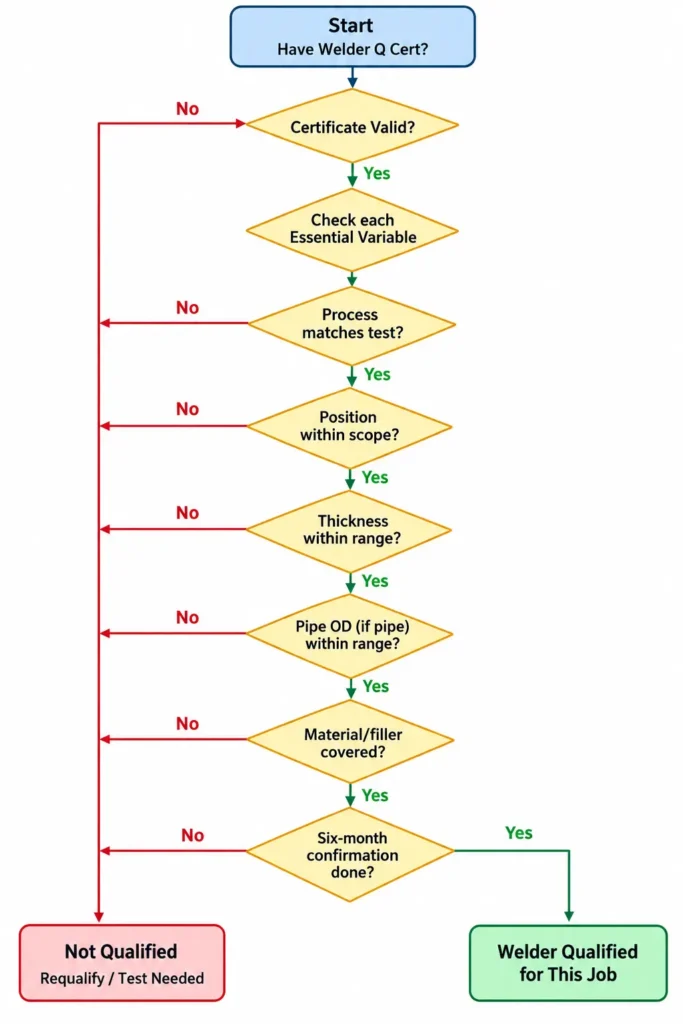
A welder needs a proper ISO 9606-1 certificate that matches the tested factors with the real weld joint. If the requirements aren’t satisfied, they can’t be given the job without more testing or proof.