
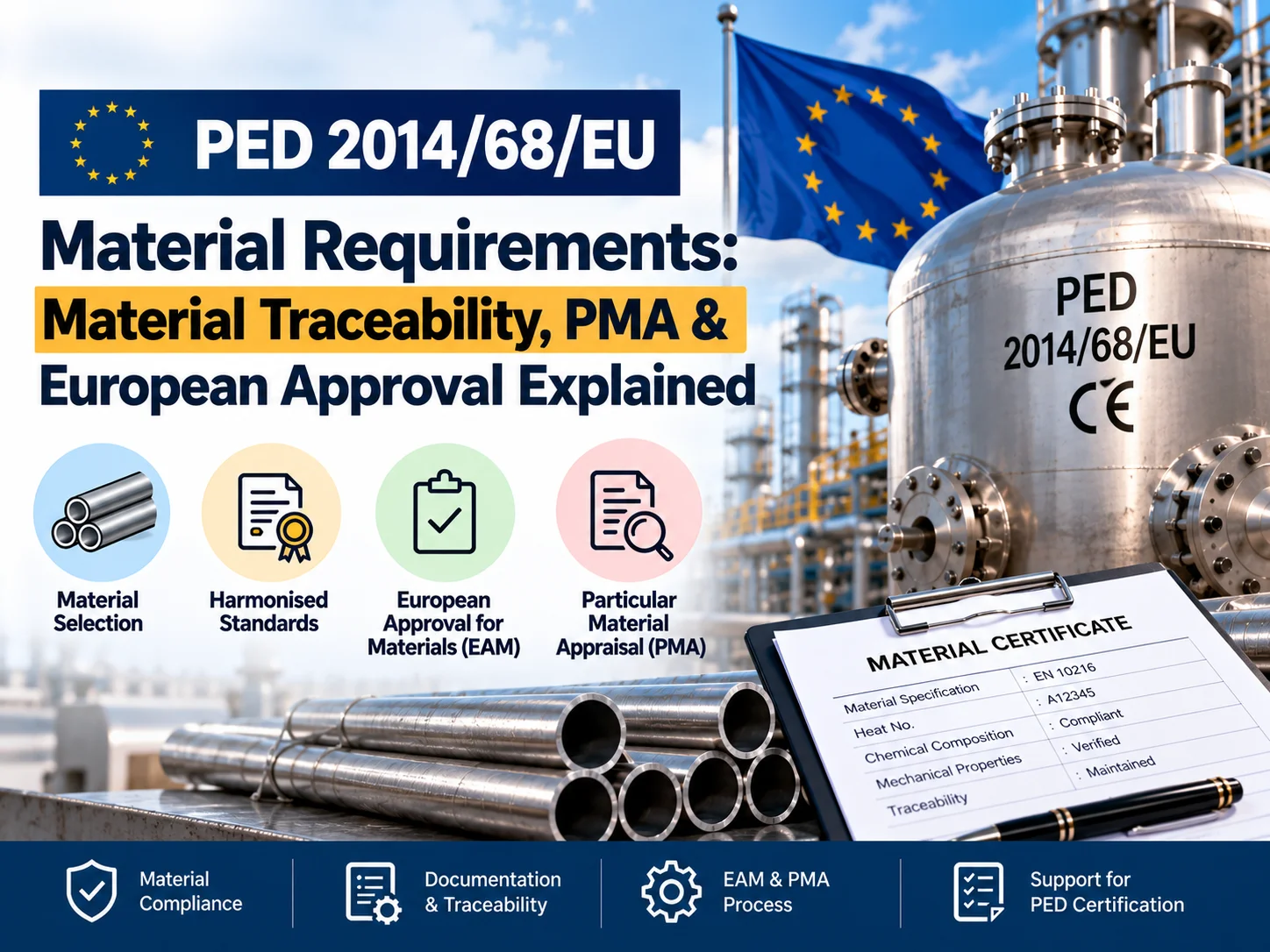
PED 2014/68/EU
EUROPEAN APPROVAL
TRACEABILITY
03 Oct 2026
PED 2014/68/EU Material Requirements: Material Traceability, PMA & European Approval Explained
By Editorial Team
Table Of Contents
- What Are the PED 2014/68/EU Material Requirements?
- PED Material Compliance at a Glance
- PED Material Compliance Routes
- 1. Materials Covered by Harmonised Standards
- 2. What Is European Approval for Materials (EAM)?
- EAM is particularly relevant when:
- 3. What Is Particular Material Appraisal (PMA)?
- A PMA may consider factors such as:
- PMA vs EAM: What Is the Difference?
- PED Material Traceability: Why It Matters
- What Material Documentation Is Required?
- A practical PED material documentation file may include:
- Common PED Material Compliance Mistakes
- PED Material Compliance Checklist
- How Material Compliance Supports PED Certification
- Final Takeaway
Related Blogs
SEP
11
What Are the Latest PED 2014/68/EU Pressure Vessel Regulations, Design Standards, Safety Factors and Certification Requirements in 2026 for Indian and Global Manufacturers?
SEP
10
ASME Section VIII vs EN 13445 for PED 2014/68/EU: CE Marking Requirements for Indian Manufacturers in 2026
See Also.....
Material selection is an important step in following PED 2014/68/EU rules. When making pressure equipment that is sold in the EU, the manufacturer has to show that the materials used are right for the conditions they will be used in, and that all the information about the materials is properly recorded and can be followed through the entire production process.
The Pressure Equipment Directive (PED) 2014/68/EU sets out clear guidelines about the materials used in parts that hold pressure, including the characteristics of the materials, how they should be documented, the ways to prove compliance, and how the materials can be traced during manufacturing.
What Are the PED 2014/68/EU Material Requirements?
According to Annex I, Section 4 of PED, the materials used in pressure equipment need to be suitable for their intended use and for the length of time they are expected to be used. For parts that are under pressure, the materials should have the right:
– Mechanical properties
– Ability to stretch and absorb energy (ductility and toughness)
– Resistance to chemical reactions
– Ability to withstand long-term use without breaking down (ageing resistance)
– Ease of working with (processability)
– Ability to work well with other materials
When choosing materials, it’s also important to think about the conditions they will face during normal operation and testing.
PED Material Compliance at a Glance
| Requirement | What the Manufacturer Must Demonstrate |
|---|---|
| Material suitability | Material is suitable for intended service conditions |
| Mechanical properties | Required strength, toughness and ductility |
| Chemical resistance | Compatibility with the contained fluid |
| Material specification | Material conforms to an accepted specification |
| Documentation | Appropriate material documentation is available |
| Traceability | Pressure-bearing material can be identified throughout production |
| Conformity route | Harmonised standard, EAM or PMA is applicable |
PED Material Compliance Routes
PED 2014/68/EU outlines three main methods that a manufacturer can use to show they meet the material requirements.
1.Using harmonized standards
2.Getting European Approval for Materials (EAM)
3.Conducting a Particular Material Appraisal (PMA)
The right method depends on the type of material and the specific rules that apply to it.
1. Materials Covered by Harmonised Standards
If there is a harmonized standard that covers the material specification, the manufacturer can use that standard to show they are following the rules.
The technical documents need to show which material specification is being used and prove that the material has the right qualities.
This method makes it easier to check if the material is compliant because the requirements are already set out in the standard.
2. What Is European Approval for Materials (EAM)?
European Approval for Materials (EAM) is a formal process outlined in Article 15 of the PED. It is given by a recognized notified body after they complete necessary checks and tests to confirm that the material meets the required PED standards. The European Commission publishes information about EAMs that meet these standards.
EAM is particularly relevant when:
• The material is not covered properly by any existing harmonized standard.
• A recognized material specification needs official approval from Europe.
• The manufacturer must have a proven way to meet PED material requirements.
Important: EAM should not be mixed up with a regular material certificate.
It is a specific approval for the material type under the PED rules.
3. What Is Particular Material Appraisal (PMA)?
Another way to show that a material meets the required standards is through a Particular Material Appraisal (PMA), which is offered by PED. This is used when the material is not covered by a harmonized standard or European Approval. The manufacturer includes all the required information about the material and supporting evidence in the technical documentation. For pressure equipment in Categories III and IV, the PMA must be assessed by the notified body that handles the conformity-assessment process.
A PMA may consider factors such as:
Type and quality of material
- Chemical makeup
- Physical strength and performance
- Temperature it is designed to handle
- Pressure it is built to withstand
- Needs for toughness
- Conditions for making and shaping the material
- Tests that need to be done
- How well the material works with other materials
The specific proof needed depends on the equipment, the material used, and the relevant technical standards.
PMA vs EAM: What Is the Difference?
| Feature | PMA | EAM |
|---|---|---|
| Full name | Particular Material Appraisal | European Approval for Materials |
| Purpose | Demonstrates suitability/compliance of a particular material for the equipment | Provides European approval for a material type |
| PED reference | Annex I, Section 4.2 | Article 15 |
| Assessment | Linked to the pressure equipment conformity assessment | Issued by a designated notified body |
| Scope | Equipment/material application | Approved material type |
| Category III & IV | Specific notified-body assessment required | Formal European approval process |
In simple words: PMA is a way to assess materials specifically for certain equipment, while EAM is an official European approval process for materials.
PED Material Traceability: Why It Matters
Material traceability is an important part of manufacturing under the PED.
Manufacturers need to create and follow processes that help track materials used in parts that help with pressure resistance, from when they are received until the final testing is done.
Typical traceability chain
The process starts with receiving materials, then identifying them, followed by cutting or shaping, assembling, welding, checking for quality, and finally testing. A strong tracking system links the finished pressure equipment back to its original material records.
Example
A pressure vessel shell plate needs to be tracked through records like:
Heat or lot number → Material certificate → Plate identification → Cutting record → Component identification → Welding or fabrication record → Final inspection
This shows that the material used in the pressure equipment matches the documented standards.
What Material Documentation Is Required?
PED requires the manufacturer to get documents from the material supplier that show the material meets the required standards.
For the main parts of Category II, III, and IV equipment that carry pressure, PED requires a certificate that proves the product meets specific control requirements.
The exact set of documents needed depends on the type of material, the equipment category, the relevant standard, and the chosen conformity assessment process.
A practical PED material documentation file may include:
Material specification
- Material certificate
- Heat or lot number
- Chemical composition
- Results of mechanical tests
- Dimensions of the product
- Heat-treatment details, if applicable
- Records of inspection and testing
- Records for material identification and traceability
- PMA or EAM documentation, if applicable
Tip: Do not treat the material certificate as a separate document.
It should be linked to the actual material used in the pressure equipment.
Common PED Material Compliance Mistakes
Manufacturers often face problems when the paperwork for materials doesn’t match what is actually used.
Common issues include:
1.Missing certificates for materials
2.Using the wrong type of material
3.Losing the heat numbers, which identify the material batch
4.Not matching the certificate with the part’s identification
5.Not having full traceability after cutting the material
6.Using a material that isn’t allowed by the standards
7.Not having enough PMA (Product Material Approval) documents
8.Having wrong or missing technical documents
9.Not checking the material requirements before making the part
10.Not keeping complete records for parts that hold pressure
These problems can lead to more questions during inspections and when reviewing technical documents.
PED Material Compliance Checklist
Before starting fabrication, manufacturers should verify:
| Check | Status |
|---|---|
| Applicable material specification identified | |
| Material is suitable for operating conditions | |
| Applicable harmonised standard checked | |
| EAM requirement evaluated | |
| PMA requirement evaluated | |
| Material certificate obtained | |
| Heat/lot identification recorded | |
| Material traceability maintained during fabrication | |
| Material properties verified | |
| Technical documentation updated | |
| Final material records reviewed |
How Material Compliance Supports PED Certification
Material compliance is just one part of meeting PED conformity requirements, but it is closely connected to other manufacturing controls. For pressure equipment, manufacturers also need to take care of several areas, including:
- Design calculations
- Manufacturing processes
- Permanent joining
- Welder and welding procedure qualifications
- Non-destructive testing
- Heat treatment
- Final inspection
- Pressure testing
- Technical documentation
- CE marking and Declaration of Conformity
PED specifically requires proper procedures to identify pressure-resistant materials during manufacturing and final testing.
For manufacturers producing welded pressure equipment, material traceability should be included in the WPS, WPQR, welding, inspection, and quality control documents rather than being handled separately.
Final Takeaway
PED 2014/68/EU material requirements are not just about choosing the right material grade. Manufacturers need to show that the material is suitable, keep proper records, ensure traceability, and pick the correct way to prove compliance.
The three main paths for material compliance under PED are:
Harmonized Standard → European Approval for Materials (EAM) → Particular Material Appraisal (PMA)
For parts that are under pressure, it’s important to clearly connect the material, its certificate, identification, and the final equipment, to ensure proper PED compliance.
If your pressure equipment uses materials that aren’t covered by the harmonized standard or EAM, then a PMA might be a key part of the compliance process, especially for equipment in higher risk categories.