
PED 2014/68/EU
CERTIFCATION GUIDE
LATEST UPDATES
24 Sep 2026
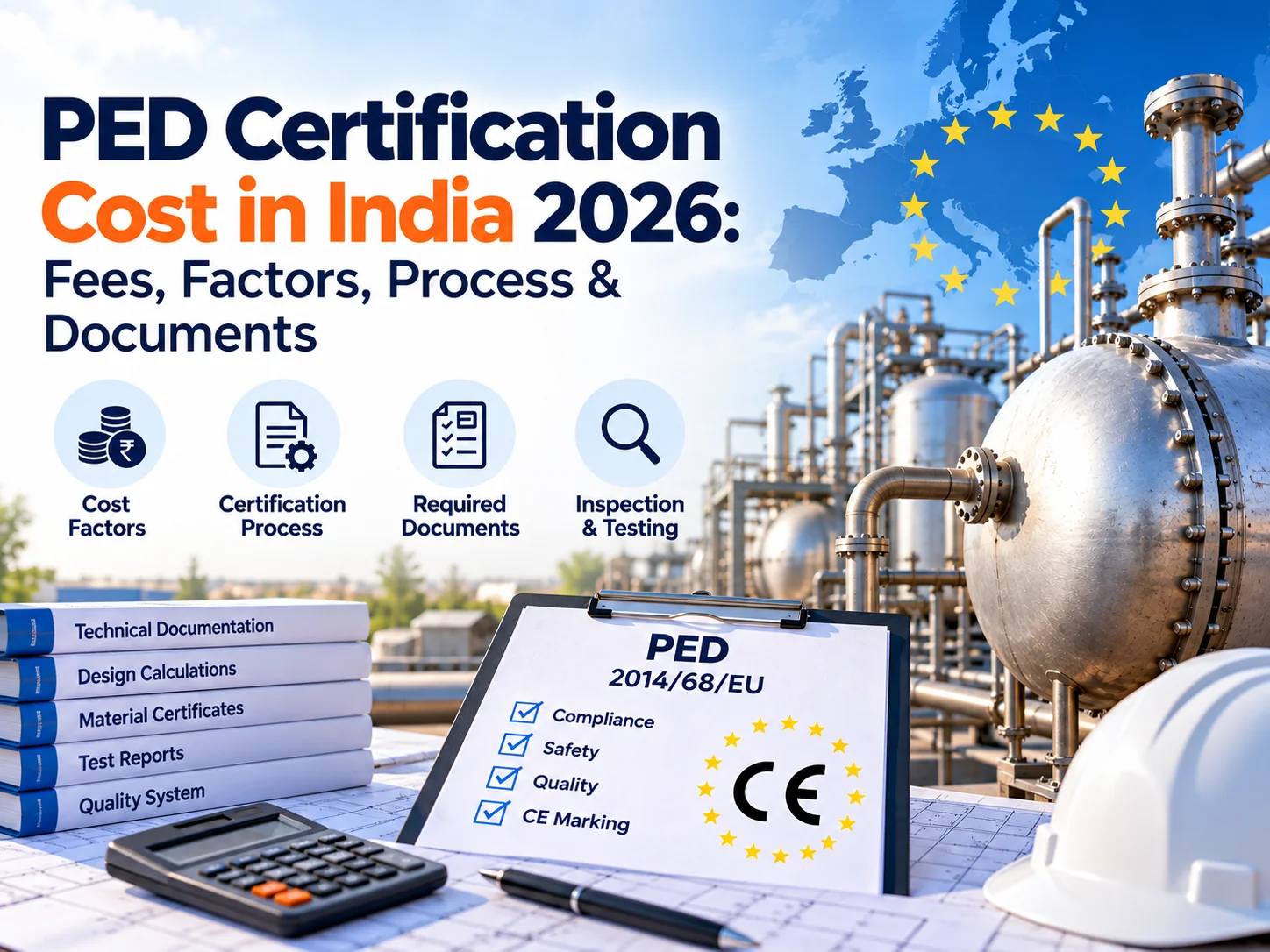
PED Certification Cost in India 2026: Fees, Factors, Process & Documents
By Editorial Team
Table Of Contents
- What Is PED Certification?
- How Much Does PED Certification Cost in India?
- Key Factors That Determine PED Certification Fees
- PED Certification Process in India
- Documents Required for PED Certification
- How Can Manufacturers Reduce PED Certification Delays?
- PED Certification vs CE Marking
- Do Indian Manufacturers Need a Notified Body?
- Why Choose First Welding Certification Pvt Ltd (PRVÁ ZVÁRAČSKÁ, a.s.) for PED Certification?
- PED Certification Cost in India: Quick Summary
- Key Takeaway
- Frequently Asked Questions About PED Certification
Related Blogs
SEP
11
What Are the Latest PED 2014/68/EU Pressure Vessel Regulations, Design Standards, Safety Factors and Certification Requirements in 2026 for Indian and Global Manufacturers?
SEP
10
ASME Section VIII vs EN 13445 for PED 2014/68/EU: CE Marking Requirements for Indian Manufacturers in 2026
See Also.....
For Indian manufacturers who make pressure equipment and sell it to the European Union, getting PED certification is a key step in showing they follow the Pressure Equipment Directive (PED) 2014/68/EU.
A common question that manufacturers ask is: How much does it cost to get PED certification in India?
There isn’t one set price for PED certification.
The total cost can change based on the type of pressure equipment, the PED category it falls into, the conformity assessment method used, the documentation needed, the inspection and testing involved, the manufacturing scope, and whether a third-party assessment is required.
This guide covers the main factors that affect the cost of PED certification, the process involved, the required documents, and the necessary steps for Indian manufacturers in 2026.
What Is PED Certification?
The Pressure Equipment Directive 2014/68/EU sets out rules for designing, making, and checking pressure equipment that stays in one place and has a maximum allowed pressure higher than 0.5 bar, as covered by the directive.
PED certification allows manufacturers to show that their pressure equipment meets EU safety and compliance standards before selling it in the EU.
The process can include checking documents, inspecting the equipment, testing it, reviewing the company’s quality system, and involving a Notified Body, depending on the equipment and the chosen compliance method.
How Much Does PED Certification Cost in India?
The cost of PED certification in India can be different for each project.It’s not possible to give a fixed price without looking at the equipment and what needs to be certified.
The main things that affect the cost are:
– The type of pressure equipment
– The PED category it falls into
– The maximum pressure it can handle
– The volume or size, if that’s relevant
– The type of fluid it will hold
– The chosen method for conformity assessment
– The design and technical papers needed
– The inspection and testing that are required
– The welding and joining methods used
– The manufacturing process
– The quality system check
– How many and what kind of inspections are needed
– The certification and assessment steps involved
So, manufacturers should start by figuring out the PED classification and the right conformity assessment path before getting a quote for their specific project.
Key Factors That Determine PED Certification Fees
- Type of Pressure Equipment
Certification needs can vary depending on the type of equipment, which includes:
– Pressure vessels
– Boilers
– Heat exchangers
– Piping
– Valves
– Safety accessories
– Pressure accessories
– Assemblies
The type of equipment influences how it is classified and what steps are needed to prove it meets requirements.
- PED Category
How equipment is classified under the PED plays a key role in deciding what steps are needed for certification.
Depending on the classification, equipment can fall into one of these categories:
– Category I
– Category II
– Category III
– Category IV
The category is determined based on things like the type of equipment, the type of fluid it handles, the pressure, volume, or size, and the rules in the PED.
- Conformity Assessment Module
The PED Annex III lists different ways to show that equipment meets standards, such as modules A2, B, C2, D, E, F, G, H, and H1.
The right module depends on the equipment category and other rules.
Some of these methods require a Notified Body to check the equipment.
A more complex process might require extra steps like technical reviews, inspections, testing, or checking the quality system.
- Technical Documentation
Having full technical documents helps speed up the certification process.
Depending on the method used, the documents may include:
– General description of the equipment
– Technical drawings
– Design calculations
– Manufacturing drawings
– Relevant standards
– Risk assessment
– Material details
– Inspection and test records
– Welding records
– Non-destructive testing (NDT) reports
– Pressure test records
– Quality system documents
The PED requires that the documents match the method used for checking compliance.
- Inspection and Testing
The certification process might include activities like:
– Design review
– Checking the materials used
– Inspecting welds
– Performing non-destructive testing
– Testing under pressure
– Final inspection
– Checking manufacturing processes
– Reviewing quality control
The exact requirements depend on the equipment and which method is used for conformity assessment.
PED Certification Process in India
A typical PED certification process goes like this:
First, there is an initial inquiry where details about the pressure equipment, its manufacturer, the scope of the certification, and the intended use in the EU market are provided.
Next, the scope and classification of the equipment are reviewed to determine if PED applies, what category the equipment falls into, and what conformity assessment steps are needed.
Then, the documentation is checked.
This includes looking at technical drawings, calculations, material specifications, manufacturing details, welding records, and any other relevant documents.
After that, the certification body looks at the scope and prepares a specific commercial offer for the project.
Following this, audits, inspections, tests, and technical evaluations are carried out as needed.
Once the assessments are done, the reports and supporting documents are reviewed to ensure everything meets the requirements.
If all steps are completed successfully, the necessary certification documents are issued.
If required, the manufacturer also prepares the EU Declaration of Conformity and applies the CE marking.
The European Commission explains conformity assessment as the process to show that the equipment meets EU standards, which can involve testing, inspection, and certification.
Documents Required for PED Certification
Manufacturers need to gather all the necessary technical and production documents before beginning the evaluation process.
Some typical documents that are usually required include:
- Information about the company and how the product is made
- Details about the product’s features and standards
- Drawings of the equipment used
- Calculations related to the design
- Certificates proving the quality of materials used
- Records showing where materials came from
- Instructions for welding procedures
- Documentation like WPQR/PQR, if needed
- Proof of welder qualifications
- Guidelines and reports for non-destructive testing
- A plan for inspections and tests (ITP)
- Records from pressure tests
- Records of heat treatment, if applicable
- Records of manufacturing and inspection steps
- Documentation about the quality system
- Risk evaluation reports
- Instructions on how to operate the equipment
- A technical file
- An EU Declaration of Conformity, if required
The specific list of documents may vary depending on the type of equipment and the process used to check its compliance.
How Can Manufacturers Reduce PED Certification Delays?
A good technical file can help avoid unnecessary delays during the assessment process.
Before beginning the certification process, manufacturers should:
- Check if the PED applies early on
- Figure out the right equipment category
- Find the correct conformity assessment method
- Check which standards apply
- Keep track of where materials come from
- Make sure welding qualifications are up to date
- Prepare records for testing and inspections
- Keep all manufacturing records complete
- Get all technical documents ready before the assessment
- Fix any missing documents before the inspection takes place
Manufacturers should also check if the standards they need are still valid, because the European Commission regularly updates and publishes these standards in the Official Journal of the European Union.
PED Certification vs CE Marking
PED certification and CE marking are connected, but they are different.
PED conformity assessment is the process that shows a product meets the rules in Directive 2014/68/EU.
CE marking is put on a product once all the required steps for conformity have been done.
For pressure equipment, the manufacturer must finish all the needed steps for conformity and make a declaration before selling the product in the EU.
Do Indian Manufacturers Need a Notified Body?
Whether a Notified Body is needed depends on the specific conformity assessment process required by the PED.
In some cases, a Notified Body is involved in tasks like reviewing the design, evaluating the product, conducting audits, inspections, or checking the quality system.
So, manufacturers need to figure out which PED category and conformity assessment path applies to their product before deciding if they need a third party to be involved.
Why Choose First Welding Certification Pvt Ltd (PRVÁ ZVÁRAČSKÁ, a.s.) for PED Certification?
First Welding Certification Pvt Ltd (PRVÁ ZVÁRAČSKÁ, a.s.) offers services to help with PED 2014/68/EU conformity assessment.These services include activities like design, making, welding, checking, testing, quality control, tracking materials, and preparing technical documents.
Their process starts with a request, then they provide a quote, confirm the order, register the project, conduct necessary audits, prepare a report, review it, get approval, and finally issue the certificate.
Manufacturers can send information about their equipment and what they want to certify to find out the needed requirements and get a custom quote for their project.
PED Certification Cost in India: Quick Summary
| Factor | Impact on Certification Cost |
|---|---|
| Equipment type | Determines applicable requirements |
| PED category | Influences assessment complexity |
| Pressure & volume/DN | Can affect classification |
| Fluid group | Influences PED classification |
| Conformity assessment module | Determines assessment activities |
| Technical documentation | Affects review requirements |
| Welding & permanent joining | May require additional assessment |
| Inspection & testing | Depends on certification scope |
| Quality system | May require audit/assessment |
| Manufacturing scope | Can affect inspection requirements |
Key Takeaway
In India, there is no single fixed cost for PED certification.The total fee varies based on the equipment type, its classification, the chosen conformity assessment method, the required documents, inspection and testing needs, and the overall scope of certification.
To get an accurate estimate, manufacturers need to give detailed information about the equipment and their production process.
This helps in identifying which specific PED requirements apply to their product.
Frequently Asked Questions About PED Certification
What is the cost of PED certification in India?
PED certification cost varies according to equipment type, PED category, conformity assessment procedure, documentation, inspection, testing, and assessment scope. A project-specific quotation is therefore required.
How long does PED certification take?
The timeline depends on equipment complexity, documentation readiness, conformity assessment requirements, inspection activities, and the selected certification route.
Is PED certification mandatory for Indian manufacturers?
PED requirements apply when applicable pressure equipment within the Directive’s scope is placed on the EU market. Manufacturers should first determine whether their equipment falls within the scope of PED 2014/68/EU.
What documents are required for PED certification?
Typical documentation includes technical drawings, design calculations, material certificates, manufacturing records, welding documentation, inspection and testing records, and other technical documentation required by the applicable conformity assessment procedure.
Does PED certification include CE marking?
PED conformity assessment supports the manufacturer’s demonstration of compliance. Where the equipment is subject to CE marking under the Directive, the manufacturer completes the applicable CE marking and EU Declaration of Conformity requirements.
Is a Notified Body required for PED certification?
Not always. The requirement depends on the applicable conformity assessment procedure and equipment classification.
Can an Indian manufacturer get PED certification?
Yes. Indian manufacturers can undergo the applicable PED conformity assessment process for pressure equipment intended for the EU market, subject to the Directive’s scope and requirements.
Can First Welding Certification Pvt Ltd (PRVÁ ZVÁRAČSKÁ, a.s.) provide a PED certification quotation?
Yes. Manufacturers can submit their equipment and certification details to First Welding Certification Pvt Ltd (PRVÁ ZVÁRAČSKÁ, a.s.) for assessment of the applicable scope and a project-specific commercial offe