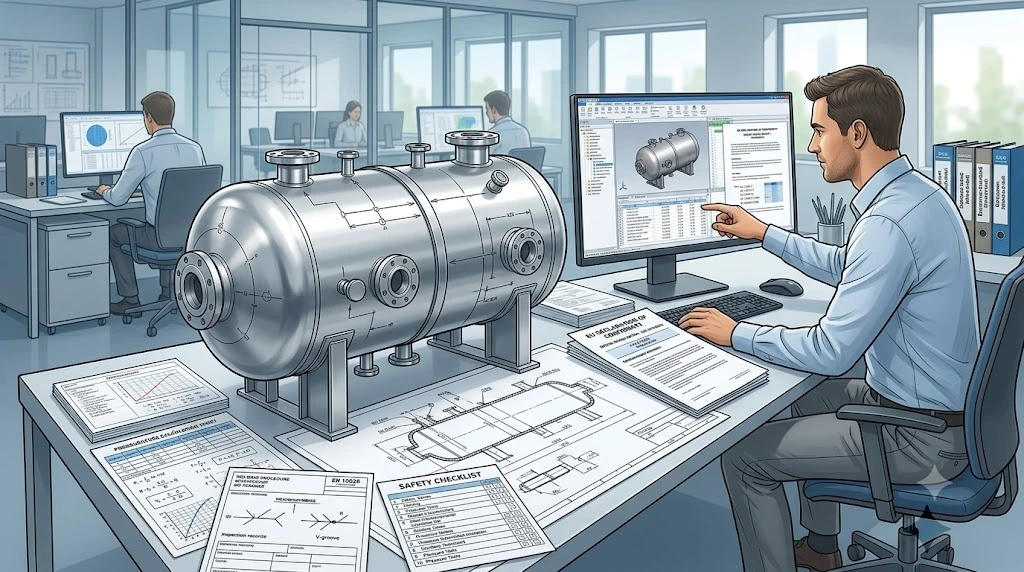
PED Documentation
Welding Compliance
WPS, WPQR, Welder & NDT Records
Top 10 PED Documentation & Welding Compliance Gaps That Can Delay Pressure Equipment Conformity Assessment: WPS, WPQR, Welder & NDT Records Explained
By First Welding Certification Technical Editorial Team
8 Min Read
29 Sep 2026
Table of Contents
- Why Is PED Documentation So Important?
- 10 PED Documentation & Welding Compliance Gaps
- Real-World Example: Indian Pressure Vessel Manufacturer Preparing for the EU Market
- PED Documentation & Welding Compliance Checklist
- 2026: One More Check Manufacturers Should Not Miss
- How to Reduce PED Documentation Gaps Before Assessment
- Frequently Asked Questions
- Conclusion
- Review Your PED Documentation Before Conformity Assessment
What Can Delay PED Conformity Assessment?
Technical Documentation
WPS, WPQR & Welder Records
NDT & Traceability

A pressure vessel can be completely made, welded checked and tested and still have questions during the PED 2014/68/EU conformity assessment.
Why?
Because being compliant is not shown by the product alone. The manufacturer also needs a clear and easy to follow collection of proof that shows how the product was designed, built joined, checked, tested and reviewed.
PED 2014/68/EU covers the design, building and checking of pressure equipment and systems that have a maximum allowed pressure higher than 0.5 bar. The right way to check conformity depends on the equipment, how it’s classified and what category it falls into.
For manufacturers especially those sending pressure equipment from India to the market one question is very important:
Can each important compliance statement be linked to the correct drawing, certificate, qualification, inspection record or test result?
This article lists 10 documentation and welding compliance issues that manufacturers should check before the conformity assessment.
Why Is PED Documentation So Important?
Under PED, technical documentation must make it possible to check if the requirements are met. Depending on the conformity assessment method, it can include the equipment description, drawings, relevant harmonized standards, design calculations, checks and test reports, along with any needed approval or qualification details.
The Directive also requires manufacturers to keep documentation and statements for 10 years after the pressure equipment is placed on the market under the proper procedures.
2026 PED compliance snapshot
- 0.5 bar. The limit for PED coverage for stationary pressure equipment.
- 10 years. The time period the documentation must be kept under the Directive for relevant records.
- 2026. The European Commissions page for harmonized standards shows an update on 12 January 2026 for Implementing Decision (EU) 2025/165.
This makes document control a long-term responsibility, for compliance not something done on the day of an audit
10 PED Documentation & Welding Compliance Gaps
1. Incomplete PED Technical Documentation
The first gap is a file that has documents but does not tell a full compliance story.
Manufacturers must make sure the documentation clearly links:
Product description → Drawings → Design calculations → standards → Manufacturing → Inspection → Testing → Conformity evidence
Common issues include missing drawings, incomplete design calculations, unclear standards or missing test reports.
The technical documentation must be detailed enough to support the conformity assessment route.
2. WPS Exists, but the WPQR Does Not Properly Cover Production
A Welding Procedure Specification (WPS) shows how welding should be done.
A Welding Procedure Qualification Record (WPQR) holds the proof that the procedure works.
The key question is not:
“Do we have a WPS?”
It is:
“Does the WPQR actually cover the welding we plan to do?”
Variables like material type, thickness, welding process and other essential factors must match the qualification range.
To get more details check WPS & WPQR qualification tests
3. WPQR Qualification Range Does Not Match Actual Fabrication
A typical problem happens when a WPQR is in place. The actual welding is done outside the qualified range.
For example a manufacturer may qualify for one thickness. Later use a different thickness without checking if the qualification still applies.
Before welding starts check:
Actual production variable → WPS → WPQR → Qualification range
This check can catch a serious documentation issue early.
4. Missing Welder Qualification Records
A WPS covers the procedure. It does not cover the person doing the welding.
PED Annex I point 3.1.2 says that permanent joining of pressure-resisting components must be done by personnel using approved procedures. For Categories II, III and IV both procedures and personnel need approval from a third party.
Manufacturers must be able to show:
Welder → Qualification → Welding process → Production weld
The qualification records must be current. Match the work being done.
5. Material Certificates Cannot Be Traced to the Final Equipment
Having a material certificate is not enough if the material identity gets lost during fabrication.
PED Annex I 3.1.5 requires procedures to keep pressure-resisting materials from receipt to final test.
A proper traceability chain is:
Material certificate → Heat/Batch number → Component → Fabrication record → equipment
This is especially important for materials that handle pressure.
In order to check the documentation process check EN 10204 Type 3.2 material certification and traceability
6. NDT Reports Are Present. Personnel Qualification Evidence Is Missing
NDT reports should not be seen as standalone documents.
PED Annex I 3.1.3 says that non-destructive testing of joints must be done by qualified personnel. For Categories III and IV the personnel must be approved by a party.
An NDT report should make clear:
- What was inspected
- Which method was used
- Which weld or component was examined
- What procedure applied
- What result was obtained
- Who performed the examination
- How the record connects to the equipment, In order to know this learn about ISO 9712 NDT personnel qualification
7. Permanent Joining Documentation Is Incomplete
Welding and other permanent joining methods are control points in pressure equipment.
PED Annex I 3.1.2 says that permanent joining of pressure-resisting parts must follow approved procedures and be done by personnel. For Categories II, III and IV approvals are required by the Directive.
Manufacturers should keep a chain:
Joining procedure → Qualification record → Qualified personnel → Production weld → NDT/inspection record
A break in this chain can raise red flags during assessment.
8. Inspection and Test Reports Use the Wrong Equipment Identification
This may seem small. It causes big problems.
Imagine:
- Drawing: PV-024
- NDT report: PV-042
- Pressure test report: PV-024A
All documents exist, but which one belongs to the vessel?
Consistency in identification is part of traceability. Equipment numbers, component numbers, weld numbers and test references must match across all records.
The goal is to make the evidence easy to follow without guesswork.
9. Manufacturing Records Are Separated From Quality Records
Manufacturing information must connect to quality records.
Depending on the equipment and assessment route evidence may include:
- Material records
- Welding records
- Heat-treatment records where needed
- NDT reports
- Inspection records
- Test data
- Calibration information
- Personnel qualifications
- Final inspection records
PED quality-system rules say that examinations and tests must be done before during and after manufacturing. Quality records must include inspection reports, test data, calibration data and personnel qualification records. For more clarity refer our WPS and WPQR qualification requirements
10. The Documents Do Not Tell One Consistent Compliance Story
This is the gap that ties all the others together.
A manufacturer may have all the documents:
Drawing. Material Certificate + WPS + WPQR + Welder Qualification + NDT Report + Test Report
But if those records cannot be linked the documentation package becomes hard to verify.
Before assessment ask:
Can a reviewer start with the pressure equipment and trace it back, through design, materials, welding, personnel, inspections and tests?
If the answer is no the documentation needs a structured review.
Imagine a manufacturer that builds a welded pressure vessel for a customer in the European Union. The vessel has already been. Pressure-tested. The company has most of the documents it expects to need.. During a detailed document review four problems stand out.
First the welding procedure specification or WPS is there.. The weld procedure qualification record or WPQR does not clearly cover the thickness of the material used in production. That creates a gap. The qualification does not match what was actually built.
Second welder qualification records are available.. They are not connected to the actual welding records from production. So there is no proof that the right welders did the work.
Third the material certificate is present.. One fabrication record is missing the heat number. That makes it hard to trace the material back to its source.
Fourth an NDT report uses a weld identification number than the one shown on the manufacturing drawing. This breaks the link between the inspection and the actual part.
The vessel itself may still be safe and sound.. The problem is the evidence. There is no chain of documentation. The records do not connect properly. The story does not add up.
This situation shows why manufacturers should not wait until the minute to prepare their PED documentation. It should be built step by step alongside the manufacturing process. Not assembled when the conformity assessment is due.
PED Documentation & Welding Compliance Checklist
| Compliance area | What manufacturers should verify |
|---|---|
| Technical file | Drawings, calculations, standards and technical evidence are complete |
| Materials | Certificates and identification remain traceable |
| WPS | Production welding instructions are controlled |
| WPQR | Qualification range covers actual welding conditions |
| Welder | Personnel qualifications match the welding scope |
| Permanent joining | Applicable procedures and approvals are documented |
| NDT | Reports, methods, results and personnel records are traceable |
| Inspection | Equipment and component identification is consistent |
| Testing | Test records identify the correct equipment |
| Final documentation | Conformity evidence is complete and internally consistent |
2026: One More Check Manufacturers Should Not Miss
In 2026 the European Commission will update its list of harmonised standards used under the Pressure Equipment Directive or PED. The current list is published in Implementing Decision (EU) 2025/165. There will be an amendment on 12 January 2026. This update will change which standards apply to pressure equipment.
This is important. A company that relies on an internal list of standards may unknowingly use outdated references. That can lead to non-compliance. It can create a documentation risk.
Before finalising the file for a PED assessment manufacturers must check the current standards. They need to confirm which standards apply to their product its design method and the conformity assessment route they are using.
Do not assume that a standard used in a project still applies to a new one. Standards change. What was valid year may not be valid today.
How to Reduce PED Documentation Gaps Before Assessment
Manufacturers can prevent these issues with an internal review. The review should answer five questions:
1. Is the equipment correctly identified?
Make sure the product type, pressure setting and other classification details are correct. The documentation must reflect the equipment.
2. Is the design evidence complete?
Check that drawings, calculations, specifications and the relevant standards are all present. Every design decision must be supported.
3. Is manufacturing traceable?
Ensure materials, forming, welding and joining records are all connected. Each part should have a paper trail from raw material to finished product.
4. Are personnel and inspection records
Verify that welders, welding personnel and NDT inspectors are qualified for the work they did. Their records must match the production scope.
5. Does the final file tell one story?
Every certificate and report must link back, to the pressure equipment. The documentation should flow logically. Support compliance.
This approach builds a PED compliance checklist. It helps manufacturers avoid last-minute surprises and ensures that their documentation is ready when the assessment begins.
Frequently Asked Questions
What documents are required for PED 2014/68/EU conformity assessment?
Depending on the equipment and the conformity assessment procedure the documents can include descriptions, drawings, design calculations, applicable standards, examination reports, test reports, manufacturing information, material records, qualification records and conformity documents. The exact set of documents depends on the route chosen for assessment.
Is a WPS for PED welding compliance?
Not necessarily. When procedure qualification is required the production WPS must have qualification evidence and must be used only within its approved range. Welder qualification is an required step.
Does PED certification require welders?
Yes PED Annex I 3.1.2 states that permanent joining of pressure-resisting components must be done by qualified personnel using approved procedures. For Categories II, III and IV additional third-party approval is also needed.
Why is material traceability important, under PED?
PED Annex I 3.1.5 requires procedures to track pressure-resisting materials from the time they are received through production to the final testing of the finished pressure equipment. This ensures materials meet the required standards and are used correctly.
Why can NDT documentation become a PED compliance issue?
Because PED covers both the -destructive testing of permanent joints and the qualification of the people doing the testing. The exact rules depend on the equipment category and the conformity assessment route being used.
Conclusion
The hardest problems in PED documentation are usually not about missing documents. They are about missing links between documents.
A manufacturer might have the drawing, material certificate, WPS, WPQR, welder qualification, NDT report and test report.. The conformity assessment is harder if those records do not all point to the same equipment, component or production stage.
The core principle is: Design → Material → Welding → Qualified Personnel → NDT → Inspection → Testing → Technical File → Conformity Evidence
Manufacturers who prepare pressure equipment for the market should review this chain before they start formal assessment.
For international manufacturers First Welding Certification Pvt Ltd offers certification and conformity assessment that covers European and international requirements, such as PED 2014/68/EU, WPS/WPQR, EN 10204 Type 3.2 and ISO 9712.
Review Your PED Documentation Before Conformity Assessment
First Welding Certification Pvt Ltd represents the operations of PRVÁ ZVÁRAČSKÁ, a. S. which is a European Commission Notified Body (NB 2408), for the Pressure Equipment Directive PED 2014/68/EU. The conformity assessment activities that apply are chosen based on the pressure equipment category and the PED requirements that are relevant.
Before you proceed with conformity assessment manufacturers should review their documentation, design records, material traceability, WPS, WPQR, welder qualifications, permanent joining procedures, NDT records, inspection and testing documentation and the conformity assessment route that applies.
Ready to Review Your PED Documentation?
Explore the PED 2014/68/EU conformity assessment information that First Welding Certification Pvt Ltd provides. Identify the documentation and technical requirements that apply to your pressure equipment.