
Related Blogs
SEP
08
EN 1090 Standard: Which Companies Need It in India & International Markets in 2026?
AUG
14
EN 1090 CE Marking Audit: Complete Checklist, Common Non-Conformities & Preparation Guide
AUG
12
EN 1090 Execution Classes: Complete Guide to EXC1, EXC2, EXC3 & EXC4
AUG
10
Mastering EN 1090 Factory Production Control (FPC): Comprehensive Audit Checklist & Compliance Guide
JLY
31
EN 1090 Certification Requirements: 15-Point Checklist for Structural Steel & Aluminium Manufacturers
JLY
20
CE Marking vs EN 1090: Key Differences Every Manufacturer and Exporter Should Know (2026 Guide)
EN 1090-2
Structural Steel
ESSENTIAL TOLERANCES
29 Sep 2026
EN 1090-2 Dimensional Tolerances: Essential vs Functional Tolerances for Structural Steel Fabrication
By Editorial Team
Table Of Contents
Structural steel fabrication requires more than accurate cutting, welding, and assembly. Every fabricated component must meet the specified dimensional tolerances to ensure structural integrity, correct fit-up, and reliable site installation.
For steel fabricators supplying European construction projects, EN 1090-2 dimensional tolerances are an important part of fabrication quality control.
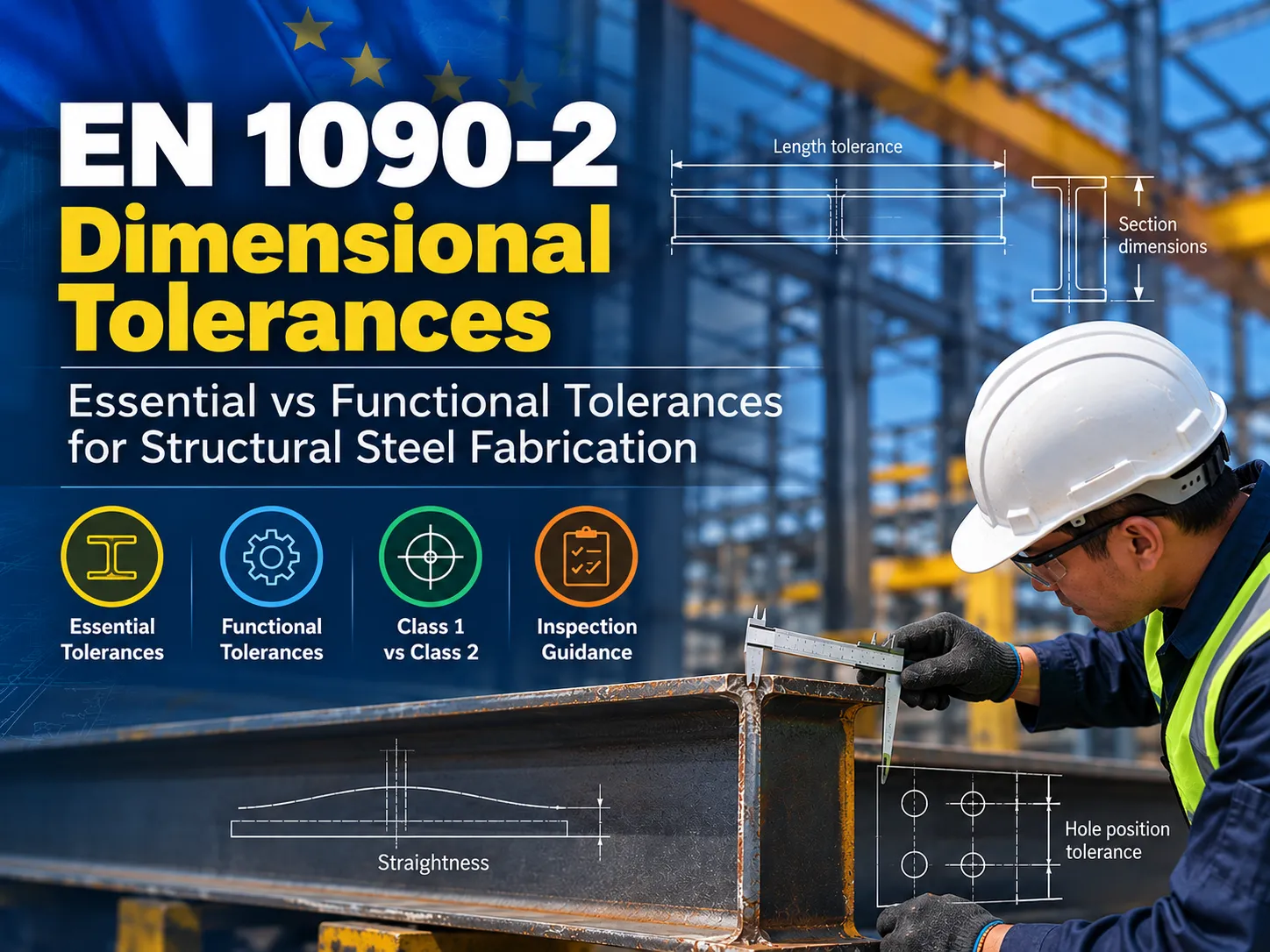
The standard distinguishes between essential tolerances, which relate to structural resistance and stability, and functional tolerances, which address fit-up, appearance, and other functional requirements.
Understanding this difference helps manufacturers reduce rework, improve inspection planning, and prepare structural steel components for project acceptance.
1. What Are Dimensional Tolerances Under EN 1090-2?
EN 1090-2 specifies technical requirements for the execution of steel structures, including fabrication, welding, inspection, and geometrical tolerances.
A dimensional tolerance defines the permitted deviation between a specified dimension or geometrical condition and the actual manufactured or erected component.
In structural steel fabrication, tolerances may apply to:
- Member length, depth, and flange width.
- Straightness, flatness, and twist.
- Hole positions and connection geometry.
- Welded assembly dimensions.
- Column alignment and beam positioning during erection.
EN 1090-2:2018+A1:2024 includes provisions addressing geometrical tolerances, with essential and functional tolerances identified in the execution requirements and Annex B. Manufacturers should verify the applicable edition and project specification before using tolerance values for acceptance.
2. Essential vs Functional Tolerances: Key Differences
The main difference is the purpose of the tolerance.
Essential tolerances are associated with the design assumptions for mechanical resistance and structural stability. Functional tolerances address other requirements, such as fit-up, appearance, and the proper functioning of the completed structure.
Table 1. Essential and functional tolerances compared
| Parameter | Essential tolerances | Functional tolerances |
|---|---|---|
| Primary purpose | Meet design assumptions for resistance and stability | Meet fit-up, appearance, and other functional requirements |
| Typical application | Structural geometry affecting load transfer and stability | Connection fit, interfaces, alignment, and installation |
| Specification | Defined by the applicable essential tolerance requirements | Tabulated values or specified alternative criteria |
| Functional classes | Not divided into Class 1 and Class 2 in the same way | Functional tolerance Class 1 and Class 2 |
| Acceptance | Assessed against the applicable essential limits | Assessed against the specified functional class or alternative criteria |