
ISO 9001
BENIFITS
QMS
06 Oct 2026
What Is the Purpose of ISO 9001 Certification?
By Editorial Team
Table Of Contents
- What Is ISO 9001 Certification?
- What Is the Main Purpose of ISO 9001 Certification?
- How Does ISO 9001 Certification Work?
- 7 Key Purposes of ISO 9001 Certification
- ISO 9001:2015 vs ISO 9001:2026
- What Does ISO 9001 Certification Cover?
- Who Needs ISO 9001 Certification?
- ISO 9001 Certification for Manufacturers
- ISO 9001 vs Quality Control
- Is ISO 9001 Certification Mandatory?
- Who Issues ISO 9001 Certificates?
- What Are the Benefits of ISO 9001 Certification?
- ISO 9001 Certification: Simple Example
- Key Takeaways
- Frequently Asked Questions
- Conclusion
Related Blogs
SEP
17
How Does Documented Information Help With ISO 9001 Certification for Manufacturing Companies?
See Also.....
ISO 9001 certification shows that an organization has a strong Quality Management System (QMS) in place. This helps ensure that the company consistently meets the needs of its customers and follows important rules and regulations. It also acts as an independent proof that the organization follows ISO standards, giving confidence to those involved that they are managing quality properly. The newest version of the standard is ISO 9001:2026, which was released on September 16, 2026.This replaces the older version, ISO 9001:2015, and shows that the standard continues to improve over time.
What Is ISO 9001 Certification?
ISO 9001 is a worldwide quality management standard that gives guidelines for organizations to manage and improve their quality in a structured way. It is used in many areas like making products, healthcare, schools, and government. The standard offers a adaptable system for handling processes, meeting needs, checking how well things are going, and keeping things better over time, but it doesn’t tell you exactly how to do each task.
What Is the Main Purpose of ISO 9001 Certification?
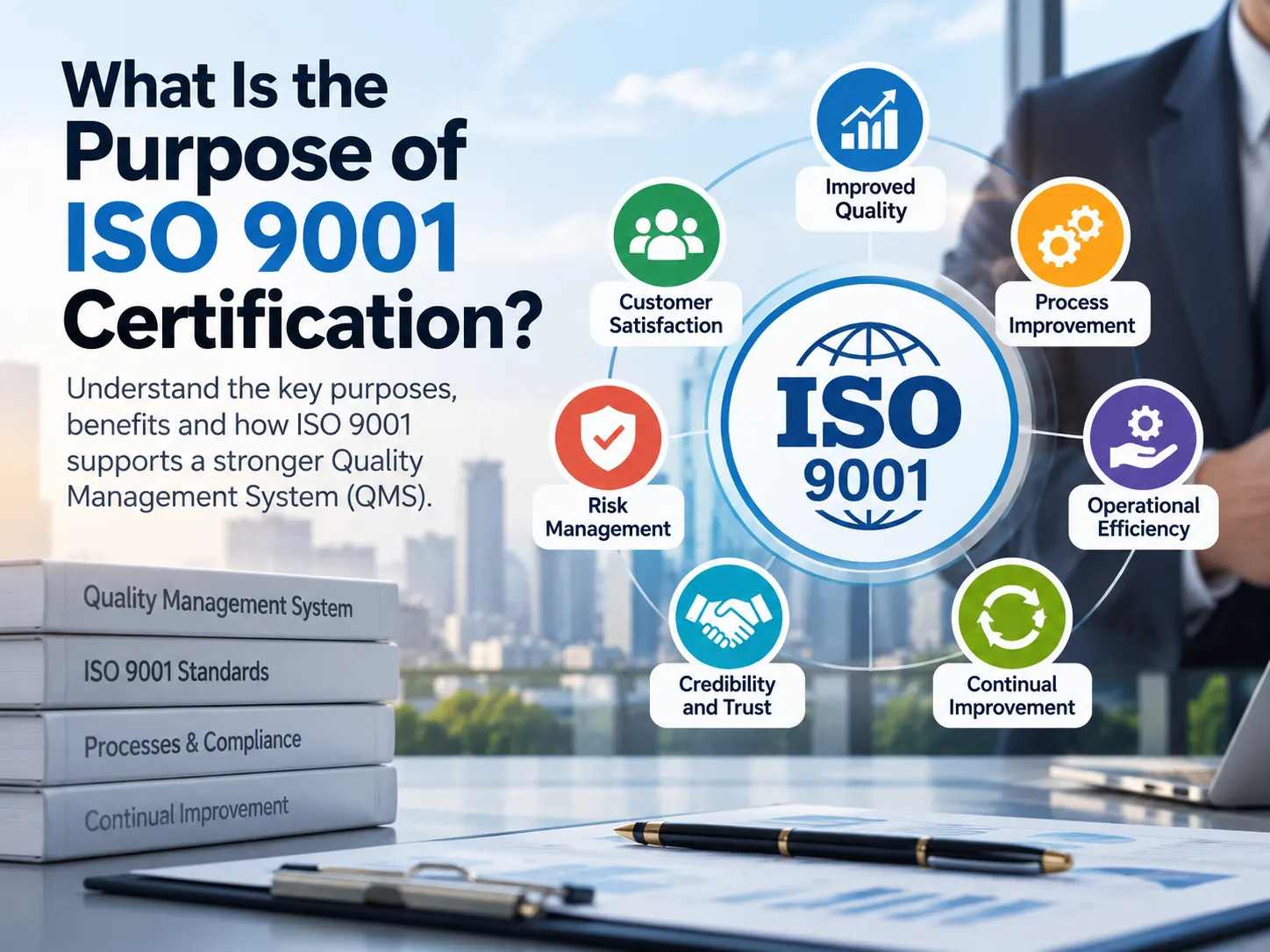
The main goal is to show that an organization can reliably provide products or services that meet the required standards. ISO 9001 certification helps achieve this by assisting organizations in:
| Purpose | How ISO 9001 Helps |
|---|---|
| Risk management | Encourages organizations to identify and address risks |
| Consistent quality | Establishes controlled and repeatable processes |
| Employee competence | Establishes requirements for resources and competence |
| Customer satisfaction | Focuses processes on customer requirements |
| Regulatory compliance | Helps control applicable statutory and regulatory requirements |
| Operational efficiency | Identifies process inefficiencies and waste |
| Customer confidence | Provides independent evidence of QMS conformity |
| Process improvement | Uses monitoring measurement and corrective action |
| Continual improvement | Uses performance evaluation and improvement activities |
ISO 9001 brings several key advantages, such as increased customer trust, better processes, less spending, higher efficiency, and ongoing improvements.
How Does ISO 9001 Certification Work?
ISO 9001 certification is a step-by-step process. First, you need to understand what the ISO 9001 standards require. Then, you set up a Quality Management System. After that, you put in place the processes and controls needed. You also check how well things are going and measure performance. Internal audits are done to make sure everything is working as it should. Management looks at the results and decides what needs to be improved. Any issues or mistakes are fixed. Then there’s a certification audit to check if everything meets the standards. If it does, you get the ISO 9001 certificate. But certification isn’t the end. You need to keep improving and have regular checks called surveillance audits to make sure you stay compliant.
7 Key Purposes of ISO 9001 Certification
1 Improve Product and Service Quality
– ISO 9001 gives a way to control processes
– It sets up controls across all operations
– This leads to consistent results and fewer mistakes
– It also improves customer satisfaction and overall performance
2 Increase Customer Satisfaction
– Focusing on customers is a key part of quality management
– Understanding what customers need is important
– This helps reduce complaints and improves delivery
– Solving problems in a systematic way builds better relationships
– ISO 9001 helps meet customer expectations and increases trust
3 Improve Business Processes
– It helps understand how different processes work together
– It finds areas where things can be better or more efficient
– It follows a clear path from customer needs to feedback
– It shows where there are delays or wasteful steps
4 Reduce Errors, Waste, and Rework
– A strong quality management system looks for the real causes of problems
– It focuses on fixing the root issues, not just the symptoms
– This leads to fewer reworks, complaints, waste, and costs
– It matches ISO 9001 goals for better decision-making
5 Manage Risks and Opportunities
– It offers a way to find and handle risks
– It focuses on preventing problems rather than just fixing them after they happen
– It encourages thinking about risks and opportunities when making decisions
6 Demonstrate Credibility to Customers
– Certification shows that a company follows ISO 9001 standards
– It is helpful when working with suppliers or in negotiations
– It is not required, but many customers prefer or need it
7 Establish a Culture of Continual Improvement
– It encourages regularly checking how well processes work
– It uses a simple improvement method called Plan-Do-Check-Act
– Being able to adapt to new situations and expectations is important
ISO 9001:2015 vs ISO 9001:2026
For organizations researching ISO 9001 today, the edition matters.
| Feature | ISO 9001:2015 | ISO 9001:2026 |
|---|---|---|
| Edition | 5th | 6th |
| Publication | 2015 | 16 September 2026 |
| Current status | Replaced | Current edition |
| Quality management | Yes | Yes |
| Customer focus | Yes | Yes |
| Continual improvement | Yes | Yes |
| Risk-based thinking | Yes | Yes |
| Leadership | Yes | Strengthened emphasis |
| Quality culture | Present | Greater emphasis |
| Risks and opportunities | Combined approach | Clearer distinction and emphasis |
| Strategic alignment | Yes | Strengthened |
| Digital/business environment | Less explicit | Updated for modern business conditions |
ISO 2026 builds on ISO 9001 by making leadership stronger, promoting a better quality culture, aligning with strategies, and handling risks more effectively.
What Does ISO 9001 Certification Cover?
ISO 9001:2026 addresses major areas of a quality management system, including:
| Area | What It Addresses |
|---|---|
| Organizational context | Internal and external factors affecting the QMS |
| Leadership | Leadership responsibility and quality culture |
| Planning | Quality objectives risks and opportunities |
| Support | Resources, competence, awareness and documented information |
| Operation | Planning and control of processes |
| Performance evaluation | Monitoring, measurement, analysis and evaluation |
| Improvement | Corrective action and continual improvement |
These areas team up to form a organized quality management system instead of just separate quality-control actions.
Who Needs ISO 9001 Certification?
ISO 9001 works for organizations of all sizes and different industries. It helps companies show they consistently provide good quality. Many businesses use it, like manufacturers, engineering firms, construction companies, auto suppliers, service businesses, IT companies, healthcare groups, and exporters. This shows how widely it can be used.
ISO 9001 Certification for Manufacturers
ISO 9001 helps improve control during the production process.
Process steps: Customer needs are reviewed, then a contract is checked, followed by planning the production, getting the necessary materials, making the product, checking and testing it, handling any issues that come up, getting final approval, delivering the product, getting feedback from the customer, and continuously improving the process.
This system is important for ensuring quality, keeping track of the product’s history, meeting delivery times, and satisfying customer needs.
ISO 9001 vs Quality Control
ISO 9001 certification should not be confused with simply inspecting products.
| Quality Control | ISO 9001 QMS |
|---|---|
| Focuses heavily on detecting defects | Focuses on managing processes |
| Often product-oriented | Process and system-oriented |
| Finds problems | Helps prevent recurrence |
| Mainly inspection-based | Includes planning operation and improvement |
| Usually one part of quality management | Provides a broader QMS framework |
Quality control is a part of quality management, but ISO 9001 includes a much wider range of management practices.
Is ISO 9001 Certification Mandatory?
ISO 9001 certification is not required by law. Companies can follow its guidelines without getting certified by an external body. But sometimes, customers or market demands might require certification for business reasons. Getting certified isn’t compulsory.
Who Issues ISO 9001 Certificates?
ISO creates and shares standards, such as ISO 9001. Separate companies, which are approved by a certification body, check if an organization’s quality management system meets the standards. When an organization shows it follows the standards, it gets certified. It’s important to know that ISO itself does not give certifications. Instead, it’s other approved companies that issue the certifications.
What Are the Benefits of ISO 9001 Certification?
The business benefits can be summarized as follows:
| Benefit | Business Impact |
|---|---|
| Better process control | More consistent operations |
| Fewer errors | Reduced rework and waste |
| Customer focus | Improved satisfaction |
| Risk management | Better preparedness |
| Continual improvement | Better long-term performance |
| Documented processes | Greater consistency |
| Independent certification | Increased credibility |
| Supplier confidence | Stronger business relationships |
| Market access | Potential access to customers requiring certification |
ISO 9001 enhances customer trust, quality control, cost savings, productivity, and continuous improvement culture.
ISO 9001 Certification: Simple Example
A manufacturing company handles complaints about product dimensions well by using a quality management system based on ISO 9001.When complaints come in, they are recorded as nonconformities, then the company finds the root cause, takes steps to fix the problem, checks if the fixes worked, improves their processes, and reduces similar issues in the future. This shows how ISO 9001 helps control processes and improve performance.
Key Takeaways
ISO 9001 certification shows how well an organization manages quality through a structured system. It focuses on making customers happy, controlling processes, managing risks, and improving over time. This helps companies provide reliable products and services, meet what is needed, improve their work processes, lower mistakes, handle risks better, gain customer trust, and keep getting better. By September 2026, companies must switch to the new ISO 9001:2026 standard, which replaces ISO 9001:2015, and they need to follow set timeframes to update their certifications.
Frequently Asked Questions
What is the main purpose of ISO 9001 certification?
The main purpose is to demonstrate that an organization has an effective quality management system capable of consistently meeting requirements and supporting continual improvement.
Is ISO 9001 only for manufacturing companies?
No. ISO 9001 can be applied to organizations across manufacturing, services, healthcare, education, IT, construction and many other sectors.
Is ISO 9001 certification mandatory?
No. ISO 9001 certification is voluntary, although customers, contracts, tenders or industry requirements may require certification.
What is the latest version of ISO 9001?
The latest edition is ISO 9001:2026, published on 16 September 2026. It replaces ISO 9001:2015.
Does ISO issue ISO 9001 certificates?
No. ISO develops the standard but does not certify organizations. Independent certification bodies conduct certification audits.
Does ISO 9001 guarantee product quality?
No. Certification does not guarantee that every product or service will be defect-free. It demonstrates conformity of the organization’s quality management system with ISO 9001 requirements.
Conclusion
ISO 9001 certification shows that a company has a good system in place to handle quality in a clear and organized way. This certification helps ensure that processes are done the same way every time, which makes customers happier and operations run more smoothly. It also helps in managing risks and constantly improving how things are done. Companies need to make sure their quality system meets the newest standards set by ISO 9001:2026.