
Control Production
Pressure Vessel
Manufacturing Method
SPVD 2014/29/EU: How to Control Production Changes Between Batches of Simple Pressure Vessels
By First Welding Certification Technical Editorial Team
6 Min Read Time
26 Oct 2026
Table of Contents
- Introduction
- Why Production Change Control Matters Under SPVD
- What Is a Production Change in Pressure Vessel Manufacturing?
- Five Common Changes That Require Technical Review
- How to Assess the Impact of a Production Change
- Maintaining Consistency Between Manufacturing Batches
- What Happens When a Change Affects Conformity?
- Records to Maintain During Production Changes
- Common Mistakes Manufacturers Should Avoid
- Frequently Asked Questions
- Related searches
- Conclusion
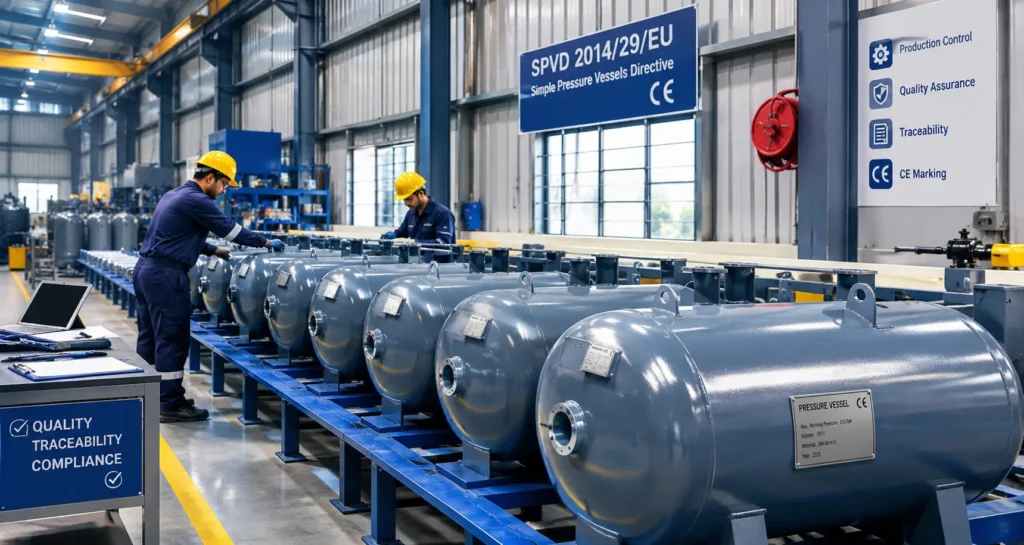
Manufacturing a pressure vessel that meets the required specifications is only one part of supplying a compliant product to the European market. Manufacturers producing simple pressure vessels in series must also consider how changes in materials, dimensions, welding conditions and production methods affect conformity. A change that appears minor on the shop floor may have consequences for the approved design, manufacturing instructions, inspection arrangements or conformity assessment documentation.
For manufacturers working under the Simple Pressure Vessels Directive (SPVD) 2014/29/EU, a controlled approach to production changes can help prevent inconsistencies between batches and reduce avoidable delays during verification.
This article explains how manufacturers can identify, assess and document production changes while maintaining appropriate controls over their simple pressure vessel manufacturing processes.
Why Production Change Control Matters Under SPVD
The Simple Pressure Vessels Directive 2014/29/EU establishes requirements for certain series-manufactured welded pressure vessels intended to contain air or nitrogen and meeting the Directive’s scope conditions. Manufacturers must identify the applicable requirements and follow the relevant conformity assessment procedure for their products.
In a production environment, the same vessel model may be manufactured repeatedly. Although the product design is intended to remain consistent, manufacturing conditions can change because of supplier substitutions, equipment adjustments, revised drawings or process improvements. Without an appropriate review, a change may introduce differences between the product that was assessed and the product being manufactured.
A controlled change process helps manufacturers:
- Identify changes that may affect product conformity.
- Confirm that applicable technical requirements remain satisfied.
- Maintain consistency between production instructions and actual manufacturing.
- Preserve relevant material, welding and inspection records.
- Determine whether additional verification or assessment is necessary.
- Reduce avoidable rework, delays and documentation gaps.
The important principle is that a production change should be evaluated according to its technical impact, not simply its commercial cost or convenience.
What Is a Production Change in Pressure Vessel Manufacturing?
A production change is any modification to a design, material, manufacturing method, supplier arrangement or inspection process that could affect the vessel or the evidence used to demonstrate conformity. Not every operational adjustment affects conformity. However, manufacturers should have a way to distinguish routine activities from changes that require technical review.
Consider a manufacturer producing a series of compressed-air receivers.
The first production batch is manufactured using the specified material, approved drawings and established welding procedures. Before the next batch begins, the purchasing team proposes a different steel grade because the original material is temporarily unavailable.
The replacement material may appear suitable, but its acceptability cannot be established by price or nominal thickness alone. The manufacturer needs to determine whether it satisfies the applicable design and material requirements and whether the change affects the supporting technical documentation. The same principle applies to changes in vessel dimensions, weld details, forming processes or inspection arrangements.
A documented review helps ensure that the decision is based on applicable technical requirements rather than assumptions.
Five Common Changes That Require Technical Review
Change 1: Substitution of Base Material
A supplier may propose an alternative grade of steel or a different source. Prior to accepting the substitute, the manufacturer must evaluate the appropriate material specification, mechanical properties, design assumptions and applicable requirements.
Where material documentation or traceability is required, the corresponding records should be updated or linked to the new material. A material that appears similar is not automatically an acceptable replacement.
Change 2: Changes to Vessel Dimensions or Wall Thickness
A manufacturer may consider changing a vessel’s wall thickness, diameter, length or head geometry to improve production efficiency. Such changes can affect design calculations, manufacturing tolerances and other product characteristics.
The proposed change should be reviewed by the responsible technical personnel against the applicable design requirements. Production should not proceed on the assumption that a dimension change is harmless.
Change 3: Changes to Welding Procedures or Conditions
A manufacturer may change a welding process, consumable, joint preparation or other welding condition. The significance of the change depends on the applicable welding requirements and the existing qualification range.
The manufacturer should determine whether the existing welding procedure remains suitable, whether additional qualification is required and whether associated inspection arrangements need revision. A new production batch does not automatically require a new Welding Procedure Qualification Record (WPQR). The decision depends on the actual change and applicable qualification rules.
Change 4: Changes to Manufacturing Equipment or Methods
Replacing equipment or introducing a new forming, cutting or welding method may affect process capability and product conformity. Manufacturers should evaluate whether the new arrangement can consistently produce vessels meeting the applicable requirements.
Where necessary, production trials, verification checks or additional controls may be appropriate.
Change 5: Changes to Inspection or Testing Arrangements
A manufacturer may propose changing an inspection method, testing frequency, acceptance criteria or external inspection provider. Before implementing the change, the manufacturer should establish whether the revised arrangement remains consistent with the applicable conformity assessment procedure, technical requirements and contractual obligations.
An internal cost-saving decision cannot override a required inspection or verification activity.
How to Assess the Impact of a Production Change
A practical change-control process can help manufacturers make consistent decisions.
Step 1: Record the Proposed Change
Identify the affected vessel model, production order, batch, drawing or manufacturing instruction. Describe what is changing, why the change is proposed and when it is intended to take effect.
Step 2: Review the Technical Impact
Assess whether the change affects:
- Design assumptions and vessel dimensions.
- Material specifications and properties.
- Welding procedures and qualification applicability.
- Manufacturing methods and process controls.
- Inspection and testing requirements.
- Product identification and traceability.
- Technical documentation and conformity assessment evidence.
The review should be proportionate to the nature and potential consequences of the change.
Step 3: Determine Who Must Approve It
Assign the review to personnel with appropriate technical authority. Depending on the change, additional review or approval may be needed from the design authority, customer or relevant conformity assessment body.
Do not assume that an internal production approval is sufficient for every change.
Step 4: Decide Whether Further Verification Is Necessary
Determine whether the change can be implemented under existing approved arrangements or whether additional calculations, testing, inspections, documentation or assessment are needed. Where the change could affect conformity, resolve the issue before relying on the revised arrangement for production.
Step 5: Update the Relevant Documents
Update the affected drawings, specifications, manufacturing instructions, inspection plans and other records as applicable. Ensure that production personnel can identify the current approved information.
Step 6: Verify Implementation
Confirm that the revised requirements have been communicated and implemented correctly. Record the verification results and close any outstanding actions.
This workflow is a practical management approach rather than a prescribed SPVD form. Manufacturers should adapt it to the applicable requirements and their conformity assessment arrangements.
Maintaining Consistency Between Manufacturing Batches
Batch consistency is especially important when a manufacturer produces multiple vessels of the same model.
A useful approach is to connect each batch with the technical and manufacturing information relevant to that production run.
For example, a batch record may identify:
- Vessel model and applicable design revision.
- Production order or batch identifier.
- Relevant material specifications and records.
- Applicable manufacturing and welding instructions.
- Inspection and testing results.
- Nonconformities and their documented disposition.
- Relevant release or conformity documentation.
The exact records required depend on the product, applicable requirements and assessment procedure. Manufacturers should also consider how changes introduced between batches are communicated. If one batch uses a revised drawing while the previous batch follows an earlier revision, the records should make that distinction clear.
A well-organised batch history helps the manufacturer investigate discrepancies and demonstrate which technical information was used for a particular production run.
What Happens When a Change Affects Conformity?
A change that may affect conformity should not be treated as a routine paperwork update.
The manufacturer should identify the affected products, assess the technical implications and determine the appropriate action.
Depending on the circumstances, this may involve:
- Reviewing calculations or technical specifications.
- Performing additional inspection or testing.
- Reassessing the applicability of an existing welding procedure.
- Correcting manufacturing instructions.
- Evaluating nonconforming or already completed vessels.
- Consulting the relevant conformity assessment body when required.
- Updating technical documentation and related records.
The appropriate response depends on the nature of the change and the applicable requirements. If affected products have already been supplied, the manufacturer should assess the situation under the applicable legal and contractual obligations and take appropriate action. The objective is to establish whether conformity remains demonstrated, rather than merely to ensure that the paperwork has been updated.
Records to Maintain During Production Changes
Manufacturers can use a change register to connect technical decisions with production activities.
Useful record categories may include:
- Change request: Description and reason for the proposed modification.
- Affected-product identification: Vessel model, batch and production order.
- Technical review: Assessment of the potential impact.
- Approval records: Evidence of the necessary technical or external approvals.
- Revised documentation: Applicable drawings and manufacturing instructions.
- Material records: Relevant specifications and supporting documentation.
- Welding records: Applicable procedures and qualification evidence.
- Inspection and testing: Relevant verification results.
- Nonconformity records: Disposition of affected products where necessary.
- Change closure: Evidence that implementation and outstanding actions have been addressed.
This is a recommended working checklist, not a universal list of documents mandated by SPVD for every manufacturer. The record system should be tailored to the actual product scope and the applicable conformity assessment requirements.
Common Mistakes Manufacturers Should Avoid
Mistake 1: Treating Every Change as an Administrative Update
A revised drawing or material purchase order may have technical consequences.
Better approach: Screen changes for their potential effect on product conformity before implementation.
Mistake 2: Assuming the Previous Batch Proves the Next Batch Is Acceptable
A previous successful production run does not automatically establish conformity after materials or manufacturing conditions have changed.
Better approach: Evaluate the new batch against the applicable technical requirements and current approved information.
Mistake 3: Updating Drawings Without Updating Production Instructions
Engineering documents may be revised while shop-floor instructions remain outdated.
Better approach: Identify all affected documents and ensure the revised information reaches the relevant departments.
Mistake 4: Assuming Any Material Substitution Is Acceptable
Similar dimensions or a supplier’s assurance do not establish that an alternative material meets the design requirements.
Better approach: Verify the material against the applicable specification and technical assessment.
Mistake 5: Informing the Conformity Assessment Body Too Late
Some changes may require additional review or action under the applicable assessment arrangement.
Better approach: Establish the applicable change-notification and approval expectations before implementing a potentially significant change.
Frequently Asked Questions
Does SPVD require manufacturers to use a formal change-control register?
The Directive establishes product safety and conformity assessment requirements, but a particular register format should not be assumed to be universally prescribed. A documented change-control register is a practical way to manage changes and maintain supporting evidence.
Does every new batch require a new conformity assessment?
Not automatically. The applicable conformity assessment procedure determines the relevant requirements. Manufacturers should establish how their series production and batches are covered by that procedure and whether a particular change requires further assessment.
Can a manufacturer change the steel supplier without reviewing the technical documentation?
The need for review depends on the change and applicable requirements. Manufacturers should verify that the material supplied meets the specified requirements and that relevant documentation and traceability remain adequate.
Does changing a welding consumable always require a new WPQR?
No. The effect depends on the applicable welding procedure qualification rules and the specific change. The manufacturer should determine whether the existing qualification remains applicable.
Should the conformity assessment body be informed about every production change?
Not necessarily every routine change. Whether notification, approval or further assessment is required depends on the applicable procedure, certification arrangement and nature of the change. Manufacturers should establish these expectations with the relevant body.
Related Searches
- SPVD Certification 2026: Latest 2014/29/EU Update, EN 286-1, Documents & CE Marking for Indian Manufacturers
- SPVD 2014/29/EU vs PED 97/23/EC vs PED 2014/68/EU: Key Differences Explained
- SPVD 2014/29/EU for Malaysian Manufacturers: CE Marking and EU Market Access for Simple Pressure Vessels
- SPVD Certification: Complete Guide to the Simple Pressure Vessels Directive (2014/29/EU)
Conclusion
For manufacturers producing simple pressure vessels in series, controlling production changes is an important part of maintaining consistency and demonstrating conformity.
Material substitutions, design revisions, welding changes and modified inspection arrangements should be evaluated according to their technical impact. Maintaining clear records helps connect those decisions with the actual products manufactured.
A practical starting point is to review the changes introduced between two recent production batches and determine whether their technical impact, approvals and implementation can be demonstrated.
Planning SPVD certification for your pressure vessels?
First Welding Certification Pvt Ltd (PRVÁ ZVÁRAČSKÁ, a.s.) can help you explore the relevant welding quality and certification requirements for your application.