
CE MARKING
EU MARKET
SPVD 2014/29/EU
28 Sep 2026
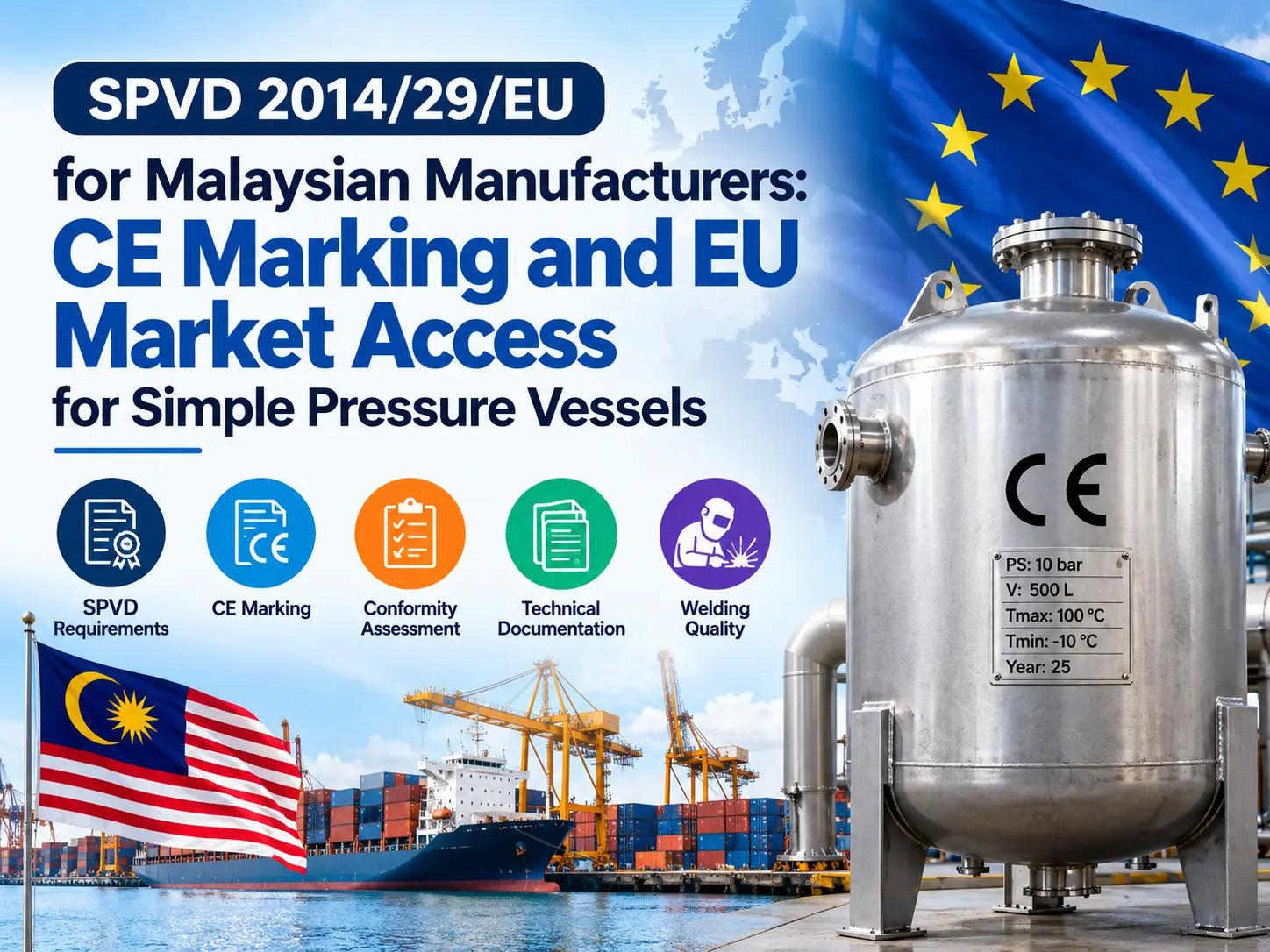
SPVD 2014/29/EU for Malaysian Manufacturers: CE Marking and EU Market Access for Simple Pressure Vessels
By Editorial Team
Table Of Contents
- 1. What Is SPVD 2014/29/EU?
- 2. Which Pressure Vessels Are Covered by SPVD?
- 3. SPVD Requirements for Malaysian Manufacturers
- 4. CE Marking and Conformity Assessment for Simple Pressure Vessels
- How the conformity assessment process works
- What information must appear on a CE-marked vessel?
- 5. Technical Documentation and Welding Quality Requirements
- Essential technical documentation
- 6. Importer Responsibilities and EU Market Access
- 7. SPVD Compliance Checklist for Malaysian Manufacturers
- 8. Frequently Asked Questions
- Conclusion: Preparing Malaysian Pressure Vessels for EU Market Access
Related Blogs
SEP
11
SPVD Certification 2026: Latest 2014/29/EU Update, EN 286-1, Documents & CE Marking for Indian Manufacturers
AUG
06
SPVD Certification: Complete Guide to the Simple Pressure Vessels Directive (2014/29/EU)
See Also.....
1. What Is SPVD 2014/29/EU?
The Simple Pressure Vessels Directive (SPVD) 2014/29/EU is a rule from the European Union that sets safety standards and rules for checking if simple pressure vessels are safe to sell in the EU.
This rule began being used on 20 April 2016 and replaced the older Directive 2009/105/EC.
Its main purpose is to ensure that simple pressure vessels are made safely and can be sold freely in the EU market.
For companies in Malaysia, it is important to follow SPVD rules if they want to send products like air receivers, compressor tanks, and other simple pressure vessels to customers in the EU.
Important note: Just because a pressure vessel is made in Malaysia does not mean it is allowed to skip EU safety rules.
Any vessel brought into the EU from another country must pass the correct safety checks, have proper paperwork, and be properly labeled before it can be sold there.
2. Which Pressure Vessels Are Covered by SPVD?
Not every pressure vessel is included in SPVD 2014/29/EU.This directive only applies to a specific kind of welded vessels that are produced in batches and meet the conditions mentioned in Article 1.
SPVD scope requirements
| Parameter | Requirement under Article 1 |
|---|---|
| Manufacturing | Manufactured in series and welded |
| Intended contents | Air or nitrogen |
| Internal pressure | Greater than 0.5 bar gauge |
| Design | Not intended to be fired |
| Material | Non-alloy quality steel or specified non-alloy aluminium and non-age-hardening aluminium alloys |
| Maximum working pressure | 30 bar |
| Pressure-volume limit | PS × V must not exceed 10000 bar·L |
| Temperature — steel | -50°C to 300°C |
| Temperature — aluminium | -50°C to 100°C |
Source: Article 1 of Directive 2014/29/EU.
The directive does not include certain types of vessels, such as those made for nuclear use, vessels meant for putting into or moving ships and planes, and fire extinguishers.
Important: To find the pressure-volume product, you multiply the maximum working pressure (PS), which is measured in bar, by the vessel’s capacity (V), which is measured in liters.
For example, a vessel that has a maximum working pressure of 10 bar and a capacity of 100 liters would have:
PS × V = 10 × 100 = 1,000 bar·L
This is under the directive’s maximum pressure-volume limit of 10,000 bar·L, but other conditions must also be met.
3. SPVD Requirements for Malaysian Manufacturers
Malaysian manufacturers need to figure out which rules apply depending on the vessel’s pressure-volume product and what it’s meant to be used for.
One key difference is the 50 bar·L limit mentioned in Article 4.
| Pressure-volume product | Main compliance requirement |
|---|---|
| PS × V ≤ 50 bar·L | Design and manufacture according to sound engineering practice in an EU Member State. |
| PS × V > 50 bar·L | Meet the essential safety requirements in Annex I and undergo the applicable conformity assessment procedure. |
For vessels with a capacity of more than 50 bar·L, the manufacturers need to create technical documents, finish the required conformity check, write an EU Declaration of Conformity, and put the CE mark on the product once they show they meet the standards.
For vessels with a capacity of 50 bar·L or less, there’s no need for a CE mark under SPVD.
But these vessels still have to follow the correct engineering practices and marking rules set by the directive.
This difference is very important for Malaysian exporters because they shouldn’t put a CE mark under SPVD on products that don’t match the rules for that marking.
4. CE Marking and Conformity Assessment for Simple Pressure Vessels
CE marking shows that a product meets the required EU laws.For simple pressure vessels with a volume-pressure product over 50 bar·L, the maker needs to prove they follow the SPVD rules before putting the CE mark on the product.
How the conformity assessment process works
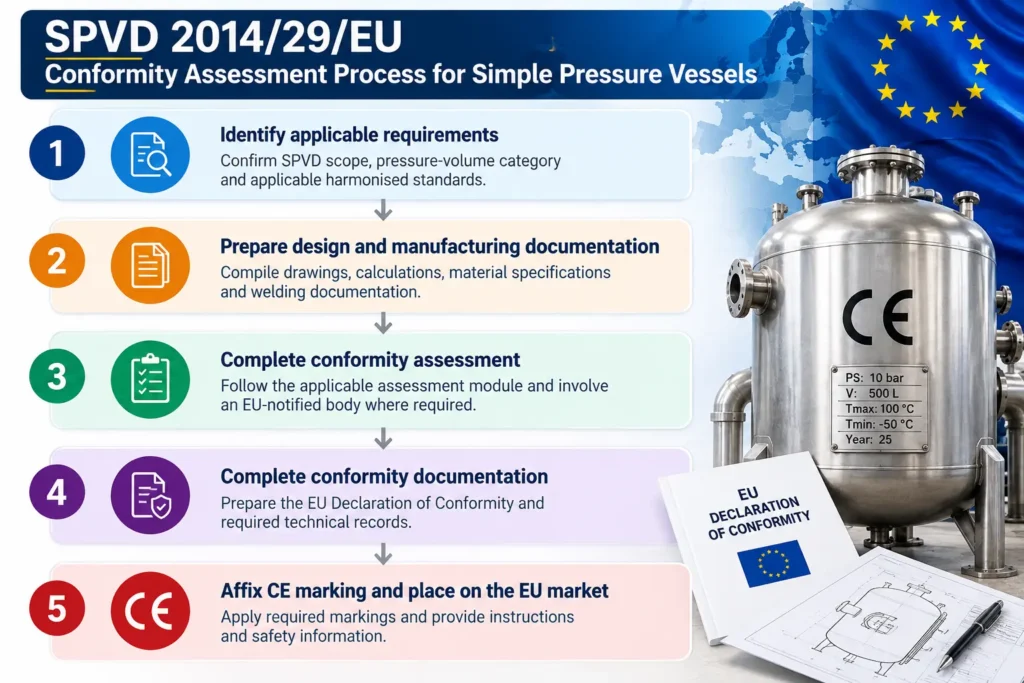
The directive lists the ways to check if a product meets the required standards in Annex II.These methods include EU-type examination along with checking the product type and ensuring good production quality, as well as other possible combinations of these checks.The right method depends on the specific rules and the type of product being made.
Malaysian companies making products should check which specific checks and requirements they need to follow before they start the process of proving their product meets the standards.
What information must appear on a CE-marked vessel?
Under Annex III, vessels with a pressure higher than 50 bar·L must have the CE marking and the last two numbers of the year when the marking was added.
The vessel or its data plate must also show the following:
| Required information | Description |
|---|---|
| Maximum working pressure | PS in bar |
| Maximum temperature | Tmax in °C |
| Minimum temperature | Tmin in °C |
| Vessel capacity | V in litres |
| Manufacturer identification | Name or registered trade mark and address |
| Product identification | Type and serial or batch number |
5. Technical Documentation and Welding Quality Requirements
Technical documentation is important for showing that a basic pressure vessel meets the necessary safety standards.Malaysian manufacturers need to create and keep records that allow the vessel’s compliance to be checked and confirmed.
Essential technical documentation
| Document | Purpose |
|---|---|
| Design drawings and calculations | Demonstrate the design meets applicable safety requirements. |
| Material specifications and certificates | Verify the materials used in pressure-retaining components. |
| Welding procedures and qualifications | Demonstrate that welding processes are suitable and qualified. |
| Inspection and testing records | Document required inspections examinations and tests. |
| Risk and safety information | Address relevant hazards and safe operating conditions. |
| EU Declaration of Conformity | Formally declares compliance with applicable EU legislation. |
Welding quality is very important because the welded joints help keep the vessel strong and able to hold pressure.
Manufacturers need to set up good welding methods, check that welders are qualified, manage the welding process during production, and keep records of inspections and tests as required by the design rules and standards for product conformity.
EN ISO 3834 gives general guidelines for welding quality, but the specific standards for the product and the SPVD rules set out the exact technical requirements the vessel must meet.
You can find more information about WPS and WPQR requirements, as well as ISO 9712 certification for NDT personnel.
6. Importer Responsibilities and EU Market Access
Even though the manufacturer is responsible for making sure the product meets standards, the EU importer also has certain duties under SPVD.
For Malaysian manufacturers, knowing these responsibilities helps them set up clear agreements with EU distributors and importers.
| Malaysian manufacturer | EU importer |
|---|---|
| Ensures the vessel meets applicable requirements | Verifies that conformity assessment has been carried out |
| Prepares technical documentation and the EU Declaration of Conformity | Checks that required markings and documents are available |
| Affixes the required CE marking and product identification | Provides importer identification and contact details as required |
| Maintains relevant compliance records | Cooperates with authorities and addresses identified non-compliance |
The rule says that makers and people who bring products into the EU must keep important papers for 10 years and give them to the right officials if asked.
The information about how to use the product and keep it safe has to be in a language that people in the EU country where the product is sold can easily understand.
So Malaysian companies should work with their EU partners to make sure the labels, papers, language used, and any extra rules from the country are all correct.
7. SPVD Compliance Checklist for Malaysian Manufacturers
Use this checklist as a first step to check before sending simple pressure vessels to the EU.
| Checkbox | EU export readiness checklist |
|---|---|
| ☐ | Confirm the vessel falls within SPVD 2014/29/EU scope. |
| ☐ | Calculate PS × V and determine the applicable compliance category. |
| ☐ | Identify applicable harmonised standards and essential safety requirements. |
| ☐ | Prepare design drawings calculations and material documentation. |
| ☐ | Verify welding procedures and relevant personnel qualifications. |
| ☐ | Establish inspection testing and traceability records. |
| ☐ | Complete the applicable conformity assessment procedure. |
| ☐ | Prepare the EU Declaration of Conformity where required. |
| ☐ | Verify product markings instructions and safety information. |
| ☐ | Coordinate importer details and EU market documentation. |
This checklist is a helpful tool for planning, but it doesn’t replace the official instructions, consistent standards, or the evaluation done by a recognized body.
8. Frequently Asked Questions
Does SPVD 2014/29/EU apply to Malaysian manufacturers?
Yes. SPVD applies to qualifying simple pressure vessels placed on the EU market, regardless of whether they are manufactured within or outside the EU. Malaysian manufacturers must meet the applicable requirements before exporting covered vessels to the EU.
Is CE marking mandatory for all simple pressure vessels?
No. Under SPVD, vessels with a PS × V product greater than 50 bar·L must meet the applicable essential safety requirements and conformity assessment provisions, including CE marking. Vessels at or below 50 bar·L are subject to sound engineering practice requirements and are not CE-marked under this directive.
Is SPVD the same as the Pressure Equipment Directive (PED)?
No. SPVD 2014/29/EU covers a defined category of simple pressure vessels, while PED 2014/68/EU covers pressure equipment within its own scope. Manufacturers must determine which legislation applies based on the product’s design, intended use and technical characteristics.
Does a Malaysian manufacturer need an EU-notified body?
For vessels above 50 bar·L, the manufacturer must follow the applicable conformity assessment procedure, which involves a notified body where required by the selected module. The relevant notified body should be verified through the European Commission’s NANDO database.
How long must SPVD technical documentation be retained?
The directive generally requires manufacturers to keep the EU Declaration of Conformity and relevant technical documentation available for 10 years after the vessel is placed on the market, subject to the specific applicable provisions.
Conclusion: Preparing Malaysian Pressure Vessels for EU Market Access
SPVD 2014/29/EU sets the rules for making sure simple pressure vessels are safe, properly checked, and have the right paperwork when they are sold in the European Union.
For Malaysian makers, getting into the EU market means checking if their product fits under this regulation, using the right checking process, putting together the necessary technical papers, making sure the welding is done properly, and having all the required labels and safety info ready.
By taking care of these steps before making and sending the products, manufacturers can make the compliance process easier and avoid problems like missing papers or delays when entering the EU market.