
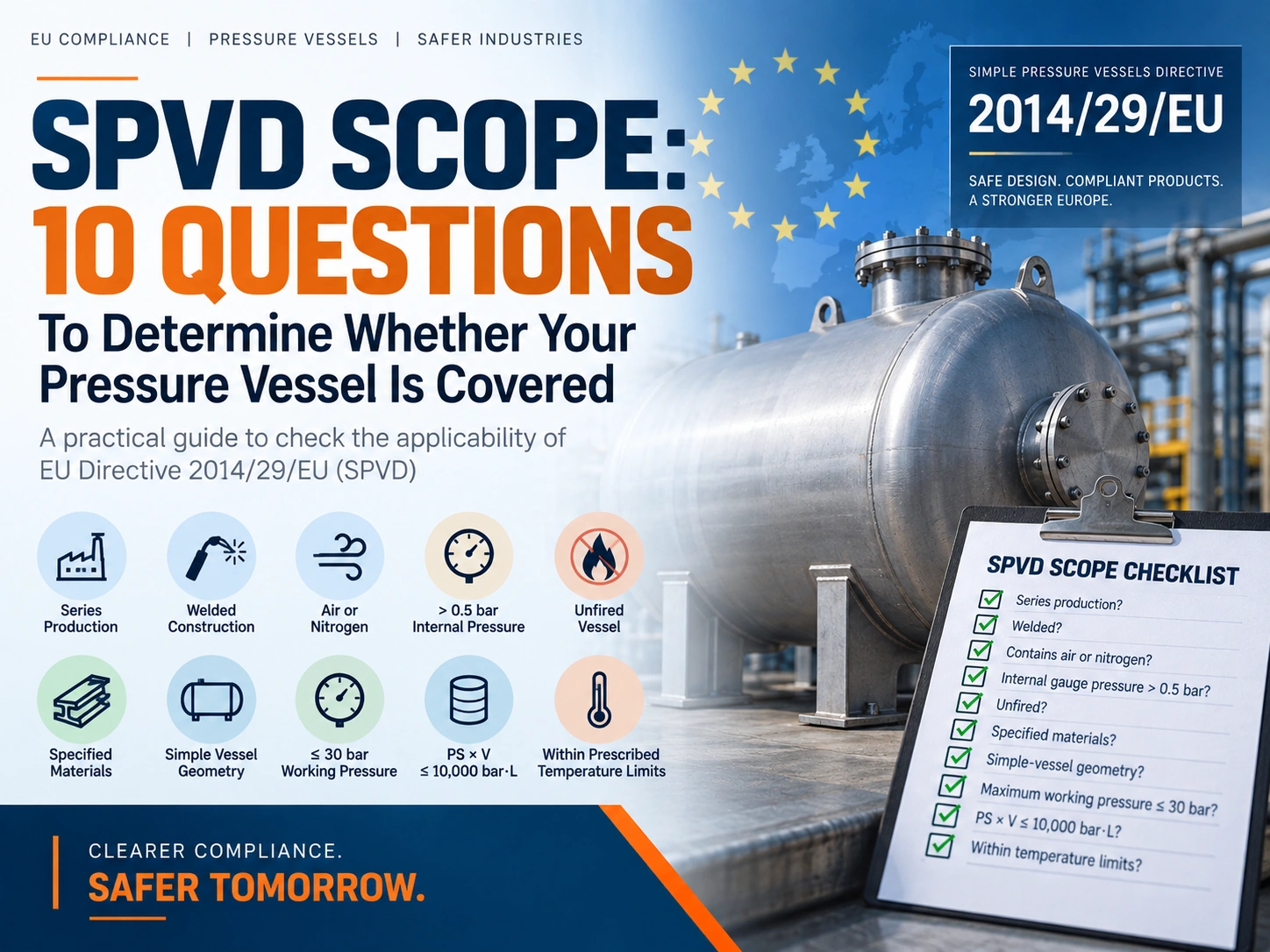
SPVD SCOPE
PRESSURE VESSEL
GUIDE
15 Sep 2026
SPVD Scope: 10 Questions to Determine Whether Your Pressure Vessel Is Covered
By Editorial Team
Table Of Contents
- 1. Is the vessel manufactured in series?
- 2. Is the vessel welded?
- 3. Does the vessel contain air or nitrogen?
- 4. Is the internal gauge pressure greater than 0.5 bar?
- 5. Is the vessel unfired?
- 6. Are the pressure-retaining materials within the specified material scope?
- 7. Does the vessel have the required simple-vessel geometry?
- 8. Is the maximum working pressure within 30 bar?
- 9. Does PS × V remain within 10,000 bar·L?
- 10. Are the operating temperatures within the SPVD limits?
- SPVD Scope: Quick Decision Checklist
- What If the Vessel Does Not Meet These Conditions?
- SPVD Scope vs CE Marking
- Why Scope Assessment Matters
- Practical Example
- Final Takeaway
- FAQ
Related Blogs
SEP
11
SPVD Certification 2026: Latest 2014/29/EU Update, EN 286-1, Documents & CE Marking for Indian Manufacturers
AUG
06
SPVD Certification: Complete Guide to the Simple Pressure Vessels Directive (2014/29/EU)
See Also.....
Directive 2014/29/EU, commonly known as the Simple Pressure Vessels Directive (SPVD), applies to a specific category of welded pressure vessels manufactured in series. Not every pressure vessel falls under SPVD.
Before starting a conformity assessment, manufacturers should first establish whether the product actually satisfies the Directive’s scope conditions.
The following 10 questions provide a practical first-level scope check.
1. Is the vessel manufactured in series?
SPVD applies to simple pressure vessels manufactured in series.
Therefore, the production method and product design need to be considered before assuming SPVD applies. A one-off vessel may require assessment under another applicable regulatory framework rather than being automatically treated as an SPVD vessel.
Check: Is the vessel part of a series of vessels manufactured to the same design or type?
2. Is the vessel welded?
A vessel within SPVD scope must be a welded vessel.
This makes welding procedure control, qualified welding procedures and qualified welders important parts of the compliance process. The European Commission’s harmonised-standard references for SPVD include welding-related standards such as EN ISO 9606-1 and EN ISO 15614-1.
Check: Is the pressure-retaining vessel manufactured using welding?
3. Does the vessel contain air or nitrogen?
SPVD specifically covers vessels intended to contain air or nitrogen.
If the vessel is designed for another fluid or gas, do not automatically apply SPVD. The applicable EU legislation must be determined based on the actual product and intended service.
Check: Is the intended contents air or nitrogen?
4. Is the internal gauge pressure greater than 0.5 bar?
The Directive requires the vessel to be intended for an internal gauge pressure greater than 0.5 bar.
This threshold is important because pressure is one of the first parameters to examine when determining applicability.
Check: Is the intended internal gauge pressure above 0.5 bar?
5. Is the vessel unfired?
SPVD applies to vessels that are not intended to be fired.
This distinguishes simple pressure vessels from certain fired pressure equipment where another regulatory framework may apply.
Check: Is the vessel designed as an unfired pressure vessel?
6. Are the pressure-retaining materials within the specified material scope?
The parts and assemblies contributing to pressure strength must be made from:
- Non-alloy quality steel, or
- Non-alloy aluminium, or
- Non-age-hardening aluminium alloys.
Material selection therefore needs to be verified against the Directive and applicable technical standards—not simply based on whether the material is commonly used for pressure vessels.
Check: Does the pressure-retaining material meet the SPVD material requirements?
7. Does the vessel have the required simple-vessel geometry?
SPVD specifies particular vessel configurations.
The vessel must generally consist of either:
- A cylindrical circular-section body with outwardly dished and/or flat ends rotating around the same axis; or
- Two dished ends rotating around the same axis.
Therefore, vessel geometry is part of the scope assessment—not just pressure and volume.
Check: Does the vessel configuration correspond to the geometries specified by the Directive?
8. Is the maximum working pressure within 30 bar?
The Directive sets a maximum working pressure of 30 bar for vessels within its scope.
A vessel exceeding this limit should not simply be treated as an SPVD vessel because it otherwise looks similar to a simple pressure vessel.
Check: Is the maximum working pressure ≤ 30 bar?
9. Does PS × V remain within 10,000 bar·L?
The Directive also specifies that:
PS × V ≤ 10,000 bar·L
where PS is the maximum working pressure and V is the vessel capacity.
Example
Suppose:
PS = 10 bar
V = 500 L
Then:
PS × V = 10 × 500 = 5,000 bar·L
The result is below 10,000 bar·L.
However, this calculation does not by itself prove SPVD applicability. All other scope conditions must also be satisfied.
10. Are the operating temperatures within the SPVD limits?
Temperature is another important scope condition.
For vessels within the Directive:
These limits come directly from Article 1 of Directive 2014/29/EU.
Check: Does the vessel’s specified operating-temperature range remain within the applicable limit for its material?
SPVD Scope: Quick Decision Checklist
A preliminary assessment can therefore be summarized as:
All conditions should be evaluated together. Meeting only the pressure or PS × V requirement does not automatically bring a vessel within SPVD.
What If the Vessel Does Not Meet These Conditions?
This is where manufacturers should be careful.
A vessel outside SPVD scope does not automatically mean that it is exempt from EU pressure-equipment legislation.
For example, the Pressure Equipment Directive (PED) 2014/68/EU generally applies to pressure equipment with a maximum allowable pressure above 0.5 bar, while explicitly excluding simple pressure vessels covered by SPVD.
Therefore, if a product does not satisfy SPVD’s scope, the manufacturer should determine which other EU legislation or regulatory framework applies rather than simply removing CE compliance from consideration.
SPVD Scope vs CE Marking
Determining that a vessel falls within SPVD scope is only the first step.
The manufacturer must then address the applicable essential safety requirements, conformity assessment procedure, technical documentation, marking and other obligations under the Directive. The European Commission states that SPVD covers the design, manufacture and conformity assessment of simple pressure vessels.
The applicable conformity-assessment route depends on the vessel and the requirements of the Directive; it should not be selected merely because a particular module is commonly used in the industry.
Why Scope Assessment Matters
Incorrectly identifying the applicable directive can create problems later in:
- Product design
- Material selection
- Welding qualification
- Inspection and testing
- Technical documentation
- Conformity assessment
- CE marking
- EU market access
The European Commission also notes that CE marking may only be affixed after the applicable conformity-assessment procedure has been completed.
Practical Example
Consider a welded steel air receiver manufactured in series with:
- PS: 10 bar
- Capacity: 500 L
- Contents: Air
- Minimum temperature: −20 °C
- Maximum temperature: 100 °C
- Unfired construction
Its PS × V is:
10 × 500 = 5,000 bar·L
The pressure is below 30 bar, PS × V is below 10,000 bar·L, and the temperature range is within the stated steel limits.
That makes it a candidate for SPVD scope, provided that the remaining requirements—such as material, geometry and series-production conditions—are also satisfied.
Final Takeaway
SPVD scope is not determined by pressure alone.
A manufacturer should evaluate the complete combination of:
Production → Welding → Gas → Pressure → Material → Geometry → PS × V → Temperature → Exclusions
Only after this scope assessment should the manufacturer proceed to the appropriate conformity-assessment route and technical compliance process.
For borderline or unusual designs, the applicable version of Directive 2014/29/EU, harmonised standards and relevant conformity-assessment requirements should be reviewed before making a compliance decision. The European Commission notes that its SPVD guidelines support consistent application but are not legally binding; the Directive and legally effective Official Journal publications remain the authoritative basis.
FAQs
What pressure vessels are covered by SPVD?
SPVD covers qualifying series-manufactured welded simple pressure vessels intended for air or nitrogen, subject to the Directive’s pressure, material, geometry, PS × V and temperature conditions.
What is the maximum pressure under SPVD?
The maximum working pressure specified for vessels within SPVD scope is 30 bar.
What is the SPVD PS × V limit?
The Directive specifies PS × V ≤ 10,000 bar·L for vessels within its scope.
Does SPVD apply to all pressure vessels?
No. SPVD has a specific scope. Vessels that do not satisfy its conditions must be assessed against the other potentially applicable EU legislation.
Is SPVD the same as PED?
No. SPVD is Directive 2014/29/EU, specifically addressing simple pressure vessels. PED is Directive 2014/68/EU, covering broader categories of pressure equipment. PED explicitly excludes simple pressure vessels covered by SPVD.