
Inspection Compliance
Material Traceability
Welding Quality
Are You Ready for a Welding Quality Audit? 12 Checks for Welding Procedures, Material Traceability and Inspection Compliance
By First Welding Certification Technical Editorial Team
6 Min Read Time
14 Oct 2026
Table Of Contents
Which Standards May Be Relevant?
EN ISO 3834
EN 15085
EN ISO 14732
EN ISO 9606
Introduction
A welding quality audit helps manufacturers check whether their welding processes meet applicable quality requirements. It also helps identify problems with welding procedures, personnel qualifications, material traceability and inspection records.
For manufacturers working with structural steel, railway components or other welded products, proper documentation and production control are essential. However, having certificates alone does not guarantee that every welding activity meets the required specifications.
This Audit Checklist helps manufacturers review important controls before an internal audit, customer assessment or certification audit. In this guide, we explain 12 critical checks, common audit mistakes and practical ways to prepare.
What Is a Welding Quality Audit?
A quality audit helps manufacturers identify gaps in their production controls. For example, auditors may review WPS documents, welder qualifications and material traceability records. In addition, they may examine inspection reports and equipment records. As a result, manufacturers can identify weaknesses and plan corrective actions. However, the required checks depend on the applicable standards and customer specifications.
During an audit, the reviewer may examine:
-Welding Procedure Specifications (WPS).
-Welding Procedure Qualification Records (WPQR).
-Welder and welding operator qualifications.
-Welding consumables and storage conditions.
-Material identification and traceability.
-Welding equipment and inspection instruments.
-Inspection and non-destructive testing (NDT) records.
-Nonconformities and corrective actions.
The exact checks depend on the applicable standard, certification scope, product and customer requirements.
Why Is a Welding Quality Audit Important?
An audit helps manufacturers identify weaknesses before they affect product quality or customer acceptance.
First, it checks whether production personnel follow approved welding procedures. It also helps confirm that welders have the required qualifications for their assigned work. In addition, an audit reviews material identification, inspection results and technical records. These controls help demonstrate that manufacturing activities meet the applicable requirements.
Regular internal reviews can also reveal recurring problems. Manufacturers can then investigate the causes and take appropriate corrective action.
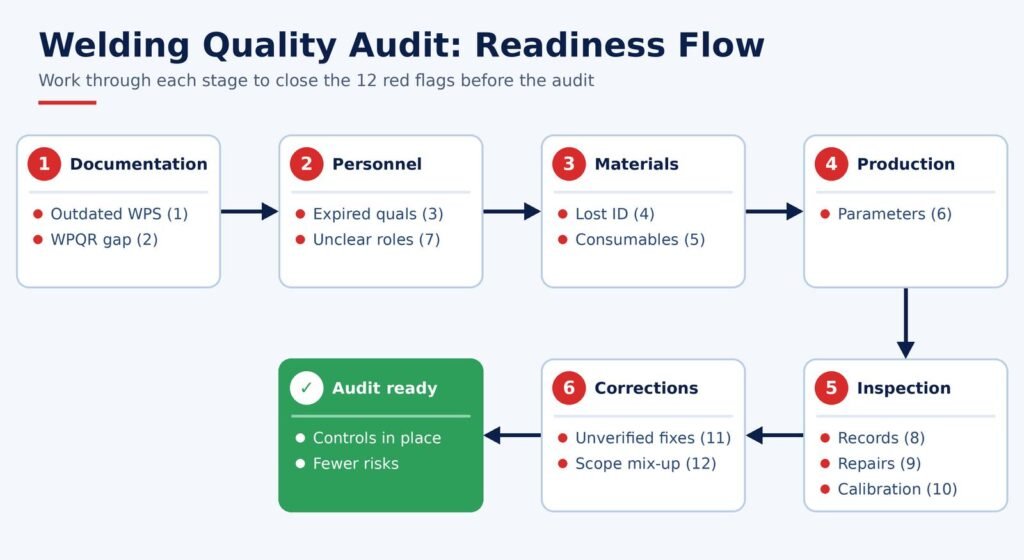
Welding Quality Audit Checklist: 12 Critical Checks
Use the following checklist to review key areas of your welding quality management system. Apply each check according to the relevant standards, technical specifications and customer requirements.
1. Welding Procedure Specification (WPS)
Confirm that the correct WPS is available to production personnel. Check that they use the current approved revision.
Next, compare the WPS with the actual welding operation. Review the applicable welding process, material, joint details and specified parameters.
Audit question: Are production personnel following the approved WPS?
2. Welding Procedure Qualification Record (WPQR)
A WPQR records the results and conditions of a welding procedure qualification. It provides evidence that the procedure was qualified within a defined range.
Check whether the supporting qualification record covers the intended production application. Review the applicable material groups, thickness ranges and other essential variables.
Audit question: Does the qualified procedure cover the production conditions?
3. Welder and Welding Operator Qualifications
Verify that personnel hold the qualifications required for their assigned work. Check the applicable process, material, welding position and qualification range.
Also review any continuity, validity or renewal requirements that apply. Maintain an organised register so supervisors can check personnel qualifications before assigning work.
Audit question: Are personnel appropriately qualified for the welding tasks they perform?
4. Material Identification and Traceability
Material traceability connects the materials used in production with the relevant technical and quality records.
Check material grades, identification marks and certificates where required. Confirm that identification remains traceable during cutting, fabrication and assembly.
Audit question: Can the required material records be linked to the finished product?
5. Welding Consumable Control
Check how welding consumables are received, identified, stored and issued. Confirm that the selected consumables meet the approved procedure and applicable specifications.
Some consumables require specific moisture protection, storage temperatures or drying controls. Verify that these requirements are followed and documented where necessary.
Audit question: Are welding consumables stored and handled according to the applicable requirements?
6. Welding Parameter Control
Compare actual welding conditions with the approved WPS. Depending on the process, relevant parameters may include current, voltage, travel speed, wire-feed speed and shielding gas.
Preheat and interpass temperatures may also require control. Review the relevant monitoring records and investigate any deviations.
Audit question: Are welding parameters maintained within the specified limits?
7. Welding Coordination
Confirm that welding responsibilities are clearly assigned. Relevant duties may include procedure control, technical review, production monitoring and the evaluation of welding problems.
Check whether responsible personnel understand their authority and responsibilities. Where applicable, review the arrangements against EN ISO 14731 and the requirements governing the product.
Audit question: Are welding coordination duties assigned and implemented appropriately?
8. Inspection and NDT Records
Review the inspection and testing records required for the product. These may include visual testing, dimensional inspection and non-destructive testing.
Check that reports identify the correct component or weld. Also verify that the inspection method, acceptance criteria and results meet the applicable requirements.
Audit question: Do inspection records demonstrate conformity with the specified requirements?
9. Weld Repair and Reinspection
Weld repairs should follow an established process. Check whether defects are recorded, evaluated and repaired using an appropriate method.
Where required, confirm that repaired areas are reinspected and that the results are documented. Repeated defects should also be reviewed to identify possible underlying causes.
Audit question: Are weld repairs documented and verified before acceptance?
10. Equipment Calibration and Maintenance
Review the condition and status of welding equipment and relevant inspection instruments. Check calibration, verification or maintenance records where applicable.
Also confirm that equipment is suitable for its intended use. If equipment is found to be outside the required status, assess whether previous results may have been affected.
Audit question: Is the relevant equipment maintained and controlled as required?
11. Nonconformity and Corrective Action
A nonconformity occurs when a requirement is not met. Examples may include incorrect welding parameters, incomplete records or material identification problems.
Check whether the organisation records these issues and takes appropriate action. It should also investigate recurring problems and verify the effectiveness of corrective actions where required.
Audit question: Are welding nonconformities addressed and recurring problems investigated?
12. Certification Scope and Customer Requirements
Check the requirements that apply to the product, contract and manufacturing activity. Review the relevant certification scope and customer specifications.
Remember that a certificate does not automatically demonstrate compliance with every product requirement. Additional approvals, inspections or records may be required for particular applications.
Audit question: Does the manufacturing process meet the applicable certification and customer requirements?
Common Welding Audit Mistakes to Avoid
Manufacturers should pay attention to recurring weaknesses that can lead to audit findings.
Outdated WPS documents: Ensure production teams use approved revisions.
Incomplete qualification records: Check personnel qualifications and applicable validity conditions.
Missing material identification: Maintain traceability wherever required.
Incomplete inspection reports: Record the correct component, inspection method and results.
Uncontrolled welding deviations: Evaluate deviations against the applicable technical requirements.
Weak corrective actions: Investigate the cause instead of addressing only the immediate problem.
Overlooked customer requirements: Review contractual specifications before production and inspection.
By addressing these issues early, manufacturers can improve their quality controls and prepare more effectively for an audit.
Which Standards May Be Relevant?
Several standards may be relevant to a welding quality audit, depending on the product and application.
∙EN ISO 3834: Quality requirements for fusion welding of metallic materials.
∙EN 15085: Welding requirements for railway vehicles and components within its scope.
∙EN ISO 15609-1: Requirements for the content of a WPS for arc welding.
∙EN ISO 15614-1: Welding procedure qualification testing within its scope.
∙EN ISO 14732: Qualification of welding operators and weld setters for mechanised and automatic welding within its scope.
∙EN ISO 9606 series: Qualification testing of welders for fusion welding, according to the applicable part and material scope.
These standards have different scopes and purposes. Manufacturers should identify the applicable parts and editions based on their products, contracts and certification requirements.
Frequently Asked Questions
Can a company have valid certification and still receive audit findings?
Yes. Certification does not eliminate the possibility of nonconformities. Auditors may identify gaps between documented procedures, actual production, and applicable requirements.
What is the most important document during a welding quality audit?
There is no single document that proves overall conformity. WPSs, WPQRs, personnel qualification records, material documents, inspection results, and traceability records may all be relevant.
Does every welding deviation require a new WPQR?
No. The manufacturer should evaluate the deviation against the applicable standard, qualified range, and technical requirements. Additional qualification may be necessary in some circumstances, but not every deviation automatically requires a new WPQR.
Why is material traceability important during an audit?
It establishes the relationship between the specified material, supplied material, production item, and relevant inspection records where traceability is required.
Is an OEM supplier approval the same as a welding certification?
No. A welding certification addresses its defined scope and applicable requirements. An OEM may impose separate supplier approval or product-specific conditions.
Conclusion
Checklist helps manufacturers review the controls that support consistent welding quality. The 12 checks in this guide cover procedure qualification, personnel competence, material traceability, production controls, inspection and corrective action.
However, a checklist alone cannot guarantee compliance. Manufacturers must evaluate their processes against the standards, contracts and customer requirements that apply to their products.
Are you confident your welding processes meet the applicable quality and compliance requirements?
First Welding Certification Pvt Ltd (PRVÁ ZVÁRAČSKÁ, a.s.) — Explore EN ISO 3834 certification requirements and discuss the relevant conformity assessment process for your organisation.