
WPS REACEABILITY
ISO 3834
INSPECTION RECORD
WPS Traceability in India: How to Link Welding Procedures, Materials, Welders & Inspection Records for ISO 3834 Accreditation
By First Welding Certification Technical Editorial Team
8 Min Read Time
05 OCT 2026
Table of Contents
- Introduction
- What Is WPS Traceability?
- Why Is Welding Traceability Important?
- How WPS, WPQR and Welder Qualification Are Connected
- How to Link Materials to a Weld
- How to Link Welders to Production Welds
- How Inspection Records Complete the Traceability Chain
- Example of a Complete WPS Traceability System
- Common Welding Traceability Gaps
- WPS Traceability Checklist
- Frequently Asked Questions
- Conclusion
WELDING QUALITY & TRACEABILITY
MATERIAL - Heat No. / Material ID
WPS - WPS No. / Revision
WELDER - Welder ID / Qualification
WELD JOINT - Weld ID / Production Record
INSPECTION - VT / UT / RT / Final Result
Introduction
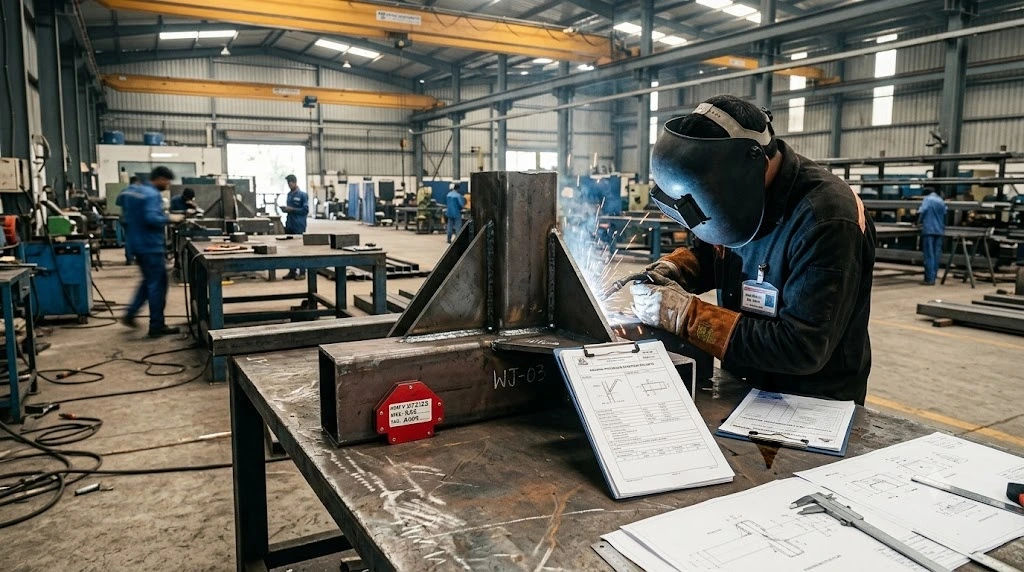
WPS traceability connects the welding procedure used in production with the material, qualified welder, welding joint and inspection records associated with that weld.
For manufacturers, fabrication companies and engineering industries in India, maintaining this connection is important when demonstrating controlled welding production and preparing for customer, regulatory or certification audits.
A Welding Procedure Specification (WPS) defines the controlled welding variables used for production. The related qualification records establish whether the procedure has been qualified, while welder qualification records establish whether the person performing the weld is qualified for the applicable work.
However, traceability goes further than maintaining separate documents. The records should create a clear chain:
Material → WPS → Qualified Welder → Weld Joint → Inspection → Final Record
ISO 3834 addresses quality requirements for fusion welding and includes areas such as welding personnel, inspection and testing personnel, welding procedures, production planning, material storage and related welding activities.
This article explains how manufacturers in India can structure WPS and welding traceability so that production records can be followed from the finished weld back to the relevant technical documents.
What Is WPS Traceability?
WPS traceability is the ability to identify and connect the documents and production records associated with a particular weld.
A traceable welding record should allow an auditor or quality professional to start with a weld joint and identify:
- The applicable drawing or weld number
- WPS number and revision
- Supporting WPQR/PQR, where applicable
- Base material identification
- Material heat or batch number
- Welding consumable identification
- Welder identification
- Welder qualification record
- Welding date
- Inspection and testing records
- Repair records, if applicable
- Final acceptance status
The objective is not simply to maintain more paperwork. The objective is to establish a documented connection between the welding procedure and the physical weld.
Why Is Welding Traceability Important?
Welding is treated as a controlled production activity because the quality of a weld cannot always be completely verified through final inspection alone. ISO explains that welding quality needs to be built into the production process through appropriate controls from design and material selection through manufacture and inspection.
A practical welding traceability system therefore allows a manufacturer to answer questions such as:
Which WPS was used for this weld?
Which material was welded?
Who performed the weld?
Was the welder qualified for the applicable process?
Which inspection was performed?
What was the inspection result?
Was the weld accepted or repaired?
If these questions cannot be answered from controlled records, the organization may have a traceability gap.
How WPS, WPQR and Welder Qualification Are Connected
A common mistake is to treat the WPS, WPQR/PQR and welder qualification record as independent documents.
They perform different functions but must connect within the production documentation system.
WPS – Welding Procedure Specification
The WPS establishes the welding variables and instructions applicable to production.
Depending on the applicable code or standard, it can contain information such as:
- Welding process
- Joint details
- Base material
- Filler metal
- Welding position
- Preheat requirements
- Interpass temperature
- Electrical parameters
- Shielding gas
- Post-weld heat treatment requirements
- Applicable thickness or diameter ranges
WPQR/PQR – Procedure Qualification Record
The WPQR/PQR records the qualification test used to demonstrate that a welding procedure meets the applicable qualification requirements.
The WPS should therefore be traceable to its relevant qualification basis where the governing standard requires it.
Welder Qualification
The welder qualification record establishes the range of work for which the individual welder or welding operator is qualified under the applicable code or standard.
The production record should therefore establish:
WPS → Qualified procedure → Qualified welder → Production weld
This relationship is one of the most important parts of WPS traceability.
How to Link Materials to a Weld
Material traceability connects the physical material used in production with its material documentation.
For example, a manufacturer may assign a unique heat number or material identification to incoming steel.
That identification can then be recorded on:
Material Certificate → Cutting/Part Identification → Weld Joint → Production Record
A traceability system should prevent the material identity from disappearing during cutting, fabrication, machining or assembly.
For a particular weld, the production record may therefore reference:
| Traceability Item | Example |
|---|---|
| Drawing No. | DWG-1045 |
| Weld ID | W-027 |
| Material ID | MAT-118 |
| Heat No. | HN-45872 |
| WPS No. | WPS-014 |
| Welder ID | WR-032 |
| Inspection Report | VT-027 |
| NDT Report | UT-027 |
| Status | Accepted |
How to Link Welders to Production Welds
Material traceability connects the physical material used in production
A welder identification system makes the production weld traceable to the person who performed it.
The identification can be a:
- Welder ID
- Stamp number
- Employee number
- Digital identification
- Controlled production record reference
The production record should connect the welder ID with the applicable welder qualification record.
For example:
Weld W-027 → Welder WR-032 → Qualification Record WQ-032
This allows quality personnel to verify whether the person who performed the weld had the required qualification for the relevant welding process and conditions.
Production records can also become important when investigating a rejected weld or recurring welding defect.
with its material documentation.
For example, a manufacturer may assign a unique heat number or material identification to incoming steel.
That identification can then be recorded on:
Material Certificate → Cutting/Part Identification → Weld Joint → Production Record
A traceability system should prevent the material identity from disappearing during cutting, fabrication, machining or assembly.
For a particular weld, the production record may therefore reference:
How Inspection Records Complete the Traceability Chain
Inspection records form the final major connection in the welding traceability system.
Depending on the project and applicable requirements, records may include Non Destructive Tests :
- Visual Testing (VT)
- Radiographic Testing (RT)
- Ultrasonic Testing (UT)
- Magnetic Particle Testing (MT)
- Penetrant Testing (PT)
- Dimensional inspection
- Welding parameter records
- Repair records
- Final inspection records
The inspection report should reference the same weld or joint identification used in the production documentation.
For example:
Weld ID W-027 → WPS-014 → Welder WR-032 → Material HN-45872 → UT Report UT-027 → Accepted
This creates a searchable audit trail.
ISO 3834 includes requirements covering welding personnel, inspection and testing personnel, welding procedure specifications, qualification of welding procedures and production planning.
Example of a Complete WPS Traceability System
Consider a fabrication company manufacturing a welded steel assembly.
The company assigns Weld ID W-105 to a specific joint.
The traceability chain could look like this:
Step 1 – Identify the material
The material is recorded against its material certificate and heat number.
Material → MTC → Heat Number
Step 2 – Identify the welding procedure
The engineering or welding documentation assigns the applicable WPS.
Weld W-105 → WPS-021
Step 3 – Identify the qualified welder
The production record identifies the welder.
Weld W-105 → Welder ID WR-018
The quality team can then retrieve the relevant qualification record.
Step 4 – Record production
The production record captures the required welding information and joint identification.
Step 5 – Perform inspection
The inspector records the inspection against the same weld number.
Weld W-105 → VT-105 / UT-105
Step 6 – Record final disposition
The weld receives an appropriate status such as:
Accepted / Repaired / Re-inspected / Rejected
The result is a complete traceability chain rather than a collection of unrelated documents.
Common Welding Traceability Gaps
Manufacturers commonly encounter traceability problems when records are maintained separately.
1. WPS number is missing from production records
The weld exists, but there is no clear reference to the applicable procedure.
2. Welder identification is missing
The inspection report identifies the weld but does not identify the person who performed it.
3. Material heat number is lost
Material identification disappears after cutting or fabrication.
4. Inspection records use different weld numbers
The production team uses one joint number while the inspection team uses another.
5. WPS revision is not controlled
The production record references a WPS number but does not establish which revision was applicable.
6. Repair records are disconnected
A repaired weld is not linked to the original weld identification and subsequent inspection.
These gaps can make an audit considerably more difficult because the organization must reconstruct the history manually.
WPS Traceability Checklist
Before an audit or certification assessment, manufacturers can review the following chain:
☐ Material identification is maintained
☐ Material certificates can be retrieved
☐ Weld joints have unique identification
☐ Applicable WPS is identified
☐ WPS revision is controlled
☐ Supporting procedure qualification is traceable where required
☐ Welder identification is recorded
☐ Welder qualification is current and applicable
☐ Welding consumables are controlled where required
☐ Production records are maintained
☐ Inspection records reference the correct weld ID
☐ NDT records can be connected to the weld
☐ Repair records are linked to the original weld
☐ Final acceptance status is documented
A strong system should allow the organization to move forward and backward through the records.
For example:
Material → Weld → WPS → Welder → Inspection
and also:
Inspection Finding → Weld → Material → WPS → Welder → Repair Record
That two-way traceability makes the documentation more useful during audits, investigations and customer reviews.
Frequently Asked Questions
What is WPS traceability?
WPS traceability is the documented connection between a Welding Procedure Specification and the materials, qualified welder, production weld and inspection records associated with that procedure.
Why is material traceability important in welding?
Material traceability connects the material used in a welded component with its identification and material documentation. It can also allow the material history to be followed back to the applicable certificate.
What is the difference between WPS and WPQR?
A WPS defines the welding variables and instructions for production. A WPQR/PQR records the qualification evidence for the welding procedure according to the applicable requirements.
Does ISO 3834 require welding traceability?
ISO 3834 establishes quality requirements for fusion welding and addresses areas including welding procedures, welding personnel, inspection and testing personnel, materials and production activities. The specific documentation and traceability arrangements depend on the applicable level, product requirements and contractual or regulatory requirements.
Can digital systems improve WPS traceability?
Yes. A controlled digital system can connect weld IDs, WPS records, welder qualifications, material records and inspection results in a searchable structure. The underlying records and identification controls remain important regardless of whether the system is paper-based or digital.
Conclusion
WPS traceability is more than maintaining a WPS register. It creates a documented relationship between the welding procedure, material, qualified welder, production weld and inspection result.
For manufacturers in India working with international customers or welding quality requirements, a clear traceability structure can make technical records easier to review and audit.
The basic chain is simple:
Material → WPS/WPQR → Qualified Welder → Weld Joint → Inspection → Final Acceptance
When each record uses consistent identification and controlled revisions, the organization can demonstrate how a specific weld was planned, produced, inspected and accepted.
ISO 3834 remains an important international framework for quality requirements in fusion welding, with different levels of quality requirements defined within the series.
Need to establish or strengthen your welding certification and documentation process?
First Welding Certification Pvt Ltd (PRVÁ ZVÁRAČSKÁ, a.s.) can guide manufacturers through the applicable certification requirements for welding procedures, welder qualifications and welding quality systems.
Discuss your welding certification requirements with First Welding Certification Pvt Ltd (PRVÁ ZVÁRAČSKÁ, a.s.) today.