
Add Your Heading Text Here
Add Your Heading Text Here
Add Your Heading Text Here
ISO 3834 vs ISO 9001: Why Welding Manufacturers Need More Than a General Quality Certificate for Welded Products & Fusion Welding
By First Welding Certification Technical Editorial Team
8 Min Read
28 Sep 2026
Table of Contents
- What Is the Difference Between ISO 3834 and ISO 9001?
- What Is ISO 9001?
- What Is ISO 3834?
- ISO 3834 vs ISO 9001: What are the Key Differences?
- Why ISO 9001 Is Not Sufficient for Some Welding Needs
- What Does ISO 3834 Bring to Welding Quality Control?
- Which Welding Manufacturers May Need to Consider ISO 3834?
- What Are ISO 3834‑2 ISO 3834‑3 and ISO 3834‑4?
- What Should Companies Check Before Pursuing ISO 3834?
- Frequently Asked Questions
- Conclusion
- Relatd Resources
- Is Your Welding Quality System Ready for ISO 3834?
Steps to Determine Your Welding Quality Requirements
Identify Your Products
Start with the welded product
Review Applicable Requirements
Check standards and specifications
Assess Welding Controls
Evaluate your welding processes
Determine the Quality Level
Select the applicable ISO 3834 level
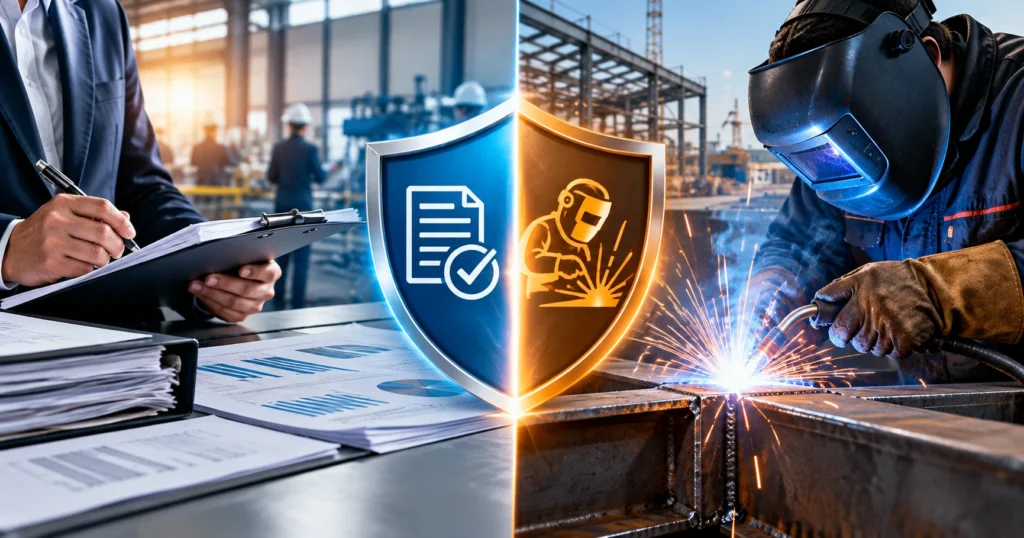
Your ISO 9001 Certificate Covers Quality.. What About the Weld?
Your company already has ISO 9001 certification. You have documented processes. You conduct audits. You control documents. Manage customer requirements. So why would a customer, project specification or certification requirement still ask about ISO 3834?
This question creates confusion for welding manufacturers.
A company can operate an ISO 9001 quality management system. Still need to address specific welding quality requirements for fusion welding of metallic materials. ISO 3834 focuses on welding- quality requirements. It does not replace ISO 9001. Manufacturers can use the two standards together. This difference matters for manufacturers producing steel, cranes, bridges, pressure vessels, railway products, marine structures, oil and gas equipment and offshore structures.
So the real question is not:
Which is better. ISO 3834 or ISO 9001?
The better question is:
What does each standard cover and why might a welding manufacturer need welding- quality requirements in addition to a general quality management system?
The simplest way to understand the difference is:
ISO 9001 focuses on the organization’s quality management system.
ISO 3834 focuses on quality requirements for fusion welding of metallic materials.
These standards address areas.
ISO 9001 provides a framework for managing quality throughout an organization. ISO 3834 focuses on the controls associated with welding quality.
ISO 3834 does not replace ISO 9001. ISO states that manufacturers can use the ISO 3834 series independently or together with ISO 9001.
This distinction becomes important when welding forms a part of manufacturing.
A manufacturer cannot always verify every aspect of welding quality by inspecting the finished product. The manufacturer therefore needs to control welding activities before during and after production.
That is where ISO 3834 becomes relevant.
What Is ISO 9001?
ISO 9001 provides a recognized framework for a quality management system.
It helps an organization establish controlled processes for managing quality across its operations.
Depending on the organization the quality management system can cover:
- Customer requirements
- Process management
- Resources
- Competence
- Documented information
- Risk-based thinking
- Monitoring and measurement
- Internal audits
- Corrective actions
- Continual improvement
ISO 9001 addresses quality at an organizational level. However ISO 9001 does not specifically establish the technical framework for controlling fusion welding of metallic materials.
That distinction matters when welding directly affects the quality and conformity of the product.
What Is ISO 3834?
ISO 3834 outlines quality requirements for fusion welding of metallic materials.
This standard relates to the process of welding conducted in workshops and installations. It does not confine its applicability to a single industrial sector.
In accordance with ISO 3834 level and manufacturing demands, companies may have to control the following issues:
- Welding procedure
- WPS and WPQR
- Welding personnel
- Welding coordination
- Parent material
- Welding material
- Welding equipment
- Inspection and testing
- Traceability
- Quality record
Manufacturers use these controls to develop a systematic approach to welding quality.
It should be noted that for organizations studying EN ISO 3834 certification, the main issue here is that the standard relates to welding quality requirements, but does not substitute the whole quality management system of the company.
ISO 3834 vs ISO 9001: What are the Key Differences?
| Area | ISO 9001 | ISO 3834 |
|---|---|---|
| Main focus | Quality management system | Welding quality requirements |
| Scope | Organization-wide | Fusion welding of metallic materials |
| Welding focus | General process management | Welding-specific controls |
| WPS/WPQR | Not the central focus | Relevant to applicable welding requirements |
| Welding personnel | General competence | Welding-specific competence |
| Welding coordination | Not welding-specific | Relevant to welding quality |
| Inspection and testing | General QMS framework | Welding-related controls |
| Traceability | Depends on the organization's QMS | Welding-specific controls where applicable |
| Quality levels | Not based on welding quality levels | ISO 3834-2, -3 and -4 |
| Relationship | General quality management framework | Can complement ISO 9001 |
It is easier to see the distinction by examining the questions answered by each standard:
ISO 9001 -> How is quality managed in the organization?
ISO 3834 -> How is quality control carried out for the fusion welding process?
Each of the above questions makes the other standard redundant.
Why ISO 9001 Is Not Sufficient for Some Welding Needs
Imagine a company that fabricates welded pressure vessels.
It can already have:
- ISO 9001 certified quality management system
- Quality manual
- Document control
- Internal audit
- Correction and prevention activities
- Customer feedback mechanisms
However, the company still needs to deal with welding-related issues, including:
- Is the welding procedure qualified?
- Is the applicable welding procedure qualification sufficient?
- Do welding personnel have the required qualifications?
- Does the company control welding coordination?
- Does the company identify and control the materials?
- Does the company establish necessary inspection and testing?
- Does the company maintain appropriate welding records and traceability?
These questions require taking into account welding-specific needs. But that does not make ISO 9001 unnecessary. On the contrary, it demonstrates why ISO 9001 and ISO 3834 can address different aspects of quality control in welding manufacturing.
What Does ISO 3834 Bring to Welding Quality Control?
ISO 3834 is about making sure welding quality is kept under control during manufacturing.
A simple way to understand this is:
ISO 3834 Welding Quality Flow
Customer / Project Requirements
↓
Applicable Welding Requirements
↓
Welding Procedures + Qualified Personnel + Materials
↓
Controlled Welding Production
↓
Inspection & Testing
↓
Records & Traceability
↓
Welded Product
This approach looks beyond checking the finished weld. For example a manufacturer may need to set up controls for:
Welding Procedures – The manufacturer uses welding procedures that fit within the ranges.
Welding Personnel – The manufacturer assigns personnel who’re qualified and competent for the welding tasks.
Welding Coordination – The manufacturer sets responsibility for coordinating welding work.
Materials and Consumables – The manufacturer controls the materials and consumables needed for welding following the rules.
Inspection and Testing – The manufacturer carries out inspection and testing that match the rules.
Traceability – The manufacturer keeps records that show welding work met the required rules.
If manufacturers want technical detail on procedure qualification read our article on WPS and WPQR qualification testing.
Which Welding Manufacturers May Need to Consider ISO 3834?
ISO 3834 covers fusion welding of metal parts, not one industry.
Companies in sectors may face ISO 3834 rules because of product standards, customer specs, contracts or regulations.
Structural Steel and Metal Construction – Companies that make welded structural parts may have to show that their welding processes are controlled.
Crane and Structural Construction – Welding might be a part of heavy load‑bearing structures.
Bridge and Girder Construction – Companies may need to cover welding quality within structural rules.
Pressure Vessel Manufacturing – Welding is central to building pressure vessels and meeting related conformity rules.
Railway Manufacturing and Maintenance – Railway makers and maintenance teams may face welding rules with railway standards.
Marine Applications – Marine structures may have welded parts that need controlled manufacturing.
Oil and Gas – Welded parts in oil and gas projects may need project‑specific quality rules.
Offshore Applications – Offshore structures may have welding and fabrication rules.
Contract Manufacturing – Companies that make welded items for others may have to meet customer or project welding rules.
A company does not automatically need ISO 3834 certification just because it works in one of these fields.
The applicable requirement depends on factors such as:
- Product type
- Welding activities
- standards
- Customer requirements
- Contract requirements
- Regulatory requirements
- Required welding quality level
What Are ISO 3834‑2 ISO 3834‑3 and ISO 3834‑4?
The ISO 3834 series gives levels of welding quality rules.
ISO 3834‑2 – Comprehensive quality requirements
ISO 3834‑3 – Standard quality requirements
ISO 3834‑4– Elementary quality requirements
ISO 3834‑1 tells you how to pick the quality level. First Welding Certification Pvt Ltd’s 2026 resource also lists the 2021 editions of Parts 1–5 and the 2024 edition of ISO 3834‑6.
So the company should choose the level by looking at the product, welding and project rules not just the industry name.
Need help understanding the three levels?
Read our comparison: ISO 3834‑2, ISO 3834‑3 and ISO 3834‑4 quality levels This article shows how companies can decide the ISO 3834 level.
What Should Companies Check Before Pursuing ISO 3834?
Before pursuing ISO 3834 certification companies should first know what their products and welding work need.
1. Identify the welded products – Figure out which products and parts your company makes with fusion welding.
2. Review Applicable Requirements – You should check the product standards, customer specifications, contracts and regulatory requirements.
3. Review Your Welding Processes – Identify the welding processes used in production and determine which controls apply.
4. Review Welding Procedures – Check whether your welding procedures cover the required production activities and whether the relevant qualifications exist.
5. Review Welding Personnel – Confirm that personnel performing and coordinating welding activities meet competence and qualification requirements.
6. Review Inspection and Testing – Determine which inspection and testing activities apply to your products and welding processes.
7. Review Documentation and Traceability – Check whether your organization can maintain the records needed to demonstrate controlled welding production.
8. Determine the ISO 3834 Level – Use the relevant ISO 3834 criteria to determine whether comprehensive, standard or elementary quality requirements apply.
Where does contract review fit?
Contract and technical review form a detailed topic within the wider ISO 3834 implementation process. For that subject read our EN ISO 3834 contract review, technical specifications and quality planning article.
Frequently Asked Questions
What is ISO 3834 for metal fabrication companies?
ISO 3834 sets rules that are made for welding metal. A metal fabrication company must check if ISO 3834 is relevant. A metal fabrication company should look at the products it makes the welding it does the needs of its customers standards that apply and the details of the project.
What are ISO 3834 quality assurance requirements?
ISO 3834 quality requirements can cover areas. ISO 3834 says that a metal fabrication company must have welding procedures, skilled welding personnel, good welding coordination, proper materials, reliable equipment, thorough inspection, sound testing, traceability of parts and good quality records. Which of these ISO 3834 areas a metal fabrication company must follow is based on the chosen ISO 3834 quality level and the specific needs.
How do welding certification standards for manufacturers differ from ISO 9001?
ISO 9001 gives a framework for quality management. ISO 3834 gives rules that are made for welding. A metal fabrication company that needs welding certification must look at both ISO 9001 and ISO 3834. Which of these ISO 3834 rules a metal fabrication company must use depends on the products it makes the welding it does the needs of its customers and the other standards that apply..
Does ISO 9001 replace ISO 3834?
No. ISO 3834 does not replace ISO 9001. ISO says that a metal fabrication company can use the ISO 3834 series on its own or together, with ISO 9001..
Which ISO 3834 part should a welding manufacturer use?
ISO 3834-1 gives the rules that a metal fabrication company can use to pick the ISO 3834 quality level. The quality levels are ISO 3834-2 ISO 3834-3 and ISO 3834-4. A metal fabrication company must find the ISO 3834 level that matches its products its welding and its project requirements.
Conclusion
ISO 9001 Manages Quality. ISO 3834 Addresses Welding Quality Requirements. An ISO 9001 certificate demonstrates that an organization operates a quality management system. But when fusion welding of metallic materials plays an important role in manufacturing, the organization may also need to address welding-specific quality requirements.
That is where ISO 3834 becomes relevant.
The two standards do not compete with each other.
ISO 9001 → General quality management
ISO 3834 → Welding-specific quality requirements
For manufacturers producing welded products, structural steel, cranes, bridges, pressure vessels, railway products, marine structures, oil and gas equipment or offshore structures, the important step is to identify the requirements that apply to the specific product and production process.
The right question is therefore not simply:
“Do we have ISO 9001?”
It is:
“Does our quality system adequately address the welding-specific requirements applicable to our products and projects?”
Is Your Welding Quality System Ready for ISO 3834?
If your manufacturing process involves fusion welding of metallic materials, identify the applicable ISO 3834 quality requirements before pursuing certification.
First Welding Certification Pvt Ltd (PRVÁ ZVÁRAČSKÁ, a. s.) is an accredited Certification Body for Quality Systems in Welding and certifies welding quality systems according to ISO 3834-2, ISO 3834-3 and ISO 3834-4, as applicable. ISO 3834 certification can be relevant to manufacturers and organizations involved in rail vehicle manufacturing and maintenance, contract manufacturing, steel and metal construction, crane and structural construction, bridge and girder construction, pressure vessel construction, pipeline construction, marine, oil and gas, offshore and other welded-product applications.
Before selecting a certification level, manufacturers should determine the applicable welding quality requirements based on their products, processes and relevant specifications.