
ISO 3834
REVIEW
QUALITY PLANNING
28 Sep 2026
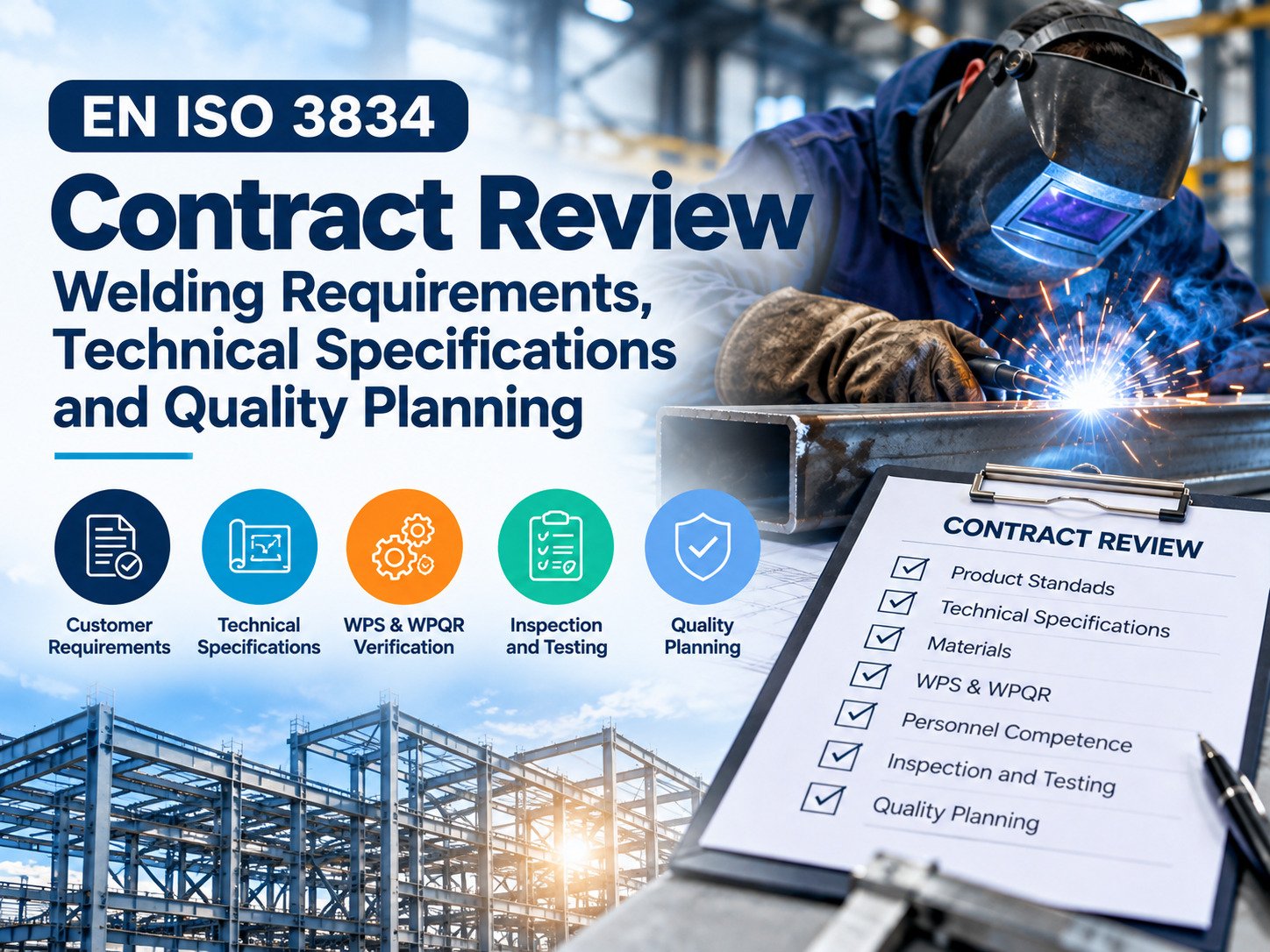
EN ISO 3834 Contract Review: Welding Requirements, Technical Specifications and Quality Planning
By Editorial Team
Table Of Contents
- 1. What Is Contract Review Under EN ISO 3834?
- 2. EN ISO 3834 Contract Review Requirements
- 3. Welding Technical Specifications to Review Before Production
- 4. How to Prepare a Welding Quality Plan
- Welding quality planning workflow
- Key elements of a welding quality plan
- 5. EN ISO 3834 Contract Review Checklis
- 6. Common Contract Review Mistakes in Welding Projects
- 7. How EN ISO 3834 Certification Supports Welding Quality
- Need EN ISO 3834 Certification?
- Conclusion
Related Blogs
SEP
19
EN ISO 3834 Equipment Control: Calibration, Verification and Maintenance Guide for Welding Manufacturers
SEP
15
Which Industries and Manufacturers Need ISO 3834 Certification in India and International Markets? Top 10 Sectors That Need It
SEP
12
Best Standard for Fusion Welding Quality Control: Why ISO 3834 Is Required for EN 1090 & EN 15085
SEP
08
ISO 3834 Latest Edition 2026: 2021 Revision, Current Status & What Welding Manufacturers Need to Know
AUG
24
ISO 3834 Certification Cost in India: Factors, Fees & Budget Guide
JLY
30
EN ISO 3834 Certification Requirements: What Welding Manufacturers Need to Know in 2026
See Also.....
Effective contract review helps make sure everyone understands the welding requirements, technical details, and quality goals before starting production. For welding companies, carefully checking the contract lets them understand what the customer needs, check if they can handle the work, and plan for quality checks and inspections. Based on EN ISO 3834, looking at contracts and technical information helps confirm that welding quality meets standards and follows regulations. This guide explains the main steps for reviewing contracts, the important documents to look at, and how to create a welding quality plan before work begins.
1. What Is Contract Review Under EN ISO 3834?
Contract review means checking customer needs, technical papers, standards, and what the manufacturer can do before starting a welding job. EN ISO 3834-2:2021, Clause 5 says it’s important to check if the requirements are clear and do technical checks. The manufacturer has to make sure all needed info is there and that quality steps are planned, to make sure the contract is followed and the right welding methods are used.
| Contract review | Technical review |
|---|---|
| Checks contractual and regulatory obligations | Examines welding and manufacturing specifications |
| Confirms capability resources and delivery schedule | Reviews welding procedures materials personnel and inspection |
| Identifies differences between quotations and contracts | Establishes technical controls for production |
2. EN ISO 3834 Contract Review Requirements
Clause 5.2 of EN ISO 3834-2 lists four main areas that should be considered when reviewing the requirements.
| Requirement | What manufacturers should verify |
|---|---|
| Product standards | Applicable product standards and supplementary requirements. |
| Statutory and regulatory requirements | Relevant legal regulatory and contractual obligations. |
| Additional requirements | Any additional quality or technical requirements established by the manufacturer. |
| Manufacturing capability | Availability of competent personnel equipment processes and resources. |
Manufacturers need to make sure that the technical documents are easy to understand, that they deliver what was promised, and that any differences between the first quote and the final agreement are clearly explained. Even if there’s no official contract, these checks should still be done as part of the technical review for stock products.
3. Welding Technical Specifications to Review Before Production
Technical review checks if the welding work follows quality and acceptance standards set in EN ISO 3834-2 Clause 5.3. This includes looking at the materials used, the quality of the welds, the welding methods, the skills of the workers, how the parts can be traced back, quality control steps, and the testing done. Manufacturers need to make sure the types of materials, their specifications, thickness, and minimum properties match what was approved in the design and order. It’s important to have proper material certificates.
A Welding Procedure Specification (WPS) tells workers how to do the welding.
A Welding Procedure Qualification Record (WPQR) proves that the welding process meets the required standards through testing. Manufacturers must make sure that approved WPS documents are available, that all required qualifications are completed, and that all welding parameters match the materials and methods used.
Contract reviews help find out what quality of weld is needed, the acceptance standards, and any extra customer requirements.
These details determine the inspection methods and tests that must be carried out. Manufacturers also need to check that welders and operators have the right qualifications for the specific job.
Before starting production, it’s important to set up inspection and testing plans.
This includes choosing non-destructive testing (NDT) methods, making sure welds are accessible for inspection, setting the order for inspections, planning heat treatment steps, and keeping proper records for final approval.If the project needs certified NDT personnel, refer to the guidelines in ISO 9712 to make sure all technical parts of the welding process are covered properly.
4. How to Prepare a Welding Quality Plan
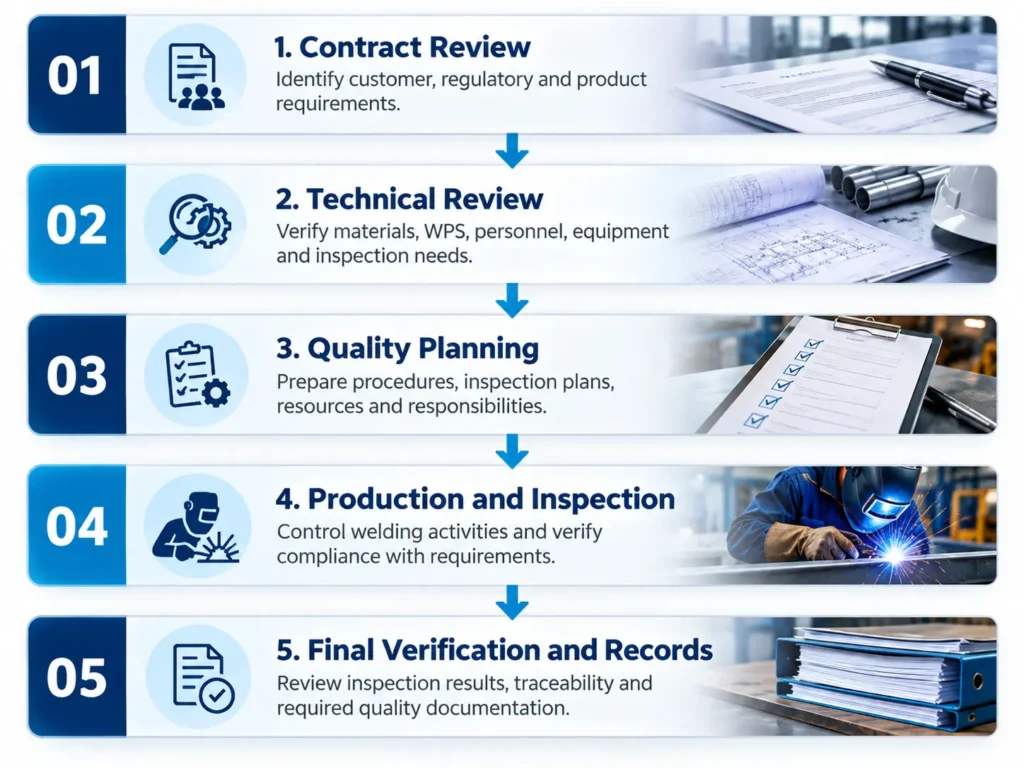
A welding quality plan turns the findings from contract and technical reviews into clear steps for production, checking, and record-keeping. EN ISO 3834 requires detailed planning of all quality-related activities before any work starts.
Welding quality planning workflow
Key elements of a welding quality plan
| Planning element | Purpose |
|---|---|
| Welding procedures | Ensure production follows qualified and applicable WPS documents. |
| Inspection and test plan (ITP) | Define inspection stages testing methods and acceptance criteria. |
| Personnel and equipment | Confirm availability of competent personnel and suitable equipment. |
| Material traceability | Maintain identification of materials and welds where required. |
| Quality records | Establish documentation for inspection testing and final acceptance. |
The level of planning and record-keeping should match the needed quality standards, product guidelines, and terms of the agreement.
5. EN ISO 3834 Contract Review Checklist
Manufacturers can use this checklist to check things before starting a welding job, which helps in actual situations but doesn’t take the place of specific standards or rules for each project.
| Checkbox | Pre-production review checklist |
|---|---|
| ☐ | Applicable product standards and supplementary requirements identified |
| ☐ | Customer statutory and regulatory requirements reviewed |
| ☐ | Material specifications and welded joint properties confirmed |
| ☐ | Welding procedures and qualifications verified |
| ☐ | Welder and welding coordination qualifications checked |
| ☐ | Weld acceptance criteria and NDT requirements established |
| ☐ | Inspection access sequence and testing arrangements reviewed |
| ☐ | Manufacturing resources and delivery schedule confirmed |
| ☐ | Material and weld traceability requirements established |
| ☐ | Quality documentation and customer approval requirements confirmed |
Unresolved requirements should be talked over with the customer or the technical lead before starting the manufacturing process.
6. Common Contract Review Mistakes in Welding Projects
Incomplete contract reviews can cause problems with quality, require redoing work, and create delays because of several common issues. These include unclear rules for accepting welds, wrong procedures, missing details about materials, not enough planning for inspections, and bad control over changes. These problems can result in changes that aren’t approved, which can affect costs, time schedules, and the quality of the work. Doing a detailed review process helps find and fix these issues before they interfere with production and makes sure everything follows the agreed-upon standards and requirements.
7. How EN ISO 3834 Certification Supports Welding Quality
EN ISO 3834 sets quality standards for welding metal in workshops and on-site. EN ISO 3834-2:2021 gives detailed quality rules based on the latest ISO 2026 review. When a company gets certified, it shows they have good systems in place for welding, including testing procedures, training workers, checking welds, and keeping track of quality. Which part of the standard is used depends on the specific job and what quality control is needed. PZVAR offers welding certification services to help manufacturers build or improve their welding quality management systems.
Need EN ISO 3834 Certification?
Make sure your welding quality procedures, technical papers, and production management systems match the necessary standards.
8. Frequently Asked Questions
What is contract review in EN ISO 3834?
Contract review is the evaluation of contractual, regulatory and technical requirements to confirm that a welding manufacturer can meet the specified requirements, has sufficient resources and can plan the necessary quality activities before manufacturing begins.
What documents are required for welding contract review?
Depending on the project, documents may include the purchase order, contract, technical drawings, product standards, material specifications, welding procedure specifications, inspection requirements and applicable regulatory documentation.
What is the difference between contract review and technical review in welding?
Contract review examines the customer’s requirements, contractual obligations and manufacturing capability. Technical review focuses on the technical execution of welding, including materials, welding procedures, personnel, inspection and testing arrangements.
How does EN ISO 3834 contract review affect WPS and WPQR requirements?
Contract review identifies the applicable welding procedure and qualification requirements. Technical review verifies that suitable WPS documents and supporting qualification records are available and applicable to the production conditions.
When should a welding manufacturer complete contract review?
Contract review should be completed early enough to establish that requirements are understood, information is available, resources are adequate and quality-related activities are planned before the relevant manufacturing work begins.
Conclusion
EN ISO 3834 contract review ensures welding quality from the beginning of a project by looking at contract requirements, technical information, welding techniques, the skills of the workers, and how inspections are done. This method helps manufacturers make a clear plan to follow rules and manage their work. Good contract review helps welding companies deal with technical problems, keep detailed records, meet what customers want, and make sure the products are consistently good. It sets up a strong base for planning quality before the first weld is made.