
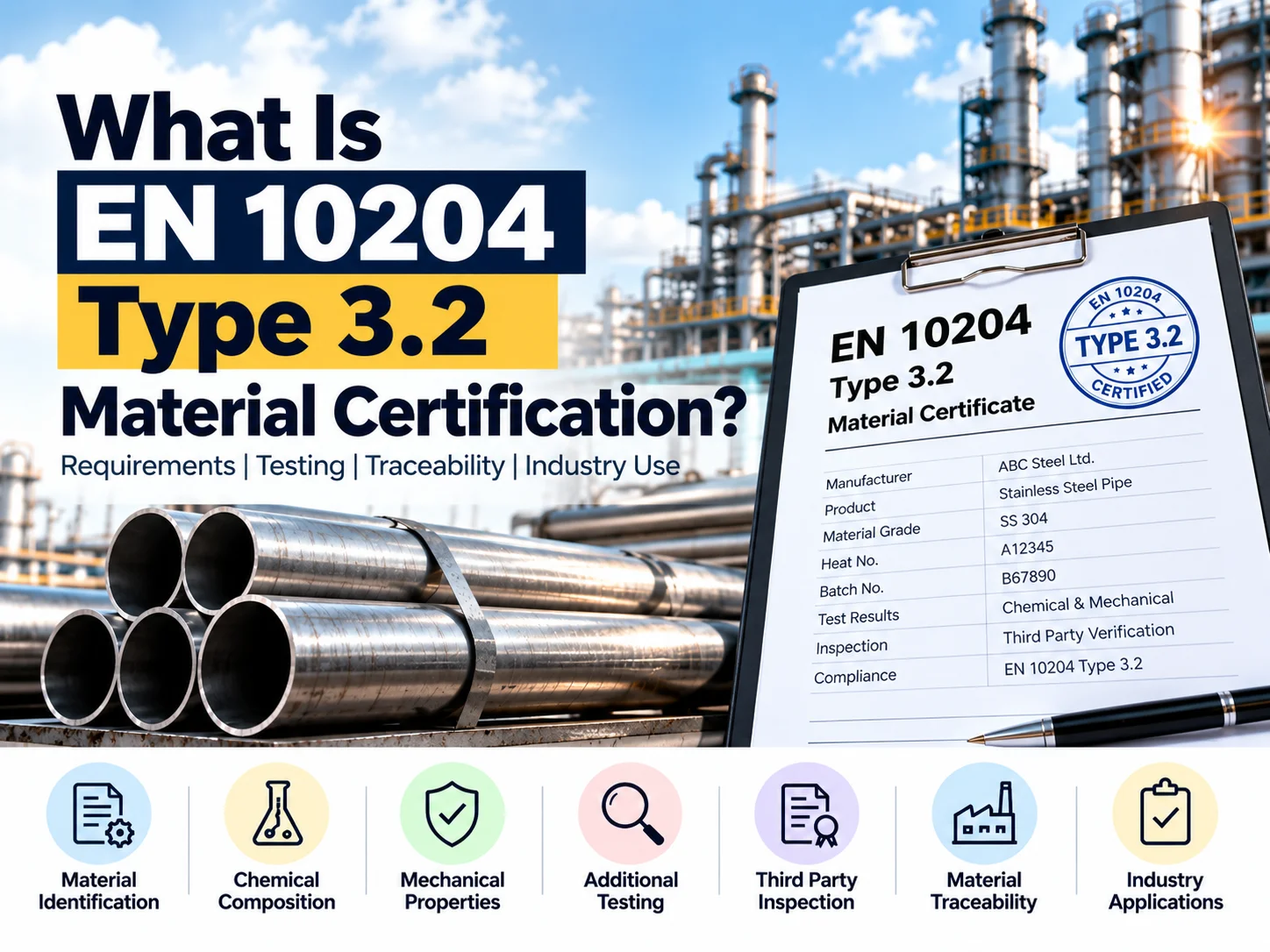
EN 10204
TYPE 3.2
TESTING
REQUIREMENTS
03 Oct 2026
What Is EN 10204 Type 3.2 Material Certification?
By Editorial Team
Table Of Contents
Related Blogs
AUG
20
Steel Traceability for EU Exports: EN 10204, Heat Numbers & Digital Product Passport
AUG
11
EN 10204 Type 3.2 Inspection Certificate: Complete Guide for Manufacturers and Buyers
See Also.....
An EN 10204 Type 3.2 material certificate is a type of inspection document that shows metallic products meet certain standards.
EN 10204:2004 sets out different kinds of inspection documents for metallic products, such as 2.1, 2.2, 3.1, and 3.2.
Type 3.2 is used when the material needs special testing along with a check by an approved inspector, based on the buyer’s, contract, or legal requirements.
This type of certificate is especially important for projects like engineering, pressure vessels, fabrication, piping, steel, and other areas where it’s crucial to know the material’s origin and have it checked independently.
What Does EN 10204 Mean?
EN 10204 is a European standard called “Metallic products — Types of inspection documents.”
It explains the different kinds of documents that can come with metallic products.
The main categories are:
| Type | Inspection document | General description |
|---|---|---|
| 2.1 | Declaration of compliance | Compliance declaration without test results |
| 3.2 | Inspection certificate | Specific inspection with additional authorized inspection/validation |
| 3.1 | Inspection certificate | Specific inspection with manufacturer-authorized validation |
| 2.2 | Test report | Test results from non-specific inspection |
The key thing is that EN 10204 tells you what type of inspection document is needed. It doesn’t set the chemical or mechanical requirements for each material grade. These requirements usually come from the relevant product standard, material specification, purchase order, or project specifications.
What Is an EN 10204 Type 3.2 Certificate?
A Type 3.2 certificate shows that the material has been checked and tested according to the necessary specific steps.
This type of certificate is different from Type 3.1 because it includes extra checks or validation.
Depending on the project, these extra checks might involve:
– A representative from the manufacturer’s authorized inspection team
– A representative from the purchaser’s authorized inspection team
– An inspector chosen based on the rules or contract requirements
It’s important to always check the purchase specification, inspection plan, and relevant regulations to confirm the exact arrangement.
EN 10204 3.1 vs 3.2
This is one of the most important distinctions when purchasing certified material.
| Requirement | EN 10204 Type 3.1 | EN 10204 Type 3.2 |
|---|---|---|
| Specific inspection | Yes | Yes |
| Product-specific results | Yes | Yes |
| Chemical test results | Where specified | Where specified |
| Mechanical test results | Where specified | Where specified |
| Manufacturer's inspection representative | Yes | Yes |
| Additional authorized inspection involvement | Generally not part of 3.1 | Yes |
| Material traceability | Yes, as applicable | Yes, as applicable |
| Typical requirement | Standard material supply | Projects requiring additional inspection/verification |
The main difference
Type 3.1: The manufacturer’s authorized inspection process checks and confirms the results.
Type 3.2: The manufacturer’s authorized inspection process is used, along with another approved inspection party as required by the relevant agreement.
Because of this, a Type 3.2 certificate shouldn’t just be called a “better version of a 3.1 certificate.” It’s a different way of handling the inspection documents.
What Information Does a Type 3.2 Certificate Contain?
The exact content depends on the material specification and what the customer needs, but an EN 10204 Type 3.2 certificate usually includes:
Material Identification
– Manufacturer’s name
– Description of the product
– Material grade
– Dimensions of the product
– Amount or quantity
– Heat number
– Batch or lot number
– Condition of delivery
Chemical Composition
Depending on the standard for the material, the results may include elements like:
| Element | Purpose |
|---|---|
| Carbon (C) | Grade verification |
| Silicon (Si) | Chemical compliance |
| Manganese (Mn) | Chemical compliance |
| Phosphorus (P) | Impurity control |
| Sulfur (S) | Impurity control |
| Chromium (Cr) | Alloy verification |
| Nickel (Ni) | Alloy verification |
| Molybdenum (Mo) | Alloy verification |
The needed parts and the limits for acceptance are based on the standard for the material or product being used.
Mechanical Properties
If asked for, the certificate can include:
– The strength needed to bend without breaking
– The maximum strength before breaking
– How much it can stretch before breaking
– Results from impact tests (Charpy test)
– Hardness of the material
– Any other mechanical properties that are specified
Additional Testing
Depending on the order or technical instructions, the following tests may be done:
– Ultrasonic testing (UT)
– Radiographic testing (RT)
– Magnetic particle testing (MT)
– Penetrant testing (PT)
– Checking the size and shape
– Looking at it visually
– Identifying the type of material used (PMI)
Material Traceability in EN 10204 3.2 Certification
Material traceability is very important when it comes to supplying materials that are certified.
The material that is provided should be able to be tracked through its identification and the related inspection records.
A usual way to track the material is like this:
Purchase Order
↓
Material Grade
↓
Heat/Batch Number
↓
Manufacturing Records
↓
Chemical and Mechanical Tests
↓
Inspection Results
↓
EN 10204 Type 3.2 Certificate
If there is no good traceability, it will be hard to show that the certificate matches the material that was actually sent to the customer.
How Is an EN 10204 3.2 Certificate Issued?
A typical certification process goes through these steps:
1.Define requirements
The buyer tells the seller:
– What kind of material to use
– Which product standard to follow
– The size and shape of the product
– How many items are needed
– What tests need to be done
– What level of inspection is required
– What type of certificate is needed
2.Make the material
The manufacturer creates the material based on the technical rules provided.
3.Keep track of the material
Each piece is marked with its heat number, batch number, and product details during production.
4.Do the tests
All necessary chemical, mechanical, and other tests are carried out as required.
5.Check the results
The test results are compared with the standards or rules that need to be met.
6.Do extra inspection
For Type 3.2, an approved inspector checks the product according to the agreed plan.
7.Get the certificate
The inspection report is reviewed and approved by the proper authorized body.
When Is EN 10204 Type 3.2 Required?
Type 3.2 is not required for all metal products automatically.
It might be needed because of:
– Customer orders
– Project rules
– Inspection and testing plans
– Material standards
– Engineering needs
– Legal rules
– Projects involving pressure equipment
– Applications where safety is very important
For example, a customer might say:
“Material must come with an EN 10204 Type 3.2 inspection certificate.”
In this case, the manufacturer has to follow the inspection document requirements as stated.
EN 10204 3.2 for Pressure Equipment
Material certification is very important in making pressure equipment, because the qualities of the materials and being able to track them back can directly influence how safe and legal the equipment is.
According to the Pressure Equipment Directive 2014/68/EU (PED), specifically in Annex I, Section 4.3, there are rules about keeping records of materials used in certain parts that hold pressure.
For main pressure parts in equipment that is categorized as II, III, or IV, the PED asks for a certificate from the material maker.
This certificate is part of a specific product control process, but only if it follows the rules set by the Directive.
But it’s important to remember that:
PED requirement does not always mean the same as EN 10204 Type 3.2.
The right kind of documentation depends on the category of the equipment, the type of material used, the way the product is checked for conformity, and what the project needs.
EN 10204 3.2 Certificate Verification Checklist
Before accepting a Type 3.2 certificate, quality engineers and procurement teams should verify:
| Verification point | What to check |
|---|---|
| Material grade | Matches purchase specification |
| Heat number | Matches physical material marking |
| Dimensions | Match order requirements |
| Quantity | Matches delivery |
| Chemical composition | Meets applicable standard |
| Mechanical properties | Meet specified requirements |
| Heat treatment | Correct condition where required |
| NDT | Required examinations completed |
| Traceability | Product linked to certificate |
| Inspection | Required inspection completed |
| Validation | Correct authorized parties involved |
| Certificate reference | Matches purchase order/project |
Common EN 10204 3.2 Certification Mistakes
Mistake 1: Mixing up 3.1 with 3.2
The main difference lies in the extra approved inspection or validation process.
Mistake 2: Thinking 3.2 refers to a type of material
3.2 is a category for inspection documents, not a type of steel.
Mistake 3: Not tracking the heat number
The marking on the material should match the certificate and related test results.
Mistake 4: Believing EN 10204 describes material properties
EN 10204 is about the types of inspection documents.
The actual technical requirements for the material or product are set by the relevant standard.
Mistake 5: Scheduling inspection too late
If extra inspection is needed, the plan for it should be set before the related manufacturing or testing activities start.
Frequently Asked Questions
Is EN 10204 Type 3.2 the same as 3.1?
No. Both involve specific inspection, but Type 3.2 includes an additional authorized inspection/validation arrangement.
Is an EN 10204 3.2 certificate mandatory?
Not universally. It becomes applicable when required by the customer, contract, project specification, regulatory framework or other applicable requirements.
Who validates a Type 3.2 certificate?
The manufacturer’s authorized inspection representative and the additional authorized inspection party specified by the applicable contractual or regulatory arrangement.
Does Type 3.2 guarantee material quality?
The certificate provides documented inspection and test evidence against specified requirements. It does not replace proper material specification, manufacturing controls or traceability.
Can Type 3.2 be used for pressure equipment?
Yes, where the applicable project, material and regulatory requirements call for this type of inspection documentation.
Conclusion
An EN 10204 Type 3.2 material certificate offers proof that the product was tested and inspected with an extra check by an approved person.
For manufacturers, buyers, and inspectors, the key parts are:
Right product standards → Testing the product → Keeping track of where the materials came from → Checking the product → Getting approval from an authorized body.
Knowing the difference between EN 10204 3.1 and 3.2 helps companies choose the right kind of inspection paper for their project and to follow the rules properly.