
EN 10204 Type 3.2
Buyers
Structural Steel
What Should Buyers Verify in an EN 10204 Type 3.2 Certificate for Steel Plates, Pipes and Structural Steel in India?
By First Welding Certification Technical Editorial Team
8 Min Read Time
07 Oct 2026
Table of Content
- Introduction
- What Is an EN 10204 Type 3.2 Certificate?
- Why Should Buyers Verify a Type 3.2 Certificate?
- What Should Be Checked on the Certificate?
- Steel Plate Certificate Verification
- Steel Pipe and Tube Certificate Verification
- Structural Steel Certificate Verification
- Material Traceability and Heat Numbers
- Inspection and Validation
- Common Buyer Mistakes
- EN 10204 Type 3.2 Verification Checklist
- Frequently Asked Questions
- Related Searches
- Conclusion
EN 10204 Type 3.2 Certification | Buyer Verification
Material Identity
Material grade
Product standard
Dimensions
Quantity
Traceability
Heat number
Material marking
Certificate reference
Inspection
Chemical results
Mechanical tests
Required inspection & validation
Introduction
An EN 10204 Type 3.2 certificate gives buyers documented evidence that metallic products comply with the requirements of the order and includes relevant test results validated through the Type 3.2 inspection process. Unlike a Type 3.1 certificate, Type 3.2 involves the manufacturer’s authorized inspection representative together with the purchaser’s authorized inspection representative or an inspector designated under applicable official regulations.
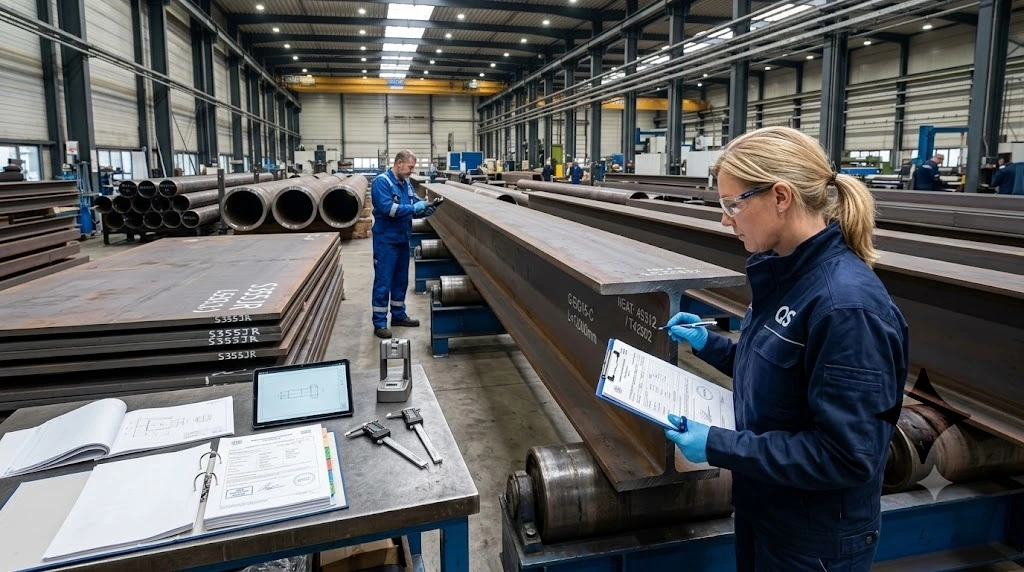
For buyers purchasing steel plates, pipes, tubes, structural sections, forgings or other metallic products, simply receiving a certificate is not enough. The certificate should be checked against the purchase order, material markings, applicable product standard and delivered material.
This guide explains what buyers should verify in an EN 10204 Type 3.2 certificate, how material traceability works, and which documentation issues can create compliance problems.
What Is an EN 10204 Type 3.2 Certificate?
EN 10204 Type 3.2 is an inspection certificate for metallic products.
Under EN 10204:2004, the document is prepared by the manufacturer’s authorized inspection representative, who is independent of the manufacturing department, and either the purchaser’s authorized inspection representative or an inspector designated by official regulations. The document declares compliance with the order requirements and supplies test results.
This means Type 3.2 is about inspection-document validation and traceability, not a separate steel grade.
A buyer may therefore specify a Type 3.2 certificate when the purchase specification, contract, applicable regulation, project quality plan or customer requirement calls for additional independent inspection.
Why Should Buyers Verify an EN 10204 Type 3.2 Certificate?
A material certificate is useful only when the documentation can be reliably connected to the material being supplied.
For example, a buyer may receive a certificate showing:
- Correct steel grade
- Chemical composition
- Mechanical properties
- Heat number
- Product dimensions
- Inspection results
- Authorized signatures
But if the heat number on the certificate does not match the physical material, the buyer cannot establish reliable traceability.
Therefore, verification should compare three things:
Purchase Order → Certificate → Physical Material
This simple relationship forms the foundation of effective EN 10204 material traceability.
What Should Buyers Verify in an EN 10204 Type 3.2 Certificate?
1. Certificate Type
First, confirm that the document actually states the required inspection-document type.
If the purchase order requires EN 10204 Type 3.2, a Type 3.1 certificate should not automatically be treated as equivalent.
The buyer should verify:
- EN 10204 reference
- Type 3.2 designation
- Certificate number
- Supplier/manufacturer identification
- Relevant order or project reference
2. Material Grade and Product Standard
The material grade on the certificate should correspond with the purchase order and applicable product specification.
Check:
- Material grade
- Product standard
- Grade designation
- Delivery condition
- Applicable supplementary requirements
For example, if the purchase order specifies a particular structural-steel grade, the buyer should confirm that the certificate identifies the same grade and applicable standard.
3. Heat Number or Cast Number
The heat number is one of the most important elements in steel material traceability.
The buyer should compare the heat number shown on:
Certificate → Material marking → Packing/bundle tag → Delivery documentation
If the numbers do not match, stop the material-release process and investigate the discrepancy.
A certificate cannot establish useful traceability if the buyer cannot connect it to the actual material received.
4. Chemical Composition
The certificate should contain the applicable chemical-analysis results required by the relevant product specification or purchase order.
Depending on the material, this may include elements such as:
- Carbon
- Manganese
- Silicon
- Phosphorus
- Sulfur
- Chromium
- Nickel
- Molybdenum
- Other specified alloying elements
The buyer should compare the reported values with the applicable specification limits rather than simply checking whether a number appears on the certificate.
5. Mechanical Properties
Where required by the applicable specification, buyers should verify relevant mechanical-test results.
These may include:
- Yield strength
- Tensile strength
- Elongation
- Impact properties
- Hardness
- Other specified mechanical tests
The buyer should confirm that the results correspond to the required material grade, delivery condition and applicable test requirements.
What Should Buyers Check for Steel Plates?
EN 10204 Type 3.2 for steel plates, the buyer should compare the certificate with the physical plates and purchase order.
Important verification points include:
Material
- Grade
- Product standard
- Heat number
- Delivery condition
Dimensions
- Thickness
- Width
- Length
- Quantity
Test Results
- Chemical composition
- Tensile properties
- Impact testing where specified
- Other required tests
Traceability
Check that the plate marking or identification corresponds to the certificate.
For critical applications, buyers should also confirm that any project-specific inspection requirements have been completed.
What Should Buyers Check for Steel Pipes and Tubes?
EN 10204 Type 3.2 for steel pipes and tubes, verification should include both material certification and product identification.
Check:
- Pipe/tube grade
- Applicable product standard
- Heat number
- Pipe size
- Wall thickness
- Length
- Quantity
- Chemical properties
- Mechanical properties
- Heat-treatment condition where applicable
- Required NDT or additional testing
- Certificate references
The heat or cast number should remain traceable to the delivered pipes or tubes.
This becomes particularly important when multiple heats, sizes or production lots are included in one shipment.
What Should Buyers Check for Structural Steel?
EN 1020-4 Type 3.2 for structural steel, material certificates can form an important part of the overall documentation and traceability system.
Depending on the project, buyers may receive:
- Plates
- Beams
- Columns
- Channels
- Angles
- Hollow sections
- Other structural sections
The buyer should verify:
Material → Heat Number → Certificate → Purchase Order → Project Requirement
For structural-steel projects involving EN 1090, the material certificate should also fit into the broader manufacturing and traceability documentation required for the project.
This creates a useful connection between EN 10204 material certification and EN 1090 execution requirements.
EN 10204 Type 3.2 Material Traceability: What Buyers Should Check
Material traceability should continue throughout the supply chain.
A practical traceability chain can look like:
Mill → Material Certificate → Heat Number → Supplier → Fabricator → Component → Final Documentation
The buyer should determine whether the traceability system can maintain this connection throughout the relevant manufacturing stages.
EN 10204 also permits relevant test results from primary or incoming products to be transferred into a Type 3.2 document where the manufacturer maintains appropriate traceability procedures and can provide the corresponding inspection documents.
Who Validates an EN 10204 Type 3.2 Certificate?
This is one of the most important differences between Type 3.1 and Type 3.2.
A Type 3.2 document involves:
- Manufacturer’s authorized inspection representative
- Purchaser’s authorized inspection representative or inspector designated by official regulations
The manufacturer’s inspection representative must be independent of the manufacturing department.
Therefore, buyers should not assume that simply adding a third-party stamp to an existing document automatically creates a valid Type 3.2 inspection certificate.
The inspection and validation arrangement should be established as part of the purchasing and inspection process.
Common EN 10204 Type 3.2 Verification Mistakes
Mistake 1: Checking Only the Certificate
A certificate can look complete while the physical material has a different identification.
Better approach: reconcile the certificate with the actual material.
Mistake 2: Confusing 3.1 and 3.2
The difference is not simply that Type 3.2 means “higher-quality steel.”
The inspection-document types differ in their validation arrangements.
Mistake 3: Ignoring the Purchase Order
The buyer should compare the certificate against the exact purchase requirements.
Mistake 4: Losing Heat-Number Traceability
When material is cut, processed or divided, the identification system should preserve the required traceability.
Mistake 5: Checking Signatures Without Checking Inspection Scope
A signature alone does not tell the buyer whether the required inspection and testing were completed.
EN 10204 Type 3.2 Certificate Verification Checklist
| Verification Point | What Buyers Should Check |
|---|---|
| Certificate type | Type 3.2 specified and identified |
| Manufacturer | Correct manufacturer/supplier |
| Purchase order | Correct PO/project reference |
| Material grade | Matches specification |
| Product standard | Correct applicable standard |
| Heat number | Matches physical marking |
| Dimensions | Match order requirements |
| Quantity | Matches delivery |
| Chemical results | Meet applicable requirements |
| Mechanical results | Meet applicable requirements |
| Delivery condition | Matches specification |
| NDT/testing | Required testing completed |
| Traceability | Material linked to certificate |
| Inspection | Required inspection performed |
| Validation | Appropriate authorized parties involved |
Frequently Asked Questions
What does EN 10204 Type 3.2 mean?
EN 10204 Type 3.2 is an inspection certificate for metallic products containing test results and validated by the manufacturer’s authorized inspection representative together with the purchaser’s authorized inspection representative or an inspector designated by official regulations.
Is an EN 10204 Type 3.2 certificate the same as a material grade?
No. Type 3.2 identifies an inspection-document type, not a steel or metallic-material grade.
What is the difference between EN 10204 3.1 and 3.2?
Both are inspection certificates based on specific inspection. Type 3.2 adds validation by the purchaser’s authorized inspection representative or an inspector designated by official regulations.
Is heat-number traceability important?
Yes. The heat number provides a critical link between the material and its inspection documentation.
When should a buyer request Type 3.2?
The requirement should be established before purchasing or manufacturing, based on the purchase specification, applicable standards, project requirements, contract and inspection plan.
Related Searches
Conclusion
An EN 10204 Type 3.2 certificate should be treated as part of a broader material-verification and traceability process—not simply as a document to file after delivery.
For steel plates, pipes and structural steel, buyers should verify the certificate type, material grade, product standard, heat number, dimensions, test results, inspection requirements, traceability and authorized validation.
The most important practical principle is simple:
Do not verify the certificate in isolation. Verify the certificate against the purchase order and the physical material.
For critical engineering procurement, this approach strengthens documentation control, material traceability and confidence in the supplied metallic products.
Need EN 10204 Type 3.2 Certification or Inspection?
First Welding Certification Pvt Ltd (PRVÁ ZVÁRAČSKÁ, a.s.) works with manufacturers, suppliers and purchasers dealing with EN 10204 Type 3.2 inspection certification, material traceability and international compliance requirements.
If your project involves steel plates, pipes, structural steel, pressure equipment or export-oriented manufacturing, establish the applicable inspection and certification requirements before material procurement and production.