
EN 10204
TYPE 3.1 AND 3.2
INSPECTIONS
12 Sep 2026
EN 10204 Type 3.1 vs 3.2: When Third-Party Inspection Is Needed
By Editorial Team
Table Of Contents
- Definitions & Quality Assurance: EN 10204 3.1 and 3.2
- Regulatory & Industry Context (Compliance, Traceability, ESG)
- Industry Use-Cases & Risk Mitigation
- Decision Criteria for Buyers (Traceability, Safety, Contract Terms)
- Cost, Lead Time and Supply-Chain Impact
- Procurement Checklist & Contract Clauses
- Real-World Scenarios
- Conclusion & Recommendations
Related Blogs
AUG
20
Steel Traceability for EU Exports: EN 10204, Heat Numbers & Digital Product Passport
AUG
11
EN 10204 Type 3.2 Inspection Certificate: Complete Guide for Manufacturers and Buyers
See Also.....
Executive Summary: EN 10204 is an EU standard defining inspection documents for metallic products. A Type 3.1 certificate is issued by the manufacturer’s own quality representative (independent of production) and includes specific test results. Type 3.2 adds a second signature by an independent third-party inspector (e.g. customer’s rep or notified body) to verify those test results. Buyers should reserve 3.2 certificates for high-risk or safety-critical applications where regulatory or contract requirements demand independent assurance (offshore, pressure vessels, energy, aerospace, etc.). While 3.2 bolsters traceability, risk mitigation and quality assurance, it also adds cost and lead time. This article explains 3.1 vs 3.2, legal/regulatory drivers (e.g. EU PED), industry practices, decision criteria, and practical buying guidance (checklists, clauses, scenarios) to integrate compliance, supply-chain resilience, ESG and digital-traceability goals into procurement strategy.
Definitions & Quality Assurance: EN 10204 3.1 and 3.2
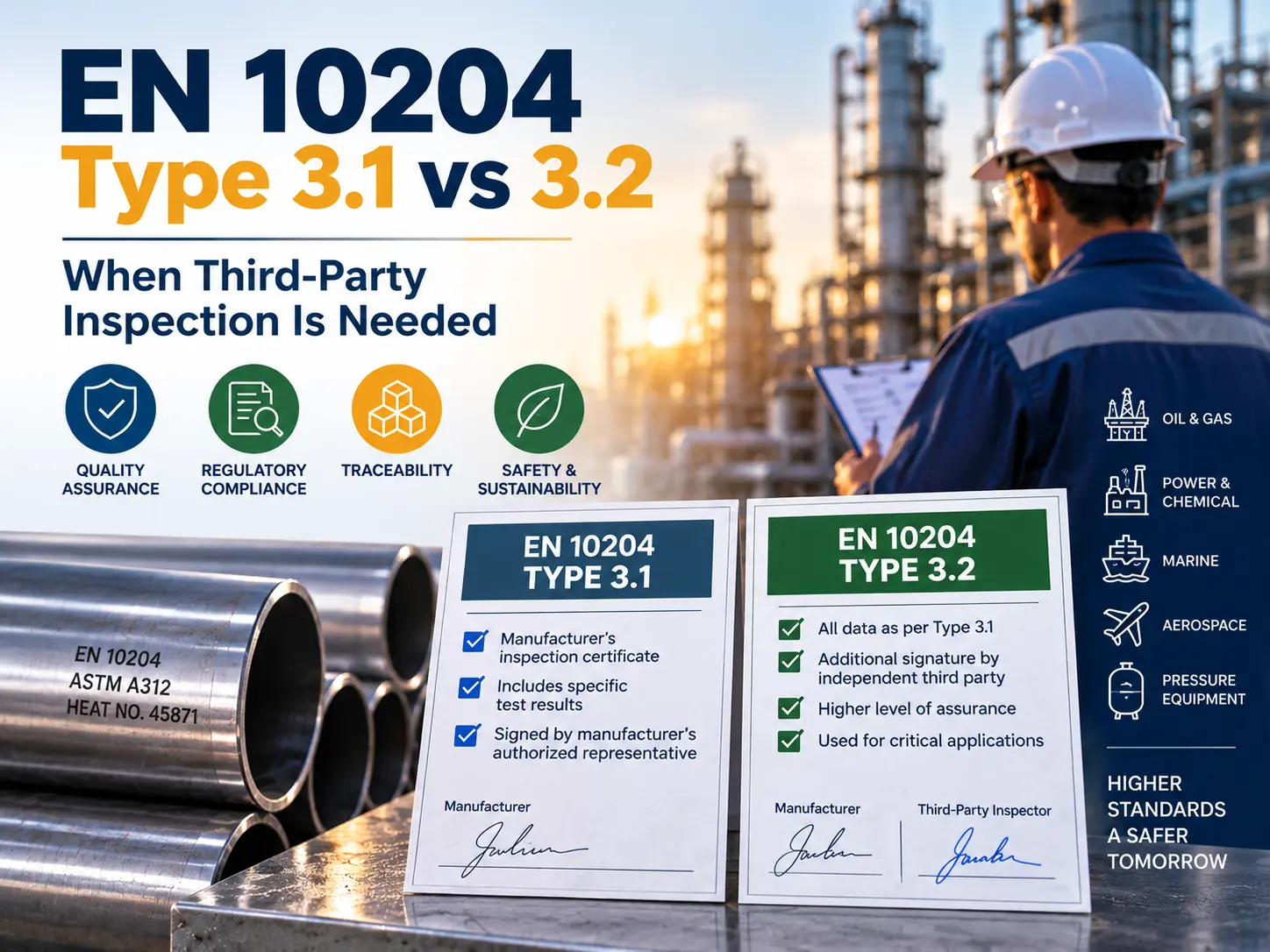
EN 10204:2004 (Metallic Products – Types of Inspection Documents) specifies inspection certificates for metals (plates, bars, tubes, forgings, castings, etc.). In simple terms, a Type 3.1 Inspection Certificate is a quality-assurance document from the manufacturer confirming that the delivered material meets the order and technical specifications. It includes all relevant specific test results (chemical, mechanical, NDT, etc.) from the actual heat or batch and is signed by the manufacturer’s authorized inspection representative (who must be independent of the production team).
Figure: A stainless steel investment casting foundry floor (production of pressure-containing components). EN 10204 certificates travel with each batch to guarantee quality, traceability and regulatory compliance.
By contrast, a Type 3.2 Inspection Certificate contains the same data as a 3.1 (specific test results and declaration of compliance) but is co-signed by an independent third party. This third-party is either the purchaser’s appointed inspector or a qualified external body (e.g. TUV, ABS, LR, SGS, DNV) acting on the buyer’s behalf. In other words, 3.1 = manufacturer-only attestation, 3.2 = manufacturer plus external validation (double-inspected). This added verification makes 3.2 the highest level of assurance under EN 10204. Both certificates must identically list product ID (heat/batch numbers, dimensions, quantity), referenced standards, and all required test data; the difference is who signs it (independence) and who witnesses the tests.
Regulatory & Industry Context (Compliance, Traceability, ESG)
EN 10204 is cited in many national and international regulations. For example, the EU’s Pressure Equipment Directive (PED 2014/68/EU) effectively requires EN 10204 certificates for pressure parts, with higher inspection levels for higher risk categories. Bruynseels notes that PED Category III/IV equipment (offshore, nuclear, NORSOK or DNV governed) typically mandates 3.2 with notified-body witness. In general, any regulation or contract clause that calls for “third-party inspection” or heightened scrutiny will push toward Type 3.2. International oil & gas standards (API, NACE), transport codes, and classification society rules often name EN 10204 explicitly, reflecting compliance and quality assurance expectations.
In practice, sectors with stringent safety and environmental requirements lean on 3.2 to demonstrate traceable conformity. RINA (a notified inspection body) emphasizes that Type 3.2 is used for “critical industrial applications and pressure equipment” (oil & gas, energy, chemical, marine) and provides complete traceability and risk reduction. The certificate review process (often digitalized) ensures the entire supply chain is audited for the correct heat numbers and testing. Indeed, many providers now offer electronic certificate management to integrate with Industry 4.0 supply chain platforms, enhancing transparency and supporting ESG goals (e.g. verifying sustainable sourcing or carbon footprint claims). In sum, EN 10204 3.2 plays into broader compliance and ESG strategies by embedding independent verification of critical material properties.
Industry Use-Cases & Risk Mitigation
Type 3.1 certificates suffice for many standard industrial projects (non-critical equipment, general fabrication) where the manufacturer’s own lab and QA process are trusted. In contrast, Type 3.2 is common in higher-consequence applications. Examples include:
- Offshore & Oil/Gas: subsea pipelines, platforms, wellhead components – where material failure risks life, environmental damage or huge cost. EN 10204 3.2 is often specified by major oil companies and in NORSOK/PED requirements.
- Power & Chemical Plants: pressure vessels, heat exchangers, reactors subject to stringent design codes often require 3.2 or documented vendor inspection by a third party. Regulatory regimes (PED in EU, ASME U-code in US sometimes by analogy) may demand independent material certification.
- Marine & Aerospace: critical marine engine parts or aircraft components (turbine disks, landing gear) rely on double-checks. Classification societies and airworthiness authorities may require third-party MTCs.
- Nuclear & Specialty: reactor systems and high-purity applications adopt extra verification. Specifications like EN 15085 (rail welding) or NQA-1 (nuclear quality) often refer to EN 10204 requirements.
In all these sectors, a Type 3.2 certificate mitigates supply-chain risk by adding an objective inspection step. Even if a manufacturer is ISO 9001 certified, the 3.2 inspector (e.g. TUV, Bureau Veritas) provides independent reassurance of metal chemistry, heat treatment, mechanical properties and traceability. This reduces the chance of discovering nonconforming material only at final inspection or service – a key compliance and safety consideration.
Decision Criteria for Buyers (Traceability, Safety, Contract Terms)
Choosing between 3.1 and 3.2 should be driven by risk, regulatory demand and contractual terms. Key factors include:
- Project Risk/Safety-Criticality: If failure consequences are severe (H₂S service, high pressure, nuclear, offshore), default to 3.2. The NTIA guide advises 3.2 for “high design P/T” or severe consequence scenarios.
- Regulation or Contract Requirements: If codes (PED categories, NORSOK, API) or customer specifications explicitly call for third-party inspection, the certificate type is fixed at 3.2. Conversely, if only a 3.1 is required by spec, buyers should not accept 3.2 post-shipment without approval. Always state the requirement clearly in the purchase order (e.g. “EN 10204:2004 Type 3.2 inspection certificate required”) so it can be planned from the start.
- Supplier and Quality Chain: For new or unproven mills, third-party validation reduces trust issues. If a supplier’s QA is known reliable (and certified), a 3.1 certificate might suffice for routine orders. However, if the material’s pedigree in the vendor chain is unclear, 3.2 adds traceability.
- End-Use and Customer Audit: End-user requirements (e.g. OEM or owner’s inspector involvement) often drive 3.2. For example, many EPC contracts in petrochemicals require 3.2 for all pressure parts. Civil or structural projects without strict criticality may accept 3.1.
- Supply-Chain Resilience: In a globalized supply chain, 3.2 can hedge against fraud or misdocumentation of certificates. It supports traceability initiatives and digital audit trails (blockchain or IoT tracking) that are popular in modern procurement.
In short, if any of safety, regulatory or traceability flags are raised, 3.2 should be requested. If not, 3.1 is often adequate (and cheaper/faster). Procurement teams should include decision cues like those above in their inspection test plans and POs.
Cost, Lead Time and Supply-Chain Impact
Independent 3.2 certification incurs extra cost and lead time, which must be balanced against risk mitigation. Industry sources report that third-party inspection typically adds 5–15% to material cost (depending on batch size and scope). Scheduling the inspection and having a qualified person on-site usually adds several working days (e.g. 3–10 days) to production and delivery. (One pipeline vendor notes 2–4 weeks longer due to coordinating the inspector visit.)
Despite this overhead, many buyers view the extra expense as an insurance policy. A Bruynseels guide stresses that specifying 3.2 “when 3.1 is sufficient adds cost and lead time without technical value, but accepting 3.1 when 3.2 is required creates a compliance gap”. In practice, organizations should plan the inspection early: include certificate type in RFQs so that inspectors can be booked into the production schedule. When done upfront, 3.2’s delays become part of the timeline rather than a last-minute hold-up.
Moreover, using Type 3.2 can strengthen supply-chain resilience. It provides confidence that incoming material won’t be held up or rejected at final inspection, reducing re-work and warranty risks. The independent check can uncover documentation errors (e.g. mismatched heat numbers) early, avoiding production stoppages. In an era of digitalization, many inspection bodies now deliver certificates electronically, enabling real-time visibility and integration with ERP/QMS systems. This digital approach enhances traceability and supports corporate ESG goals by verifying responsible sourcing and reducing the need for corrective actions (which have their own environmental and social costs).
Procurement Checklist & Contract Clauses
To operationalize these principles, buyers should use checklists and clear contract language. Important checklist items include:
- Certificate Type: Confirm “EN 10204:2004 Type 3.2” (or 3.1) is specified on the PO. If 3.2, note that the inspector is buyer-appointed.
- Independent Signatories: Verify the final certificate is signed by the manufacturer’s QA rep and an independent third-party (e.g. TÜV, ABS or customer inspector) as per the order.
- Inspector Appointment: Ensure contractually the buyer engages the inspector. (EN 10204 requires the inspector be “designated by official regulations” or the purchaser – many sources emphasize the inspector must be contracted by the buyer, not the vendor.)
- Scope of Testing: Check that all required specific tests (chemical analysis, tensile, hardness, impact, NDT, etc.) are included and traceable to material heat numbers. Heat/batch numbers on the MTC should match shipment tags.
- Standards & Traceability: Confirm referenced standards/editions match the spec. Maintain a traceability map (heat → piece serials) and link MTC lines to delivery notes.
- Digital Records: Wherever possible, require digital certificate submission. For example: “Supplier shall provide an electronic EN 10204:2004 Type 3.2 certificate (PDF or eMTC) including manufacturer and third-party stamps, heat numbers, and test results.” This supports digital traceability and auditability.
- Contract Wording Example: A suitable clause might read: “All delivered materials must be accompanied by an EN 10204:2004 Type 3.2 inspection certificate, signed by the manufacturer’s authorized inspection representative and a third-party inspector approved by [Buyer], verifying full compliance with the order requirements.” This ensures the contract legally binds the vendor to supply a genuine 3.2 certificate.
Using such a checklist in the supplier quality approval process and purchase order documentation will help enforce the certificate requirements.
Real-World Scenarios
- Oil & Gas Pipeline: An EPC contractor mandated Type 3.2 certificates for all flange steel to meet PED Category II requirements. One sub-supplier without ready 3.2 certs had to schedule a last-minute TUV inspection, delaying spool delivery by two weeks. The buyer concluded that planning 3.2 at RFQ stage would have avoided the bottleneck.
- Chemical Plant Pressure Vessel: A pressure vessel fabricator required 3.2 for all stainless steel plate. During shop acceptance, a third-party inspector spotted a documentation error (heat number typo) on one plate’s certificate that the mill missed. The vendor reissued a corrected 3.2, preventing a potential flaw in the final vessel. The buyer noted that the extra step paid off in avoiding expensive repairs.
- Standard Industrial Order: A general equipment buyer specified 3.2 for minor structural components “just in case.” The mills conducted unnecessary inspections, increasing costs ~10%. In retrospect, the buyer recognized that 3.1 would have been technically sufficient (per standards), and the excess requirement did not add value.
These cases show that 3.2 is most useful when risk, regulations or end-use critically demand it. In low-risk or purely commercial orders, 3.1 can adequately support quality without burdening the supply chain.
Conclusion & Recommendations
- Align Certificate Type to Risk: Use EN 10204 3.2 for high-risk, safety-critical or regulation-bound applications (pressure equipment, offshore, nuclear, etc.), and 3.1 for routine parts. Always specify the needed type in the PO and quality plan.
- Ensure Traceable, Independent Verification: Contract the third-party inspector yourself (not the supplier) and verify both signatures on a 3.2 certificate. This embeds traceability and compliance checks, strengthening supply-chain resilience and quality assurance.
- Plan for Cost & Time: Factor in the 5–15% cost premium and extra days when requiring 3.2. View this as an investment in risk mitigation and ESG alignment (e.g. verifying material provenance) rather than a pure cost.
- Leverage Digital Tools: Use electronic MTC systems or certificate-tracking software to automate verification (heat maps, checksum of signatures, blockchain tags, etc.). This enhances digitalization of quality management and reduces manual errors.
- Use Checklists & Clauses: Incorporate the above checklist in vendor audits and contracts. Example clause: “Material shall be delivered with EN 10204 Type 3.2 certificate signed by [Manufacturer] and an independent inspector, confirming all order requirements.” Such governance ensures ongoing compliance and audit readiness.
By carefully matching certificate levels to project needs and using robust verification procedures, buyers can balance compliance, quality assurance and supply-chain resilience while controlling cost and lead-time impacts.
| Attribute | EN 10204:2004 3.1 Certificate | EN 10204:2004 3.2 Certificate |
|---|---|---|
| Issuer | Manufacturer’s own authorized inspection representative | Manufacturer’s rep and buyer’s-appointed/official inspector |
| Independence | Internal QA (independent of production dept only) | External verification (independent third-party present) |
| Scope | Specific tests on delivered batch; confirms compliance | Same tests + independent audit of tests/documentation |
| Typical Use-Cases | Standard projects, general engineering (non-critical) | Critical applications (oil/gas, pressure vessels, nuclear) |
| Cost / Lead-Time | Lower cost, faster turnaround | 5–15% higher cost and additional days/weeks for inspection |
Sources: Official EN 10204 text and industry guidelines; procurement and quality association articles; major classification/inspection bodies. (URLs included above for reference.)