
EN 10204 Type 3.2
Third-Party Inspection
Requirements
What Does an EN 10204 Type 3.2 Certificate Contain? Requirements, Third-Party Inspection and International Recognition in India
By First Welding Certification Technical Editorial Team
10 Min Read Time
23 Sep 2026
Table Of Content
- Introduction
- What Is an EN 10204 Type 3.2 Certificate?
- What Information Does a Type 3.2 Certificate Contain?
- EN 10204 3.2 Material Certificate Requirements Checklist
- How Does Third-Party Inspection Work?
- EN 10204 3.2 Certification Process in India
- What Materials and Industries Use Type 3.2?
- What Affects EN 10204 3.2 Certification Cost?
- International Recognition and Acceptance
- EN 10204 Type 3.2 vs Type 3.1
- Frequently Asked Questions
- Conclusion
EN 10204 TYPE 3.2 - INSPECTION CERTIFICATE
Material Identification
Inspection / Test Result
Material Traceability
Inspection Documents
Final Audit Report
Introduction
For manufacturers supplying metallic products for demanding engineering projects, a material certificate must do more than identify the product. It should connect the supplied material with its specification, inspection results and traceability records.
An EN 10204 Type 3.2 certificate is an inspection document used when specific inspection results require additional validation. Under Type 3.2, the inspection documentation is validated by the manufacturer’s authorized inspection representative together with the purchaser’s authorized inspection representative or an inspector designated under applicable official requirements.
But what information should a Type 3.2 inspection certificate contain? What documents are required? How does third-party inspection work in India? And where can the certificate be used?
This guide explains the key points for manufacturers, exporters, procurement teams and buyers.
What Is an EN 10204 Type 3.2 Certificate?
EN 10204 defines inspection documents used for metallic products. Type 3.2 is used when the applicable product specification, purchase order, contract or regulatory requirement calls for specific inspection with additional validation.
The certificate connects the supplied metallic product with relevant inspection and testing results. It can include material identification, applicable specification, test results and traceability information.
A Type 3.2 document therefore should not be treated as a generic material certificate. The exact information depends on the applicable product standard and the inspection requirements agreed for the order.
What Information Does a Type 3.2 Certificate Contain?
A typical EN 10204 Type 3.2 inspection certificate can contain:
- Manufacturer name and identification
- Product or material description
- Material grade
- Applicable product standard
- Product dimensions and quantity
- Heat, cast or batch identification where applicable
- Purchase order or contract reference
- Specific inspection and testing results
- Chemical composition results where applicable
- Mechanical test results where applicable
- Heat-treatment information where required
- Non-destructive testing results where specified
- Product identification and traceability information
- Statement of compliance with the applicable requirements
- Validation by the manufacturer’s authorized inspection representative
- Validation by the purchaser’s authorized inspection representative or applicable designated inspector
The certificate should correspond to the actual material supplied. Traceability is important because the inspection records need to remain connected to the relevant products. PZVAR’s certification page specifically identifies material identification, mechanical and chemical test results, inspection records and traceability as key Type 3.2 elements.
EN 10204 3.2 Material Certificate Requirements: Complete Checklist
Before requesting an EN 10204 3.2 Standards, manufacturers and buyers can review the following checklist.
Product Information
☐ Manufacturer identification
☐ Product description
☐ Material grade
☐ Product standard
☐ Dimensions and quantity
☐ Heat/cast/batch identification where applicable
Inspection Requirements
☐ Applicable purchase-order requirements
☐ Specific inspection requirements
☐ Chemical testing where specified
☐ Mechanical testing where specified
☐ NDT requirements where applicable
☐ Heat-treatment requirements where applicable
Traceability
☐ Material identification is maintained
☐ Test results can be linked to the supplied material
☐ Inspection records are available
☐ Material documentation matches the supplied product
Validation
☐ Manufacturer’s authorized inspection representative
☐ Purchaser’s authorized inspection representative or applicable designated inspector
☐ Final inspection documentation reviewed and validated
The exact checklist should always be established against the applicable product standard, purchase order, contract and project requirements rather than using a generic checklist for every product.
How Does Third-Party Inspection Work for EN 10204 Type 3.2?
One of the defining features of Type 3.2 is the involvement of an additional inspection representative.
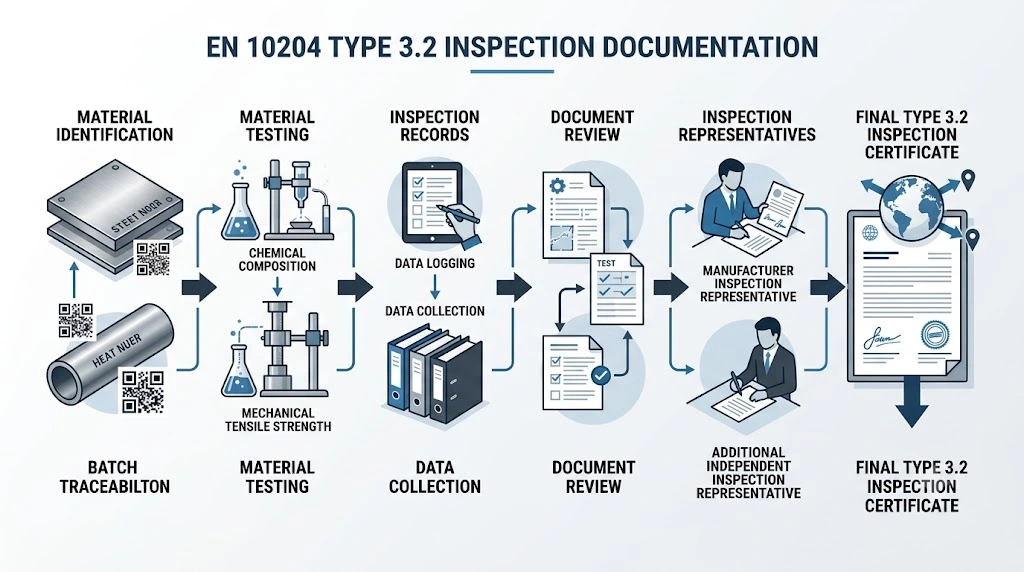
The basic flow can be represented as:
- Purchase Order / Specification
- Material Identification
- Inspection & Testing
- Review of Results
- Manufacturer’s Authorized Inspection Representativ
- Purchaser’s Authorized Inspection Representative / Applicable Designated Inspector
- Type 3.2 Inspection Documentation
The additional inspection representative verifies the relevant inspection documentation according to the applicable requirements. The exact role and designation should be established by the purchase order, contract, product requirements or applicable regulations.
This is why buyers should establish the EN 10204 Type 3.2 third party inspection requirement before material production or inspection activities begin.
EN 10204 3.2 Certification Process in India
For manufacturers in India, the certification and inspection process should begin by defining exactly what the buyer, product standard and project specification require.
A typical process can include:
1. Initial Inquiry
The manufacturer submits product, material and inspection details.
2. Requirement Review
The applicable product specification, purchase order and inspection requirements are reviewed.
3. Commercial and Inspection Planning
The inspection scope, applicable activities and commercial requirements are established.
4. Order Confirmation
The agreed requirements are confirmed before proceeding.
5. Inspection and Testing
The required specific inspection and testing activities are carried out.
6. Document Review
Inspection results, material identification and supporting records are reviewed.
7. Independent Validation
The required additional inspection representative validates the Type 3.2 documentation.
8. Certificate Release
The completed inspection documentation is reviewed, approved and released according to the agreed process.
Published Type 3.2 process similarly describes inquiry, commercial offer, order confirmation, registration, audit/inspection activities and report preparation, review, approval and release.
What Materials and Industries Use Type 3.2?
EN 10204 Type 3.2 can be relevant to metallic products where contractual, technical or regulatory requirements call for additional inspection validation.
Typical applications include:
- Steel plates
- Stainless steel products
- Pipes and tubes
- Bars and sections
- Forged products
- Cast products
- Structural steel products
- Pressure equipment materials
- Oil and gas equipment
- Power-generation equipment
- Shipbuilding
- Heavy engineering
Identifies pressure equipment, oil and gas, power generation, shipbuilding, structural steel and heavy engineering among the applications where Type 3.2 documentation can be relevant.
What Affects EN 10204 3.2 Certification Cost?
The EN 10204 3.2 certification cost is not a single fixed amount for every manufacturer.
Factors can include:
- Type and quantity of material
- Number of inspection stages
- Required testing
- Product complexity
- Inspection location
- Documentation scope
- Travel requirements where applicable
- Third-party inspection requirements
- Project-specific contractual requirements
Therefore, manufacturers should define the inspection scope before comparing certification or inspection costs.
International Recognition and Acceptance
An important point for exporters is that EN 10204 Type 3.2 should not be described as universally accepted for every project simply because it follows a European standard.
Its acceptance depends on the applicable product standard, purchase order, contract, customer requirements and relevant regulatory framework.
When an international buyer specifies EN 10204 Type 3.2, the inspection documentation can form part of the technical documentation demonstrating the specified inspection results and traceability of the supplied material.
For Indian manufacturers exporting metallic products, the practical step is to confirm the buyer’s documentation requirements before production and inspection.
EN 10204 Type 3.2 vs Type 3.1
| Requirement | Type 3.1 | Type 3.2 |
|---|---|---|
| Specific inspection results | Yes | Yes |
| Manufacturer's authorized inspection representative | Yes | Yes |
| Additional authorized inspection representative | No | Yes |
| Additional independent validation | Not the defining feature | Required according to applicable Type 3.2 requirements |
| Typical use | When manufacturer validation meets requirements | When additional validation is specified |
The key distinction is the additional validation associated with EN 10204 Type 3.2 third party inspection. The correct inspection document should be selected according to the applicable technical, contractual and regulatory requirements.
Frequently Asked Questions
What is an EN 10204 Type 3.2 certificate?
It is an inspection document for metallic products containing relevant specific inspection results and additional validation according to the applicable Type 3.2 requirements.
Is third-party inspection required for EN 10204 Type 3.2?
Type 3.2 involves validation by the manufacturer’s authorized inspection representative together with the purchaser’s authorized inspection representative or an inspector designated by applicable official requirements.
Is EN 10204 Type 3.2 certification mandatory?
Not for every metallic product. It becomes applicable when required by the purchase order, contract, product standard, project specification or relevant regulatory requirements.
How much does EN 10204 3.2 certification cost in India?
The cost depends on the material, inspection scope, testing requirements, quantity, location and project-specific requirements. A fixed price cannot be applied to every Type 3.2 inspection.
What is the difference between EN 10204 Type 3.1 and 3.2?
Both involve specific inspection results. Type 3.2 additionally involves validation by the purchaser’s authorized inspection representative or an inspector designated by applicable official requirements.
Can Indian manufacturers use EN 10204 Type 3.2 for export projects?
Yes, where the buyer, contract, product specification or applicable regulatory requirements specify or accept Type 3.2 documentation. The exact acceptance criteria should be confirmed for the particular project.
Conclusion
An EN 10204 Type 3.2 certification connects metallic products with their specified inspection results, identification and traceability records while adding the required independent validation.
For Indian manufacturers and exporters, the key is to establish the required inspection scope early, maintain clear material traceability, prepare the required testing records and confirm the buyer’s documentation requirements before inspection.
Whether the requirement concerns steel plates, pipes, structural materials, pressure equipment or other metallic products, a clearly defined Type 3.2 inspection process can create a structured record of conformity for the applicable order and project requirements.
Related Searches
- EN 10204 Type 3.2 Inspection Certificate: Complete Guide for Manufacturers and Buyers
- EN 10204 Type 3.1 vs 3.2: When Third-Party Inspection Is Needed
- EN 10204 Type 3.2 Certificate in Malaysia: Step-by-Step Guide
- EN 1090 Material Traceability & Inspection: Complete Guide
- EN 1090 Certification
- EN 10204 Type 3.2 Certification & Inspection
Start Your EN 10204 Type 3.2 Certification Process
First Welding Certification Pvt. Ltd. (PRVÁ ZVÁRAČSKÁ, a.s.) conducts certification and inspection activities for applicable European and international requirements. If your project specifies EN 10204 3.2 certification, discuss your material, inspection scope and documentation requirements to determine the applicable assessment route.