
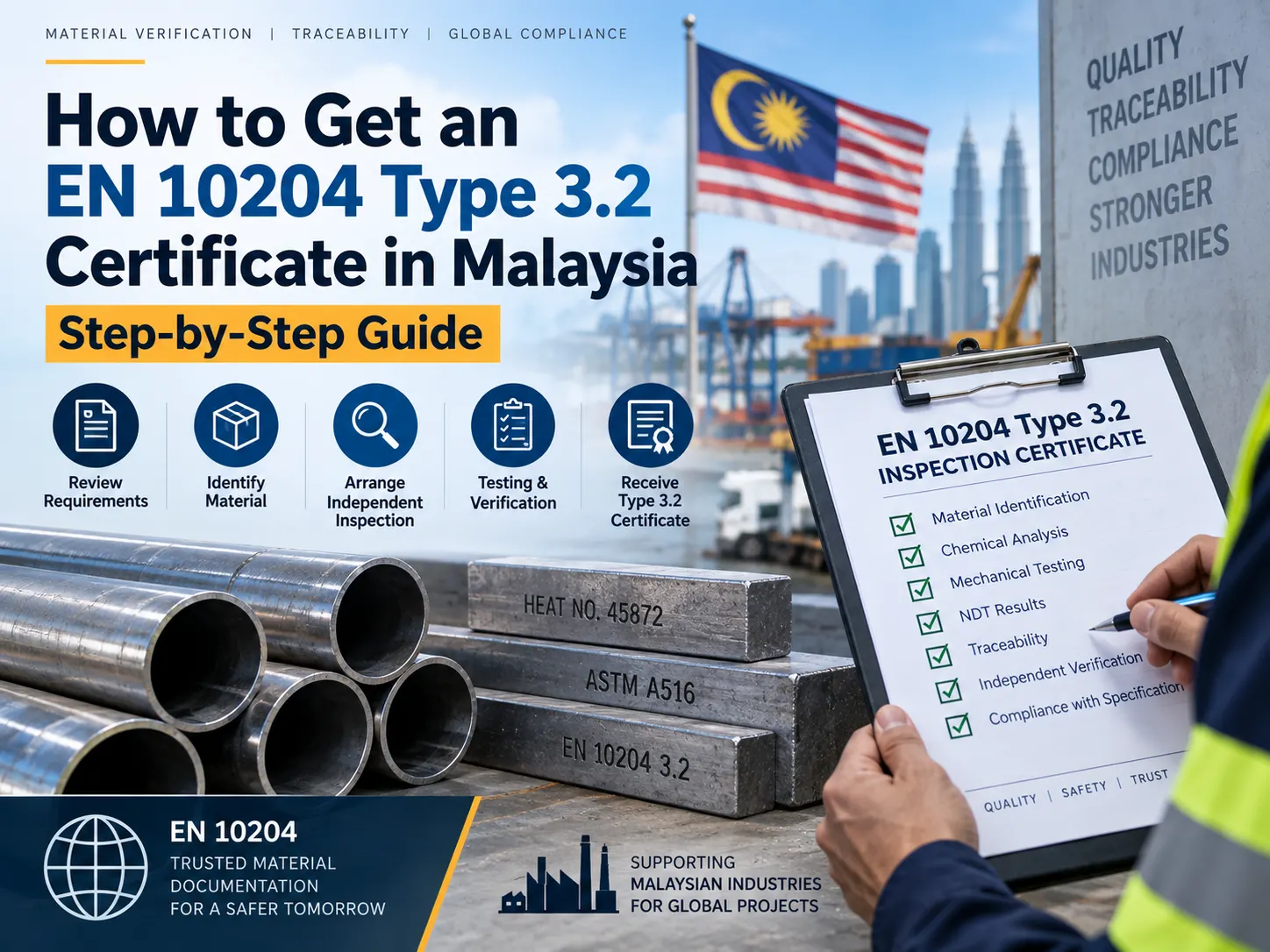
EN 10204
TYPE 3.2
MALAYSIA
19 Sep 2026
How to Get an EN 10204 Type 3.2 Certificate in Malaysia: Step-by-Step Guide
By Editorial Team
Table Of Contents
- What Is an EN 10204 Type 3.2 Certificate?
- Step-by-Step EN 10204 Type 3.2 Certification Process in Malaysia
- Common Mistakes to Avoid
- Who May Need EN 10204 Type 3.2 Certification in Malaysia?
- Why EN 10204 Type 3.2 Matters for Malaysian Manufacturers
- EN 10204 Type 3.2 Certification: Quick Checklist
- Conclusion
Related Blogs
AUG
20
Steel Traceability for EU Exports: EN 10204, Heat Numbers & Digital Product Passport
AUG
11
EN 10204 Type 3.2 Inspection Certificate: Complete Guide for Manufacturers and Buyers
See Also.....
EN 10204 Type 3.2 certification in Malaysia is used when a project requires specific inspection of metallic materials together with independent verification of conformity. The certificate provides documented evidence linking the supplied material to its applicable specification, inspection results and traceability records.
For Malaysian manufacturers, fabricators, suppliers and engineering companies working on international or safety-critical projects, understanding the EN 10204 Type 3.2 certification process can help prevent documentation gaps, material rejection and project delays.
Important: EN 10204 defines the type of inspection document; it does not by itself determine whether a Malaysian project must use Type 3.2. The requirement normally comes from the purchase order, technical specification, applicable product standard, contract or regulatory requirements.
What Is an EN 10204 Type 3.2 Certificate?
An EN 10204 Type 3.2 inspection certificate is a specific inspection document for metallic products. It confirms conformity with the order requirements and includes relevant test results.
The key distinction from Type 3.1 is the involvement of an additional authorized inspection representative. Under EN 10204, the document is prepared by the manufacturer’s authorized inspection representative, independent of the manufacturing department, together with either the purchaser’s authorized representative or an inspector designated by applicable regulations.
This additional independent verification is particularly relevant where material traceability, quality assurance and project-specific inspection requirements are important.
Step-by-Step EN 10204 Type 3.2 Certification Process in Malaysia
- Confirm Whether Type 3.2 Is Required
Start by checking the:
- Purchase order
- Technical specification
- Project quality plan
- Inspection and Test Plan (ITP)
- Applicable material/product standard
- Client requirements
- Contract requirements
- Applicable regulatory requirements
Do not automatically request Type 3.2 simply because it provides additional independent verification. First establish what the project actually specifies.
For example, certain pressure-equipment projects may require enhanced material documentation depending on the applicable regulatory and technical requirements.
- Identify the Material and Applicable Specification
Prepare the technical information for the material requiring certification.
This may include:
- Material grade
- Product type
- Dimensions
- Quantity
- Heat/cast number
- Applicable EN, ASTM, ASME or other specification
- Manufacturing standard
- Heat-treatment requirements
- Required mechanical tests
- Chemical analysis requirements
- NDT requirements
- Project-specific requirements
Accurate material identification is essential because the EN 10204 3.2 certificate must be traceable to the supplied material.
- Select an Independent Inspection Representative
The next step is to arrange the required independent inspection.
Depending on the project, the independent representative may be:
- The purchaser’s authorized inspection representative
- An independent inspection/certification body
- An inspector designated under applicable regulations
The inspection arrangement should be agreed before manufacturing or testing activities that require verification take place.
This is one reason why EN 10204 Type 3.2 inspection should be planned early, rather than treated as paperwork after the material has already been supplied.
- Review the Inspection and Test Plan
The inspection scope should be clearly defined.
Typical activities can include:
- Material identification
- Heat-number verification
- Chemical analysis
- Mechanical testing
- Tensile testing
- Impact testing, where applicable
- Hardness testing
- Heat-treatment record review
- Dimensional inspection
- Surface examination
- Non-destructive testing
- Positive Material Identification (PMI), where specified
- Review of manufacturer documentation
The exact inspection and testing requirements depend on the applicable material specification and project requirements.
- Verify Material Traceability
Material traceability is one of the most important parts of EN 10204 Type 3.2 certification.
The inspector should be able to establish a clear connection between:
Material → Heat/Cast Number → Test Results → Manufacturing Records → Inspection Certificate
The heat or batch identification should be consistent across the relevant material markings and documentation.
A traceability gap can create problems during client inspection, material acceptance or quality audits.
- Conduct or Review the Required Testing
The required tests are performed or reviewed according to the applicable specification and project requirements.
Depending on the material and application, this may include:
Chemical testing
Verification of chemical composition against the applicable material specification.
Mechanical testing
For example, tensile, yield, elongation, hardness or impact properties where specified.
NDT
Methods such as UT, RT, PT or MT may be required depending on the product and project specification.
Heat-treatment verification
Where applicable, heat-treatment records and conditions are reviewed.
The independent inspection scope should follow the agreed ITP, purchase order and applicable technical requirements rather than assuming that every Type 3.2 certificate requires the same tests.
- Review the Manufacturer’s Documentation
The inspection representative reviews the relevant documentation supporting conformity.
Typical documents may include:
- Manufacturer’s inspection certificate
- Material test results
- Chemical analysis
- Mechanical test results
- Heat-treatment records
- NDT reports
- PMI reports, where applicable
- Material identification records
- Inspection reports
- Applicable product specifications
The documentation should be consistent and traceable to the material supplied.
- Complete the Type 3.2 Certificate
After the required inspection and verification activities are completed, the relevant authorized representatives validate the inspection documentation.
A Type 3.2 certificate involves validation by:
Manufacturer’s authorized inspection representative
+
Purchaser’s authorized representative or inspector designated by applicable regulations
This additional independent verification is the defining feature of Type 3.2 compared with Type 3.1.
- Verify the Final Certificate Before Material Acceptance
Before accepting the material, the purchaser or QA/QC team should check:
| Checkpoint | What to Verify |
|---|---|
| Material grade | Matches purchase requirements |
| Heat number | Matches physical material |
| Quantity | Matches delivery |
| Dimensions | Match specification |
| Chemical results | Meet applicable limits |
| Mechanical results | Meet required values |
| Heat treatment | Correct condition documented |
| NDT | Required reports available |
| Traceability | Documentation links to material |
| Signatures | Required authorized representatives |
| Certificate type | Clearly identified as Type 3.2 |
This final review can help identify documentation discrepancies before the material enters fabrication or installation.
Common Mistakes to Avoid
Requesting Type 3.2 Too Late
Independent inspection requirements should be established during procurement and planning.
Confusing Type 3.1 With Type 3.2
Type 3.2 adds independent verification; it should not simply be treated as another name for a Type 3.1 certificate.
Poor Heat-Number Traceability
If the certificate cannot be connected to the actual supplied material, its usefulness for material verification is compromised.
Missing Project Requirements
A generic material certificate may not satisfy additional requirements specified in the purchase order, ITP or project specification.
Treating EN 10204 as a Product Certification Standard
EN 10204 specifies inspection-document types. It does not itself establish the material grade or automatically demonstrate compliance with every regulatory or product requirement.
Who May Need EN 10204 Type 3.2 Certification in Malaysia?
The requirement can arise across industries where material traceability and independent verification are specified, including:
- Pressure equipment
- Oil and gas
- Petrochemical projects
- Power generation
- Piping and process equipment
- Steel fabrication
- Heavy engineering
- Offshore and marine projects
- Industrial manufacturing
- Export-oriented engineering projects
The exact requirement depends on the project’s contractual, technical and regulatory specifications.
Why EN 10204 Type 3.2 Matters for Malaysian Manufacturers
For Malaysian manufacturers and fabricators supplying international projects, proper EN 10204 3.2 material certification can provide documented evidence of material conformity and traceability.
It can help organizations:
- Demonstrate material compliance
- Maintain heat-number traceability
- Support client inspections
- Meet specified procurement requirements
- Reduce documentation-related material rejection
- Support quality audits
- Provide independent verification where required
Malaysia-facing inspection providers also emphasize traceability and independent verification as key aspects of Type 3.2 certification.
EN 10204 Type 3.2 Certification: Quick Checklist
Before starting the process, make sure you have:
✓ Purchase order/specification
✓ Material grade and applicable standard
✓ Heat/cast numbers
✓ Inspection and Test Plan
✓ Required testing scope
✓ Manufacturer documentation
✓ Independent inspection arrangement
✓ Material traceability records
✓ Test reports
✓ Required signatures and validation
Conclusion
Obtaining an EN 10204 Type 3.2 certificate in Malaysia is primarily a structured process of specification review, material identification, traceability, inspection, testing, documentation review and independent validation.
For Malaysian manufacturers, fabricators and suppliers, the most important step is to establish the Type 3.2 requirement before procurement and inspection activities begin. This allows the manufacturer, purchaser and independent inspection representative to agree on the required scope and documentation from the beginning.
When correctly implemented, EN 10204 Type 3.2 certification provides a documented route for demonstrating conformity and maintaining traceability of metallic materials for projects where independent verification is specified.