
News Letter
ISO 3834
Checklist
EN ISO 3834 Production Control: Managing Welding Defects, Repairs and Material Changes
November 2026 Edition | Steel Trade & Compliance Update
Stay informed with the latest developments in international welding standards and certification requirements. This month’s update focuses on the current status of EN ISO 15614-1, one of the most important standards governing welding procedure qualification for metallic materials.
The integrity of welding operations is contingent upon the competency of personnel, the validation of procedural methodologies, and rigorous oversight of production modifications, material logistics, defect management, and remediation efforts. In strict adherence to EN ISO 3834, manufacturers are mandated to exert comprehensive control over planning protocols, material specification, inspection regimes, and record-keeping, thereby mitigating the incidence of errors and ensuring sustained quality standards.
Production Planning and Technical Review
Effective implementation of ISO 3834 mandates that production planning be initiated prior to the commencement of welding operations. Manufacturers are required to conduct a comprehensive review encompassing customer specifications, technical drawings, material standards, and relevant welding procedures.
Key checks include:
- Review technical and contractual requirements.
- Verify the relevant WPS and WPQR documentation.
- Assign qualified welding personnel.
- Establish inspection and acceptance criteria.
- Define welding coordination responsibilities.
Conducting a rigorous ISO 3834 technical review is instrumental in detecting ISO 3834 contract amendments prior to their impact on production.
Controlling Welding Defects and Repairs
Welding imperfections may arise from erroneous operational parameters, deficient joint preparation, the utilization of inappropriate consumables, or a lack of rigorous process oversight.
Prevalent challenges encompass porosity, fissuring, insufficient fusion, and inadequate penetration.
| Production Issue | Recommended Control |
|---|---|
| Welding defects | Inspection against applicable acceptance criteria |
| Weld repairs | Approved repair procedure and reinspection |
| Distortion | Controlled welding sequence and heat input |
| Production errors | Process monitoring and corrective actions |
In accordance with ISO 3834, the execution and documentation of weld repairs must be rigorously controlled. Manufacturers are required to define appropriate repair methodologies, validate the integrity of the restored welds, and preserve comprehensive inspection records.
Material and Consumables Control
The deployment of inappropriate materials or the execution of unregulated substitutions can detrimentally compromise weld integrity and overall product functionality.
Manufacturers are obligated to uphold rigorous ISO 3834 protocols governing both material storage and the control of consumables.
Important practices include:
- Verify material specifications before production.
- Maintain material identification and traceability.
- Store welding consumables according to manufacturer recommendations.
- Oversee the management and resolution of consumable-related matters.
- Review and approve material substitutions before use.
ISO 3834 Material Substitution should never happen without technical verification and appropriate approval.
Welding Personnel and Subcontracting
The caliber of production is intrinsically linked to the proficiency of the workforce and the rigorous regulation of extraneous factors.
Manufacturers should regularly verify:
- In adherence to ISO 3834 requirements for welder continuity, organizations must preserve documented evidence of ongoing welding activities whenever mandated by relevant qualification standards.
- ISO 3834 Welding Coordination: Assign competent personnel with defined responsibilities.
- ISO 3834 Subcontracting: Establish technical requirements and controls for outsourced welding activities.
- ISO 3834 Supplier Audits: Evaluate suppliers and verify the suitability of supplied materials and services.
Establishing unambiguous delineation of duties is instrumental in upholding uniform standards of production excellence.
Documentation, Inspection and Corrective Actions
Accurate records demonstrate that welding activities are controlled and verified.
| Record | Purpose |
|---|---|
| Welding records | Document production welding activities |
| Inspection reports | Verify weld quality and acceptance criteria |
| Material records | Maintain material and consumable traceability |
| Repair records | Track repair welding and reinspection |
| Internal audit reports | Evaluate production control effectiveness |
| Customer complaints | Identify recurring quality problems |
| Corrective actions | Address root causes and prevent recurrence |
Compliance with ISO 3834 mandates the provision of robust evidence demonstrating that welding processes possess the inherent capability to consistently attain the stipulated performance criteria.
Manufacturers are likewise tasked with monitoring ISO 3834 production errors, audit findings, and customer complaints in order to discern opportunities for enhancement.
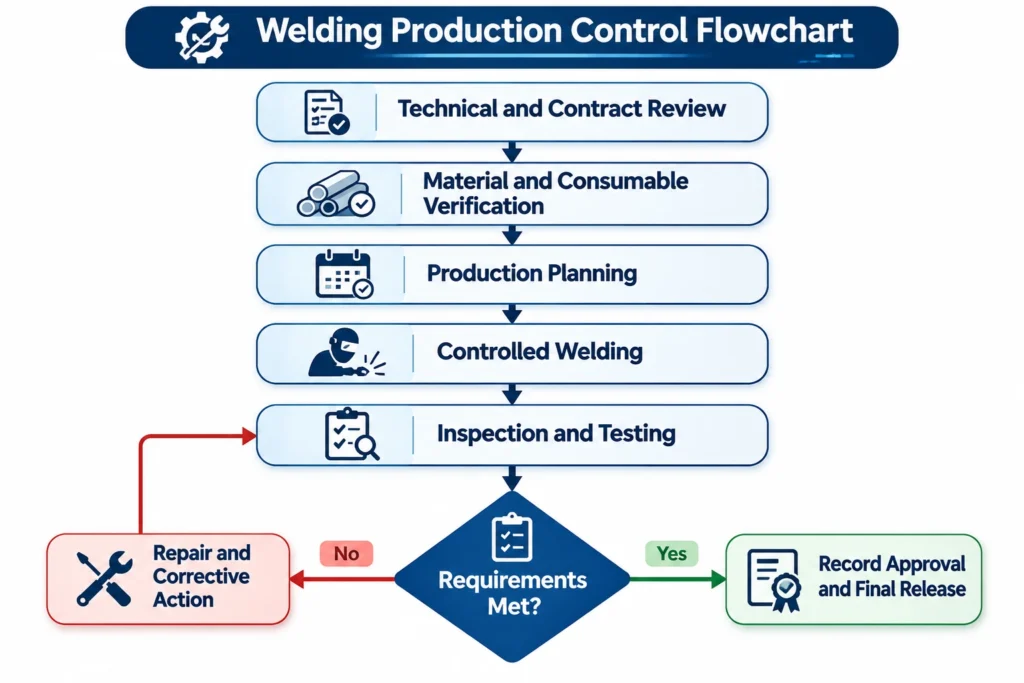
A Practical Welding Production Control Workflow
Implementing a structured workflow is essential for guaranteeing that both production modifications and quality concerns are resolved prior to the release of products.
Key Takeaway
Adherence to EN ISO 3834 mandates a rigorous, ongoing governance of welding operations, extending far beyond the mere possession of sanctioned procedures and certified personnel. By integrating robust production planning, diligent consumable management, systematic repair oversight, comprehensive traceability, and proactive corrective measures, manufacturers can significantly mitigate defect rates and substantiate the reliability of their welding quality.
Does your welding production infrastructure fully conform to the stipulations of EN ISO 3834?