
Related Blogs
Nov
9
ISO 3834 Welding Quality Control: Managing Production Errors, Repairs and Audit Findings
Nov
02
ISO 3834 Consumables Control: Requirements for Welding Consumable Storage, Handling and Traceability
Oct
27
EN ISO 3834 Material Substitution: Risks, Approval and Traceability
Oct
23
Welder and Welding Operator Roles in EN ISO 3834 Certification for Manufacturing Companies in Chennai – What Are the Requirements?
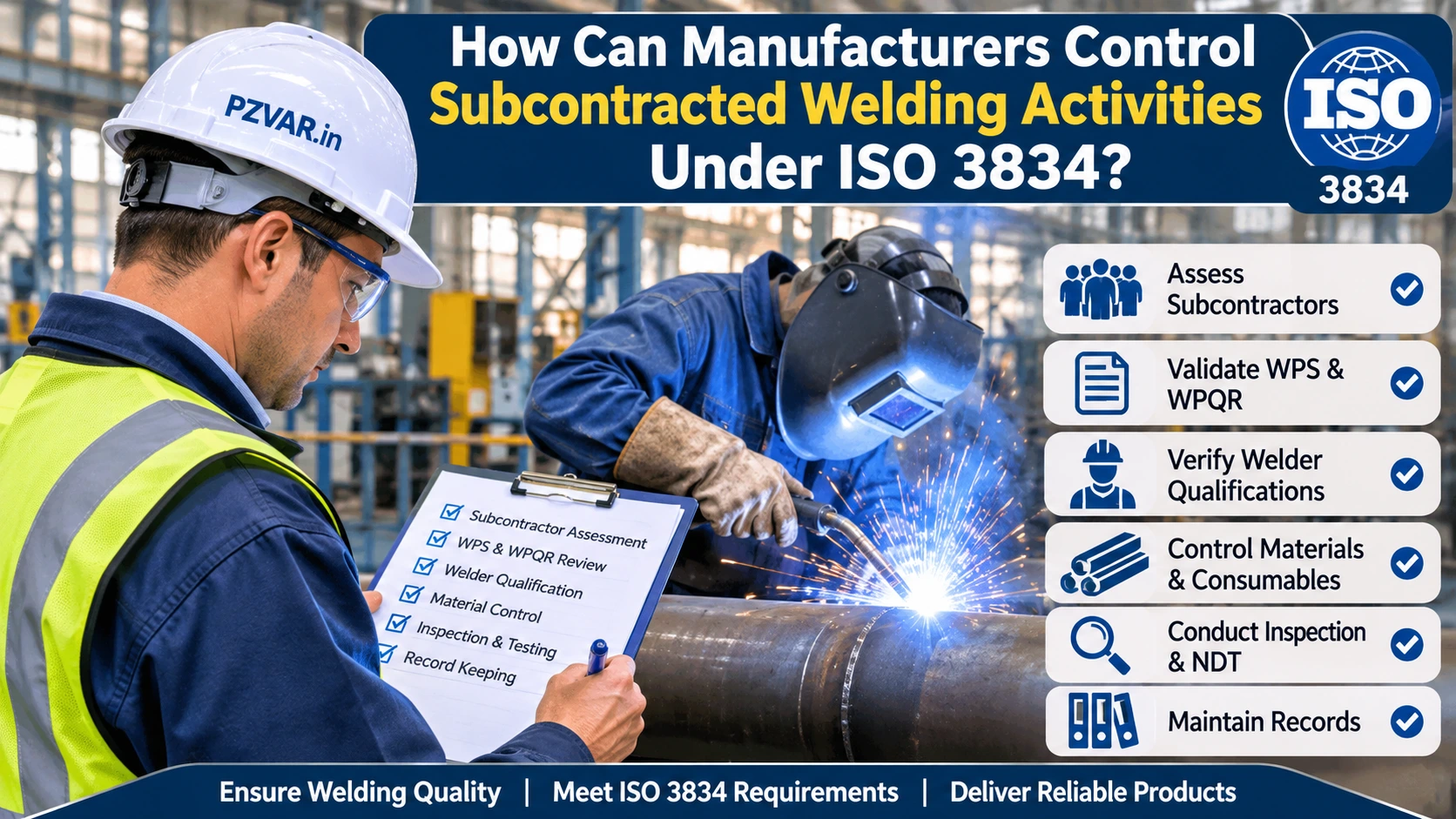
Subcontracted Welding Activities
ISO 3834 Certification
10 Nov 2026
How Can Manufacturers Control Subcontracted Welding Activities Under ISO 3834?
By Editorial Team
Table Of Contents
In modern manufacturing industries, certain processes are often subcontracted to third-party service providers. These may include welding of structural components, pressure equipment, railway components, pipe welding and other specialist welding applications.
While subcontracting offers the advantage of increased production flexibility, it also creates challenges in maintaining consistent welding quality. Proper planning, assessment and controls need to be implemented to ensure that the required standards are met.
ISO 3834 provides quality requirements for fusion welding of metallic materials. It helps manufacturers establish appropriate controls to ensure that welding activities are properly managed.
Manufacturers should ensure that welding processes undertaken by subcontractors are performed under suitable technical and quality controls. Even when welding is subcontracted, the manufacturer remains responsible for meeting applicable contractual, technical and regulatory requirements. With effective subcontractor controls in place, manufacturers can maintain consistent welding quality, improve production efficiency and ensure that subcontracted welds meet the required specifications.
Selection and Evaluation of Welding Subcontractors
Choosing the right welding subcontractor is an important factor when implementing effective controls.
Manufacturers should assess subcontractors to ensure they have the necessary technical skills, welding experience and resources to meet project requirements.
Things to consider before allocating welding activities include:
- Experience in similar welding projects.
- Availability of qualified welders.
- Suitable welding equipment and facilities.
- Availability of qualified welding procedures.
- Ability to carry out required inspections and testing.
- Knowledge of applicable welding standards and specifications.
- Ability to maintain welding records.
For example, if a manufacturer subcontracts structural steel welding, it should ensure that the subcontractor has qualified welders, suitable welding procedures and appropriate inspection arrangements.
The assessment should also consider the type of product, material, welding process and required quality level.
Manufacturers should establish clear acceptance criteria for subcontractor approval. Their performance should be reviewed regularly to identify recurring issues related to quality, delivery times and record keeping.
Proper subcontractor assessment helps reduce welding defects and improves the reliability of outsourced work.
Verification of Welding Procedures and Qualified Personnel
Having appropriate welding procedures and qualified welders is one of the most important factors in controlling subcontracted welding activities.
Before starting any welding work, manufacturers should clearly identify the welding procedures and welder qualifications required for the project.
Important considerations include:
Welding Procedure Specification (WPS): Ensure that the WPS contains the necessary details for performing the welding operation, including welding process, base material, filler material, joint preparation, welding position and applicable welding parameters.
Welding Procedure Qualification Record (WPQR): Where required, ensure that the welding procedure is supported by appropriate qualification evidence, such as a WPQR, demonstrating that the procedure meets applicable requirements.
Welder Qualifications: Verify that subcontracted welders have appropriate qualifications for the welding process, material, product type and welding position.
Welding Coordination: Ensure that suitable welding coordination arrangements are established to maintain technical control over welding activities.
For example, if a subcontractor carries out stainless steel pipe welding, the manufacturer should verify that the welding procedure and welder qualifications cover the relevant material group, welding process and joint requirements.
Using an incorrect welding procedure or an unqualified welder can result in welding defects, rework and product rejection.
Therefore, all relevant qualifications should be reviewed before subcontracted welding activities begin.
Control of Welding Materials, Consumables and Production Activitie
Materials and welding consumables should be properly controlled to achieve the required quality.
Before welding begins, manufacturers should provide subcontractors with the necessary information about materials, welding requirements and project specifications.
Important control measures include:
- Verification of base materials, grades and specifications.
- Material identification and traceability.
- Control of welding consumables.
- Proper storage and handling of electrodes and filler materials.
- Control of preheating and interpass temperatures, where required.
- Monitoring of applicable welding parameters.
- Compliance with approved drawings and WPS requirements.
- Prevention of material mixing and incorrect consumable usage.
For example, pressure equipment fabrication can be affected if incorrect filler materials or unsuitable welding parameters are used.
For railway welded components, manufacturers should ensure that subcontractors meet project specifications and applicable EN 15085 requirements, where relevant.
Manufacturers should also establish suitable arrangements to monitor subcontracted production activities. These may include reviewing welding records, checking material identification, conducting inspections and verifying compliance with approved technical documents.
Effective communication with subcontractors helps avoid confusion and ensures that the required welding controls are consistently implemented
Inspection, Testing and Documentation of Subcontracted Welding
Verify subcontracted welding activities meet specifications through inspection and testing. Determine and implement appropriate inspection protocols that align with the specific product characteristics, stipulated contractual requirements, and applicable industry standards.
Inspection activities may include:
- Visual Testing (VT)
- Non-Destructive Testing (NDT) like ultrasonic and radiographic testing
- Dimensional inspection
- Verification of welding parameters
- Material and consumable traceability
- Final inspection of welded assemblies
In the context of structural steel welding, particular inspections may be mandated. Scrutinize the outcomes of the inspection and implement corrective measures to address any non-conforming items.
Maintain important records such as:
- Subcontractor assessments
- WPS and WPQR documents
- Welder qualifications
- Material certificates
- Inspection reports
- Non-conformity records
- Final acceptance records
Ensure documentation is available for customer reviews and audits.
Conclusion
Implementing effective controls for subcontracted welding activities is important for maintaining consistent welding quality.
Although subcontracting offers several production benefits, manufacturers must ensure that outsourced welding work meets the applicable technical, contractual and quality requirements.
By assessing subcontractors, verifying welding procedures and welder qualifications, controlling materials and consumables, and implementing suitable inspections and record-keeping practices, manufacturers can reduce welding-related risks and improve production reliability.
ISO 3834 provides quality requirements that help manufacturers establish appropriate controls over welding activities, including relevant subcontracted operations.
Manufacturers involved in structural steel fabrication, railway component manufacturing, pressure equipment and other industrial welding applications can benefit from effective subcontractor controls to achieve consistent welding quality.
Frequently Asked Questions
What are subcontracted welding activities?
Subcontracted welding activities are welding operations assigned to an external organisation or service provider. These may include component fabrication, pipe welding, structural welding and specialist welding operations.
Why is it important to assess welding subcontractors?
Subcontractor assessment helps manufacturers verify that external providers have the necessary technical skills, qualified welders, suitable equipment and quality controls to perform the assigned welding work.
Should subcontracted welders have valid qualifications?
Yes. Welders should have appropriate qualifications for the welding process, material, position and application, according to applicable requirements.
Who is responsible for the quality of subcontracted welding?
The manufacturer remains responsible for ensuring that the finished product meets applicable contractual, technical and regulatory requirements, even when welding operations are subcontracted.