
ISO 3834
ERRORS
AUDITS
09 Nov 2026
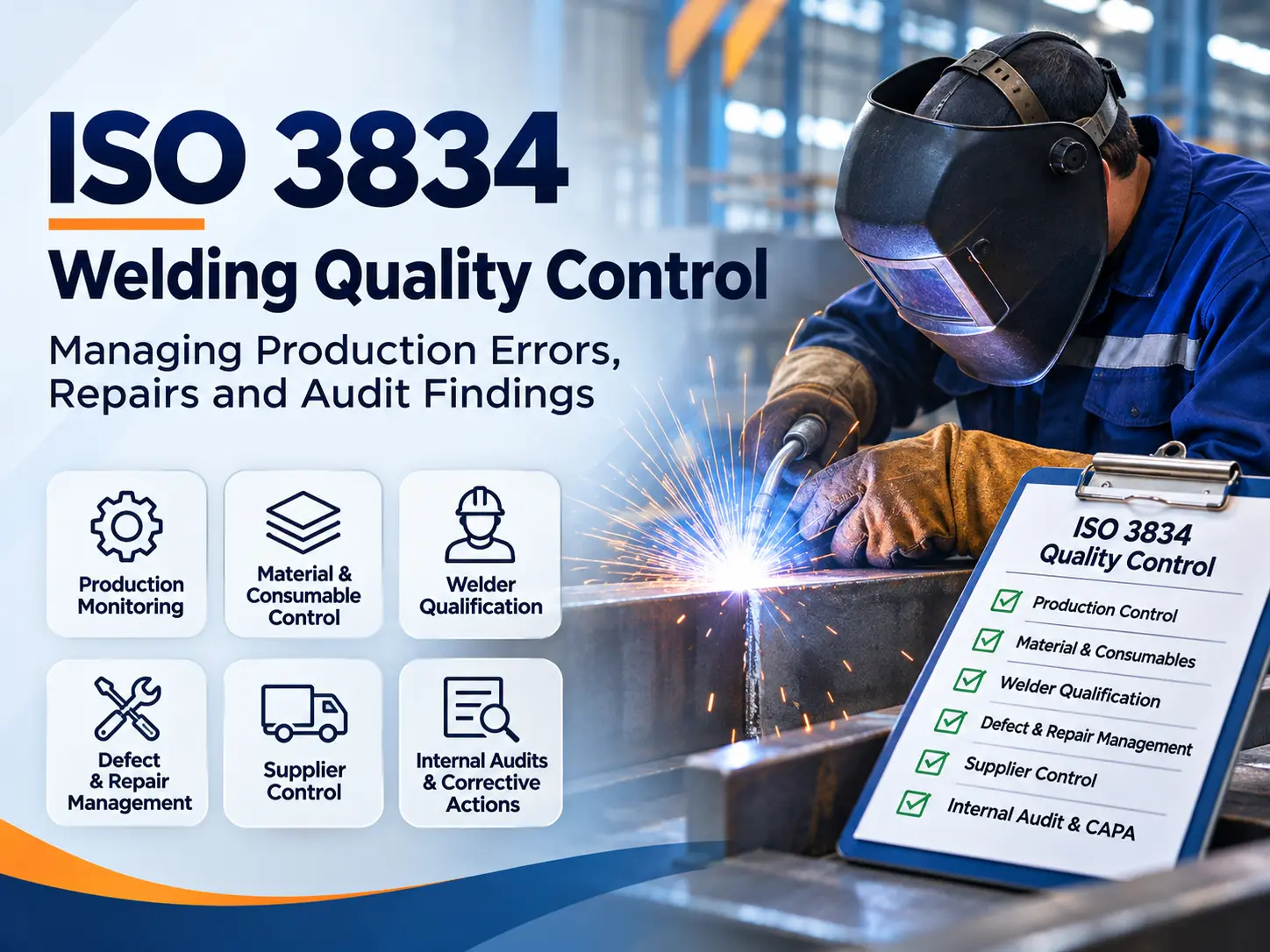
ISO 3834 Welding Quality Control: Managing Production Errors, Repairs and Audit Findings
By Editorial Team
Related Blogs
SEP
19
Can One WPQR Cover Multiple WPS? Understanding WPQR-to-WPS Qualification Scope
SEP
15
Which Industries and Manufacturers Need ISO 3834 Certification in India and International Markets? Top 10 Sectors That Need It
SEP
12
Best Standard for Fusion Welding Quality Control: Why ISO 3834 Is Required for EN 1090 & EN 15085
SEP
08
ISO 3834 Latest Edition 2026: 2021 Revision, Current Status & What Welding Manufacturers Need to Know
AUG
24
ISO 3834 Certification Cost in India: Factors, Fees & Budget Guide
JLY
30
EN ISO 3834 Certification Requirements: What Welding Manufacturers Need to Know in 2026
Achieving consistent welding quality demands a robust framework comprising certified personnel, validated procedures, and rigorous oversight of production, defect detection, remediation, and documentation. Under the EN ISO 3834 standard, quality management permeates the entire manufacturing lifecycle, extending from initial planning through to final inspection. Inadequate monitoring precipitates a cascade of failures, including material defects, obscured identification, incomplete record-keeping, and protracted certification timelines. This article delineates strategic measures designed to fortify adherence to ISO 3834 requirements.
What Is ISO 3834 Welding Quality Control?
Adherence to ISO 3834 Welding Quality Control is achieved by monitoring a comprehensive array of activities designed to satisfy technical specifications and quality mandates. These measures encompass rigorous oversight of welding procedures and personnel, precise material identification, thorough production inspections, systematic defect management, and well-defined repair protocols. Furthermore, the framework mandates robust traceability, meticulous documentation, and regular internal audits. The specific extent of these control measures is contingent upon the designated ISO 3834 quality level and the stipulations outlined in contractual agreements.
6 Essential Areas of ISO 3834 Welding Quality Control
1 Monitor Welding Production and Technical Requirements
Successful production monitoring necessitates a comprehensive technical audit and adherence to ISO 3834 Quality Planning protocols. Before commencing manufacturing, entities must verify the accessibility of engineering drawings, detailed specifications, Welding Procedure Specification (WPS) documents, requisite qualifications, and mandated inspection criteria. ISO 3834 Welding Coordination guarantees the presence of sufficient oversight, while operational teams are tasked with continuously scrutinizing output for errors and deviations from established standards.
2. Control Materials, Consumables and Production Changes
Manufacturers are mandated to employ materials and welding consumables that adhere strictly to ISO 3834 standards, thereby guaranteeing effective safeguards against contamination and material loss. The implementation of rigorous protocols governing the selection and storage of these components is indispensable. Any modifications to production processes must undergo a comprehensive technical review and secure formal approval. Furthermore, the preservation of weld traceability serves to establish a definitive linkage between material identification, welding operations, and inspection documentation, all in compliance with ISO 3834 requirements.
3. Maintain Welder Qualification and Continuity
The caliber of welding operations is intrinsically dependent upon the competence of the personnel involved. ISO 3834 stipulates the requirement for demonstrable, ongoing welder qualifications, mandating the maintenance of comprehensive records that encompass certification documents, defined process ranges, continuity of performance, individual welder identification, and details regarding expiration and renewal. This rigorous documentation is essential to ensure that unqualified individuals are strictly prevented from executing welding tasks beyond the scope of their approved credentials.
4 Manage Welding Defects and Repair Activities
Prior to product acceptance, welding imperfections—including porosity, cracking, lack of fusion, undercutting, and slag inclusions—must be meticulously identified, assessed, and regulated. The acceptance criteria delineated in ISO 3834 must be harmonized with applicable product standards and inspection specifications. Upon the detection of such defects, manufacturers are required to adhere to the ISO 3834 guidelines for weld repairs, encompassing a comprehensive cycle of defect identification, evaluation, the implementation of approved remediation techniques, execution, rigorous inspection, and thorough documentation. Furthermore, distortion control must be integrated into the production planning phase.
5 Manage Subcontractors and Supplier Performance
The delegation of welding and inspection processes to external manufacturers creates an imperative for implementing ISO 3834 controls to ensure both technical adherence and quality compliance. To validate the capabilities of these subcontractors, rigorous supplier audits must be conducted; furthermore, maintaining effective oversight relies fundamentally on the systematic review of performance metrics, defect analysis, and quality documentation.
6 Conduct Internal Audits and Implement Corrective Actions
Routine ISO 3834 internal audits evaluate the efficacy of welding quality protocols by scrutinizing operational execution alongside, yet distinct from, mere documentation. Recurring audit observations frequently encompass absent or obsolete welding procedures, deficient welder logs, erroneous material identification, unregulated repairs, absent inspection reports, and insufficient record-keeping. Manufacturers are compelled to investigate such discrepancies, enact corrective measures, verify process integrity, and resolve customer grievances through a systematic framework, thereby guaranteeing the consistent attainment of intended outcomes.
ISO 3834 Production Quality Control Checklist
| Control Area | What Manufacturers Should Verify |
|---|---|
| Production Planning | Approved drawings, WPS and inspection requirements |
| Consumables | Correct identification, storage and handling |
| Material Control | Material certificates and identification |
| Welder Continuity | Qualification and continuity evidence |
| Welding Defects | Inspection and evaluation against applicable criteria |
| Repair Welding | Approved repair methods and reinspection |
| Distortion Control | Suitable welding sequences and dimensional checks |
| Subcontracting | Supplier approval and monitoring |
| Welding Records | Complete production and inspection documentation |
| Internal Audits | Identified findings and corrective actions |
| Traceability | Links between materials, welds and production records |
ISO 3834 Welding Quality Control Workflow
This operational framework delineates the mechanisms by which manufacturers oversee production integrity and address welding nonconformities.
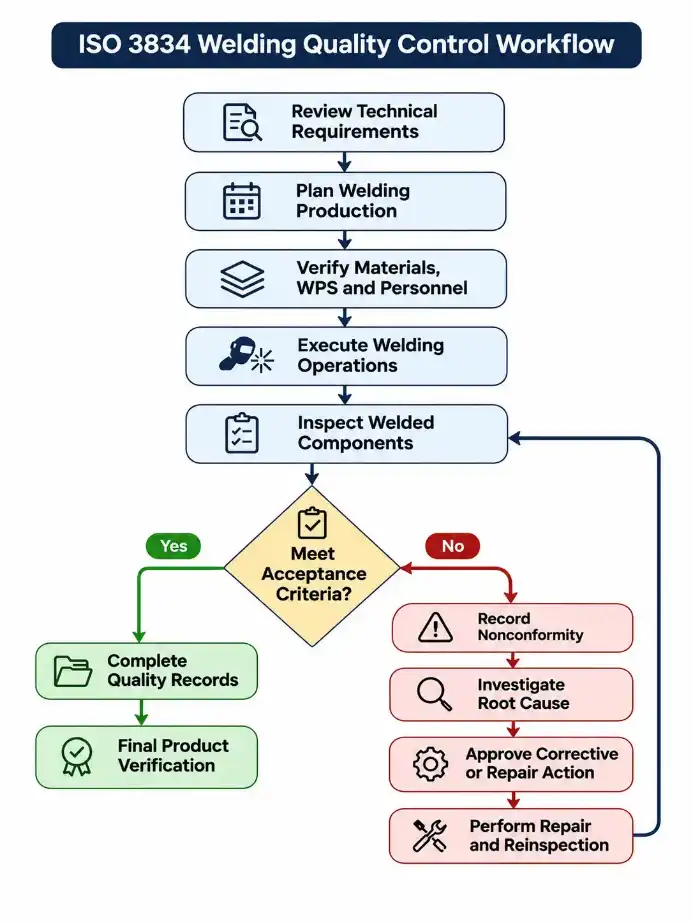
A fundamental principle dictates that each nonconformity must undergo rigorous evaluation and thorough documentation. When defects recur, a comprehensive investigation is imperative to ascertain whether enhancements are necessary regarding production methodologies, personnel proficiency, material quality, or process control mechanisms.
Common ISO 3834 Welding Quality Control Mistakes
Manufacturers should avoid these common weaknesses:
- The utilization of obsolete WPS documentation within the production environment.
- The lapse in sustaining welder qualification continuity.
- Permitting the unchecked substitution of materials.
- The improper preservation of welding consumables.
- Carrying out repairs in the absence of formal technical authorization.
- Missing material and weld traceability records.
- The reduction of internal audits to mere documentation exercises.
- Concluding audit observations without substantiating the efficacy of the implemented corrective actions.
Mitigating these challenges fosters greater production consistency while curbing unnecessary rework.
Frequently Asked Questions
Why is welding quality control important under ISO 3834?
It enables manufacturers to exert precise oversight over welding methodologies, workforce deployment, material sourcing, production operations, as well as inspection protocols and documentation integrity.
How should manufacturers manage welding defects?
All defects must be systematically identified, meticulously documented, and rigorously assessed in accordance with the relevant acceptance criteria. Welds deemed unacceptable shall undergo either an approved repair or another authorized disposition, contingent upon subsequent mandatory inspection.
What is the role of welding coordination?
Welding coordination guarantees that all pertinent welding operations are both technically overseen and supervised by personnel possessing the requisite competency.
Why are internal audits important?
Internal audits serve as a critical mechanism for pinpointing deficiencies within production controls, documentation integrity, personnel qualifications, and the management of welding quality.
What records should manufacturers maintain?
Relevant documentation encompasses a comprehensive array of records, including the WPS, WPQR, welder qualifications, material certificates, consumable records, inspection reports, repair documentation, and traceability records.
Conclusion
Achieving rigorous welding quality control demands the sustained oversight of production operations, the engagement of qualified personnel, the utilization of appropriate materials, the implementation of regulated repair protocols, and the maintenance of dependable documentation.
Through the fortification of production monitoring protocols, the rigorous management of welding defects, and the deployment of efficacious corrective measures, manufacturers can substantially elevate product quality while simultaneously evidencing superior command over their welding operations.
For manufacturers aiming to either institute or enhance their welding quality management systems, a comprehensive grasp of the relevant EN ISO 3834 stipulations constitutes a fundamental prerequisite.