
WPS & WPQR
CERTIFICATION
FAQ
6 Aug 2026
WPS vs WPQR: Understanding the Key Differences Every Manufacturer Should Know (2026 Guide)
By Editorial Team
Table Of Contents
- What is a Welding Procedure Specification (WPS)?
- What is a Welding Procedure Qualification Record (WPQR)?
- WPS VS WPQR: Key Differences
- How WPS and WPQR Work Together
- Why WPS & WPQR Are Important
- Common Mistakes Manufacturers Make
- Frequently Asked Questions (FAQs)
- Conclusion
- Need Expert Assistance with WPS & WPQR?
Related Blogs
AUG
11
How Long Is WPQR Valid? WPQR Validity Explained
AUG
10
How to Prepare a WPQR: Step-by-Step Welding Procedure Qualification Guide
AUG
04
WPS & WPQR Explained: The Complete Manufacturer's Guide to Welding Procedure Qualification, Requirements, Standards and Industrial Applications (2026)
See Also.....
Certification Alerts
- EN ISO 3834-4 transition deadline: 31 Dec 2024
- NABCB accreditation renewal — Updated requirements
In industries where welding plays a critical role, quality cannot be left to chance. Whether you’re manufacturing structural steel, pressure vessels, railway components, or heavy engineering equipment, every weld must be consistent, reliable, and compliant with applicable standards.
This is where Welding Procedure Specification (WPS) and Welding Procedure Qualification Record (WPQR) become essential.
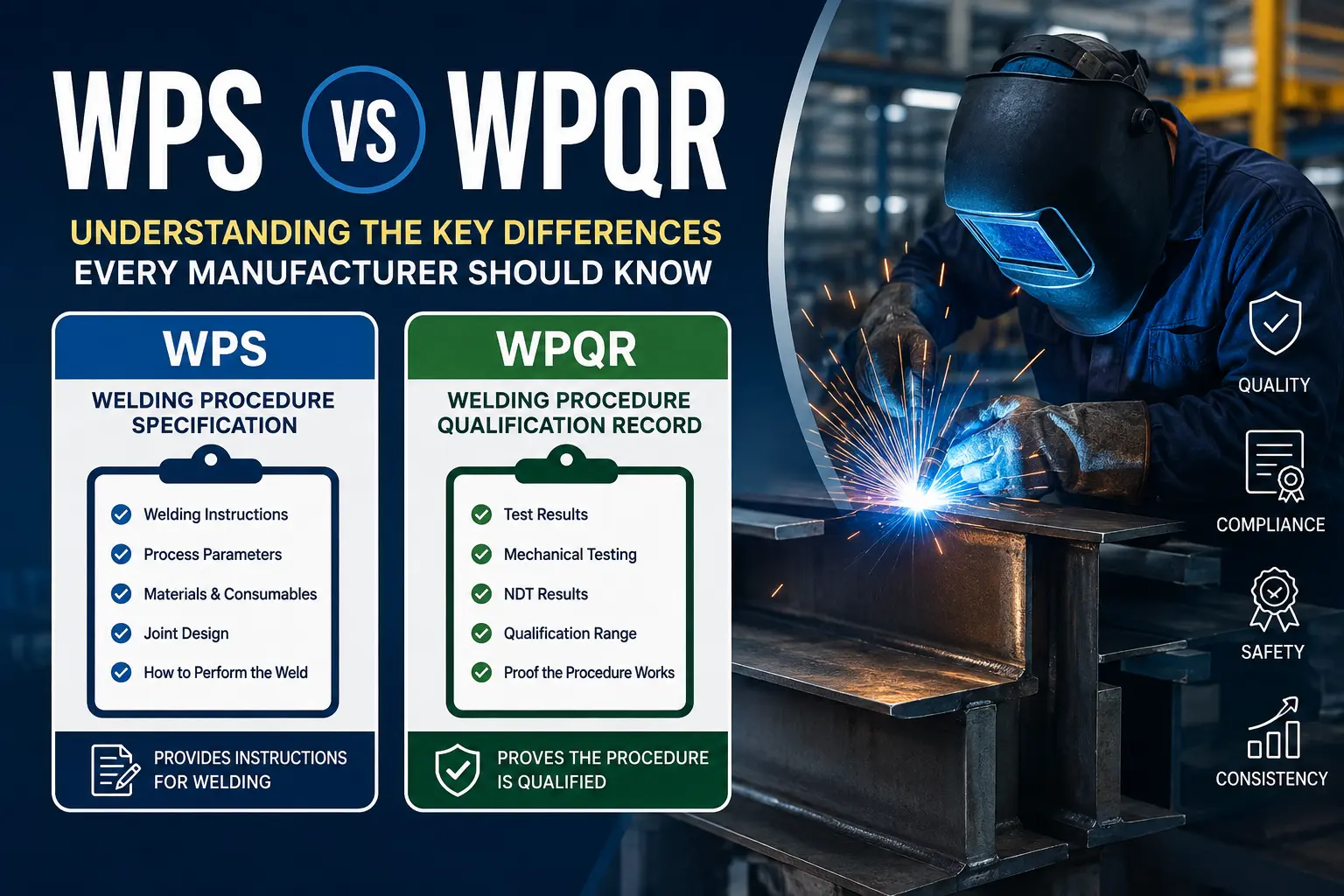
Although these two documents are closely related, they serve very different purposes. A WPS provides detailed instructions for performing a weld, while a WPQR proves that the procedure has been tested and meets the required quality standards.
Many manufacturers mistakenly use these terms interchangeably, which can lead to audit findings, certification delays, and quality issues. Understanding the difference between WPS and WPQR is crucial for compliance with standards such as EN 1090, ISO 3834, EN 15085, and PED 2014/68/EU.
This guide explains the purpose of each document, how they work together, and why they are indispensable in modern welding operations.
What is a Welding Procedure Specification (WPS)?
A Welding Procedure Specification (WPS) is a controlled document that provides detailed instructions on how a specific welding operation should be performed. Its purpose is to ensure that every welder follows the same approved procedure, producing consistent and repeatable weld quality.
A WPS typically includes:
- Welding process (MIG, TIG, SMAW, FCAW, SAW)
- Base material and thickness
- Filler metal specification
- Welding position
- Joint design
- Preheat and interpass temperature
- Current, voltage, and travel speed
- Shielding gas requirements
- Post-weld heat treatment (if applicable)
Think of the WPS as a technical instruction manual for welding. It standardizes the welding process and minimizes variations that could affect product quality.
What is a Welding Procedure Qualification Record (WPQR)?
A Welding Procedure Qualification Record (WPQR) is the document that validates a welding procedure through testing.
Before a WPS can be approved for production, a test weld is made according to the proposed procedure. This test specimen is then inspected and subjected to mechanical testing. If it meets the acceptance criteria defined by the applicable standard, the results are documented in the WPQR.
A WPQR generally contains:
- Welding parameters used during testing
- Base and filler material details
- Test coupon dimensions
- Welding position
- Visual inspection results
- Bend test results
- Tensile test results
- Impact test results (where required)
- Macro examination
- NDT results
- Qualification range
Unlike a WPS, which provides instructions, a WPQR records actual qualification data and serves as evidence that the procedure is capable of producing acceptable welds.
WPS VS WPQR: Key Differences
In simple terms:
WPS = How to weld
WPQR = Proof that the welding procedure works
Both documents are essential and should always complement each other.
How WPS and WPQR Work Together
The relationship between WPS and WPQR follows a logical sequence:
The process begins with a preliminary WPS (pWPS), which outlines the proposed welding parameters. A test weld is then produced following this procedure. The weld undergoes inspections and mechanical testing to verify its quality.
If the procedure meets all acceptance criteria, a WPQR is issued. The WPS is then approved for production use, ensuring that every welder follows a proven and qualified procedure.
The regulation aims to improve product sustainability by setting performance and information requirements throughout the product lifecycle. Manufacturers are increasingly expected to consider environmental performance during product development rather than treating sustainability as a post-production activity.
Why WPS & WPQR Are Important
Qualified welding procedures offer benefits beyond regulatory compliance.
Consistent Weld Quality
A standardized procedure ensures that every welder follows the same method, reducing variability and improving product consistency.
Regulatory Compliance
International standards such as EN 1090 and ISO 3834 require documented welding procedures and qualification records.
Improved Safety
Properly qualified welding procedures reduce the risk of weld failures, helping ensure the safety and reliability of structures and equipment.
Reduced Rework and Costs
Consistent welding practices minimize defects, repairs, and production delays, resulting in lower overall manufacturing costs.
Customer Confidence
Demonstrating that welding procedures are qualified reassures customers and certification bodies that products meet recognized international standards.
Standards That Require WPS & WPQR
Several international standards require manufacturers to prepare and qualify welding procedures.
Although each standard has specific requirements, they all emphasize the importance of qualified welding procedures and proper documentation.
Common Mistakes Manufacturers Make
Even experienced manufacturers encounter issues related to WPS and WPQR. Some of the most common mistakes include:
- Using a WPS Without a Supporting WPQR
A WPS should be backed by a valid qualification record where required by the applicable standard.
- Applying Procedures Beyond Their Qualified Range
Using a qualified procedure for materials, thicknesses, or welding positions outside its approved range can invalidate the qualification.
- Poor Document Control
Outdated revisions, missing signatures, or incomplete records frequently result in audit findings.
- Ignoring Essential Variables
Changes to essential variables—such as welding process, parent material, or filler metal—may require a new qualification.
- Inadequate Welder Training
Even a qualified WPS cannot ensure quality if welders are not trained to follow the specified procedure consistently.
Maintaining accurate documentation and regularly reviewing procedures can help manufacturers avoid these common issues.
Frequently Asked Questions (FAQs)
Is a WPS mandatory?
For many regulated industries and certification schemes, yes. Standards such as EN 1090 and ISO 3834 require documented welding procedures.
Can a WPS exist without a WPQR?
A WPS can be drafted initially as a preliminary procedure. However, production welding often requires the procedure to be supported by a valid WPQR, depending on the applicable standard.
Who prepares a WPS?
A competent welding engineer, welding coordinator, or qualified technical professional typically prepares the document.
How long is a WPQR valid?
Its validity depends on the applicable standard and whether essential variables remain unchanged.
Can one WPQR support multiple WPS documents?
Yes. In many cases, one qualified procedure can support multiple WPS documents, provided they remain within the qualification range permitted by the governing standard.
Conclusion
Although WPS and WPQR are closely connected, they perform distinct functions within a welding quality management system.
A Welding Procedure Specification (WPS) provides the instructions needed to perform a weld correctly, while a Welding Procedure Qualification Record (WPQR) confirms through testing that the procedure is capable of producing reliable results.
Together, they help manufacturers improve consistency, meet international standards, and reduce quality risks. Whether your organization is working toward EN 1090, ISO 3834, EN 15085, or PED compliance, maintaining properly qualified welding procedures is an essential step toward achieving successful certification and delivering high-quality welded products.
Need Expert Assistance with WPS & WPQR?
PZVAR helps manufacturers develop and qualify welding procedures that meet international standards. Our services include:
- WPS preparation and review
- WPQR qualification support
- EN 1090 certification