
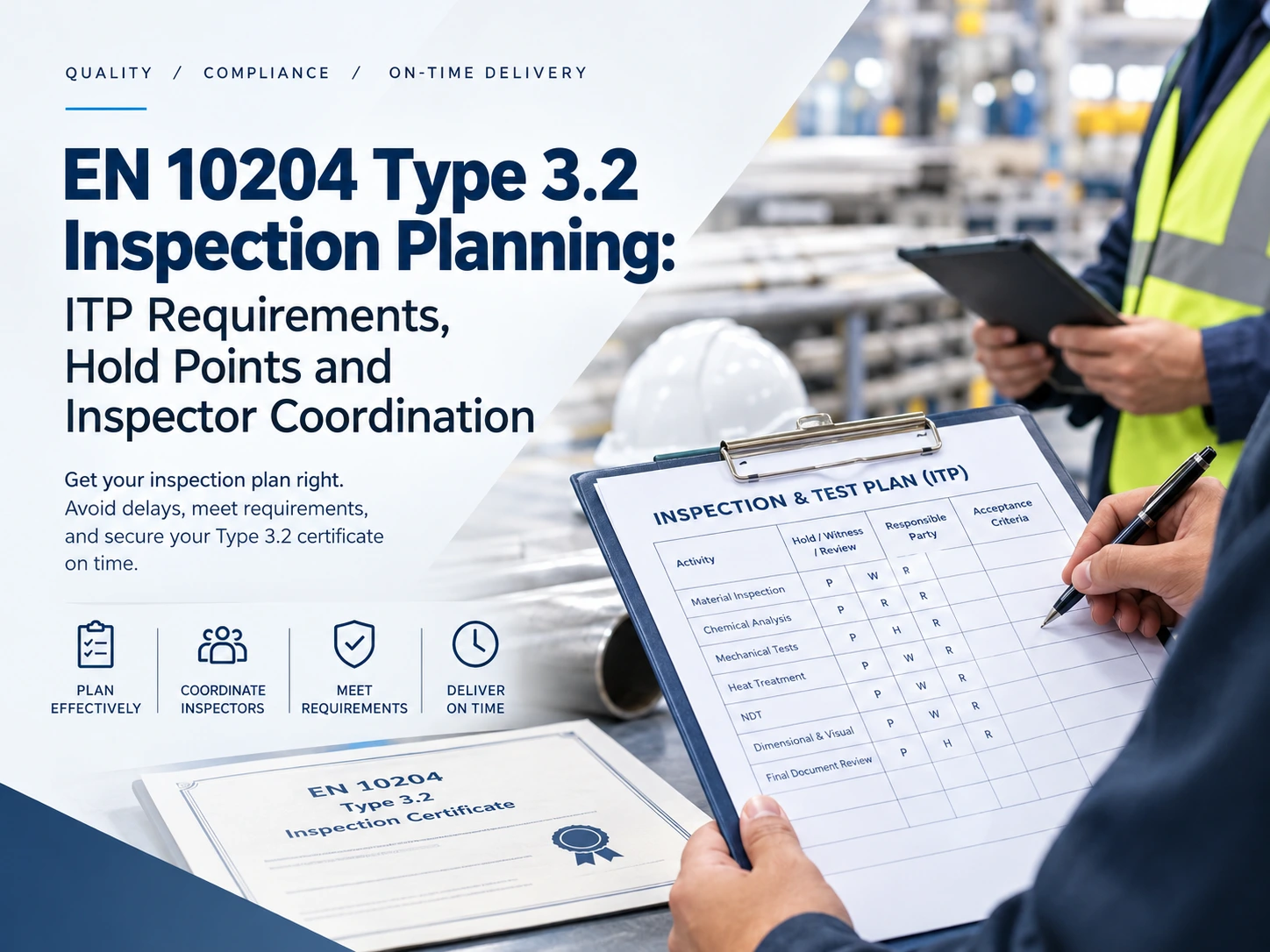
EN 10204
TYPE 3.2
ITP
21 Oct 2026
EN 10204 Type 3.2 Inspection Planning: ITP Requirements, Hold Points and Inspector Coordination
By Editorial Team
Table Of Contents
- What is an EN 10204 Type 3.2 certificate?
- 3.1 vs 3.2 at a glance
- Why inspection planning decides your delivery date
- ITP requirements: what a 3.2 Inspection and Test Plan must contain
- Minimum ITP content
- Sample ITP extract
- Hold point vs witness point vs review points
- Inspector coordination: a step-by-step workflow
- Notification timeline
- Common mistakes that delay 3.2 certificates
- Best practices for faster, cleaner third-party inspection
- Quick checklist
- FAQ
Related Blogs
OCT
07
What Should Buyers Verify in an EN 10204 Type 3.2 Certificate for Steel Plates, Pipes and Structural Steel in India?
SEP
29
EN 10204 Type 3.2 RFQ Checklist for Indian & Global Buyers: What Should You Ask Manufacturers? Top 10 Questions Before Placing an Order
SEP
23
What Does an EN 10204 Type 3.2 Certificate Contain? Requirements, Third-Party Inspection and International Recognition in India
AUG
20
Steel Traceability for EU Exports: EN 10204, Heat Numbers & Digital Product Passport
AUG
11
EN 10204 Type 3.2 Inspection Certificate: Complete Guide for Manufacturers and Buyers
A 3.2 certificate is not usually lost because the steel was bad. It is lost when the inspector isn’t told, the hold point is missed, or no one agrees who checks what. This guide explains how to plan the EN 10204 Type 3.2 inspection so the certificate comes out on time, the first time.
What is an EN 10204 Type 3.2 certificate?
EN 10204:2004 explains the different types of inspection documents used for metal products. A Type 3.2 certificate is a particular kind of inspection document where the test results are checked by two separate parties:
- The manufacturer’s approved inspector, who is not part of the production team, and
- Either the buyer’s approved representative or an inspector chosen by official rules, like those for pressure equipment.
In simple words, it’s the strongest form of independent checking within the 3.x group.
The tests are carried out on the actual goods being sent, following the order and the required product standards.
3.1 vs 3.2 at a glance
| Feature | EN 10204 Type 3.1 | EN 10204 Type 3.2 |
|---|---|---|
| Tests on the delivered product | Yes | Yes |
| Validated by | Manufacturer's independent inspection rep | Manufacturer's independent inspection rep and purchaser's rep or regulatory inspector |
| Third-party involvement | Not required | Required |
| Typical use | General industrial, structural | Pressure equipment, oil and gas, nuclear, critical piping and valves |
| Lead time impact | Low | Higher, depends on inspector availability |
Why inspection planning decides your delivery date
Type 3.2 brings in a third party to the production timeline. Every test that requires a witness depends on someone else’s schedule. Without a clear plan, you end up with idle furnaces, rushed tests, and certificates that come in weeks after the material is ready.
A solid plan answers four key questions before production begins:
1.What parts will be inspected or tested?
2.Who is responsible for inspecting, witnessing, or reviewing each step?
3.When should the inspector be informed?
4.What should happen if the inspector can’t make it on time?
ITP requirements: what a 3.2 Inspection and Test Plan must contain
The Inspection and Test Plan (ITP) is essential for the process. It needs to be approved by the buyer, and also by the independent inspector if they are different, before production begins.
Minimum ITP content
| ITP element | What to include |
|---|---|
| Activity | Each inspection or test step, in production order |
| Reference standard / spec | Product standard, purchase order clause, code (e.g. EN, ASTM, ASME, PED requirements) |
| Acceptance criteria | Measurable limits, not "as per standard" alone |
| Inspection type | Hold (H), Witness (W), Review (R) or Surveillance (S) |
| Responsible party | Manufacturer, purchaser, third-party inspector |
| Records | Report, certificate or form to be produced |
| Notice period | Days of advance notification required |
Sample ITP extract
| No. | Activity | Reference | Manufacturer | Purchaser / TPI | Record |
|---|---|---|---|---|---|
| 3 | Mechanical tests (tensile, impact) | Product standard | P | H | Mechanical test report |
| 7 | Final document review and 3.2 certificate validation | EN 10204 | P | H | EN 10204 3.2 certificate |
| 2 | Chemical analysis | Product standard | P | R | Chemical test report |
| 1 | Raw material identification and heat number check | PO, material spec | P | W | Material traceability report |
| 4 | Heat treatment | Approved procedure | P | W | Heat treatment chart |
| 5 | NDT (UT / MT / PT as specified) | NDT procedure | P | W | NDT report |
| 6 | Dimensional and visual inspection | Drawing | P | W | Inspection report |
Key: P = performs, H = hold point, W = witness point, R = review of records
Hold point vs witness point vs review points
These terms are often confused with each other, and that’s where the delays begin. Make sure to clearly define them in the ITP and in the purchase order.
| Point type | Meaning | Can work continue without the inspector? | |
|---|---|---|---|
| Hold point (H) | Mandatory stop. Work cannot pass this step until the inspector releases it in writing | No | |
| Witness point (W) | Inspector is invited to attend | Yes, if proper notice was given and the inspector did not attend, unless the contract says otherwise | |
| Review point (R) | Inspector reviews documents or records | Yes | but certificate release depends on the review |
| Surveillance (S) | Random or periodic check of the process | Yes |
A general rule is to use hold points only for the steps that really matter for compliance, like mechanical testing and final release. Using too many holds can slow down production and make everyone feel frustrated.
Inspector coordination: a step-by-step workflow
- Check the purchase order to make sure 3.2 is included, and mention which inspection body or approval process will be used.
- Submit the draft ITP early and keep track of any changes made during revisions.
- Have a pre-inspection meeting to agree on the scope, hold points, witness points, test locations, required documents, and acceptance criteria.
- Let the inspector know in advance, as agreed, before each H or W point starts.
- The inspector must be present, sign the report, and approve the hold point.
- Review all final documents to check that heat numbers, test results, and material traceability match.
7. Both parties check and sign off on the 3.2 certificate
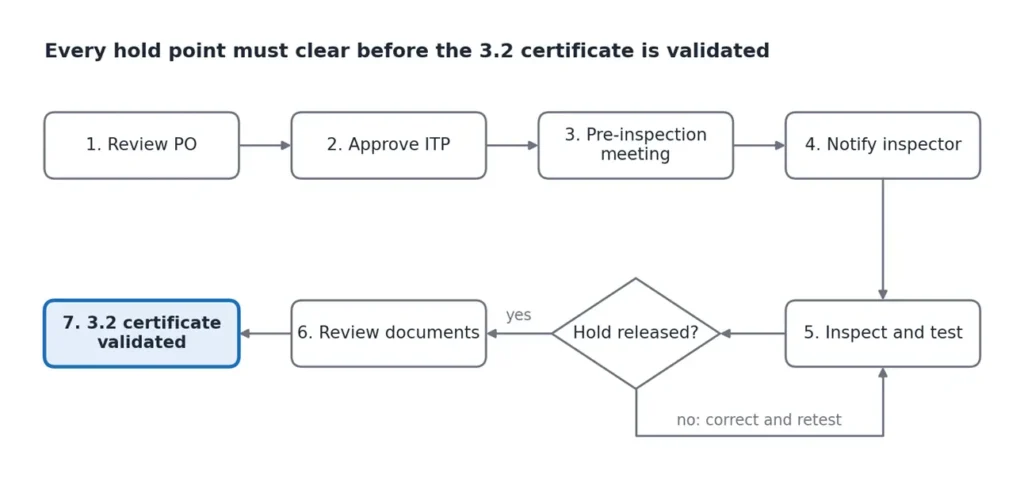
Figure 1. 3.2 inspection workflow: 7 steps, 1 decision. An unreleased hold point sends the work back for correction and retest.
Notification timeline
| Stage | Typical action | Typical timing* |
|---|---|---|
| Before production | ITP approved, PIM held | Before material is cut or melted |
| Before each hold or witness point | Written notification to inspector | As agreed in PO or ITP, commonly several working days |
| After tests | Reports sent for review | Same or next working day |
| Before shipment | Final dossier and 3.2 validation | Before release for dispatch |
*Timing is set by contract. Always follow your PO and inspection body requirements.
Common mistakes that delay 3.2 certificates
| Mistake | Consequence | How to avoid it |
|---|---|---|
| ITP approved after production starts | Rework or rejected tests | Make ITP approval a purchase order milestone |
| Unclear who the third party is | Certificate not accepted | Name the inspector or body in the PO |
| Late notification | Missed witness, repeated tests | Use a shared inspection calendar |
| Sub-supplier not covered | Material arrives without proper traceability | Flow down 3.2 requirements to sub-tier suppliers |
| Heat numbers do not match documents | Certificate invalid | Check traceability at the first ITP step |
| Too many hold points | Idle production | Reserve holds for critical steps |
Best practices for faster, cleaner third-party inspection
- Pick an inspection company that is officially recognized.
This means they follow strict rules and are trusted to do their job well.
- Share the same set of documents with everyone involved.
This includes purchase orders, designs, specifications, inspection checklists, and approved methods.
- Use a digital tool to track inspections.
This helps make sure no important updates or messages are missed.
- Allow extra time for retesting.
If a test doesn’t work the first time, or if extra heating is needed, give yourself some extra time to handle it.
- Have a quick meeting at the end.
Make sure everything is settled and clear before the final certificate is given out.
Quick checklist
3.2 requirements are clearly written in the purchase order
☐ A third-party inspector is named and available
☐ The ITP is approved before production starts
☐ The hold, witness, and review points are clearly defined
☐ The notice periods are agreed upon in writing
☐ Sub-suppliers are informed about the 3.2 requirements
☐ A pre-inspection meeting has been completed
☐ Traceability is checked at every stage
☐ All final documents are reviewed and the certificate is checked for validity
FAQ
Who can validate an EN 10204 3.2 certificate?
The manufacturer’s approved inspector, along with the buyer’s approved representative or an inspector chosen by official rules.
Is a 3.2 certificate better than 3.1?
It provides extra checks, but it’s not always needed. Use it when the code, agreement, or risk requires it.
What happens if the inspector misses a witness point?
It depends on the contract. If the proper notice was given and the ITP allows it, then work can continue. If the work is at a hold point, it has to wait for written approval to proceed.
When should the ITP be approved?
Before manufacturing starts, ideally as part of the purchase order process.