
ISO 3834-1 & 3834-2 & 3834-3 & 3834-4
LATEST UPDATE
14 Oct 2026
EN ISO 3834-2 vs 3834-3 vs 3834-4: How to Select the Right Welding Quality Level
By Editorial Team
Table Of Contents
Related Blogs
SEP
19
Can One WPQR Cover Multiple WPS? Understanding WPQR-to-WPS Qualification Scope
SEP
15
Which Industries and Manufacturers Need ISO 3834 Certification in India and International Markets? Top 10 Sectors That Need It
SEP
12
Best Standard for Fusion Welding Quality Control: Why ISO 3834 Is Required for EN 1090 & EN 15085
SEP
08
ISO 3834 Latest Edition 2026: 2021 Revision, Current Status & What Welding Manufacturers Need to Know
AUG
24
ISO 3834 Certification Cost in India: Factors, Fees & Budget Guide
JLY
30
EN ISO 3834 Certification Requirements: What Welding Manufacturers Need to Know in 2026
Quick Answer
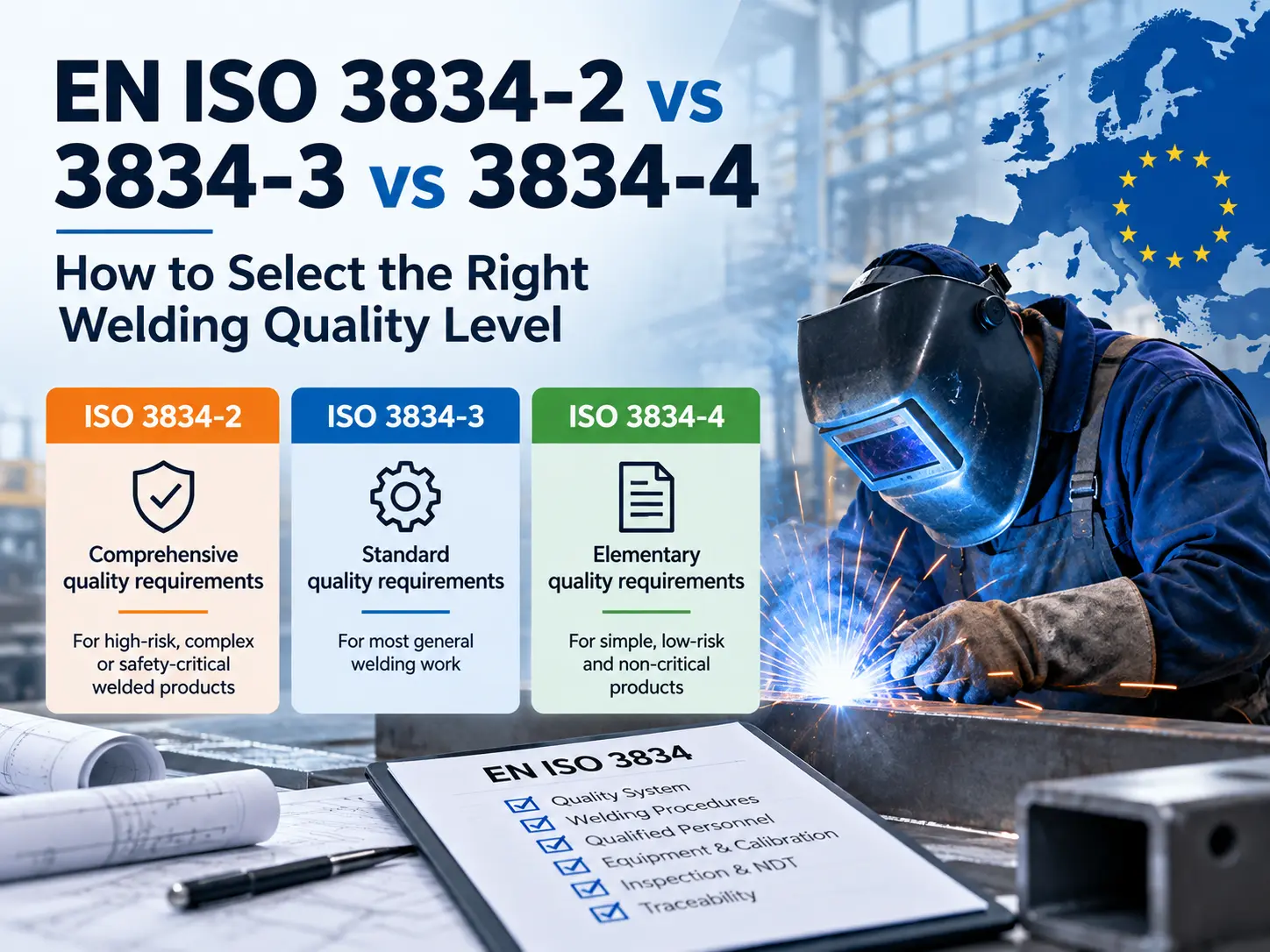
The right level depends on how much failure could cost, not on how much it costs to get certified. EN ISO 3834 has three levels of welding quality standards, and which one you choose affects your audit process, documents, and work for years to come.
- Part 2 (Comprehensive): Used for safety-critical, complex, or high-value welded products, or any contract that requires all the controls.
- Part 3 (Standard): For most general welding work, where quality is important but the cost of failure isn’t too high.
- Part 4 (Elementary): For simple, low-risk products, usually not critical, made from basic materials with standard joints.
Most buyers, industry standards, and official bodies will tell you which level they expect.
If they don’t, ISO 3834-1 provides six clear criteria to help you decide, and the chart below helps you quickly pick the right level.
What Is EN ISO 3834, and Where Do Parts 2, 3 and 4 Fit?
EN ISO 3834 sets quality standards for welding metal materials in workshops and during on-site installations. It is not a substitute for ISO 9001. It includes special rules for welding, such as who does the welding, which method is used, what equipment is involved, and how to show that it was done properly.
The standard has six parts, but you only need to follow one of the three quality levels to be compliant.
| Part | Title | What it does |
|---|---|---|
| Part 1 | Criteria for selecting the level of quality requirements | Helps you choose Part 2 3 or 4 |
| Part 2 | Comprehensive quality requirements | Highest level |
| Part 3 | Standard quality requirements | Middle level |
| Part 4 | Elementary quality requirements | Basic level |
| Part 5 | Documents needed to claim conformity to Part 2 3 or 4 | Names the standards you must meet e.g. for welders and procedures |
| Part 6 | Guidance on implementing ISO 3834 | Practical help for manufacturers |
Parts 1 through 5 are all from 2021; Part 6 was reissued in 2024. The standard itself does not require external certification, according to BSI. However, contracts and other product standards, like EN 1090, usually do. For more information on the edition history, check our guide to the latest version of ISO 3834-1.
ISO 3834-2 vs 3834-3 vs 3834-4 at a Glance
The move from Part 3 to Part 2 focuses on depth and the amount of evidence. The move from Part 3 to Part 4 is about scope, where entire clauses are removed.
| Requirement | Part 2: Comprehensive | Part 3: Standard | Part 4: Elementary |
|---|---|---|---|
| Requirement clauses | 14 (clauses 5 to 18) | 14 (clauses 5 to 18) | 10 (clauses 5 to 14) |
| ISO 14731 knowledge level typically | Comprehensive | Specific | Basic |
| EN 1090 execution class | EXC3 and EXC4 | EXC2 | EXC1 |
| Typical use | High-risk complex or safety-critical welded products | Moderate-risk general fabrication | Simple low-risk non-critical products |
| Documentation and evidence load | Highest | Medium | Lowest |
Part 3 uses the same clause structure as Part 2, but with a few small technical changes. Part 4 simplifies the structure to include only ten clauses. The EN 1090 mapping is based on TWI’s guide for structural steel and ISO 3834, while the knowledge levels come from IIW’s guidance on ISO 14731.
Clause by Clause: What Each Level Requires
Part 4 covers five areas that Parts 2 and 3 also include: welding coordination, storage of parent materials, post-weld heat treatment, calibration, and traceability. All other topics are present in all three parts.
| Requirement (Part 2 and 3 clause) | Part 2 | Part 3 | Part 4 |
|---|---|---|---|
| 5 Review of requirements and technical review | Yes, 3 sub-clauses | Yes | Yes, single clause |
| 6 Sub-contracting | Yes | Yes | Yes |
| 7 Welders and welding operators | Yes | Yes | Yes |
| 7.3 Welding coordination personnel | Yes | Yes | No separate clause |
| 8 Inspection and testing personnel including NDT | Yes | Yes | Yes |
| 9 Equipment | Yes, 5 sub-clauses | Yes | Yes, single clause |
| 10 Welding and related activities (planning WPS WPQR work instructions) | Yes | Yes | Yes, single clause |
| 11 Welding consumables | Yes | Yes | Yes, single clause |
| 12 Storage of parent materials | Yes | Yes | No separate clause |
| 13 Post-weld heat treatment | Yes | Yes | No separate clause |
| 14 Inspection and testing | Yes | Yes | Yes, single clause |
| 15 Non-conformance and corrective actions | Yes | Yes | Yes |
| 16 Calibration and validation of equipment | Yes | Yes | No separate clause |
| 17 Identification and traceability | Yes | Yes | No separate clause |
| 18 Quality records | Yes | Yes | Yes |
Part 4 changes the order of its ten clauses (now numbered 5 to 14), so you should match them by title instead of number. The structure is based on the published table of contents for Part 2 and Part 4.
What Part 2 explains and you should prepare for includes:
- A detailed technical check that covers 17 specific areas, like the order of welding, access for non-destructive testing, heat treatment after welding, and the conditions during welding.
- Production planning that has at least ten points, such as the welding sequence, inspection steps, and assigning qualified staff.
- Recorded maintenance plans for equipment that controls welding process parameters, along with tests done after new or repaired equipment is set up.
- Steps for managing quality documents like the Welding Procedure Specification (WPS), Welding Procedure Qualification Report (WPQR), and welder qualification records.
- Inspections and tests that happen before, during, and after welding, with the progress being monitored.
Part 3 might have simpler versions of some of these points, so make sure to read its content before you make assumptions.
Which Level Fits Your Product, Contract or Standard?
Begin with what is written. A product standard, a customer requirement, or a regulation usually tells you the required level. If there isn’t one, consider the factors that ISO 3834-1 is based on: how important the product is for safety, how complicated the manufacturing process is, how many different products and base materials are used, how likely it is for metal-related issues to happen, and how much weld flaws could impact how well the product works.
| Situation | Typical level | Notes |
|---|---|---|
| Structural steel or aluminum under EN 1090 EXC1 | Part 4 | Simple structures, lowest consequence |
| Structural steel under EN 1090 EXC2 (the default when nothing is specified) | Part 3 | Also needs welding coordination per ISO 14731 |
| Structural steel under EN 1090 EXC3 or EXC4 | Part 2 | Welding procedures qualified to ISO 15614-1 or ISO 15613 |
| Pressure vessels offshore structures and complex high-risk work | Part 2 | Failure carries serious consequences |
| Simple non-critical assemblies | Part 4 | Check the buyer accepts it in writing |
| Railway welding under EN 15085 | Check EN 15085-2 | It has its own certification levels; confirm the mapping with your certification body |
The EN 1090 rows come after TWI and Ancon’s EXC2 certification note. The procedure-qualification note is based on TWI’s EN 1090-2 summary, as shared by Legal Clarity. The examples related to pressure vessels and offshore structures are from a welding fabrication overview. Our EN ISO 3834 contract review guide explains how to check the required level before you agree to take on an order.
Six Mistakes When Choosing a Level
1.Choosing based on cost.
Part 4 may look cheaper, but if a buyer asks for EXC2 work and your certificate doesn’t cover it, the cost could go up. The contract sets the minimum cost, not your budget.
2.Not thinking about the next contract.
Think about the work you plan to bid on in the next few years. Certifying a higher level means more paperwork each year, so make this decision on purpose.
3.Mistaking ISO 3834 for a quality system.
Part 1 clearly says it isn’t a replacement for ISO 9001.It covers welding as a special process, so keep both in mind.
4.Underestimating the welding coordinator.
No specific certificate is required, but the person must have the right knowledge and skills for your product and part. You are still responsible, even if you outsource the role.
5.Saying clauses are “not applicable” without a reason.
Part 2 lets you change or remove requirements only if manufacturing is for a lower part or if an operation like heat treatment isn’t done. Always write down the reason.
6.Missing Part 5.
To say your product meets the standard, you must follow all the documents in Part 5, like welder qualifications and welding procedure standards. Check our guides on WPS vs WPQR and ISO 9606-1 welder qualification.
From Choice to Certificate: Five Steps
- Check your contract, product standard, or execution class to find out the required level, and remember who set it.
- Choose a welding coordinator and make sure their skills match the part you’re working on.
- Collect all the evidence needed for Part 5: WPS and WPQR, welder and operator certifications, NDT personnel records, equipment lists, and calibration records.
- Compare your process against our 35-point EN ISO 3834 audit checklist, and fix any issues you find.
- Schedule the audit, and plan for renewal and reassessment in advance.
If you’re unsure which level your product needs, share your contract details with our team via the EN ISO 3834 certification page or contact us directly.
FAQ
Is ISO 3834 certification mandatory?
Not by itself. Contracts and product standards such as EN 1090 make it a requirement for many manufacturers.
Can I use a Part 3 certificate if my customer asks for Part 2?
No. If the contract names Part 2, a Part 3 certificate does not meet it. Ask the buyer early, and in writing.
Is Part 4 enough for EN 1090 EXC2?
No. EXC2 calls for Part 3. Part 4 matches EXC1 only.
Do I need an IWE as my welding coordinator?
No specific qualification is required by ISO 14731. You must show competence at the level your work needs. For EXC3 and EXC4, Elektrolas notes that an IWS, IWT or IWE level is recommended.
Can I leave out clauses that do not apply, such as heat treatment?
Yes, if you do not perform that operation, and you record why. Part 2 allows this explicitly.
Which edition applies today?
arts 1 to 5 are 2021 editions. Check the current status on the ISO page for Part 4, which lists the 2021 edition as under systematic review.